
Results
-
 £54.00
Concerto 1945 (Parts only) - Philip WIlby
At a time when we are being encouraged to survey the recent past, its title aims to catch a flavour of that spirit of optimistic vision which coloured the British psyche at the end of the Second War, at once heroic, elegiac, and confident. The concerto's three movements are arranged in a circular pattern around a reflective slow movement. At the heart of that movement is a Cadenza, marked to be played off-stage, where the soloist is surrounded and supported by an additional group of fanfare players. By contrast, the outer movements are energetic and brisk, at times heroic, and at times virtuosic. Also available with piano accompaniment.
Estimated dispatch 7-9 working days
-
 £44.95
Triumphant (Brass Band - Score and Parts)
Triumphant was written as the opening work for the 2024 Future All-Stars final concert. Based on the well-known hymn Victory in Jesus (S.A.S.B. 464), the piece reimagines the familiar melody and words with energetic drumline-inspired rhythms and driving Bass groove.O victory in Jesus, my Saviour, for ever!He sought me and bought me with his redeeming blood;He loved me ere I knew him, and all my love is due him -He plunged me to victory beneath the cleansing flood.Musically speaking, the rhythmic pulse should remain confident and consistent throughout, with the percussion establishing the groove and the band locking in with precision. Take time to find a tempo that allows the Bass and Percussion parts to remain clear and accurate. A slightly steadier pace will produce a stronger, more convincing groove. However, a slower tempo can result in the band's playing becoming too heavy. Melodic lines should be played on the longer side, allowing phrases to sing over the rhythmic accompaniment that can be more defined and articulated. As the work builds, be patient and disciplined with dynamics, saving the band's fullest sound for the climactic moments, maximising their impact.
Estimated dispatch 7-14 working days
-
 £15.00
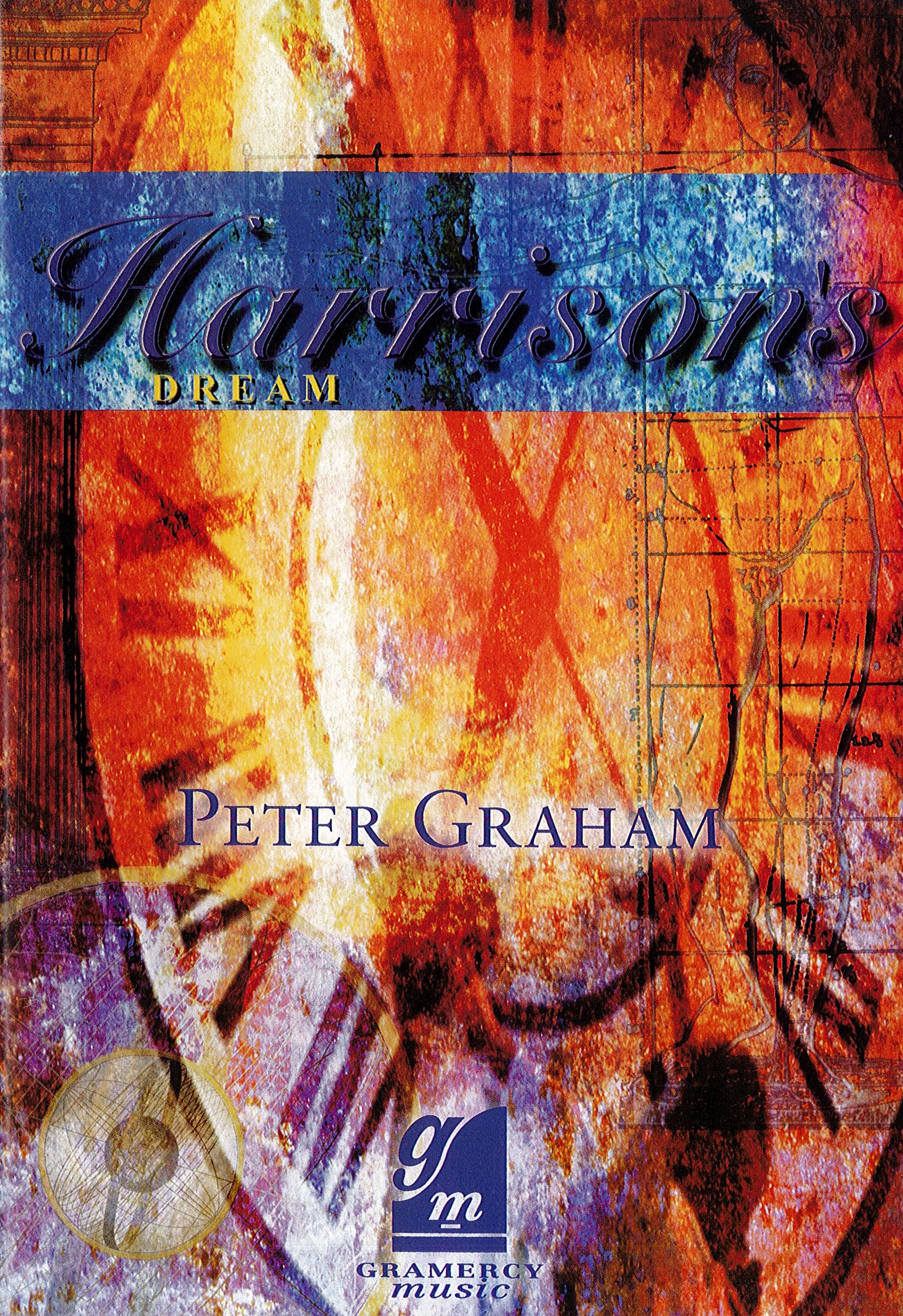
Harrison's Dream (Brass Band - Study Score)
At 8.00pm on the 22nd of October 1707, the Association, flagship of the Royal Navy, struck rocks off the Scilly Isles with the loss of the entire crew. Throughout the rest of the evening the remaining three ships in the fleet suffered the same fate. Only 26 of the original 1,647 crew members survived. This disaster was a direct result of an inability to calculate longitude, the most pressing scientific problem of the time. It pushed the longitude question to the forefront of the national consciousness and precipitated the Longitude Act. Parliament funded a prize of �20,000 to anyone whose method or device would solve the dilemma. For carpenter and self-taught clockmaker John Harrison, this was the beginning of a 40 year obsession. To calculate longitude it is necessary to know the time aboard ship and at the home port or place of known longitude, at precisely the same moment. Harrison's dream was to build a clock so accurate that this calculation could be made, an audacious feat of engineering. This work reflects on aspects of this epic tale, brilliantly brought to life in Dava Sobel's book Longitude. Much of the music is mechanistic in tone and is constructed along precise mathematical and metrical lines. The heart of the work however is human - the attraction of the �20,000 prize is often cited as Harrison's motivation. However, the realisation that countless lives depended on a solution was one which haunted Harrison. The emotional core of the music reflects on this, and in particular the evening of 22ndOctober 1707. Peter GrahamCheshireJuly 2000
Estimated dispatch 7-14 working days
-
 £39.95
Liberty Trail (Brass Band - Score and Parts)
The Melbourne Staff Band celebrated its 125th anniversary in 2015 and this work was commissioned by Staff Bandmaster Ken Waterworth to feature in their programmes throughout the year.The music opens with fiery rhythmic figures, drawing on the band's technical brilliance. As the music progresses there are hints of traditional marches from early years, both in form and the minor key harmony used.The Trio section features The Homeward Trail, a song from the pen of Colonel Arthur Arnott, a Salvation Army officer who spent the majority of his career serving in Australia. The tune is then developed thematically and, following an interlude and key change, receives another treatment filled with fanfare and flourish that leads into the concluding moments of the work.Just prior to the closing bars, the music pays a brief homage to Australian composer Arthur Gullidge with a quote from his classic march Liberty (G.S. 1296), published in 1948, as a final salute to the great music that has come from this country.
Estimated dispatch 7-14 working days
-
 £95.00
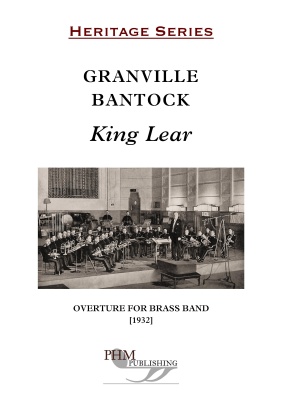
King Lear (Brass Band - Score and Parts)
Sir Granville Bantock (1868 - 1946) composed the second of his five major brass band work for Callender's Cableworks Band, completing the commission on 30 November 1932. Based in the Thames-side district of Belvedere near Erith, the band was active between 1898 and 1961. The works band of the Callender Cable & Construction Co. Ltd, it was at the peak of its popularity during the 1930s and was a frequent broadcaster on the radio. The band employed an in-house arranger and played saxophones in its lighter material. King Lear was one of the band's major commissions and was not published in Bantock's lifetime. The manuscript score and parts were thought to be lost for decades, but were found in the library of the Haydock Band (Lancashire), which had inherited part of Callender's library of manuscripts material and bespoke arrangements after it has been transferred to nearby Prescott Cables Band after Callender's Cable Works closed.King Lear is a substantial work, in essence a dramatic tone poem in the romantic Tchaikovskian manner, presenting a series of character portraits of the foolish old king and his three daughters, Goneril, Regan and Cordelia. The music is dramatic and lyrical by turns, with the most generous lyrical episode revealing perhaps the warm-hearted Cordelia. An expansive melody that flows from this is brought back towards the end as the main climax of the work.In 2001, Bantock's score was recorded by the University of Salford Brass Band, conducted by Dr. Roy Newsome. The original is serviceable, but in comparison with the orchestral version he made in 1936 (part of which was recorded on a Paxton 78 rpm) and later brass band scores, performing editions of which were prepared by others, it lacks colour and range typical of Bantock's orchestral work. Above all it lacks percussion, which can be heard on the recorded extract. With the kind permission of the Bantock Estate, I have prepared a performing edition for publication that incorporates percussion, derived from the orchestral recording and added editorially in similar manner elsewhere. I have revoiced some of the low- lying instrumental parts to present the material in more comfortable ranges. Editorial interventions more elaborate than revoicing the original text have been identified as cue notes.- Paul HindmarshDuration: 15.00
Estimated dispatch 7-14 working days
-
£40.00
King Lear (Brass Band - Score only)
Sir Granville Bantock (1868 - 1946) composed the second of his five major brass band work for Callender's Cableworks Band, completing the commission on 30 November 1932. Based in the Thames-side district of Belvedere near Erith, the band was active between 1898 and 1961. The works band of the Callender Cable & Construction Co. Ltd, it was at the peak of its popularity during the 1930s and was a frequent broadcaster on the radio. The band employed an in-house arranger and played saxophones in its lighter material. King Lear was one of the band's major commissions and was not published in Bantock's lifetime. The manuscript score and parts were thought to be lost for decades, but were found in the library of the Haydock Band (Lancashire), which had inherited part of Callender's library of manuscripts material and bespoke arrangements after it has been transferred to nearby Prescott Cables Band after Callender's Cable Works closed.King Lear is a substantial work, in essence a dramatic tone poem in the romantic Tchaikovskian manner, presenting a series of character portraits of the foolish old king and his three daughters, Goneril, Regan and Cordelia. The music is dramatic and lyrical by turns, with the most generous lyrical episode revealing perhaps the warm-hearted Cordelia. An expansive melody that flows from this is brought back towards the end as the main climax of the work.In 2001, Bantock's score was recorded by the University of Salford Brass Band, conducted by Dr. Roy Newsome. The original is serviceable, but in comparison with the orchestral version he made in 1936 (part of which was recorded on a Paxton 78 rpm) and later brass band scores, performing editions of which were prepared by others, it lacks colour and range typical of Bantock's orchestral work. Above all it lacks percussion, which can be heard on the recorded extract. With the kind permission of the Bantock Estate, I have prepared a performing edition for publication that incorporates percussion, derived from the orchestral recording and added editorially in similar manner elsewhere. I have revoiced some of the low- lying instrumental parts to present the material in more comfortable ranges. Editorial interventions more elaborate than revoicing the original text have been identified as cue notes.- Paul HindmarshDuration: 15.00
Estimated dispatch 7-14 working days
-
 £50.00
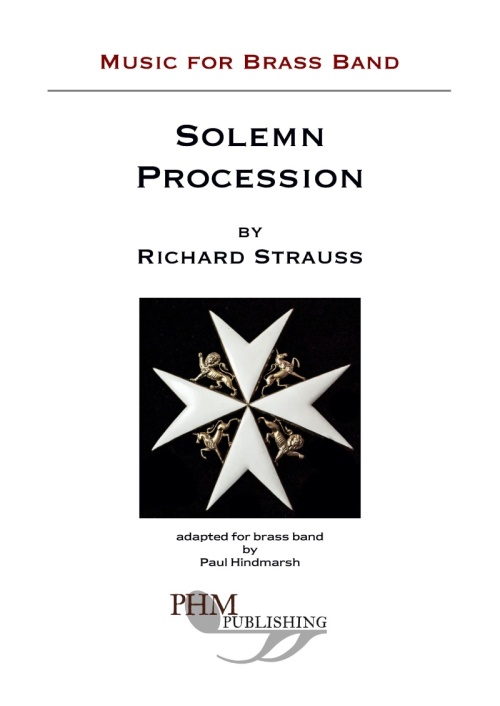
Solemn Procession (Brass Band - Score and Parts)
Richard Strauss (1864 - 1949) was a famous conductor and composer when he wrote Feierlicher Einzug der Ritter des Johanniter-Ordens (Solemn Entrance of the Knights of the Order of Saint John) in 1909. One of only a handful of his works written exclusively for winds, Strauss composed Feierlicher Einzug for the investiture ceremonies of the Order of St. John, a Christian military order that was founded in Jerusalem in 1023 to care for poor, sick, or injured pilgrims journeying to the Holy Land.Strauss scored Feierlicher Einzug (TrV 224) for a large ensemble of fifteen trumpets, four horns, four trombones, two tubas and timpani. He saw enough potential in its stately character and majestic conclusion to produce a version for symphony orchestra with organ and it has been arranged for a variety of brass ensembles with or without organ since then.This version for British style brass band was adapted from the original in 1990 by Paul Hindmarsh for the exclusive use of Besses o' th' Barn Band, of which he was then the musical director. Now that the music of Richard Strauss published in his lifetime is in the public domain, Solemn Procession, as it has been rendered in English, can be enjoyed by all brass bands and their audiences.- Paul HindmarshDuration: 6.00
Estimated dispatch 7-14 working days
-
 £38.95
Unity Series Band Journal - Numbers 478 - 481, June 2019
478: March - Seize the day (Andrew Mair)This march features the tunes God's love is wonderful (T.B. 130) and Everybody should know, and makes reference to Rescue the perishing (T.B. 808) and the chorus Able to save (T.B. 538)479: Jingle bells jazz! (Richard Phillips)The familiar strains of Jingle Bells (C.C. 121) have featured in Salvation Army music countless times over the years (perhaps more than any other non-religious song), whether as the main theme, countermelody, or as a derived frament or motif. This is an attractive laid-back jazz setting of the tune.480: Poor, wayfarin' stranger (Thomas Mack)This arrangement of the Spiritual depicts a poor wayfarin' stranger's journey through life using a minor key and a slow walking style.481: Selection - No crib for a bed (Charles Craig)This simple setting reminds us that, amidst the joy and exuberance that often accompanies the Christmas season, Jesus' birth was a very humble event.
Estimated dispatch 7-14 working days
-
 £124.99
Metamorphosis (Brass Band - Score and Parts)
The opening of this three-movement work features an initial appearance of the thematic material that returns in various guises later on in the work. The leitmotiv centres on a minor second.A range of thematic variations is heard in the lively and energetic Metamorphosis One. This movement is interrupted by an atmospheric meno mosso, containing melodic passages that return to the opening theme.Metamorhosis Two is characterised by various changes in tempo and musical character. Seven different soloists transform the thematic material - each in their own way. This eventually culminates in a passionate tutti passage.The source of inspiration for Metamorphosis Three is the so-called BACH-motif, a musical autograph consisting of the notes B flat, A, C and B. This distinctive motif arises from the leitmotiv (here a descending minor second), which continues to evolve through various transpositions and transformations. For the composer, this spectacular last movement is an homage to one of the greatest and most influential composers in the history of music: Johann Sebastian Bach.Duration: 17:00
Estimated dispatch 7-14 working days
-
 £34.95
Judd: My Hope - Roger Trigg
'My Hope' was written for, and premiered by Enfield Citadel Band (Bandmaster Jonathan Corry) on 11th October, 2013. The work formed part of the band's annual pre-contest festival on the eve of the National Brass Band Championships which are held in the august surroundings of the Royal Albert Hall, London each year. The words 'my hope' appear in both hymns that are referenced in the music. The notes 'E', 'C', 'B' also feature throughout the work as homage to Enfield Citadel Band. The verse of 'My hope is built on nothing less' (S.A.S.B. 662), to the tune 'Solid Rock' (T.B. 446), is then introduced and forms the basis of the end of the first section - set in the minor, unlike the usual setting of the melody. The more sedate middle section that follows features an original theme, again using the notes 'E', 'C', 'B' as a melodic stimulus.The tune 'Michael' (Herbert Howells), to which the text 'All my hope on God is founded' (S.A.S.B. 530) is sung, provided the original impetus for this work. The song features as a new addition to The Salvation Army's 2015 iteration of its song book. It is a noble tune and there are big majestic, organ-like sounds utilised in its final treatment which brings the work to a climactic end.
Estimated dispatch 7-14 working days