
Results
-
£115.60
In Dulci Jubilo - Idar Torskangerpoll
This Christmas psalm is famous all over the world and especially in Europe. It is likely that the melody is more than 600 years old.Many famous composers have written their own harmonics and versions of the psalm. This arrangement isbased on two different harmonics; The first and third verse is based on the harmonics by Michael Praetorius while the second verse is based on the harmonics of Johann Sebastian Bach.
Estimated dispatch 5-14 working days
-
 £60.99
So nimm denn meine Hande - Friedrich Silcher - Jacob de Haan
This celebrated song is based on a poem by Julie Hausmann (1826-1901), a Latvian teacher who was probably blind. The text draws on her personal experience and unshakeable faith in God, death and eternal life. The melody by Friedrich Silcher is written in a simple and delicate style but also draws on the grand romantic tradition of Wagner and Bruckner. This arrangement can also be performed with a mixed choir. The choir parts are in German.
Estimated dispatch 5-14 working days
-
£60.99
Who Wants To Live Forever - Brian May - Thijs Oud
Who Want to Live Forever is a rather grim title given Freddie Mercury's untimely death, but his songs, and especially his recordings with Queen will live on forever. The title refers to the immortal Connor MacLeod from the movie Highlander, and reached number 24 on the British charts. Now Thijs Oud's arrangement lets this song live on forever as part of your brass band's repertoire.
Estimated dispatch 5-14 working days
-
 £118.99
Euphonium Concerto - Edward Gregson
Commissioned by Euphonium Foundation UK. First performed by David Childs and British Brass conducted by Robert Childs at Senzoku Gakuen College of Music, Tokyo, Japan on 16 June 2018. UK premiere by David Childs and Tredegar Band conducted by Ian Porthouse at the Royal Northern College of Music Brass Band Festival, Manchester, on 29 January 2019. Premiere recording by David Childs (euphonium) with the Black Dyke Band, conducted by Nicholas Childs, on the Doyen label (DOYCD 414).
Estimated dispatch 5-14 working days
-
 £60.99
Let's Dance - Henk Hogestein
Let's Dance takes you on an exciting night of dancing,being cool on the dance floor with your designer clothes, dancing the night away and forgetting about your daily worries. It's party time on the dance floor with this grooving new work. Brass Band goes Disco!
Estimated dispatch 5-14 working days
-
 £134.99
West Wind - Oliver Waespi
West Wind is structured in three parts, each bearing a subtitle drawn from poems of Emily Bronte (1818-1848). Poetry of the Romantic period, Bronte's in particular, often presents a gentle, almost innocent surface, beneath which lies the most elemental and volatile emotional forces capable of erupting at any moment.Accordingly, the opening movement, West-wind, in the glory and pride!, begins with a mellow, warm soundscape, underpinned by lightly pulsating patterns, almost like an aquarelle. Gradually however, the music transitions into far rougher, forward-driven gestures - turbulent, restless, and at times unpredictable, much like the west wind itself.The ensuing Adagio reflects on the poem Stars, in which a fundamental tension between exaltation and regret, another recurring feature of Bronte's poetry, is palpable throughout. Introspective solo and chamber music statements give way to a broad ecstatic sound field involving the full ensemble, before finally receding into a solitary euphonium soliloquy.The final movement, Wild words of an ancient song, takes the form of an extended rondo-scherzo, driven by virtuosic, perpetual motion. The sense of relentless pursuit bears a nod to The Boy on the Moor by the German poet Annette von Droste-Hulshoff, a contemporary of Bronte who explored similar narratives, albeit from a different perspective.Although certain core musical elements recur - pulsating patterns, a chorale, a tone row - the work is guided less by systematic symphonic development than by an intuitive stream of variants. These generate a sequence of metamorphoses that illuminate the material from shifting vantage points, projecting the emotional landscapes of Romantic poetry into the present day.West Wind was commissioned by the Flowers Band and was first performed under Musical Director Paul Holland, at the 2026 European Brass Band Championships in Linz (AT), where they also became European Champions.
Estimated dispatch 5-14 working days
-
 £60.99
Cityscape - Jan Hadermann
Cityscape was commissioned for the 't Stad Geblazen event, which took place during the weekend of European Heritage Days in 2024.This short concert piece describes the impressions given when approaching and visiting the beautiful Belgian city of Antwerp from the north across the river Scheldt. We first pass the busy bustle of the harbour, home to the impressive Port House. Then the old city comes into view: the graceful cathedral tower, surrounded by smaller church spires and modern buildings, dominates the distinctive skyline. After setting foot ashore, we are struck by the beautiful way the medieval buildings here blend harmoniously with modern architecture. Our walk through the city continues: we visit the serene cathedral and are impressed by the picturesque facades of and around the city hall, as well as the Brabo Fountain on the Grote Markt (Large Market Square). Finally, it is time to enjoy the merriment taking place on the many squares of the lively city centre.
Estimated dispatch 5-14 working days
-
 £109.99
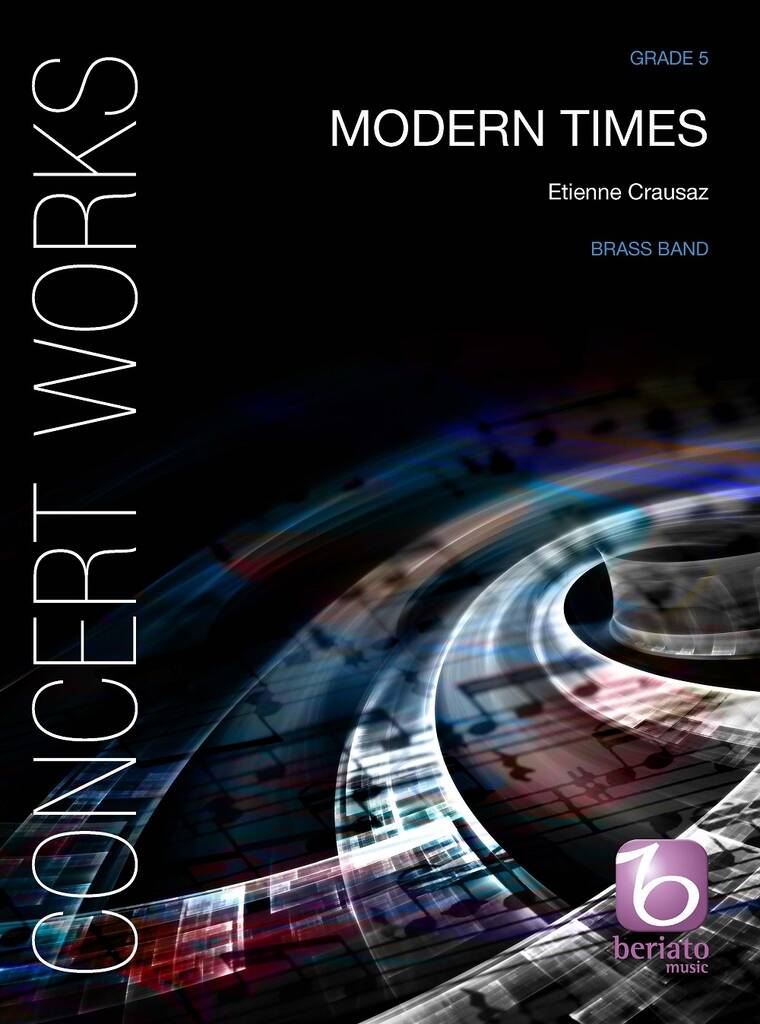
Modern Times - Etienne Crausaz
Modern Times is a concert suite from the musical and theatrical show Le Temps de Lyre, written and directed by Nicolas Bussard. The work was commissioned for the 100th anniversary of the Lyre de La Roche, directed by Marc-Olivier Broillet, with the premiere taking place in July 2024 in front of an audience of over 2,000.This suite highlights three of the dozen tableaux in the show. After an introduction evoking a sort of journey back in time, the first tableau (bar 20) illustrates various disasters that have occurred in the village over the years. The sky darkens, the thunder rumbles, the rain lashes down, and violent gusts of wind are unleashed on this corner of the country. The storm finally calms down, giving way to great desolation.The second tableau (bar 117) describes the resilience of the villagers, who summon up all their courage to repair the damage. The music is soft, calm, and hopeful.On the strength of this new beginning, the village can embrace modernity: motor vehicles replace horses, a dam is built, and tourism develops, encouraging a society open to other cultures. The third tableau in this suite illustrates all these advances (bar 177). Musically, this final section pays tribute to George Gershwin and Leonard Bernstein, two of the 20th century's great musicians and composers, who worked during the fascinating period of modern times and well beyond.
Estimated dispatch 5-14 working days
-
 £52.50
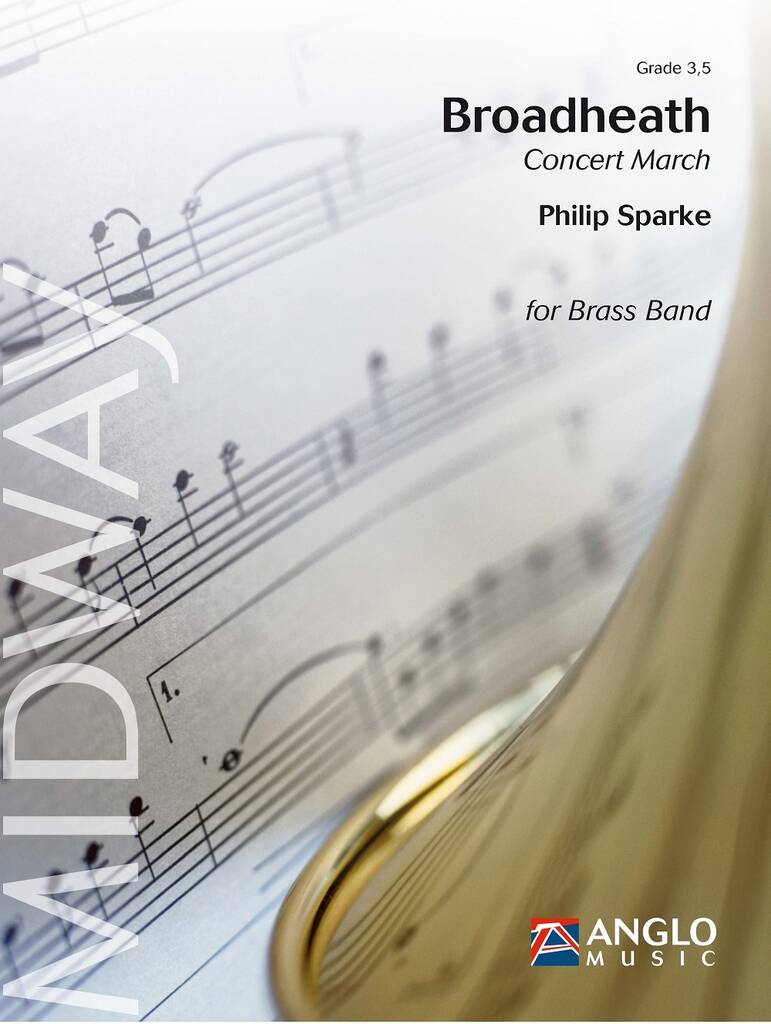
Broadheath - Philip Sparke
Broadheath was commissioned by the Elgar International Brass Band Summer School for their 2024 course. The premiere took place in the Routh Hall at Bromsgrove School on Friday 26 July.It is in conventional march form, opening with a brief fanfare before the horns take up the main theme. This is then repeated by the full band before euphoniums and baritone announce the second subject. This builds to a stirring tutti passage utilising elements of the opening theme, which brings the opening section to a close.In honour of the summer school's tribute to Sir Edward Elgar (it is held in 'Elgar country'), the trio uses the opening melody of his 1st symphony as its main theme, decorating it with filigree work from the cornets. This is repeated on the full band and leads to a varied recapitulation of the opening material to bring the march full circle.
Estimated dispatch 5-14 working days
-
 £105.20
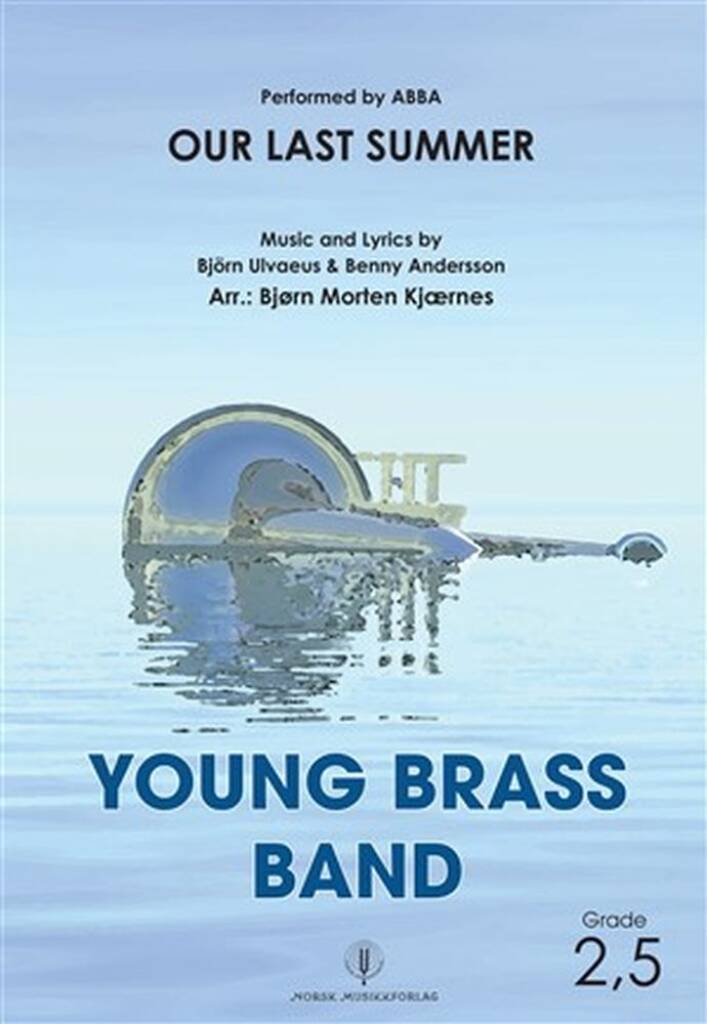
Our Last Summer - Benny Andersson - Bjørn Morten Kjærnes
An exciting arrangement where almost all players have a bit of the melody line. There are many opportunities to give individual musicians soloistic challenges. Any bandmember should find something interesting in this piece. It will be possible to add vocals to the arrangement. A lovely melody with great expressions.Our Last Summer" is a song by the Swedish pop group ABBA from their seventh studio album, "Super Trouper," released in 1980. The song is indeed featured in the musical "Mamma Mia!", a little bit shortened and with small changes in the lyrics. The musical premiered in London's West End in 1999 and is a duet performed by the characters Harry Bright and Donna Sheridan, reflecting on their past romance during a summer spent in Paris.The song is primarily sung by Bjorn Ulvaeus, with backing vocals provided by Agnetha Faltskog and Anni-Frid Lyngstad, the female members of ABBA. Their harmonies contribute to the song's nostalgic and wistful atmosphere. The lyrics vividly describe the memories of the summer spent together, including scenes of walking along the Seine River in Paris and listening to French songs. The song also touches on the passage of time and the realization that the summer romance has ended.While not released as an official single in most countries, "Our Last Summer" still received considerable airplay and became a fan favorite. It charted in some European countries and has remained popular among ABBA fans over the years.
Estimated dispatch 5-14 working days
 View Music