
Results
-
 £131.00
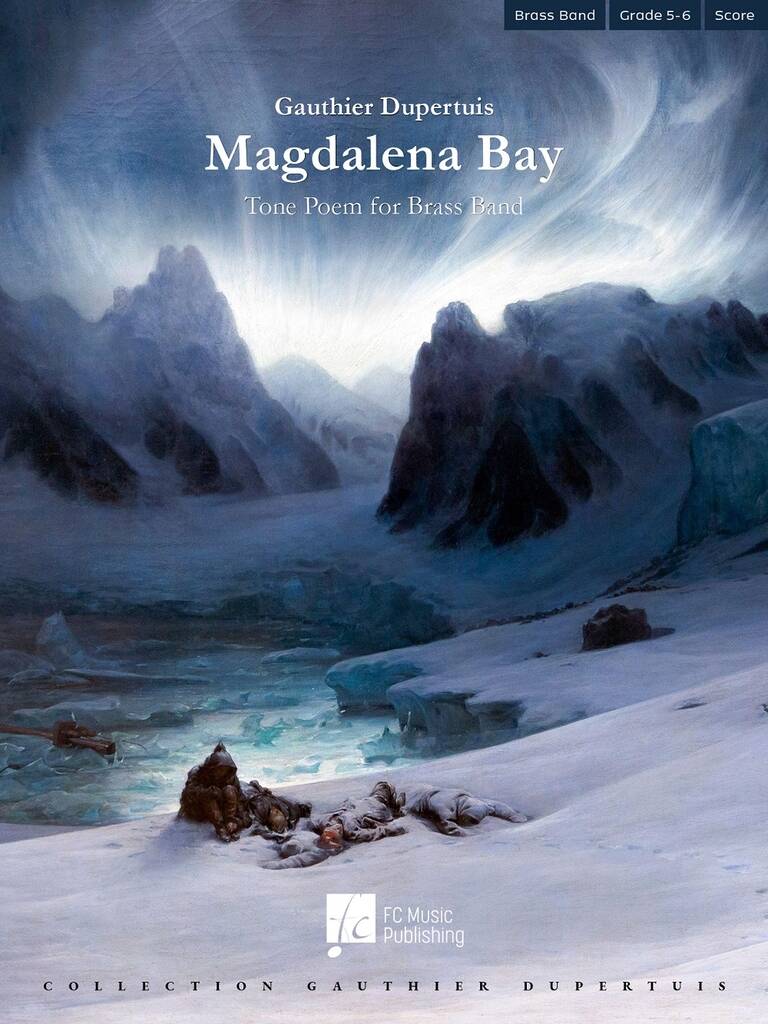
Magdalena Bay - Gauthier Dupertuis
While admiring many masterpieces at the Louvre Museum in Paris, Gauthier Dupertuis' attention was drawn to a less famous painting: Magdalena Bay, by French painter Francois-Auguste Biard (1799-1882).The work depicts a magnificent snowy landscape on the Norwegian island of Spitsbergen. However, in the foreground, the presence of the wreckage of a ship, bodies covered in snow and a visibly dying character make us understand that tragic events took place there. Thus, a strong contrast is formed between death and the sublime, between the desolation of the survivors of the shipwreck and the magnificence of the landscape. When we look in more detail at the painting, we notice that footprints have been made in the snow: so, could someone have gone to get help? This little glimmer of hope makes the picture even more touching. In this work, Gauthier Dupertuis tried to describe the different elements of the painting, using contrasting sections and dissonances (in particular, the conflict between the minor and the major) to convey the duality between death and the sublime. The work also attempts to highlight a wide palette of orchestral colors, from the most shimmering lines to the darkest low brass colours. In 2024, Magdalena Bay was awarded the first Prize as well as the band Prize at the 9th European Composition Competition for Brass Band, which was held in Palanga (LT). It was premiered on May 2, 2024 by The Cory Band, conducted by Philip Harper.
Estimated dispatch 5-14 working days
-
 £89.99
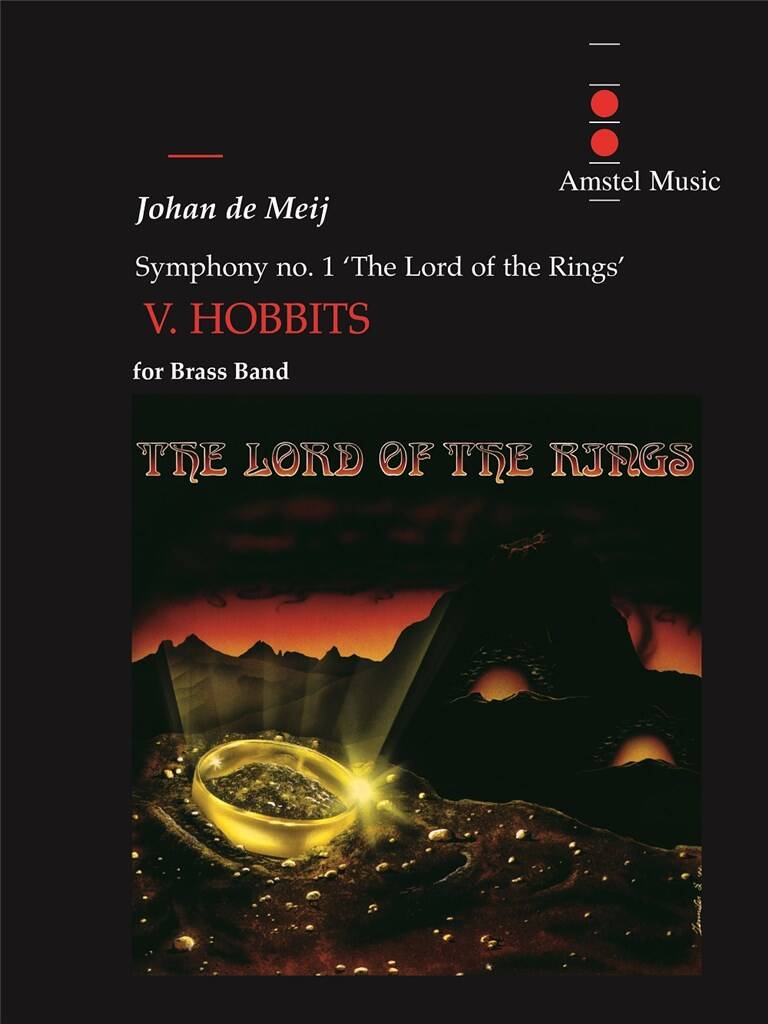
Hobbits - Johan de Meij
Johan de Meij's first symphony The Lord of the Rings is based on the trilogy of that name by J.R.R. Tolkien. This book has fascinated many millions of readers since its publication in 1955. The symphony consists of five separate movements, each illustrating a personage or an important episode from the book. This transcription for brass band, arranged by the composer has the following movements: I. GANDALF (The Wizard), IV. JOURNEY IN THE DARK (The Mines of Moria and The Bridge of Khazad-D m), V. HOBBITS. The symphony was written in the period between March 1984 and December 1987, and had its premiere in Brussels on 15th March 1988, performed by the The Royal Band ofthe Belgian Guides under the baton of Norbert Nozy. In 1989, the symphony The Lord of the Rings was awarded a first prize in the Sudler International Wind Band Composition Competition in Chicago, and a year later, the symphony was awarded a grant by the Dutch Composers Fund. In 2001, the orchestral version was premiered by the Rotterdam Philharmonic Orchestra and recorded by the London Symphony Orchestra.
Estimated dispatch 5-14 working days
-
 £109.99
Nordic Moods - Tom Brevik
The composer:1st movement: Reflections by the Fjord.Overlooking one of the mighty fjords of Norway, my mind and thoughts are with an old religious Norwegian folk-tune, with words by the famous parson Peter Dass.The majestic fanfare-likeopening reflects the power of God our Father, the choral itself heard for the first time on flugelhorn. The choral is repeated a few times, separated only by some short variations. The movement ends in thriumph, with fanfares and the choral broughttogether.2nd movement: Reflections in the Old Church.In this movement my associations of a summer day, finding myself alone in an old deserted stone church. From the old walls I hear folk songs, perhaps like the ones sung in the church bypoor fishermen and farmers in days gone by. Suddenly the light from the sun breakes through the small circular window above the altar, and a lovely melody is heard, before the original figures take us to the end of the movement.3rd movement:Festive Reflections.Any festive occasion can be reflected in this movement. from the bonfire at midsummer-night to the children celebrating the return of the sun in the northern part of Norway. from the traditional sleigh-riding at Christmas tothe Celebrations of the National Day on the 17th of May each year.
Estimated dispatch 5-14 working days
-
£60.99
Cowboy Suite - Alan Laken
In the tripartite 'Cowboy Suite' Alan Laken takes us to the Wild West, the domain of cowboys, indians, trappers and other fortune hunters. Around 1890 the west coast of America was reached, which in effect meant the end of the Wild West. Its stories, however, survived and have been a source of inspiration for many books, films, and, of course, music. Some characters, such as Jesse James, Billy the Kid, and Buffalo Bill are forever linked to these tales. In the 'Cowboy Suite' we first hear the 'Hoedown'. At the end of an exhausting workday the labourers used to lay down their tools, among others the 'hoes' and spontaneously began to play music on the instruments which they then possessed (guitars, fiddles, and banjos) and to dance. After being jolted on the 'Wagon Trail' we reach the third part, the 'Cowboy Roundup'. In this last part it becomes clear that as a cattle driver it is imperative to stay firmly seated in the saddle. As the cattle are rounded up, i.e. driven together, spectacular things happen.
Estimated dispatch 5-14 working days
-
 £54.95
Sonata - Derek Bourgeois
This work, composed in 1998, was commissioned by the American trombonist Don Lucas as a work for trombone and piano and first performed by him in Birmingham on 19th May 2000. Subsequently, I arranged the music for both solo trombone and brass band and solo trombone and wind band so that it now exists in three formats. The first movement, in B flat major, is brisk and energetic, and is cast in sonata form. The second subject is gentler and more lyrical. The second movement, a scherzo in C major, is the most complex of the four. Basically the structure is a rond. For a long time the music remains in the opening 5/8 time until a new theme introduces more broken rhythms in a more jazzy idiom. After a return of the opening theme the following episode is more tonally ambiguous. Finally, the main theme returns to round off the movement. The third movement, a lyrical adagio, is really one long extended melodic flow. The harmonies are lush and the textures simple and direct. The tonal center is A minor, but the music meanders through so many keys, that this key centre is heavily disguised. The finale is a fiery affair. G minor is really its home key, but throughout the movement the music moves about a lot and the second subject is first heard in A flat minor. The movement's underlying sonata structure is masked not only by its loose tonality but also by its frequently changing time signatures. Like the first movement the second subject is more lyrical in nature and for a while it seems that the music will end peacefully, but a final flurry heralds a triple forte unison on the home note of the first movement - B flat. Derek Bourgeois
Estimated dispatch 5-14 working days
-
 £115.60
Voluntary Artillery & Rifle Corps March - Endeerby Jackson - Ray Farr
The march was written by Enderby Jackson and performed during a series of brass band events which took place at the Crystal Palace, London 1860 - 1863. Enderby Jackson was the organiser of these historically important events, and also conducted the massed band concerts. The Volunteer Force was a part-time, citizen army created in May 1859 by the British government as a result of increasing tensions between Britain and France. By 1862 more than 200,000 men had enlisted and were paid when on duty however, each member of the corps had to provide his own weapon and equipment.Some of the volunteer corps had bands which normally numbered between six and twelve players plus percussion1 and these bands became an important stimulant to the development of brass band.2 The corps were heavily subsidised by the government and considerable funding was spent on the bands3 which were often local brass bands. These bands were often provided with rehearsal rooms, instruments and uniforms,4 furthermore, the volunteer movement created and saved many brass bands.5Most of the musicians performing at the Crystal Palace Contests were affiliated to the Volunteer Force.
Estimated dispatch 5-14 working days
-
 £127.30
Sommernatt ved fjorden - Ketil Bjørnstad - Haakon Esplo
"By the Fjord" is written by the Norwegian composer Kjetil Bjornstad and is the most famous song from the musical work "Leve Patagonia" which was published in 1978. The work is written as a modern suite about the Oslo Bohemians Hans Jaeger and OdaLasson sitting in a pram on the fjord a summer night. Odas sister sees the couple on the sea from her window and tells us the story.Kjetil Bjornstad wrote "By the Fjord" in his house outside Tvedestrand early spring 1978. He was initially notfully satisfied and considered disposing it. The beautiful music has luckily made the song a classic in Norwegian music.To the conductorThis arrangement can be used with both vocal andinstrumental soloist. Its always a challenge toarrange songs with many verses that tells a story if it is to be played by an instrumental soloist instead of a singer. Because of that, please cut the repeats if it's performed without lyrics.Solo-parts included in the set: Vocal Flugelhorn Euphonium - Trombone
Estimated dispatch 5-14 working days
-
£127.30
Dancing Trolls [Norwegian Dance] - Øystein Olsen Vadsten
"Dancing Trolls" is a sequel to "The Battle of the Hats", which was published in 2015. Like "The Battle of the Hats", "Dancing Trolls" is a piece of music based on Norwegian traditional dances. This time around,its the reinlender dance which takescentre stage.The music is composed by Oystein Olsen Vadsten who keeps the strong melodic and tempo, which is dear to this kind of dance. Admittedly given a make-over with a more rhythmic accompaniment and more exciting harmonization.Thismakes it a fun piece, both to Listen to and play. The reinlender dance derives from the Rhineland in Germany,and is also known as the German Polka.To the conductor:Because this is a dance form whichis dependent on the right "swing",it is of great importance to keep as close to the metronome mark as possible. A steady groove, primarily specified by the drum set, is also essential for a good result. Remember to keep a good balance between the melody carrying instruments and theaccompaniment. Good luck and have fun with this "crazy" little tune.
Estimated dispatch 5-14 working days
-
£54.99
Hymnus Antverpiae - Jan Van der Roost
This hymn was commissioned by "Antwerpen 93". And this city, on the banks of the river Schelde has been nominated "Cultural Capital of Europe" for 1993. The work-group "animatie" took the initiative and commissioned a hymn, which -as the finale to a grand open-air event on 27th March- was premiered by hundreds of musicians from all over Europe. Philippe Langlet (France) was the conductor at this majestic occasion.Musically speaking the piece can no doubt be labeled easy. Indeed it is meant to represent a hymn, playable by all in different instrumental combinations. Consequently a variable instrumentation was chosen and a type of music, which by native is easily accessible anduncomplicated.The conductor is free -in the instrumentation- to score this piece according to his own taste. It is perhaps advisable to use the sharp brass in the forte parts, in order to make the range in the sound of the orchestra as colouful as possible. The percussion parts are not absolutely essential, so that the hymn can also be performed without percussion.
Estimated dispatch 5-14 working days
-
 £104.99
Cambridgeshire Impressions - Rieks van der Velde
In a four-part composition Rieks van der Velde takes us to the richly varied area surrounding the university city of Cambridge. The Dutch composer was especially inspired by the atmosphere of Cambridgeshire, the county which lies north ofLondon. 1. The Journey. Although on arrival the area looks peaceful and friendly, the ruggedness of its inhabitants and landscape have an unmistakable influence on the music. In the course of the tour, which starts with an Allegromovement, we are shown the vitality, energy and freshness of the Cambridgeshire countryside. Short themes, swift and sudden motifs and rhythmical patterns supported by the drive of percussion instruments give expression to this image. Thefirst part is concluded by two Calmo movements in which the music expresses how the cathedral in the city of Ely comes into sight and is gradually approached. 2. Visit to Ely Cathedral. The famous Norman cathedral church of Ely, whichwas built in 1109, has attracted tourists from all over the world apart from being a place of worship and heritage site. A cornet solo introduces the contemplative mood of the composition at this point. The mystical atmosphere of thecathedral runs through this lyrical part like a continuous thread. 3. The Pub. The thirst caused by this intensive journey makes a visit to the local pub a definite must. These "public houses", which may be open until the earlyhours of the morning, offer all kinds of entertainment. Drinks are served liberally and the atmosphere is lively. 4. The Journey Back. Time has flown: In other words, the moment of departure has come sooner than one would havewished. In a flashback which recaptures elements of the first part of the composition we say goodbye to Cambridgeshire in a fitting manner. Two scintillating final measures bring us abruptly back to the present.
Estimated dispatch 5-14 working days
 View Music