
Results
-
 £69.99
Trumpeter's Lullaby - Leroy Anderson - Naohiro Iwai
Leroy Anderson is part of American cultural heritage and he is often compared to such masters as Gershwin and Copland. Trumpeter's Lullaby was written for The Boston Pops Orchestra of which he was the conductor. This new arrangement for brass band gives your three cornet soloists a chance to 'take to the fore' in a variety of up-tempo jazz styles. Once performed this item will become a favourite that you will use time and time again.
Estimated dispatch 5-14 working days
-
 £69.99
Triumphal Brass - Jan de Haan
This exciting and energetic composition calls on all members of the band to try their best to make the audience jump out of their seats when they hear the fi rst notes. Jan de Haan's elaboration of two main themes lets the musicians present themselves as truly Triumphal Brass! The work was written as a test piece for the concert program in the Flemish Open Brass Band Championships 2010.
Estimated dispatch 5-14 working days
-
 £74.99
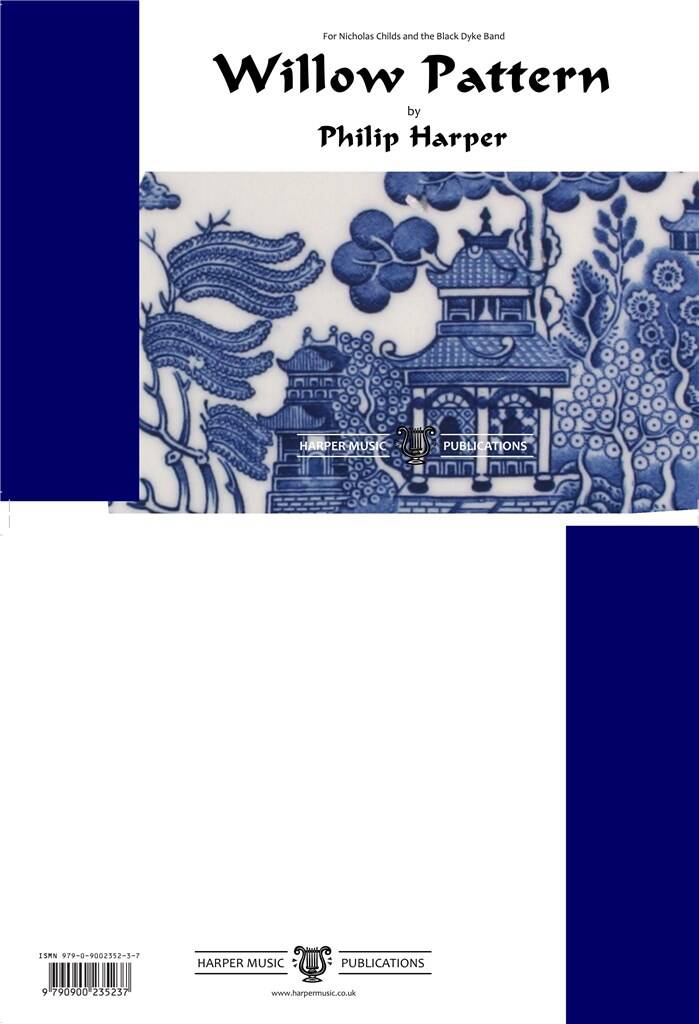
Willow Pattern - Philip Harper
Composed in 2009 for Nicholas Childs and the Black Dyke BandThis piece tells the Willow Pattern legend through music. Several leitmotifs are used both for the different characters and also for some of the important emotions in the tale. Additionally, Knoon-se's part is mainly played by the flugel horn, Changby the euphonium, the Mandarin by the Eb Bass and the Duke Ta-jin by the trombone. The Willow Pattern LegendOnce, in ancient China, there lived a wealthy and powerful Mandarin who had a beautiful daughter, Knoon-se. She had fallen in love with Chang, a humble accountant, which angered her father who imprisoned her in the Pavilion by the river with only theexotic birds for company. She learnt that the Mandarin planned to marry her to the pompous Duke Ta-jin and that the wedding would take place on the day the blossom fell from the willow tree, so she sent Chang a message: "Gather thy blossom, ere it bestolen". The Duke arrived by sea amid great fanfare when the tree was heavy with bud, and nights of magnificent banquets followed. After one such occasion when the Mandarin slept, Chang crept over the crooked fence and tiptoed into the Pavilion to rescueKnoon-se, but as they escaped the alarm was raised. They fled over the bridge with the Mandarin close on their heels brandishing his whip.They managed to escape by boat to a secluded island where they lived happily for a time. Meanwhile, the Mandarin learned of their refuge and, intent on revenge, he ordered his soldiers to kill them. As Knoon-se and Chang slept at night, the men setfire to the pagoda in which they lived and the lovers perished in the flames. However, the Gods, moved by the lovers' plight, transformed their souls into two turtle-doves which rose from the charred remains, soaring above the Earth, symbolising eternal happiness. Willow Pattern is dedicated to the memory of Jean Harper who passed away as I was completing the piece and who was a great collector of porcelain and china-ware. NOTES ON PERFORMANCEMute Requirements:Metal mutes soprano cornet, repiano cornet, 2nd cornets, 3rd cornets (6 in total) Cup mutes all cornets and trombones (10 + 3) Harmon mutes soprano cornet, solo cornets, repiano cornet (6) Percussion Requirements:There are two parts for percussion on the score. The minimum requirements are as follows: 2 players - Timpani, 2 Large tom toms, 2 Wood Blocks, Triangle, Sleigh Bells, Whip, Clash Cymbals, Suspended Cymbal, Hi-hat, Glockenspiel, Xylophone, Tam tam (or susp. cym.) For performances with extra resources, and to achieve closer authenticity, the full requirements are as follows: 3 players - Timpani, 3 Taiko Drums played with thick wooden sticks (or Large tom toms), 2 Wood Blocks, Triangle, Chinese Bells (or Sleigh Bells), Whip, Clash Cymbals, Chinese Cymbals (small clash cymbals approx 12"), Suspended Cymbal, Glockenspiel,Xylophone, Tam tam
Estimated dispatch 5-14 working days
-
 £74.99
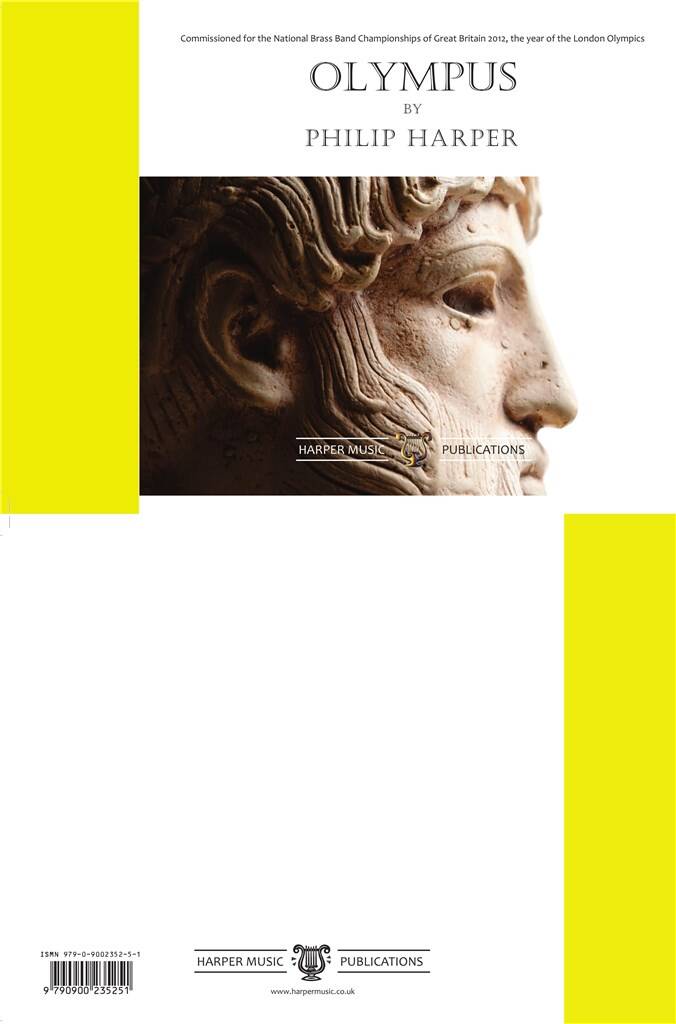
Olympus - Philip Harper
Selected as the test-piece for the 3rd Section Regional contests of the National Brass Band Championships 2012The music begins with a depiction of the exciting Opening Ceremony where noisy fanfares and sudden swells add to the cosmopolitan flag-waving clamour. Without a break the music leads to The Chariot Race, a fast compound-time gallop withthundering hooves in the basses and percussion, and a heroic melody introduced by the tenor horns. Chariot racing was the main equestrian event in the Ancient Greek Games, which were founded in memory of King Oenomaus. In the Greek legend he suffereddefeat in a chariot race to his son-in-law and Zeus' grandson, Pelops, but much of the music is bitter-sweet to symbolise the fact that Pelops had to cheat to win drawing parallels with some of the issues still facing modern-day athletics. A slow, mystical passage follows, describing The Temple of Zeus at Olympia. The statue of Zeus, who was honoured throughout the Ancient Games' history, was housed inside the temple and was one of the Seven Wonders of the Ancient World. Themusic depicts this period of the dawn of one of mankind's most ancient civilisations and there is a series of solo passages above a drone. The next section is called The Olympic Flame and a broad and lyrical anthem-like melody develops slowly in the euphoniums, which gradually ascends until the horns can take it over before passing upwards again to the cornets (Higher). The musicbursts into bright life at the lighting of the flame and the regular rhythmic pattern which has been established goes through an accelerando (Faster). The final section is called The Olympic Truce and aims to capture the cooperative spirit of the ancient practice of ending wars for the duration of the games. The anthem-like melody makes an affirmatory return (Stronger) and the work ends asit began with a blaze of colour and a real sense of optimism and global celebration. "Citius, Altius, Fortius" (Faster, Higher, Stonger)NOTES ON PERFORMANCEPercussion requirements: 1 to 3 players (3 Timpani, Snare Drum, Tenor Drum, Cymbals, Glockenspiel, Triangle)
Estimated dispatch 5-14 working days
-
 £67.50
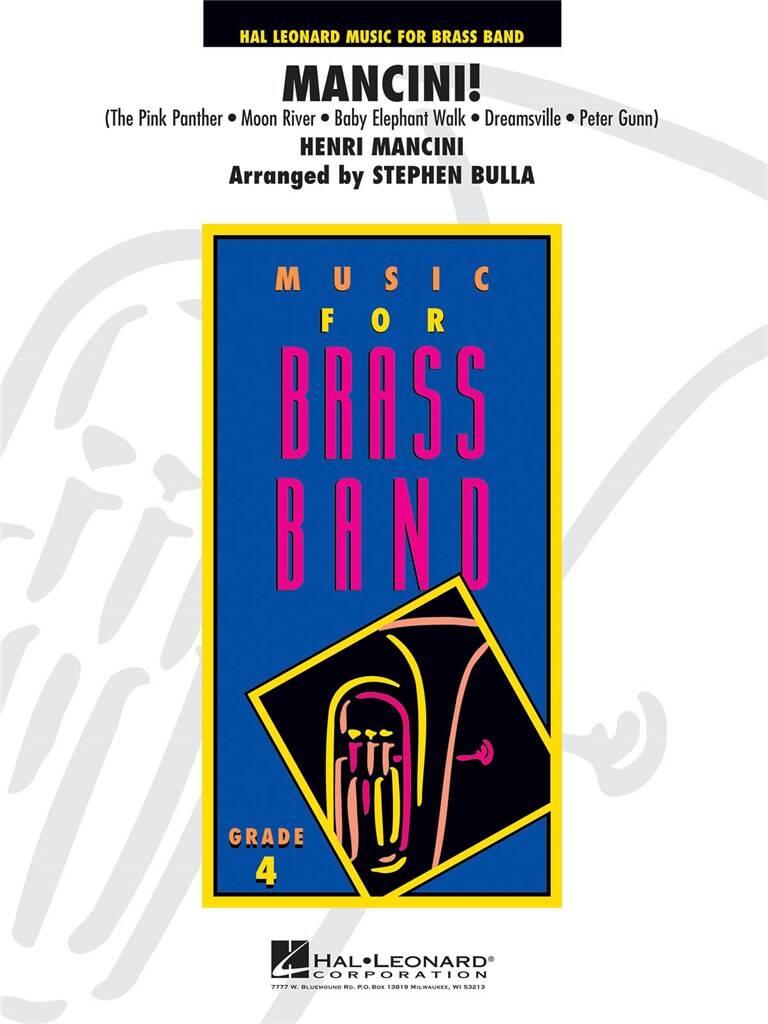
Mancini! - Henry Mancini - Stephen Bulla
Some of the most recognisable themes from film and television over the years have come from the creative genius of Henry Mancini. Here is a symphonic showstopper featuring some of Mancini's biggest hits and most recognised melodies from the last four decades! Includes: The Pink Panther, Moon River, Baby Elephant Walk, Dreamsville, and Peter Gunn.
Estimated dispatch 5-14 working days
-
 £139.00
The Jazz Police - Gordon Goodwin - Reid Gilje
This is really a powerhouse of a piece! Hard-driving rock'n roll at a high tempo with the Jazz Police at the heels... Please note the dynamics. Tempo and good articulation is a very big part of the energy of this piece. Fortissimo first appears at bar 113. A useful tip: It's possible to practice this one also at lower dynamic levels.
Estimated dispatch 5-14 working days
-
 £67.50
Tone Studies for Band - James Curnow
Tone Studies for brass band consists of nine studies designed to aid the development of good individual and ensemble tone production and intonation. Add Tone Studies to your library and you will find it quickly becomes an indispensible part of your band's rehearsal routine.
Estimated dispatch 5-14 working days
-
 £54.99
Vivo Per Lei - V. Zelli - Wim Stalman
A passionate desire for Andrea Bocelli's voice has spread across the world like wildfire for Andrea Bocelli possesses a truly remarkable voice. A voice as palpably powerful, as it is almost ethereal. Vivo Per Lei (I live for Her) tells of a passion so great that it is felt in every action, every moment of the day. This excellent arrangement will bring a moment of tender passion to any concert.
Estimated dispatch 5-14 working days
-
 £115.60
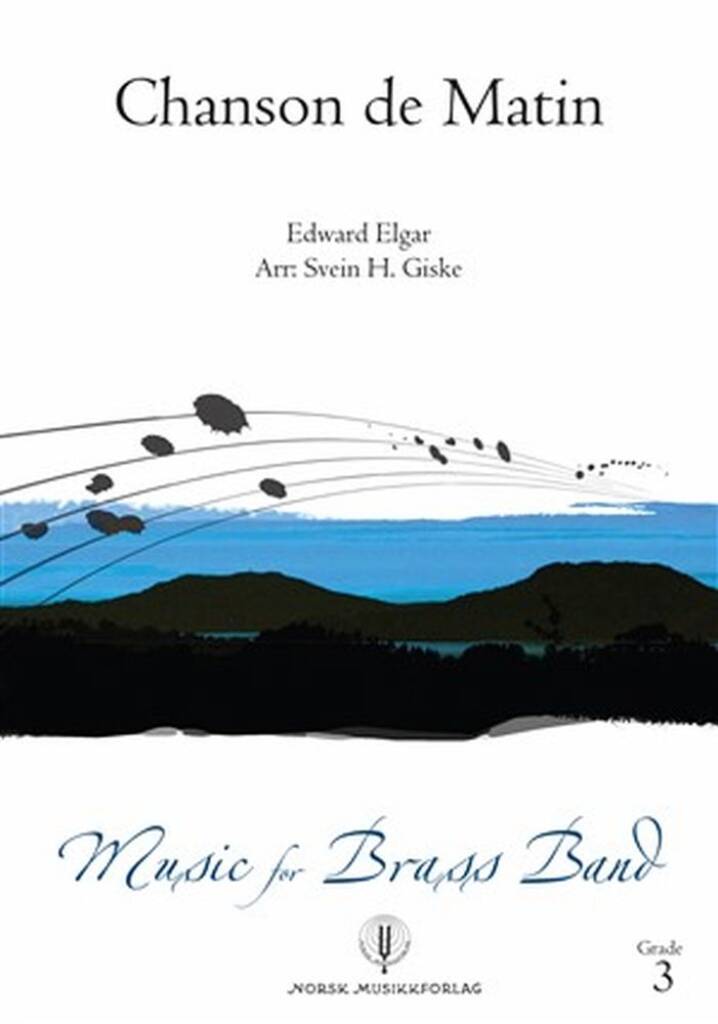
Chanson de Matin - Edward Elgar - Svein H. Giske
Chanson de Matin ("Morning Song") (Op. 15, No. 2) was likely written by Edward Elgar around 1889, originally for violin and piano. He later created an orchestral version. The premiere of this version in 1901 was conducted by none other than Henry Wood. Wood conducted the Promenade Concerts in London for almost 50 years and is considered the "father" of The Proms.The English composer Edward Elgar is perhaps best known for his Enigma Variations and Pomp and Circumstance marches.This arrangement was written during the COVID-19 pandemic for Askoy Brass Band's album "Gjensyn", available on Spotify and other streaming services.
Estimated dispatch 5-14 working days
-
 £159.99
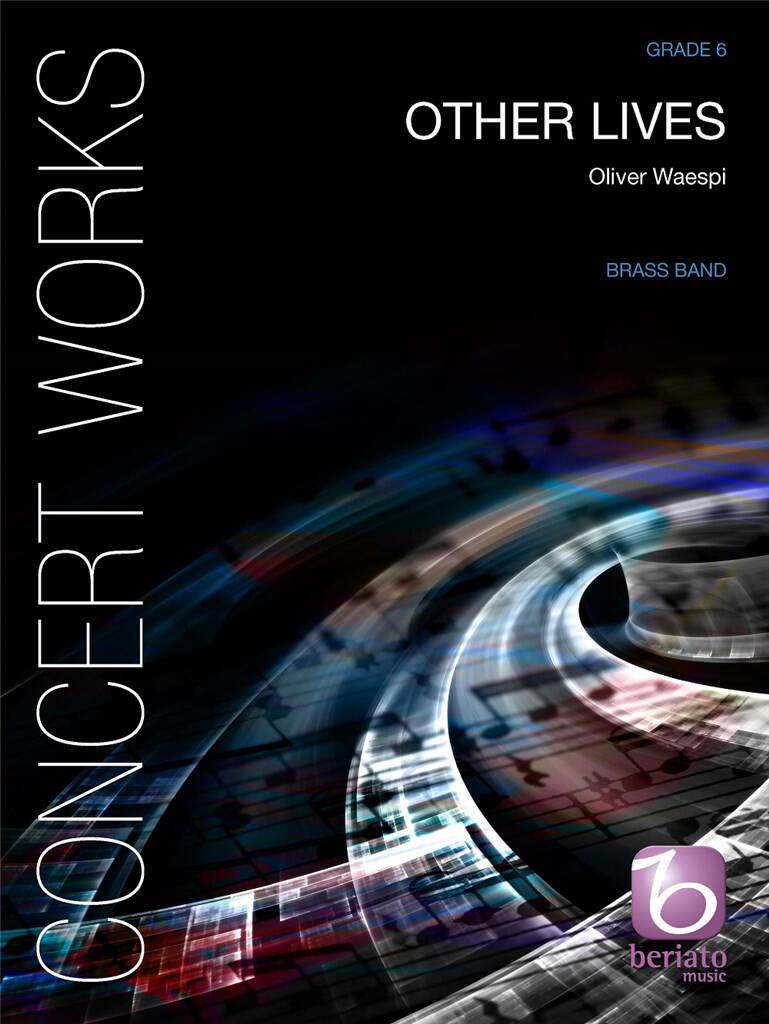
Other Lives - Oliver Waespi
Other Lives is works perfectly for a competition but can also be programmed as concert work. The dark chords at the beginning of the piece are derived from "Der Doppelganger", one of Franz Schubert's late songs. After a short development the music begins to accelerate and find its own shape, gradually moving away from the introduction. The entire first part, "Rage", has an intensely agitated character. The ensuing "Reflection" turns back to the initial chord progression, before a series of interspersing solos explore time and space at a slower pace. After another musical surge, the music is brought close to silence and then gives way to the third part, "Redemption".Here, a widely spaced sound field contains a remote allusion to another work by Schubert "Ruckblick". After this farewell, an abstract musical transformation triggers an emotional change, as the initial motifs are now presented in their inversed form in order to create a much brighter harmonic landscape. Moreover, in the last part of the piece, "Renewal", the grim, tense atmosphere of the first part is transformed into a great energy. Other Lives was commissioned by the Valaisia Brass Band.
Estimated dispatch 5-14 working days
 View Music