Results
-
 £79.95
Neverland - Christopher Bond
"All children, except one, grow up" wrote J.M. Barrie about Peter Pan in 1911; the first line and an expression of beautiful melancholy and fantasy, coming to represent one of the best-loved children's stories of the twentieth century. 'Peter & Wendy', as the book was first released, has subsequently been transformed into adaptations for film and stage, with subsequent books based on this iconic tale. In writing this new work for brass band, the composer has taken three of the main themes from J. M. Barrie's book, and used these themes to create new musical material, forming a work in three contrasting sections. I. Journey to Neverland The opening of the work, mysterious in its style, reflects the opening chapters of the story - a leafy London street, still in the dead of night - with the music transforming quickly as it builds in texture and momentum - a Journey to Neverland through the night sky; Second Star to the Right and straight on 'til morning. "Then Peter knew that there was not a moment to lose. 'Come,' he cried imperiously, and soared out at once into the night, followed by John and Michael and Wendy. Mr & Mrs Darling and Nana rushed into the nursery too late. The birds were flown." II. The Windows that Closed The central section of the work takes its inspiration from the sense of longing throughout the book, mainly by Peter Pan, the Darling Children & The Lost Boys. Distant memories of life before Neverland, memories of the Lost Boys' mothers, and regret at what the children have missed. Peter says "Long ago, I thought like you that my mother would always keep the window open for me; so I stayed away for moons and moons and moons, and then flew back; but the window was barred, for mother had forgotten all about me, and there was another little boy sleeping in my bed." III. Aboard the Pirate Ship The final section of the work takes its inspiration from the Pirate Ship, and Peter Pan's ultimate battle with its infamous Captain Hook. "In person, he was cadaverous and blackavized, and his hair was dressed in long curls, which at a distance looked like black candles, and gave a singularly threatening expression to his handsome countenance. His eyes were the blue of the forget-me-not, and of a profound melancholy, save when he was plunging his hook into you, at which time two red spots appeared in them and lit them up horribly."
Estimated dispatch 10-14 working days
-
 £10.00
Endurance
DescriptionMen wanted for hazardous journey. Small wages, bitter cold, long months of complete darkness, constant danger, safe return doubtful. Honour and recognition in case of success. - Ernest Shackleton, 4 Burlington StreetEndurance takes its title from the ship used by Sir Ernest Shackleton's Imperial Trans-Antarctic Expedition in 1914-15. After many months of fundraising (and reputedly running the above advert in The Times) the Endurance set sail from Plymouth on 6 August 1914. Whilst at sea news of the outbreak of war led Shackleton to put his ship and crew at the disposal of the Admiralty, but their services were not required and they were encouraged to continue. On October 26 1914 they left Grytviken on South Georgia for the Antarctic continent, hoping to find the pack ice shrinking in the Antarctic spring. Two days later, however, they encountered unseasonable ice which slowed their progress considerably. On 15 January 1915, when Endurance was only 200 miles from her intended landfall at Vahsel Bay, the ship became beset by ice which had been compressed against the land to the south by gale force winds. Trapped in the ice of the Weddell Sea, the ship spent the Antarctic winter driven by the weather further from her intended destination until, on 21 November 1915 Endurance broke up forcing the crew to abandon ship and set up camp on the ice at a site they named "Patience Camp".The crew spent several weeks on the ice. As the southern spring started to reduce the extent of the ice shelf they took to their three lifeboats, sailing across the open ocean to reach the desolate and uninhabited Elephant Island. There they used two of the boats to build a makeshift shelter while Shackleton and five others took the largest boat, an open lifeboat named the 'James Caird' and sailed it for 800 terrifyingly dangerous miles across the vast and lonely Southern Atlantic to South Georgia - a journey now widely regarded as one of the greatest and most heroic small-boat journeys ever undertaken. After landing on the wrong side of the island and having to climb over a mountain range in the dark with no map, Shackleton and his companions finally stumbled back into the Grytviken whaling station on 19 May 1916.After resting very briefly to recover his strength, Shackleton then began a relentless campaign to beg or borrow a ship to rescue the rest of his crew from Elephant Island; whaling ships were not strong enough to enter polar ice, but on 30 August 1916, over two years after their departure from Plymouth, Shackleton finally returned to Elephant Island aboard a steam tug borrowed from the Chilean government. Although some were in poor health, every member of the Endurance crew was rescued and returned home alive.Endurance is dedicated to the memory of my mum, who passed away in September 2017.Listen to a computer generated preview and follow the score below:
Estimated dispatch 7-14 working days
-
 £61.11
Heligan - Kevin Ackford
Score & Parts A descriptive piece of around 13 minutes telling the story of and taking you on a journey around the Lost Gardens of Heligan. Following the introduction, we begin our journey at the Grand House with the staff scurrying around carrying out their work. Next comes the outbreak of World War 1 when all of the male staff of the house signed up with the Duke of Cornwall's Light Infantry. Following the war only 6 of the gardens 22 staff survived and returned to Heligan. After the war the gardens "Go to Sleep" and become overgrown. Then comes the modern-day workers rediscovering the gardens and beginning to put them back to their former glory. Then the sun rises over the gardens and the birds begin to sing and we find ourselves in the serene lost valley. We then pass through the Jungle before turning the corner and once again see the House and lawns in all their glory.
Estimated dispatch 5-7 working days
-
 £79.95
Amundsen - Jonathan Bates
DURATION: 14'00". DIFFICULTY: 1st+. 'Amundsen' was commissioned by rskog Brass, Norway for their winning performance at the 2020 Norwegian National Championships held at the Grieghallen in Bergen. In December 1911, Norwegian Roald Amundsen gained global fame by becoming the first explorer to lead a team to the geographic South Pole. Amundsen and 4 other members of his team arrived 5 weeks ahead of a rival team from the UK led by Robert Falcon Scott, all of which perished on their attempted return from the pole. Initially when Amundsen's team set out in 1910, they were under the impression that they would be making the far shorter journey to the arctic drift to attempt to reach the North Pole, but Amundsen had received news that American explorers Peary and Cook had beaten them to this goal, and so Amundsen's focus changed southward. 'Fram, Forward' - 'Fram' (translating to English as "forward") was the name of the ship Amundsen used for this particular polar expedition. Amundsen had only informed 2 people of his real intentions of conquering the South Pole when the ship first left port in Kristiansand before heading south to the Portuguese island of Madeira in the Atlantic Ocean. After weeks at sea - causing the uninformed members of the crew to raise a number of questions and produce a general feel of uncertainty and low spirits - it was here that Amundsen announced his true plans to the rest of his crew. They were asked whether they wished to continue with their expedition, to which all - some begrudgingly - agreed to sail on to the South Pole, through the great Ice Barrier before docking in the Bay of Whales on the Ross Ice Shelf. 'Ross Ice Shelf' - Upon Amundsen's arrival in the Bay of Whales, the team were greeted by the sight of the enormous ice plateau's and glaciers, towering into the Antarctic sky. In 1907, Ernest Shackleton had attempted - and failed - to reach the South Pole, but his route and mapping was by now well documented. Scott and the UK team were to follow this route, whereas Amundsen and his men forged their own way to the pole through unchartered territory and deadly terrain littered with deep crevasses and canyons. The music here though, is a picture of tranquility. The eerie silence of total emptiness with only the heavy snow falling around Amundsen as Fram and the Bay of Whales disappears into the distance, faced by the maginute of the expedition ahead. 'Advance to Polheim' - The first new challenge Amundsen discovered on this route was a rough, sharp and extremely steep glacier (which was later named the Axel heiberg Glacier after the Norwegian monarch who funded much of the expedition), which would take his team up from sea level to an altitude of over 9,000ft in just 20 miles, with most of this over just 7 miles. Once scaled, only the vast Antarctic Plateau stood between Amundsen and the pole. Here the race began, with only one aim - victory for himself, his team, and for the whole of Norway. .
In Stock: Estimated dispatch 1-3 working days
-
 £59.95
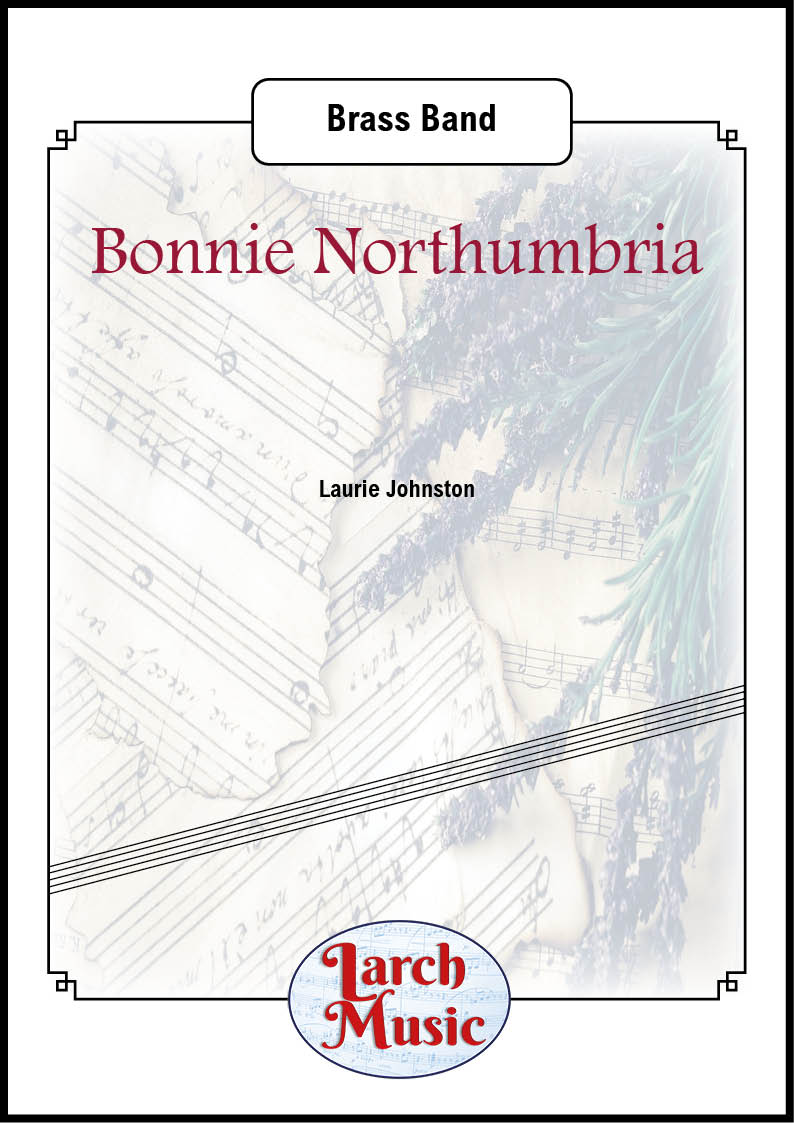
Bonnie Northumbria - Brass Band - LM786
COMPOSER: Laurie JohnstonProgramme NotesNorthumberland, or Northumbria as it is also known, is the most northern county in England and has magnificent and stunning landscapes just waiting to be explored. Filled with mystical castles, atmospheric ruins and historical sites and edged by spectacular coastal scenery, there is something wonderful to see at every turn. The Devils Causeway passes through Northumbria and reaches Berwick upon Tweed at the coast. Walkers and cyclists can also take the Coast and Castles Cycle Route or the North Sea Trail which journey through some of the most beautiful scenery along the way.The Blaydon Races is aGeordiefolk songwritten in the 19th century byGeordie Ridley, in a style deriving frommusic hall. It is regarded by many as the unofficialanthemofTynesideand is frequentlysungby supporters ofNewcastle United Football ClubandNewcastle Falconsrugby club.Blaydonis a small town inGateshead, situated about 4 miles (6.4km) fromNewcastle upon Tyne, inNorth East England. The race used to take place on the Stella Haugh 1 mile (1.6km) west of Blaydon.Stella South Power Station(demolished in 1995) was built on the site of the track in the early 1950s, after the races had stopped taking place in 1916.Water of Tyne (sometimes rendered as The Waters of Tyne) is a folk song (Roud number1364) from the north-east of England. The song is sung by a girl or woman lamenting the fact that her paramour is on the opposite bank of theRiver Tyne. Sleeve notes to Michael Hunt's recording of Tyneside songs states that "the ferry is believed to be that atHaughton Castleon theNorth Tyne". Alternatively the "rough river" in the last line may indicate a point further downstream, possiblyTynemouth.The song was collected byJohn Bellin 1810 and published two years later inRhymes of Northern Bards.The Keel Row is a traditional Tyneside folk song evoking the life and work of thekeelmenofNewcastle upon Tyne. A closely related song was first published in aScottishcollection of the 1770s, but may be considerably older, and it is unclear whether the tune is Scottish or English in origin.The opening lines of the song set it inSandgate, that part of the quayside overlooking the River Tyne to the east of the city centre where the keelmen lived and which is still overlooked by theKeelmen's Hospital.Versions of the song appear in both England and Scotland, with Scottish versions referring tothe Canongaterather than Sandgate. The earliest printing was in the 1770s inEdinburghin A Collection of Favourite Scots Tunes, edited by Charles Maclean, though the tune was also found in several late eighteenth-century English manuscript collections. As the term "keel" was used both sides of the border, it has not been determined which version was the original, althoughFrank Kidsonsurmised that like many other songs collected by Maclean it may originally have been aJacobiteair from the time of the1745 rebellion. Some versions of the song make reference to a "blue bonnet[...] with a snowy rose upon it", a clear attempt to evoke Jacobite symbolism, whether dating from 1745 or not.Kidson, however, also noted that he had found the tune of The Keel Row associated with an early dance called "The Yorkshire Lad" as early as 1748.By the 19th century the tune was well associated with the River Tyne; a few years before the 1850s the keelmen had met yearly to celebrate the founding of the Keelmen's Hospital, perambulating the town to the accompaniment of bands playing The Keel Row.Dance To Thy Daddyis a traditional Englishfolksong, originating inNorth East England. An early source for the lyrics, Joseph Robson's "Songs of the bards of the Tyne", published 1849, can be found on the Farne archive. In Farne's notes to the song, it is stated that these lyrics were written by William Watson around 1826.
In Stock: Estimated dispatch 3-5 working days
-
 £62.00
Montage (Score only) - Peter Graham
Each of the movements of the symphony take as their starting point forms originating in music of the 16th and 17th centuries. The first, an intrada, introduces the main thematic material (based on the interval of a minor third) in its embryonic state. As the piece progresses, this material is developed and manipulated in a variety of ways. The interval of the third remains central to the overall scheme of the work, even unifying the three movements on a tonal plane (I: F (minor); II: A flat (major); III: C flat (minor). The internal structure of the intrada is an arch form: ABCBA, roughly modelled on the first movement of Concerto for Orchestra by Witold Lutoslawski, to whose memory the movement is dedicated. A chaconne follows - the basic material now transformed into expansive solo lines underpinned by a recurring sequence of five chords (again, a third apart). The movement's structure combines both ternary form and golden section principles and the chaconne's continuous cycle of chords may be visualised as circles. The final movement, a rondo, bears the dramatic weight of the entire work, as the underlying tonal tensions surface. A musical journey ensues, making diversions through lyrical territories as well as through more spiky, jazz-flavoured ones. The aural (and visual) montage is perhaps most apparent towards the climax of the piece, where three keys and polyrhythms sound simultaneously in the upper brass, xylophone, horns, and timpani. The climax itself combines the lyrical music heard earlier with the rondo theme, now presented by cornets and trombones in canon. The teleological thrust of the movement (if not the entire work) can be symbolized by the flight of an arrow, as it steers a predetermined course towards its target. Duration: 16:00
Estimated dispatch 7-9 working days
-
 £74.00
Montage (Parts only) - Peter Graham
Each of the movements of the symphony take as their starting point forms originating in music of the 16th and 17th centuries. The first, an intrada, introduces the main thematic material (based on the interval of a minor third) in its embryonic state. As the piece progresses, this material is developed and manipulated in a variety of ways. The interval of the third remains central to the overall scheme of the work, even unifying the three movements on a tonal plane (I: F (minor); II: A flat (major); III: C flat (minor). The internal structure of the intrada is an arch form: ABCBA, roughly modelled on the first movement of Concerto for Orchestra by Witold Lutoslawski, to whose memory the movement is dedicated. A chaconne follows - the basic material now transformed into expansive solo lines underpinned by a recurring sequence of five chords (again, a third apart). The movement's structure combines both ternary form and golden section principles and the chaconne's continuous cycle of chords may be visualised as circles. The final movement, a rondo, bears the dramatic weight of the entire work, as the underlying tonal tensions surface. A musical journey ensues, making diversions through lyrical territories as well as through more spiky, jazz-flavoured ones. The aural (and visual) montage is perhaps most apparent towards the climax of the piece, where three keys and polyrhythms sound simultaneously in the upper brass, xylophone, horns, and timpani. The climax itself combines the lyrical music heard earlier with the rondo theme, now presented by cornets and trombones in canon. The teleological thrust of the movement (if not the entire work) can be symbolized by the flight of an arrow, as it steers a predetermined course towards its target. Duration: 16:00
Estimated dispatch 7-9 working days
-
 £79.95
Corineus - Christopher Bond
Corineus, in medieval British legend, was a prodigious warrior, a fighter of giants, and the eponymous founder of Cornwall. The first of the legendary rulers of Cornwall, he is described as a character of strength and power. It is on the medieval ruler that this new work, Corineus, is based, presented in three contrasting sections. The work opens with heraldic fanfares and a sense of jubilance before presenting musical material which changes and develops organically, portraying the journey taken by Corineus, Brutus, and the Trojans from modern-day mainland Europe to Britain. The central section of the work is slower, creating a feeling of longing. Brutus' son, Locrinus, had agreed to marry Corineus' daughter, Gwendolen, but instead fell in love with a German princess. In writing this part of the work, the composer portrays the longing of Gwendolen for her husband, knowing he is in love with somebody else. After Corineus died, Locrinus divorced Gwendolen, who responded by raising an army in Cornwall and making war against her ex-husband. Locrinus was killed in battle, and legend suggests that Gwendolen threw Locrinus' lover into the River Severn. This dramatic battle provides the inspiration for the final part of the work. In writing this work, the composer hopes to flare the imagination of young brass players around the country, in an engaging new take on a firm fixture in British folklore.
Estimated dispatch 10-14 working days
-
£125.00
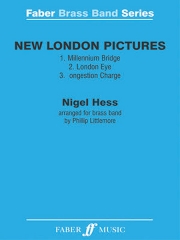
New London Pictures - Nigel Hess
New London Pictures represents elements of London in the 21st Century. The Millennium Bridge describes the pedestrian's journey across this wonderful new landmark bridge over the Thames, starting at the imposing Tate Modern, crossing the busy river, and onwards to St. Paul's Cathedral with its bells ringing out over the great city. London Eye is an incredibly large ferris wheel situated on the South Bank of the River Thames. This movement depicts a 'flight' on this riverside wheel, at the top of which the panoramic view of London is breath-taking and the expanse of the music is a suitable depiction of the view. As with all modern cities, London is over-crowded with motor vehicles. London is the first major city in Europe to adopt a Congestion Charge, and this piece (with its stop and go traffic lights) is both racy and comical. Here are Londoners attempting to go about their business in the face of overwhelming odds.....Brass Band Grades 4/5: Premier Youth and 2nd SectionDuration: 15 minutes
In Stock: Estimated dispatch 1-3 working days
-
 £34.95
Time Eternal - Christopher Bond
Time Eternal (2011) was written as a showcase for band in the form of a seven-minute journey which demonstrates the ability of the band and its soloists. As the title suggests, the idea of time is important in the work, with bell-like gestures forming the opening and closing sections. Rhythmic material is heard, often juxtaposing more lyrical passages, sometimes with dramatic percussion or semiquaver running accompaniments in the cornets.A slow and expressive middle section hears soloistic contributions from the flugel horn and euphoniums, as well as fuller tutti passages, before a return to the energetic tempo of the opening where material is heard again, often presented in different ways with a real sense of drive through to the close.
Estimated dispatch 10-14 working days