
Results
-
 £69.99
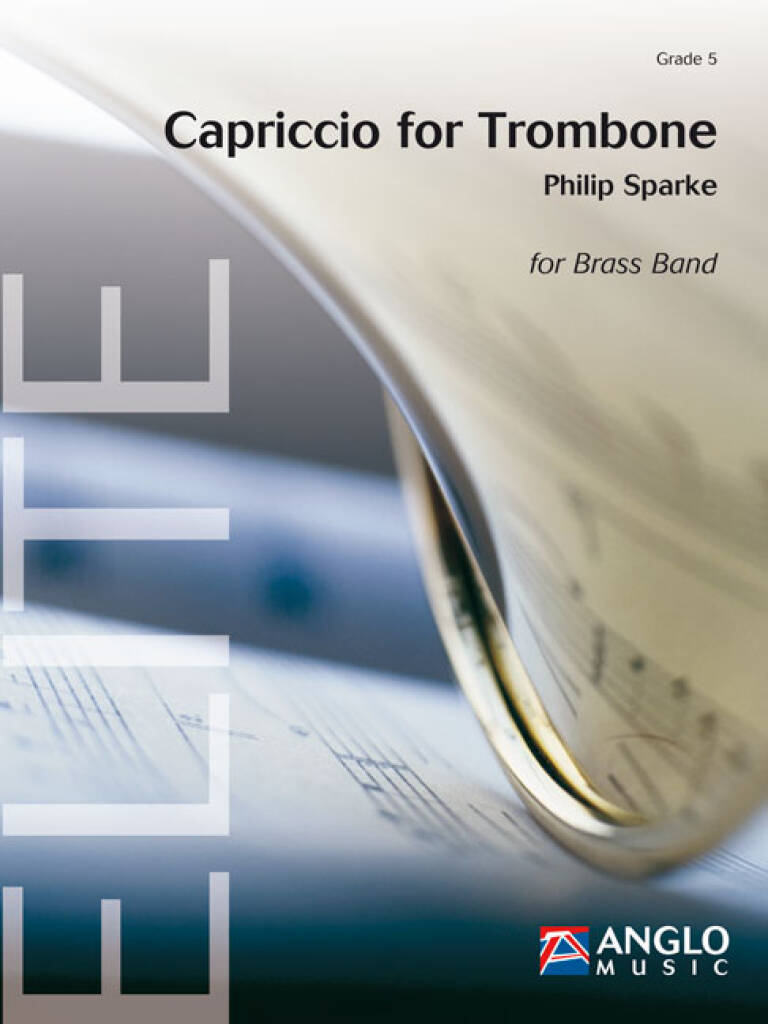
Capriccio for Trombone - Philip Sparke
Capriccio for Trombone was commissioned by Brett Baker, trombone soloist and member of the famous Black Dyke Band. It is a tribute to the late Mike Moor, close friend and colleague of both Brett and the composer.The piece aims to capture Mike's good humour, his love for brass band music and the irrepressible, enthusiastic energy he involved in all things he did in his life.
Estimated dispatch 5-14 working days
-
 £80.00
The Unfortunate Traveller (Brass Band - Score and Parts)
Imogen Holst (1907-1984) submitted The Unfortunate Traveller (1929) as her final work as a student portfolio at the Royal College of Music, where her composition teacher was Gordon Jacob. The title was taken from Thomas Nashe's famous 1594 picaresque novel of the same title. The Suite was first performed on 12 February 1933 at her Majesty's Theatre, Carlisle, by the St. Stephen's Band, with the composer conducting. Te concert was given in memory of Holst's uncle, Dr. H.A. Lediard. Holst had been impressed with the band's performance of his A Moorside Suite at the 1928 National Brass Band Championships (The Crystal Palace, South London) and was keen to work with them. Writing in Imogen Holst, a life in music, Christopher Grogan indicates that it was Gustav Holst's suggestion to include his daughter's work in the programme, quoting Imogen Holst's remarks made in interview to The Daily Mail as follows: "....it is the first time, so far as I know, that a woman has conducted a brass band at a public concert....It has been a delight to rehearse the St. Stephen's Band. It was their performance at the Crystal Palace Festival that inspired me to write this Suite, which I have dedicated to them."Imogen Holst accompanied her father to the Crystal Palace in 1928 to hear the performances of A Moorside Suite, and was so excited by the played and, audibly, by her father's music that she decided to write a brass band piece for her final examination. Te result was The Unfortunate Traveller (1929). However, it was not possible for her to present a brass band work for examination. She arranged it for string orchestra so that it could be played before she left the RCM in July 1930. Following the premiere of the original in 1933, the manuscripts did not resurface until 1969 Imogen found them among her late mother's effects. Although she requested score and parts be destroyed, they ended up in the possession of Manchester composer John Golland, who marked up the score presumably with the intention of creating a new performing edition. The original scoring reveals a lack of experience with what can be a tricky medium.With the agreement of the Holst Foundation, a revised edition, with additional percussion, was prepared in 2011 since when the work has been fortunate to travel round the world as a concert and contest piece. The original includes drums in the March only. The title was taken from Tomas Nashe's famous 1594 picaresque novel of the same title. Several Morris Dance tunes are introduced during the course of the four short movements, including Bonnie Green Garters, Shepherd's Hey, The Rose and The Wind Blaws Cauld. Quirky twists and turns of harmony and spirited rhythms that remind us how much Imogen Holst loved tradition English dance music.In September 2025, I made a performing edition of the composer's arrangement for string orchestra. The manuscript lacks the final movement, which I arranged in a similar style, ie. without extending the upper ranges. Making this edition raised some issues regarding the accuracy of my band version and some of the solutions I used to smooth out the voicing. I have used the composer's second thoughts to refine my performing edition and to correct a textual errors.- Paul HindmarshDuration: 10.00
Estimated dispatch 7-14 working days
-
£40.00
The Unfortunate Traveller (Brass Band - Score only)
Imogen Holst (1907-1984) submitted The Unfortunate Traveller (1929) as her final work as a student portfolio at the Royal College of Music, where her composition teacher was Gordon Jacob. The title was taken from Thomas Nashe's famous 1594 picaresque novel of the same title. The Suite was first performed on 12 February 1933 at her Majesty's Theatre, Carlisle, by the St. Stephen's Band, with the composer conducting. Te concert was given in memory of Holst's uncle, Dr. H.A. Lediard. Holst had been impressed with the band's performance of his A Moorside Suite at the 1928 National Brass Band Championships (The Crystal Palace, South London) and was keen to work with them. Writing in Imogen Holst, a life in music, Christopher Grogan indicates that it was Gustav Holst's suggestion to include his daughter's work in the programme, quoting Imogen Holst's remarks made in interview to The Daily Mail as follows: "....it is the first time, so far as I know, that a woman has conducted a brass band at a public concert....It has been a delight to rehearse the St. Stephen's Band. It was their performance at the Crystal Palace Festival that inspired me to write this Suite, which I have dedicated to them."Imogen Holst accompanied her father to the Crystal Palace in 1928 to hear the performances of A Moorside Suite, and was so excited by the played and, audibly, by her father's music that she decided to write a brass band piece for her final examination. Te result was The Unfortunate Traveller (1929). However, it was not possible for her to present a brass band work for examination. She arranged it for string orchestra so that it could be played before she left the RCM in July 1930. Following the premiere of the original in 1933, the manuscripts did not resurface until 1969 Imogen found them among her late mother's effects. Although she requested score and parts be destroyed, they ended up in the possession of Manchester composer John Golland, who marked up the score presumably with the intention of creating a new performing edition. The original scoring reveals a lack of experience with what can be a tricky medium.With the agreement of the Holst Foundation, a revised edition, with additional percussion, was prepared in 2011 since when the work has been fortunate to travel round the world as a concert and contest piece. The original includes drums in the March only. The title was taken from Tomas Nashe's famous 1594 picaresque novel of the same title. Several Morris Dance tunes are introduced during the course of the four short movements, including Bonnie Green Garters, Shepherd's Hey, The Rose and The Wind Blaws Cauld. Quirky twists and turns of harmony and spirited rhythms that remind us how much Imogen Holst loved tradition English dance music.In September 2025, I made a performing edition of the composer's arrangement for string orchestra. The manuscript lacks the final movement, which I arranged in a similar style, ie. without extending the upper ranges. Making this edition raised some issues regarding the accuracy of my band version and some of the solutions I used to smooth out the voicing. I have used the composer's second thoughts to refine my performing edition and to correct a textual errors.- Paul HindmarshDuration: 10.00
Estimated dispatch 7-14 working days
-
 £45.00
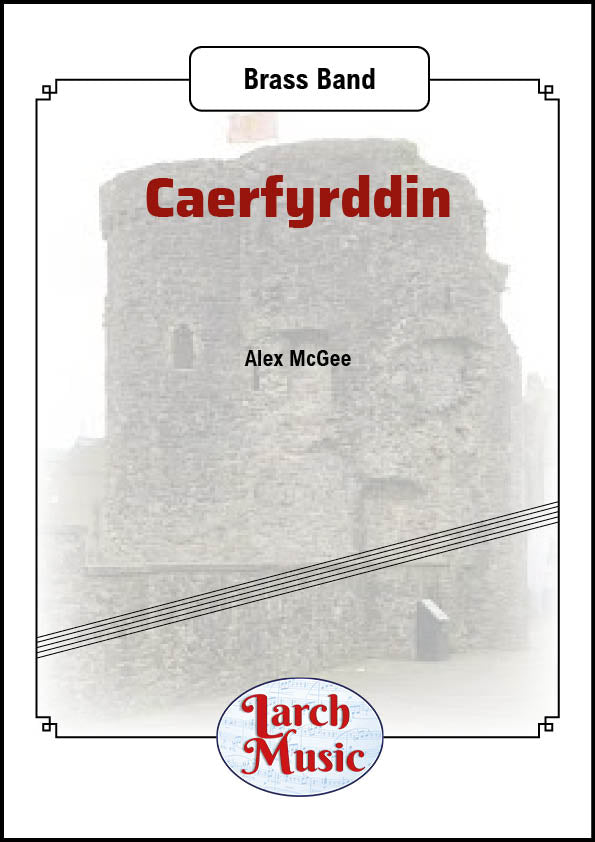
Caerfyrddin - Brass Band - LM957
COMPOSER: Alex McGeeA four movement work describing the historic county town of Carmarthen.1. FanfareThe first movement is an opening Fanfare,2. Castell Caerfyrddyn(Carmarthen Castle)The second movement is a lament describing the now ruined castle.Carmarthen Castle(Welsh:Castell Caerfyrddin) is a ruinedcastleinCarmarthen,West Wales. First built by Walter, Sheriff of Gloucester in theearly 1100s, the castle was captured and destroyed on severaloccasions before being rebuilt in stoneduring the 1190s. The castle was captured byOwain Glyndrin 1405.Henry VII's father died at Carmarthen Castle in 1456. During theWars of the Rosesthe castle fell toWilliam Herbertand, during theCivil War,was captured by Parliamentary forces. It was dismantled by order ofOliver Cromwellin the mid 1600s.It has been used as the site of Carmarthen's gaol until the 1920s.The remains of the castle were given a Grade Iheritage listingin 1954and is currently a tourist attraction and site of the town's Tourist Information Centre.3. Pysgota Cwrwgl(Coracle Fishing)The third movement is a Scherzo which depicts coracle fishing on the river Towy.Should you take an evening stroll down by the River Towy,if the weather and river conditions are suitable, you may be lucky enough to see apair of coracles float gently down river with a net suspended between them.The coracle man will hold the net in one hand and skilfully moving the paddle in afigure of eight motion in the other. As soon as a fish in caught, which many havedescribed as a 'silent noise travelling from the fish, into the net and up into thefisherman's arm', the two coracles are drawn together by pulling at the net.Sewin (sea trout) or salmon being the chosen catch.4. MarchThe Fourth movement is a March representing the town itself. Carmarthenshire in West Wales lies on the River Towy and claims to be the oldest town in Wales. Some variants of theArthurian legendclaim thatMerlinwas born outside the town and that he lies imprisoned in a cave in nearbyBryn Myrddin(Merlin's Hill), which stands right by the A40 trunk road.The myth maintains that his groans can be heard issuing forth from the hill and will continue until he is called to help his fellow countrymen. It is also claimed that, when Merlin's Oak fell, it would be the downfall of the town.For many years great effort was employed to brace the tree, situated in the town.Although it eventually died, it is hoped that catastrophe was averted by preservingsome bits in theCarmarthenshire County Museum.Larger branches are in the Civic Hall in Nott Square and a statue of Merlincarved from another local tree stands in the town centre.St. Peter's Church, the largest parish church in Wales,also has thelongest navemeasuring 60 metres and its tower containseight bellswith the heaviest weighing just under a tonne.It is surprising that few traces survive of the medieval town; however,a small section ofCivil War defences, thrown up by the Royalists, survives on the south-west of the town. They are known as "The Bulwarks," and consist of an earthwork bank and a well-preserved four-sided bastion.Suitable for Most Bands - Duration 8 mins (Approx.)
In Stock: Estimated dispatch 3-5 working days
-
 £40.00
Alchemists' Fire - Lucy Pankhurst
An original composition from Lucy Pankhurst and Winner of the 2011 John Golland Award, receiving its premiere at the RNCM Festival of Brass that same year.It is a complex, energetic and invigorating major work for brass band, and one which rightly demands attention through its intricate scoring, impact-making effects and bubbling brilliance!Comments from the composer on the work's title and its multi-purpose influence and inspiration upon her composition:"The phrase "Alchemists' Fire" has several possible connotations:Firstly, Alchemists' Fire is a magical weapon featured in the Dungeons & Dragon role playing game. It is a potion, so can be used to splash, throw or pour onto a target, dealing fire damage if it hits successfully.The second possible meaning comes from an historical source, where it was also known as Greek Fire, from which the D&D element takes its influence. This was an incendiary weapon used by the Byzantine Empire, typically used in naval battles to great effect, as it could continue to burn on water. It provided a technological advantage and was responsible for many key Byzantine victories. The manufacture of this 'fire' was kept a deadly secret; so much so that the formula was eventually lost and contemporary scientists and historians can only speculate at what the chemical make-up might have been.The final implication is a much more visual and sensory concept; that of the fire actually used by the Alchemist in his work - raging, dangerous and white-hot. Some sections of the work reflect the idea of 'magic' and ongoing experiments, some successful, some failing dangerously, in a cacophony of pops, fizzes and explosions amidst furious heat and brief moments of calm as the fire slowly cools, sizzling with residual components and elemental energy."
In Stock: Estimated dispatch 3-5 working days
-
 £30.00
National Express
I first heard of the song National Express, which was in the British Top Ten in 1998, when my son Jon mentioned it last year. It was written and sung by Neil Hannon, with his group "The Divine Comedy". Jon said that it would sound good played by a brass band. Tim Benson, solo trombone with Stannington Brass Band, also mentioned it on the internet forum, themouthpiece.com I spoke with Tim, and agreed to do a brass band arrangement with a special feature for solo trombone. In this arrangement, the solo trombone adds extra colour to a band arrangement which is a mixture of big band and country style. The trombone part is well within the capabilities of a good player. There is a comic element to this song, and the cornets and flugel contain an eight bar spoken part, which, if included, would enhance it's entertainment value.Tim Benson took the music to rehearsal at Stannington Brass Band and it instantly became a hit with the band who left whistling the melody. The piece not only retains the fun of the original, but it cleverly uses the band, and a bit of additional vocals from the cornet section. "Tim Benson and the Stannington Brass Band would like to thank Tim Paton for the arrangement." (Tim Benson)."National Express" is on Stannington Brass Band's latest CD, "AND ALL THAT BRASS", available from [email protected]."Pontins was brilliant... one of the highlights of my weekend was playing/performing National Express... absolutely belting arrangement Tim... I love it!" Message from Fiona, who performed with themouthpiece.com scratch band at the Pontins Brass Band Championships in Prestatyn.
In Stock: Estimated dispatch 3-5 working days
-
 £67.24
Armistice at Flanders Fields (Brass Band) Dwayne Bloomfield
This poignant and powerful work for brass band by Dwayne Bloomfield describes the day peace was announced to end World War I. The piece was written in 2023 to be played by bands around the world to mark Armistice Day. The composer writes: 'Unless you were there, it's impossible to imagine what it must have been like the day peace was announced ending World War I. The feelings soldiers experienced, who after years of fighting and suffering, to know it was over and they would return home to see family and loved ones again. This piece tries to tell their story. The work begins by approaching the front, distant artillery and battle sounds heard while the carnage and loss of lives was already known to the world. The band builds as we enter the thick of battle, the death and destruction, the conditions faced and the loss of hope of ever surviving. The next section, in 7/8 time, reflects the two sides fighting - both sides attacking and defending with mostly little result, but for the loss of more lives. Two euphoniums then depict the news and hope of peace talks. However, fighting did continue right up to the very end and on the last day there would be another 2,738 casualties. The Canadians were still battling to capture the town of Mons that morning. A song is sung in reflection of the estimated 5.5 million allied soldiers who lost their lives during World War I, then a clock ticks down the final minutes. The last three known casualties are depicted with French soldier Augustin Trebuchon, killed at 10:45am by a single shot as he rushed down the trenches to spread the news of coming peace; Canadian George Lawrence Price killed by a sniper round at 10:58am at the battle of Mons, and lastly a machine gun burst that killed American Henry Gunther, who is believed to have fallen on the 11th hour. Bells then toll ringing around the world announcing the end of the war. After years of war, it must have been jubilation for the families at home knowing their loved ones would be returning to them. The band builds with a hymn for peace as a final tribute to those who fought, before the piece resides with one of the most dreaded sounds at that time, the knock on the door from a telegram delivery boy or better known then as the Angels of Death. It wasn't just the 2,738 families from the casualties of the last day who would receive such a knock, but many more who expected their loved ones to be returning home would instead find out they were instead killed in the last weeks. So close. Driving around the battlefields today one comes across many intersections in the countryside which have cemetery signposts pointing in every direction. While the last post sounds in ceremonies today, this last bugle call instead depicts the horrors, devastation and death the soldiers faced during the war and right up the 11th hour of the 11th day of the 11th month, Armistice at Flanders Fields.' To view a video of Dallas Brass Band performing the work please visit https://www.youtube.com/watch?v=ljfyVz3cMgk Duration: Approx. 15.00 minutes Difficulty Level: 2nd Section + PDF download includes parts and score. Sheet music available from www.brassband.co.uk Instrumentation: Soprano Cornet Eb Solo Cornet Bb Repiano Cornet Bb 2nd Cornet Bb 3rd Cornet Bb Flugel Horn Bb Solo Horn Eb 1st Horn Eb 2nd Horn Eb 1st Baritone Bb 2nd Baritone Bb 1st Trombone Bb 2nd Trombone Bb Bass Trombone Euphonium Bb Bass Eb Bass Bb Percussion 1-3
In Stock: Estimated dispatch 1-3 working days
-
£70.00
Fire in the Sky - Peter Meechan
Fire in the Sky takes its inspiration from the stunning town of Montreux in Switzerland. I was commissioned to write the work 5 days before I visited this Montreux and was at work forming ideas for the piece as I arrived on the shore of Lake Geneva and its amazing views of the Alps.Whilst the scenery is without doubt some of the most incredible views I have ever witnessed, it was the history of the town that set Fire in the Sky in motion. Whilst there, it occurred to me that many of my musical heroes had lived or performed there, and three of them in particular had a strong connection with the town. Miles Davis, Igor Stravinsky and Freddie Mercury graced Montreux - the large convention centre, where the famous summer jazz festival is held, named its two halls after Davis and Stravinsky, and there is a quite breathtaking statue of Mercury in the town too.Each musician also commemorates an anniversary in 2011, the year of the premiere of Fire in the Sky; it is 40 years since the death of Stravinsky and both Miles Davis and Freddie Mercury died in 1991, making it 20 years since their deaths. So it seemed fitting to write a piece that in some way acknowledges them, and is a kind of personal athanksa for all they have given, and continue to give, me.The title comes from the famous Deep Purple song, Smoke on the Water - whose second line is aFire in the Skya and is a reference to the night the townas casino was set alight by a Frank Zappa fan. The piece tries to recreate the atmosphere of that night, paint a picture of fire in the sky (and smoke on the water) and also uses small anuggetsa of the music of my three greatest musical heroes, Miles Davis, Freddie Mercury and Igor Stravinsky.Fire in the Sky was commissioned by the Tomra Brass Band, Norway, and is dedicated to Stijn BerbeA and Nick Ost - both of whom are connected with the band (teaching and conducting), and both have been close friends - personally and musicaly - for many years. I am indebted to them for the opportunity to write this piece.
Estimated dispatch 12-14 working days
-
 £44.95
Powerhouse (Brass Band - Score and Parts)
Spirit divine, come as of old. So begins the song by Brindley Boon (S.A.S.B. 311), and that phrase becomes the message of this piece, and an important motif in the music. It appears at the very beginning of the work and recurs at important points during the piece. The theme of the need for spiritual power is further underlined by the use of the hymns Show your power (S.A.S.B. 365), Wonder-working power (S.A.S.B. 451) and the very old chorus Send a new touch of power on my soul, Lord (S.A.S.B. 785).The composer first heard Boon's song Spirit Divine when it was sung by Parkhead Songsters in the Sunday morning meeting at his home Corps of Greenock Citadel. They were visiting for the weekend from Glasgow, and were conducted by Songster Leader Walter Chalmers, himself a beautiful lyric tenor soloist. They sang it in a moving fashion, unaccompanied, and such was the impact that, at the conclusion, many people went to the mercy seat. It made a huge impression on the young composer. It was the first time that Downie discovered the enormous power of music in worship. It also serves as a reminder to us all that young people of a tender age are very capable of grasping deeply significant events happening around them. This music was written for the 2020 UK Territorial Youth Band course.
Estimated dispatch 7-14 working days
-
 £77.00
General Series Brass Band Journal, Numbers 2234 - 2237, August 2023
2234: Festival March - Above all names (Geoff McCorriston)This Festival March was originally written for the Camberwell Citadel Band, Melbourne, Australia. This composition marks the composers debut within our band journals. Geoff McCorriston served as Deputy Bandmaster at Preston Corps (Australia) for many years before joining the Camberwell Citadel Band. He has also been a member of the Melbourne Red Shield Band. Above all names is distinct from a standard street march in that it is more developed, both rhythmically and thematically. It is an original march that references We plough the fields and scatter (S.A.S.B. 70) and Camberwell (T.B. 182).2235: Flugel Horn Solo - Father, Creator (Simon Gash)Emma Pears has a gift for contemporary song-writing, with several of her songs featuring in the Sing to the Lord publication. The style and relaxed nature of the melody of Father, Creator (first published in the Children's Voices Series in 2011, and later in the Mixed Voices in 2014) seemed a perfect fit for the Flugel Horn. Throughout the piece, juxtaposed with Father, Creator, we hear snippets of the tune St Theodulph (T.B. 231), which outline the first lines of Albert Chesham's words, 'O Father and Creator, Thou God of perfect love' (S.A.S.B. 46).2236: A winter's carol (trs. Neil Smith)The history of the carol O come, Immanuel (C.C. 62) is, like the carol itself, a little mysterious! The melody was conceived as a monastic chant during the 8th century. It was not until 1851 that the priest and hymn writer John Mason Neale translated the verses into English, exposing the carol to a wider audience. There is an aura and enigmatic feel to this melody which is captivating to so many who hear it. This setting was originally conceived for wind band by American composer Mark Williams. The brass band transcription introduces a new name to our journals, Bandmaster Neil Smith, who is the Territorial Music Director for the USA Western Territory.2237: Mighty to keep (Eiliv Herikstad)Mighty to keep marks the composer's first publication since his Promotion to Glory in April 2023. Bandmaster Eiliv Herikstad served faithfully in his native Norway throughout his life, and since the early 1970s, has provided The Salvation Army with a wealth of original compositions and skilful arrangements. Eiliv explored many styles of big-band and jazz writing which, in the 70s, were not commonplace amongst brass bands, particularly in The Salvation Army. Music Editorial are grateful to Eiliv for using his gifts to support Salvation Army music ministry.The subject of this piece is Herbert Booth's song Mighty to keep, which was first published by The Salvation Army in 1889. The chorus of the song is more well-known that the verse and was included in the chorus section of the 1986 Salvation Army Song Book.
Estimated dispatch 7-14 working days
 View Music