
Results
-
 £72.70
Honorary March of Her Majesty Queen Sonja - Svein H. Giske
This march was commissioned by The office of cultural affairs in Fana and Ytrebygda (a part of Bergen Municipality) for the opening of The Bergen Light Rail.The premiere was given by The Norwegian Navy Band Bergen and Smoras skolemusikkduring the light rails maiden voyage. Her Majesty Queen Sonja of Norway opened the light rail on June 22nd 2010.My idea was to give the march a strong link to Bergen. In the bass solo (letter B) I have quoted Bergens "national"anthem Nystemtn and in the Trio (letter E) I have used a bugle call from Bergens unique tradition of archerchery brigades. The first part of the march is meant to have a sort of train feel to it; somethingthats moving steadily through thestreets of the city.
Estimated dispatch 5-14 working days
-
 £104.99
Kefas - Rob Goorhuis
The composition Kefas was written for the brass band 'Apollo' from Grou (The Netherlands), by order of the Unisono Foundation, the organisation for wind music in The Netherlands.The assignment was given on account of earning the Champions Title during the Dutch Brass Band Championships in the year 2001 (4th division). The theme of the composition links the tradition of the village Grou, not to celebrate Sint Nicolaas but Sint Pieter.By this typical Dutch festivity (in December) the holy Nicolaas gives presents to the children. It is a popular custom where young and old participate. Grou is the only place where this is not done by Sint Nicolaas but by Sint Pieter.Apart from that, on the 22th of Februari, a lot of festivities that take place,resemble those of the Sinterklaas celebration. In the composition two Sint Pieter songs are processed, set through bible scenes, wherein in among others the visit of Christ to the house of Peter's Mother-in-law and the calling of Peter are depicted. The title refers to the pronouncement of Christ, where he named Peter the rock on which he shall build his church. The Hebrew word for rock is Kephas. Kefas was premiered in 2003.
Estimated dispatch 5-14 working days
-
 £104.99
Scottish Dances - Peter Martin - Menno Haantjes
Scottish Dances is based on three Scottish traditionals: Cock of the North, The Bonnie Bank's O'Loch Lomond and Marie's Wedding. I. Cock of the North's name is used for multiple things or events. For example for a locomotive to a famous, it seems, delicious liqueur, and rallies to snowboard competitions. Furthermore is "Cock O' the North " a nickname of a famous Duke. (The 4th Duke of Gordon). In this composition Cock of the North (a Jig) is a traditional Scottish bagpipe tune, regularly played on tattoos by Pipe Bands. Not infrequently the drummers sing the text. Auntie Mary, had a canary, Up the leg of her trousers While she was sleeping Iwas peeping Up the leg of her trousers. II. " The Bonnie Bank's O'Loch Lomond " is about a sad story that took place during an revolt against the British. In 1745 Bonnie Prince Charlie had to retreat. Two of his men were captured. One was convicted and executed, while the other was released. The spirit of the executed soldier would arrive in Scotland via the 'low road' (underworld) before his companion, who had still a long way to go. You'll take the high road And I'll take the low road And I'll be in Scotland afore ye But me and my true love will never meet again On the Bonnie Bonnie Banks of Loch Lomond III. In a Scottish wedding, after the official ceremonies, there is often danced. This is called a ceilidh. For this we use traditional Scottish music such as "Marie's Wedding '. Mid dance we go back to the church, where a lovely song in honor of the couple sounds. Marie's Wedding has been recorded by Van Morrison (among many others). Step we gaely, on we go, heel for heel and toe for toe Arm and arm and on we go, all for Marie's wedding
Estimated dispatch 5-14 working days
-
£105.20
This is Halloween - Danny Elfman
This Is Halloween is a song by composer Danny Elfman from the 1993 film, "The Nightmare Before Christmas". In the movie it's performed by the residents of the fictional "Halloween Town", which is the films main setting, and introduces thetowns Halloween-centered lifestyle. Differently from the vast majority of Disney movies, in several countries The Nightmare Before Christmas was released only with subtitles, since the movie was originally considered to be "too dark and scary forkids", and was thus released as a film for adults.
Estimated dispatch 5-14 working days
-
 £55.00
Sweeney Todd - Malcolm Arnold
Malcolm Arnold's ballet, Sweeney Todd, was first staged in 1959 by The Royal Ballet Company with choreography by John Cranko. The music was later adapted as a concert work and it is from this versionthat this brass band arrangement is made. The original concert suite lasts some 20 minutes, but this version has been shortened to a more manageable eight minutes. The first performance of this arrangement was given on the22nd October 2006 at the Malcolm Arnold Festival, Derngate, Northampton by the Rushden Windmill Band conducted by Richard Graves. Brass Band Grade 4: Advanced Youth and 3rd Section. Duration 8 minutes.
Estimated dispatch 5-14 working days
-
 £85.00
Freaks! - Gavin Higgins
Freaks! was written for Lisa Sarasini in 2006 and first performed by her with Zone One Brass at the Royal College of Music, London.This tuneful and flamboyant showpiece was inspired by the Tod Browning film of the samename. The 1932 black and white cult classic was banned for many years due to its controversial morality issues and lead characters real life side show freaks . It is one of the most bizarre things to have ever come out ofHollywood. Gavin Higgins' virtuoso trombone solo is programmatic in style, full of humour with a sinister undercurrent, and is broken into seven short scenes:IntroductionRoll up... See theFreaksThe Amazing Cleopatra Queen of the AirGooble Gobble one of us The Wedding PartyThe Fall of CleopatraThe Freaks Take RevengeCleopatra The Duck Lady
Estimated dispatch 5-14 working days
-
 £76.99
Bread and Games - William Vean
'Panem et Circenses', Bread and Games were essential for keeping the citizens of ancient Rome in check. While the bread was meant for the poorest among the Romans, the Games were Popular Pastime Number One for everybody.There were different kinds of games, such as chariot races (especially popular with female spectators), or wild-beast fights, where lions, tigers, bulls or bears were set on one another or even on human beings. Most popular, however, were the Gladiator fights. In 'Bread and Games' William Vean depicts one of the many fights in the antique Colosseum. 1. Entrance of the Gladiators: By powerful bugle-calls the attention of the peoplewas asked for, after which the Gladiators entered the Arena at the sound of heroic marching-music.2.Swordfight: We can hear that the fights were not mere child's play in this part.On the contrary, they were a matter of life and death and were fought accordingly.3.Mercy of the Emperor: Sometimes a wounded gladiator could be fortunate, depending on the mercy of the audience. Waving one's handkerchief meant mercy, a turned-down thumb meant no pardon. The Emperor had the right to take the final decision, but he usually complied with the wish of the majority of the public. 4.Lap of Honour: Gladiators were mainly selected among slaves, convicted criminals, or prisoners of war. Consequently, winning was very important, as it would mean fame, honour and sometimes even wealth. A lap of honour, therefore, was the winner's due reward.
Estimated dispatch 5-14 working days
-
 £105.20
Riv i hjertet - Sondre Justad - John Philip Hannevik
The singer/ songwriter Sondre Justad was born in Lofoten in the north of Norway in 1990. His first album Riv i hjertet was released in 2015, and it became a huge success. He got very fine reviews in some of the largest norwegian newspapers, and the title-song was played frequently on the national radio-stations. The song title could loosely be translated as pulling at my heartstrings, and the song has a deep and dark meaning, with the opening lyrics sounding: If I knew - that I would be dying soon, would I be happy with the way I am living my life Please note that the repeating figures in upper cornets should never be dominant, they should only provide texture tothe accompaniment.
Estimated dispatch 5-14 working days
-
 £154.60
Kobolt - John Brakstad
"Cobalt" was commisioned by Modum Janitsjar as own choice piece for the Norwegian Wind Band Championships, third section in 2009. The Royal Cobalt Works of Modum were established in 1773 to extract cobalt ore from the local mines. The works were in operation until 1893. The cobalt was used in the production of cobalt blue pigment for the worlds porcelain and glass industry. To day it is a museum showing us how people at that time worked and lived. Most of the work was done by hand. There were also bad accidents with many fatalites. But in their free time there were dancing and drinking, and the entire piece ends with a dance-episode including a local tune.
Estimated dispatch 5-14 working days
-
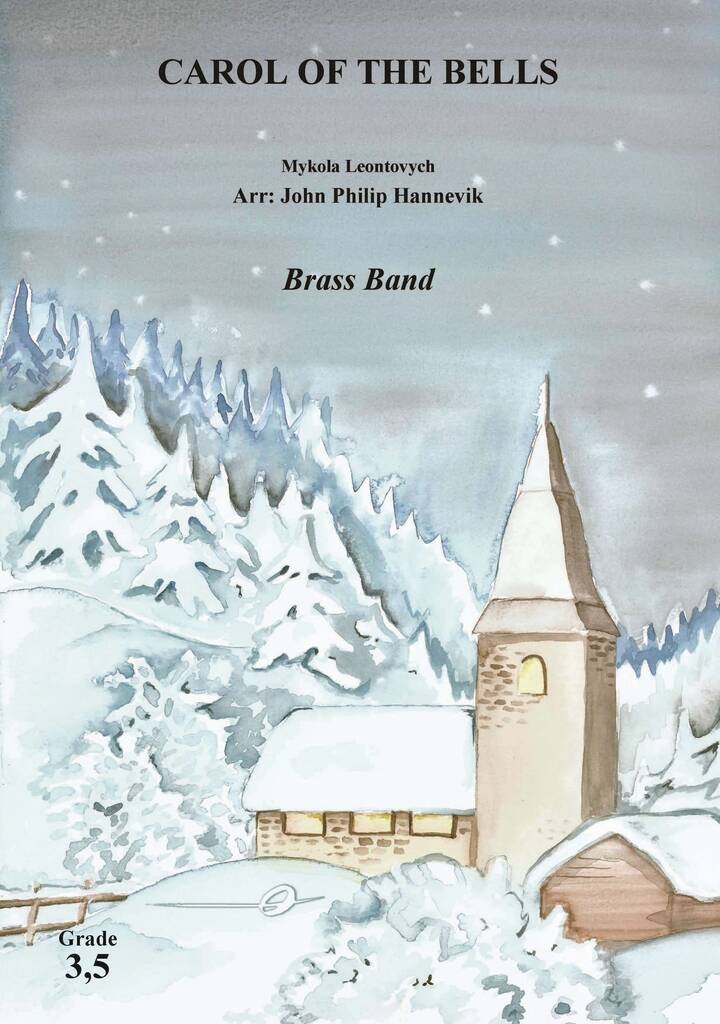 £115.60
Carol of the Bells - Mykola Leontovych - John Philip Hannevik
Ukrainian composer Mykola Leontyovich composed this famous Christmas Carol in 1914. The carol is based on a folk chant called Shchedryk.The composer was a supporter of the independence movement in Ukraina, and was assassinated by a Soviet agent in 1921.The carol was made famous after the adaption by Peter J Wilhousky in 1936. Wilhousky worked as an arranger for the NBC symphony orchestra.It is also well known from popular culture, like the film Home Alone (1990), and a version by the vocal group Pentatonix.
Estimated dispatch 5-14 working days
 View Music