
Results
-
 £29.95
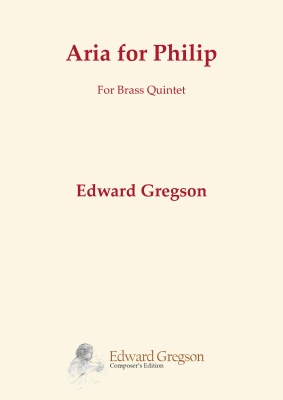
Aria for Philip (Brass Quintet - Score and Parts)
Instrumentation:2 Trumpets in CHorn in FTromboneTubaWritten in memory of Philip Jones, this short work was first performed at his memorial concert held at the Royal Northern College of Music in 2000. Scored for Brass Quintet, it was performed by former members of the Philip Jones Brass Ensemble.My friendship with Philip Jones stretched back to my student days, when my Quintet for Brass was performed during my final year at the Royal Academy of Music. Philip was present at that premiere in 1967, and soon after that his ensemble performed and broadcast the Quintet on a UK Tour, including a performance in the finals of the BBC Young Composer's Competition. I owe him a huge debt of gratitude for promoting a work by a then unknown young composer.I use a brief quote from the opening of my 1967 Brass Quintet in this work, which is generally rather sombre in character, except for the sudden change of mood and tempo in the short final section, when the clouds suddenly lift and the sun shines through.- Edward GregsonDuration: 5.00
Estimated dispatch 7-14 working days
-
 £30.00
La Perla Negra - Colin Skinner
For this brooding piece the composer has used the following storyline. "A sad elderly man sits alone in a bar whilst an accordionist plays a slowtango. A beautiful woman walks in wearing a single black pearl necklace and proceeds to dance with the old man. Gradually the music becomesmore and more spirited and the dance faster as the old man becomes youthful again. With a passionate kiss he passes out in thegirl's arms and when he awakens he is back in the bar alone save for the accordionist. As he contemplates his dream he notices a single black pearlleft behind on the bar. The sombre mood is lightened in the middle section by a deliberately trite and stylised trumpet duet, but we soon returnto the opening material for a slow fade-out"
-
 £89.95
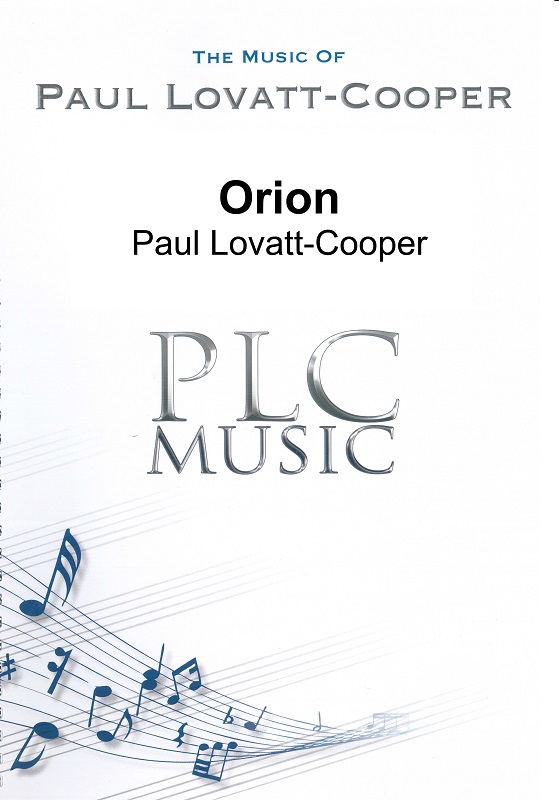
Orion (Brass Band - Score and Parts)
Orion was named after the giant huntsman in Greek mythology and is a prominent constellation located on the celestial equator and visible throughout the world. It is one of the most conspicuous and recognisable constellations in the night sky. This piece and its inspiration were composed as a tone poem creating a musical picture of this amazing phenomenon.The opening introduces the constellation. Starting mysteriously with the percussion and basses this section develops a series of rhythmic and harmonic interludes from the upper brass. As this introduction develops, the melodic line lead by the Solo Cornet and Euphonium builds as the accompanying instruments increase in their rhythmic complexity. This section climaxes with a short fanfare motif which will be a prominent theme throughout this piece.The fast rhythmic section that follows serves as a technical test for the players. The thematic device introduced by the Solo Cornets is passed around various soloists and sections within the ensemble. This part of the tone poem gives the opportunity for the ensemble to highlight their technical prowess. The fanfare motif returns to conclude this section and takes the piece into the slow middle movement.Motifs heard earlier are mixed with new ideas in this slow section which give an opportunity for a variety of soloists to demonstrate their musical prowess. After the various solo passages and cadenzas, the mood shifts dramatically to a more ominous section that builds in texture and dynamic. Concluding with our returning fanfare motif the piece then builds in momentum towards our finale section.This finale is a technical showcase which will further test the playing ability and stamina of soloists, small groups and the full ensemble. Using prominent musical themes heard throughout this piece the music builds to a glorious conclusion fitting with wonderful constellation.
Estimated dispatch 7-14 working days
-
£29.95
PAEAN (Brass Band Set) - Dudley Bright
Commissioned by the Swiss Christian Brass Band Association in celebration of their 150th anniversary, the title 'Paean' means a shout of thanksgiving and praise. It is also the composer's personal expression of gratitude to God following major surgery. Although 'Paean' includes three fairly contemporary Christian songs, it is not intended to be played in any kind of rock or jazz style. The idiom is quite firmly rooted in brass band tradition. The opening fanfare-like section begins in celebratory mood before becoming more contemplative through the song 'Father God, I wonder'. A change of tempo heralds the statement of the thematically significant song 'Hosanna' before immediately moving to 'Faithful God'. Following a fugato the music retraces its steps to a triumphant restatement of the opening music.
Estimated dispatch 7-14 working days
-
£44.95
MUSIC FOR A JOYFUL OCCASION (Revisited) (Brass Band Set) - Kenneth Downie
This music was originally written to mark the 24th anniversary of The Salvation Army's Canadian Staff Band and was performed by the band, under the direction of the composer, in January 1993. The inspiration was the theme chorus of the International Corps Cadet rally held in London in 1956; 'Jesus, I love you, I love you with tender care'. The mood of the music is often high-spirited and humorous and frequently calls for a sense of bravura although there are some tender moments too. This new edition was produced for The International Staff Band, omitting the singing and trombone quartet but containing new material in the same high-spirited style of the original.
Estimated dispatch 7-14 working days
-
 £94.95
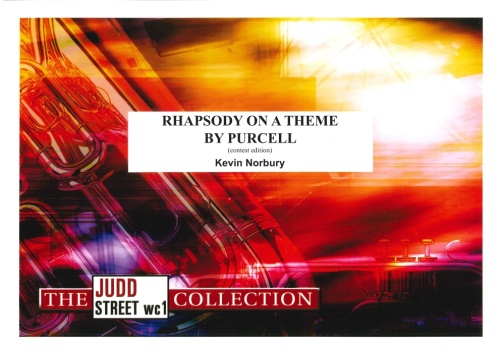
Rhapsody on a Theme by Purcell - Contest Edition (Brass Band - Score and Parts)
Contest VersionIn his relatively short lifetime, Henry Purcell (1659 -1695) achieved stellar musical success and was known and admired internationally by his contemporaries. He is justifiably considered one of England's greatest composers.I thought long and hard before using this magnificent theme as the basis for a band piece because I think that Benjamin Britten has said just about everything possible regarding it in his The Young Person's Guide to the Orchestra. Bearing this in mind, I tentatively set about working on this composition. Once started though, the job became fun because the theme still yielded possibilities - even after Britten!The piece is basically a set of linked variations, much like Rachmaninov's great Rhapsody on theme by Paginini. The music starts slowly and makes much use of crisply dotted rhythms - a Purcellian characteristic. The theme is heard twice before the music changes into a jaunty duple time variation based on the opening motif of Purcell's theme. After this, the mood changes to a waltz-like variation in which clear references to the original theme can be heard. The slow movement follows, and is based on rising and descending scalic figures. This variation is an 'A-B-A' movement with two similar passages framing a more vigorous middle section which features antiphonal fanfare-like figures. Without any preamble, the last variation launches itself - a rumbustious dance which has a distinctive feel to it.The theme eventually reappears as a counter-melody to this dance music before a final triumphant treatment of the melody featuring a somewhat athletic bass line. The music accelerates at the Coda and disappears in a 'puff of smoke'.- Kevin Norbury
Estimated dispatch 7-14 working days
-
£39.95
Rhapsody on a Theme by Purcell - Contest Edition (Brass Band - Score only)
Contest VersionIn his relatively short lifetime, Henry Purcell (1659 -1695) achieved stellar musical success and was known and admired internationally by his contemporaries. He is justifiably considered one of England's greatest composers.I thought long and hard before using this magnificent theme as the basis for a band piece because I think that Benjamin Britten has said just about everything possible regarding it in his The Young Person's Guide to the Orchestra. Bearing this in mind, I tentatively set about working on this composition. Once started though, the job became fun because the theme still yielded possibilities - even after Britten!The piece is basically a set of linked variations, much like Rachmaninov's great Rhapsody on theme by Paginini. The music starts slowly and makes much use of crisply dotted rhythms - a Purcellian characteristic. The theme is heard twice before the music changes into a jaunty duple time variation based on the opening motif of Purcell's theme. After this, the mood changes to a waltz-like variation in which clear references to the original theme can be heard. The slow movement follows, and is based on rising and descending scalic figures. This variation is an 'A-B-A' movement with two similar passages framing a more vigorous middle section which features antiphonal fanfare-like figures. Without any preamble, the last variation launches itself - a rumbustious dance which has a distinctive feel to it.The theme eventually reappears as a counter-melody to this dance music before a final triumphant treatment of the melody featuring a somewhat athletic bass line. The music accelerates at the Coda and disappears in a 'puff of smoke'.- Kevin Norbury
Estimated dispatch 7-14 working days
-
 £44.95
Judd: Music For A Joyful Occasion
This music was originally written to mark the 24th anniversary of The Salvation Army's Canadian Staff Band and was performed by the band, under the direction of the composer, in January 1993. The inspiration was the theme chorus of the International Corps Cadet rally held in London in 1956; 'Jesus, I love you, I love you with tender care'. The mood of the music is often high-spirited and humorous and frequently calls for a sense of bravura although there are some tender moments too. This new edition was produced for The International Staff Band, omitting the singing and trombone quartet but containing new material in the same high-spirited style of the original.
Estimated dispatch 7-14 working days
-
 £29.95
Judd: Paean
Commissioned by the Swiss Christian Brass Band Association in celebration of their 150th anniversary, the title 'Paean' means a shout of thanksgiving and praise. It is also the composer's personal expression of gratitude to God following major surgery. Although 'Paean' includes three fairly contemporary Christian songs, it is not intended to be played in any kind of rock or jazz style. The idiom is quite firmly rooted in brass band tradition. The opening fanfare-like section begins in celebratory mood before becoming more contemplative through the song 'Father God, I wonder'. A change of tempo heralds the statement of the thematically significant song 'Hosanna' before immediately moving to 'Faithful God'. Following a fugato the music retraces its steps to a triumphant restatement of the opening music.
Estimated dispatch 7-14 working days
-
 £112.00
March Slav (Brass Band - Score and Parts)
March Slav was composed in 1876 for a charity concert to support the war in the Balkans. It was completed in the remarkably short time of 5 days and was encored twice at its first performance! The themes are based loosely on Serbian folk songs and there is also a reference to the Russian national anthem. The mood is funereal in style at the opening but this gives way to a very triumphant style by the end.This arrangement was prepared for the 2007 Summer concerts of Brass Band of the Western Reserve, musical director Dr Keith M Wilkinson (www.bbwesternreserve.org). It has been recorded by BBWR on the CD Slides Rule!
Estimated dispatch 7-14 working days