
Results
-
 £44.95
Turris Fortissima (Brass Band - Score and Parts) - Ponsford, Steven
The geographical position of Plymouth (the composer's home city) means that, at various times in history, the city has been the United Kingdom's first line of defence. A series of forts around the coast bears testimony to this and forts have featured on the city's coat of arms ever since. However, the city's forefathers believed that physical security was worthless without a faith in God's protection and this is reflected in the city motto; Turris fortissima est nomen Jehovah (The name of Jehovah is our strongest tower) (Proverbs 18:10). Written for Enfield Citadel Band's tour of the USA in 2007, the music attempts to portray this assurance with the use of the tune Ein' Fest Burg (A mighty fortress is our God) along with the more contemporary Blessed be the Name of the Lord and Shout to the Lord. There is also an apt reference to Dean Goffin's My Strength, My Tower as the music builds to its dramatic final bars.
Estimated dispatch 7-14 working days
-
£22.50
Turris Fortissima (Brass Band - Score only) - Ponsford, Steven
The geographical position of Plymouth (the composer's home city) means that, at various times in history, the city has been the United Kingdom's first line of defence. A series of forts around the coast bears testimony to this and forts have featured on the city's coat of arms ever since. However, the city's forefathers believed that physical security was worthless without a faith in God's protection and this is reflected in the city motto; Turris fortissima est nomen Jehovah (The name of Jehovah is our strongest tower) (Proverbs 18:10). Written for Enfield Citadel Band's tour of the USA in 2007, the music attempts to portray this assurance with the use of the tune Ein' Fest Burg (A mighty fortress is our God) along with the more contemporary Blessed be the Name of the Lord and Shout to the Lord. There is also an apt reference to Dean Goffin's My Strength, My Tower as the music builds to its dramatic final bars.
Estimated dispatch 7-14 working days
-
£34.95
To Stand With Jesus In The Morning (Brass Band - Score and Parts) - Downie, Kenneth
A thoughtful treatment of Envoy Ferguson's simple yet powerful song, the first verse of which reads 'You must go home by the way of the cross, to stand with Jesus in the morning'.
Estimated dispatch 7-14 working days
-
£17.50
To Stand With Jesus In The Morning (Brass Band - Score only) - Downie, Kenneth
A thoughtful treatment of Envoy Ferguson's simple yet powerful song, the first verse of which reads 'You must go home by the way of the cross, to stand with Jesus in the morning'.
Estimated dispatch 7-14 working days
-
£34.95
Victory For Me! (Brass Band - Score and Parts) - Heaton, Wilfred
Completed in the 1970s, this is a Ravel-inspired bolero treatment of the tune 'My beautiful home' which is associated with the words 'There's victory for me'. It is fresh, inventive and wonderfully scored with a cheeky 'throw-away' ending.
Estimated dispatch 7-14 working days
-
£17.50
Victory For Me! (Brass Band - Score only) - Heaton, Wilfred
Completed in the 1970s, this is a Ravel-inspired bolero treatment of the tune 'My beautiful home' which is associated with the words 'There's victory for me'. It is fresh, inventive and wonderfully scored with a cheeky 'throw-away' ending.
Estimated dispatch 7-14 working days
-
 £59.99
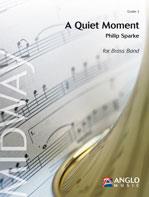
A Quiet Moment (Brass Band - Score and Parts) - Sparke, Philip
A Quiet Moment was written in memory of James Philip Krofta, a highly respected American conductor who died in the year 2006. This calm, wilful composition of Philip Sparke is equally at home on the concert platform as in the contest arena or at significant remembrance events when a quiet moment is required.Duration: 4:30
Estimated dispatch 7-14 working days
-
 £74.99
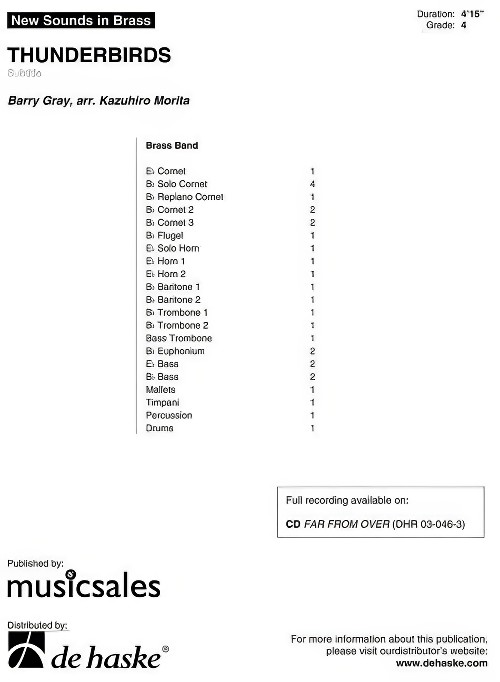
Thunderbirds (Brass Band - Score and Parts) - Gray, Barry - Morita, Kazuhiro
Who doesn't know the children's TV series Thunderbirds. The Gerry Anderson classic is still as popular today with both children and adults as when it was first shown in the sixties. This arrangement of the theme tune will be loved by all and will leave your audience humming it all the way home. Duration: 4.15
Estimated dispatch 7-14 working days
-
 £119.95
Harrison's Dream (Brass Band - Score and Parts) - Graham, Peter
At 8.00pm on the 22nd of October 1707, the Association, flagship of the Royal Navy, struck rocks off the Scilly Isles with the loss of the entire crew. Throughout the rest of the evening the remaining three ships in the fleet suffered the same fate. Only 26 of the original 1,647 crew members survived. This disaster was a direct result of an inability to calculate longitude, the most pressing scientific problem of the time. It pushed the longitude question to the forefront of the national consciousness and precipitated the Longitude Act. Parliament funded a prize of �20,000 to anyone whose method or device would solve the dilemma.For carpenter and self-taught clockmaker John Harrison, this was the beginning of a 40 year obsession. To calculate longitude it is necessary to know the time aboard ship and at the home port or place of known longitude, at precisely the same moment. Harrison's dream was to build a clock so accurate that this calculation could be made, an audacious feat of engineering.This work reflects on aspects of this epic tale, brilliantly brought to life in Dava Sobel's book Longitude. Much of the music is mechanistic in tone and is constructed along precise mathematical and metrical lines. The heart of the work however is human - the attraction of the �20,000 prize is often cited as Harrison's motivation. However, the realisation that countless lives depended on a solution was one which haunted Harrison. The emotional core of the music reflects on this, and in particular the evening of 22ndOctober 1707.- Peter GrahamJuly 2000 Recorded on Polyphonic QPRL219D Master Brass (Volume Fifteen). Duration: 14'30"
Estimated dispatch 7-14 working days
-
£44.95
Harrison's Dream (Brass Band - Score only) - Graham, Peter
At 8.00pm on the 22nd of October 1707, the Association, flagship of the Royal Navy, struck rocks off the Scilly Isles with the loss of the entire crew. Throughout the rest of the evening the remaining three ships in the fleet suffered the same fate. Only 26 of the original 1,647 crew members survived. This disaster was a direct result of an inability to calculate longitude, the most pressing scientific problem of the time. It pushed the longitude question to the forefront of the national consciousness and precipitated the Longitude Act. Parliament funded a prize of �20,000 to anyone whose method or device would solve the dilemma.For carpenter and self-taught clockmaker John Harrison, this was the beginning of a 40 year obsession. To calculate longitude it is necessary to know the time aboard ship and at the home port or place of known longitude, at precisely the same moment. Harrison's dream was to build a clock so accurate that this calculation could be made, an audacious feat of engineering.This work reflects on aspects of this epic tale, brilliantly brought to life in Dava Sobel's book Longitude. Much of the music is mechanistic in tone and is constructed along precise mathematical and metrical lines. The heart of the work however is human - the attraction of the �20,000 prize is often cited as Harrison's motivation. However, the realisation that countless lives depended on a solution was one which haunted Harrison. The emotional core of the music reflects on this, and in particular the evening of 22ndOctober 1707.- Peter GrahamJuly 2000 Recorded on Polyphonic QPRL219D Master Brass (Volume Fifteen). Duration: 14'30"
Estimated dispatch 7-14 working days
 View Music