
Results
-
 £17.50
The Southern Cross (Brass Band - Score only) - Bowen, Brian
The Southern Cross is one of several excellent marches by Brian Bowen in which he carried on the more sophisticated pattern of British marches by Wilfred Heaton, Leslie Condon and Ray Steadman-Allen. It was written for the Box Hill (Australia) Corps jubilee celebrations in 1970 and formed part of the band's repertoire when it toured Great Britain in the same year. The first half of the march features part of the song, 'March on!' by Klaus Ostby, an early pioneer of Salvation Army music in Scandinavia. The contrapuntal layering of melodies in the trio, especially in the finale where 'March on!' sounds one more triumphant time, is notable, as is the shift to a slower, more stately tempo. The harmonic and rhythmic style also represents the more modern sounds of Salvation Army brass band music in the late 1960s and early 1970s. Right from the opening gestures, listeners at early performances knew that a page had turned in the evolution of the Salvation Army march.
Estimated dispatch 7-14 working days
-
 £70.40
Suite for Brass (Brass Band - Score and Parts) - Rutter, John - Smith, Sandy
3rd Section Finals test-piece for the National Brass Band Championships of Great Britain 2008
Estimated dispatch 7-14 working days
-
£59.95
Rejoice, the Lord is King (Brass Band - Score and Parts) - Downie, Kenneth
The title of this work comes from the first line of Charles Wesley's hymn 'Rejoice, the Lord is King! Your Lord and King adore' which is set to Handel's majestic tune, Gopsal. The Handelian influence shows in more than the use of the tune itself as the opening pays homage to the Coronation Anthem 'Zadok the Priest' after which the free variations flow in quick succession. This major work was written for The International Staff Band which gave the first performance at the Epic Brass Gala Concert which followed the 2001 National Brass Band Championships.
Estimated dispatch 7-14 working days
-
£29.95
Rejoice, The Lord Is King (Brass Band - Score only) - Downie, Kenneth
The title of this work comes from the first line of Charles Wesley's hymn 'Rejoice, the Lord is King! Your Lord and King adore' which is set to Handel's majestic tune, Gopsal. The Handelian influence shows in more than the use of the tune itself as the opening pays homage to the Coronation Anthem 'Zadok the Priest' after which the free variations flow in quick succession. This major work was written for The International Staff Band which gave the first performance at the Epic Brass Gala Concert which followed the 2001 National Brass Band Championships.
Estimated dispatch 7-14 working days
-
 £44.95
Praise to the Lord (Brass Band - Score and Parts) - Mackereth, Andrew
Written for the 2003 tour of Canada and USA by Bristol Easton Band of The Salvation Army, this set of variations provides the whole band with a stern examination of technical and musical aptitude, whilst engaging the listener from beginning to end. The commission given to the composer was to create a set of variations with a similar framework to that of Edward Gregson's 'Variations on Laudate Dominum'. As in the famous Gregson work, the theme (Lobe den Herren) is not heard in its entirety until the final section when the majestic tune provides a fitting and stirring conclusion to the music.
Estimated dispatch 7-14 working days
-
£74.95
Between the Moon and Mexico (Brass Band - Score and Parts) - Sparke, Philip
Between the Moon and Mexico was composed for the 1998 Finals of the National Brass Band Championships of Great Britain. The first performance took place at the Royal Albert Hall, London, on the 17th of October.The title has no hidden meaning and was chosen preciesly because it would not predetermine the style or form of the work. The composer wanted to see what sort of piece would emerge if the only influence was what had already been written. The result is a sort of musical collage in which various musical collage in which various musical elements, ranging from two or three notes to complete melodies, assume importance by virtue of their context. In a way, the piece grew out of itself.Duration: 16.30
Estimated dispatch 7-14 working days
-
£37.95
Between the Moon and Mexico (Brass Band - Score only) - Sparke, Philip
Between the Moon and Mexico was composed for the 1998 Finals of the National Brass Band Championships of Great Britain. The first performance took place at the Royal Albert Hall, London, on the 17th of October.The title has no hidden meaning and was chosen preciesly because it would not predetermine the style or form of the work. The composer wanted to see what sort of piece would emerge if the only influence was what had already been written. The result is a sort of musical collage in which various musical collage in which various musical elements, ranging from two or three notes to complete melodies, assume importance by virtue of their context. In a way, the piece grew out of itself.Duration: 16.30
Estimated dispatch 7-14 working days
-
 £44.95
Follow the Flame (from The Torchbearer) (Flugel Horn or Cornet Solo with Brass Band - Score and Parts) - Graham, Peter
The Torchbearer was commissioned as the test piece for the 2009 National Brass Band Championships of Great Britain and the FABB Open Contest respectively and pays musical tribute to Eric Ball, considered by many to be the 20th century's most influential composer of brass band music. The thematic material is derived from the first phrase of the trio from Eric Ball's Salvation Army march, Torchbearers.Follow the Flame is a main theme from the larger work, now fully metamorphosised and mirroring in music a concept at the centre of Ball's broader philosophy, that of transformation.
Estimated dispatch 7-14 working days
-
 £65.00
Royal Fireworks, Music from the (Brass Band - Score and Parts) - Handel, George Frideric - Blakeson, Don
Handel's Music For The Royal Fireworks was composed in 1749 to celebrate the signing of the Treaty of Aix-la-Chapelle and the end of the War of the Austrian Succession. The site chosen was the fashionable upper part of St. James Park, which was becoming known at that time as Green Park. The Green Park 'Machine', which housed the pyrotechnics was an elaborate affair adorned with "statues and other figures, festoons of flowers, and other lustres". It was announced that there would be some 10,000 rockets and other devices to be let off, all culminating in a grand, burning sun with 'Vivat Rex' at its centre. There were also rumours that the event was to be accompanied by an impressively large band of military music and mention was made of "40 trumpets, 20 french horns, 16 hautboys (oboes), 16 bassoons, 8 pairs of kettle drums, 12 side drums, a proper number of flutes and fifes; with 100 cannon to go off singly at intervals". It is unlikely that Handel had ever conceived such forces and it was merely the promoter's hyberbole, not least because it was unlikely that there were sufficient numbers of extra military musicians available that could read music, as most played from memory. It is also likely that Handel, and his publisher, were conscious that future performances would be hindered by such forces. The autographed score lists the instrumentation as 9 trumpets, 9 french horns, 24 hautboys, 12 bassoons, 3 pairs of kettle drums and up to 4 side drums. The work is in five movements, although Handel's original score did not indicate in which order they should be played. However, in this score they are arranged to be played as follows: Overture; Bour?e; La Paix; Minuets; La R?jouissance. Duration: 19:00
Estimated dispatch 7-14 working days
-
 £29.95
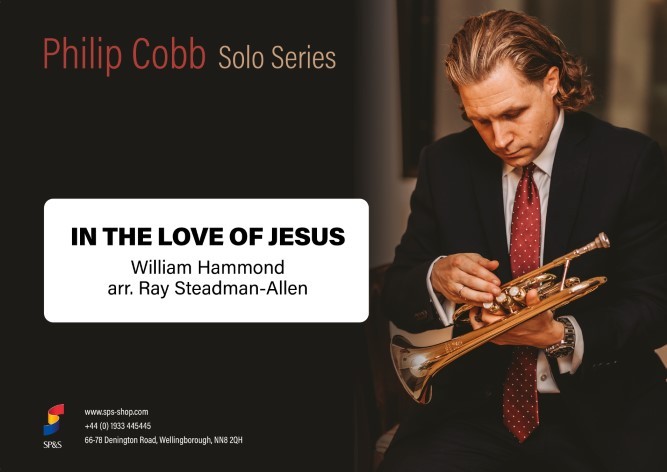
In the Love of Jesus (Cornet Solo with Brass Band - Score and Parts) - Hammond, William - Steadman-Allen, Ray
There are some pieces of music that evoke a sense of belonging, not only for the message it conveys, but the association of what it represents. In the Love of Jesus, by William Hammond and Ivy Mawby, the song brings an emotive response to words of commitment and devotion to Jesus. The melodic line starts with a somewhat hypnotic charm and expands into a beautifully shaped line of music. Duration: 3.30
Estimated dispatch 7-14 working days
 View Music