
Results
-
 £183.20
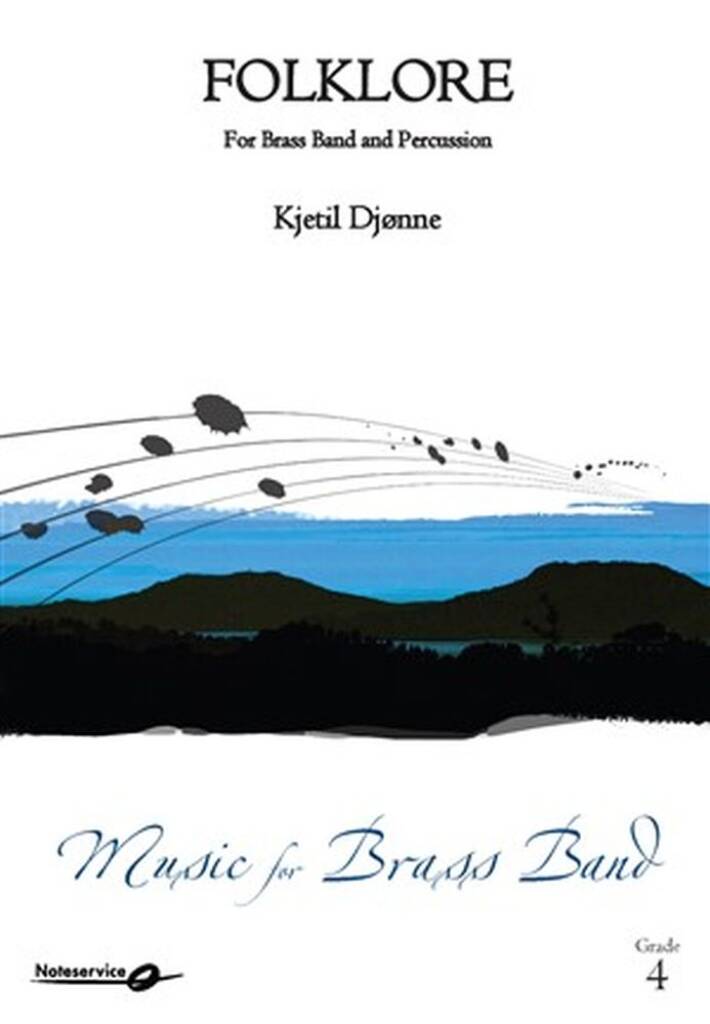
Folklore - Kjetil Djønne
"Folklore" is a work for brass band and percussion loosely based on the story of the Norwegian woman accused of witchcraft, Anne Pedersdotter. She was sentenced to be burned at the stake in Bergen in the spring of 1590 and has since been frequently highlighted as Norway's most famous and talked-about witch.The work begins with the movement "Lyderhorn," depicting the mountain outside Bergen where witches gathered to plan magical actions against the city. Here, we hear the quietness of nature and the wind blowing through the trees before a new theme appears, which will come to life in the next movement. In the distance, the witches have started their ceremony.In the next movement, "Walpurgis Night," the witches perform their rituals to afflict the city with fire, disease, and natural disasters. The ceremony becomes more and more chaotic, violent, and compelling until the darkness of the night envelops us, concluding the section.The third movement describes the women's inner struggle against the harassment they faced when the people of Bergen suspected them of being witches. Rumors often turned into formal accusations from the legal system, and many were sentenced to death after undergoing trial. "From life to death through the fire."The fourth and final movement, "The Pyre," depicts the actual death sentence. You can hear the pyre being ignited and the flames growing and intensifying. It all culminates in a chorale as a memorial to the lives that were taken.
Estimated dispatch 5-14 working days
-
 £127.30
Dans varsomt - Ray Farr
Composed October 2014 by Ray Farr, based on a religious folk-song, or psalm, from Valdres in Norway. The words to the hymn, which was written by Olof Kolmodin in 1742, warn us to 'tread warily, my soul'. Ray has adapted the music into a lively Norwegian-style dance with an equally strong warning for people not to tread on anyone's toes. The piece was first performed at the Brass in Concet competition "Siddis Brass" by Jaren Hornmusikkforening in November 2014.
Estimated dispatch 5-14 working days
-
 £116.40
Decennium - Eric Swiggers
'Decennium' was composed in 2003 as a commission by the municipality of Berheze for its tenth anniversary. The composition describes the history of this town in the Province of Brabant, consisting of 6 different villages: Heesch, Heeswijk, Dinther, Nistelrode, Loosbroek and Vorstenbosch. The composition starts with a slow introduction, Adagio Misterioso, suggesting the atmosphere in long-ago days when the area consisted mainly of swamps, meres and low woods. (The word 'Bern' is a synonym of 'Born' meaning source or water, whereas 'Hese' is derived from 'Haisjo' meaning brushwood ). Above the dark sounds we hear far away trumpet signals announcing the Middle Ages. After a piercing crescendo, we hear the full sound of festive trumpets. A medieval dance, as was to be heard in the Heeswijk castle, follows. This dance gets a more and more stirring character and finally turns into a merry popular dance ending with a burst of laughter reproduced by descending scales with the muted trombones and trumpets. A slow transition with a quotation from a Gregorian plainsong (Domine Deus) and church bell ringing, referring to the Abbey of Berne, brings us to a romantic Larghetto. This part describes the quiet rural life in a beautiful natural surrounding. The last dying note contrasts with the threatening ostinato, referring to the rise of the industrialization, which provoked quite some resistance with the local people. Once more we hear the 'Domine Deus' but much more powerful this time. When the resistance calms down, the work concludes with an Alla Marcia. The first notes of the main theme could be heard all through the composition and now we hear the complete main theme again. The new town is born. A festive conclusion refers both to the tenth anniversary and the optimism and confidence as to the future.
Estimated dispatch 5-14 working days
-
 £59.99
Marcho Brioso - Philip Sparke
Marcho Brioso was commissioned by The Brioso Brass, a British-style brass band from Hokkaido, Japan. They gave the first performance in January 2012.The commission was for a bright and breezy march that the band could use as their theme tune, so Marcho Brioso falls into the composer's series of Broadway-style marches, which includes Slipstream, The Bandwagon and Jubiloso.After a short introduction a solo cornet plays the main theme, accompanied by a euphonium counter-melody. A secondary phrase from the horns and baritones leads to a tuttiversion of the main theme which is followed by the traditional 'bass' strain. A change of key heralds the trio section, which features a cantabile melody on euphonium; this is then taken up by the full band after a short bridge passage and further change of key.This takes us back to the home key which sees a quiet staccato version of the main theme lead to a recapitulation and a short coda which brings the march to a close.
Estimated dispatch 5-14 working days
-
 £110.00
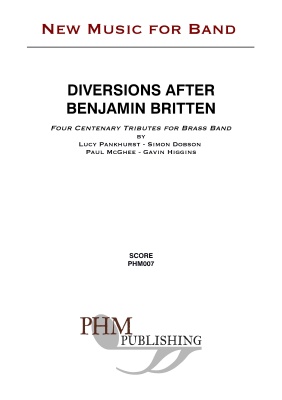
Diversions After Benjamin Britten (Brass Band - Score and Parts)
Suite by Lucy Pankhurst, Simon Dobson, Paul McGhee and Gavin HigginsHaving devised a collective centenary tribute for Michael Tippett at the 2006 RNCM Festival of Brass (Variations on a Theme of Michael Tippett by five eminent composers of brass band music, PHM002), I commissioned this companion piece as a Benjamin Britten tribute for the 2013 festival. In the late 1970s, while researching a book about the English composer, and Britten's first teacher, Frank Bridge (1879 - 1941), I came across a copy of the printed score of Benjamin Britten's Variations on a Theme of Frank Bridge (Op.10) for string orchestra, in which Britten had written descriptive titles for each of the variations suggesting appropriate character traits of his much loved mentor and guide. The character variations are cast in march, song and dance forms.Taking inspiration from Britten's youthful tribute, I invited four award-winning composers, who have all made significant contributions to the brass band medium, to create their own personal reflections on four aspects of Britten's character and music, designed to form a suite of Diversions after Benjamin Britten, but which can also be played separately.Lucy Pankhurst's hauntingly lyrical Prelude: His Depth refers to the emotional and symbolic subtexts that underpin Britten's operas, taking its musical cue from Britten's many arrangements of folk songs. The flugel horn takes a prominent role throughout.Simon Dobson's breathless Scherzo: His Vitality reminds us with its rapid passage work and leaping bass 'groove' that Britten loved tennis and fast cars in his younger days.Paul McGhee's evocative interpretation of the March: His Sympathy represents Benjamin Britten's pacifism, as the composer writes: 'We view the music through the eyes of a pacifist. Whilst war and violence surround us, we do not engage in it and though it continues to happen around us. With the use of muted effects in most of the band throughout the piece, the flugel horn is the lone voice of reason, standing firm against the mechanical and destructive society in which it is forced to live. As the machine of war continues around the lone voice, the voice is gradually dismissed and mocked as the war machine rumbles on into the distance.'In an extended finale, entitled Toccata: His Skill, Gavin Higgins celebrates Benjamin Britten's consummate creativity. For the RNCM Festival of Brass premiere, the four contrasting movements were framed and connected by Britten's Fanfare for St. Edmundsbury for three trumpets, with the trumpet soloists spaced round the hall. I am grateful to the Britten Estate and publishers Boosey & Hawkes for giving permission for the elements of Britten's fanfare to be incorporated in the collective work.- Paul HindmarshDuration: 19.30
Estimated dispatch 7-14 working days
-
£45.00
Diversions After Benjamin Britten (Brass Band - Score only)
Suite by Lucy Pankhurst, Simon Dobson, Paul McGhee and Gavin HigginsHaving devised a collective centenary tribute for Michael Tippett at the 2006 RNCM Festival of Brass (Variations on a Theme of Michael Tippett by five eminent composers of brass band music, PHM002), I commissioned this companion piece as a Benjamin Britten tribute for the 2013 festival. In the late 1970s, while researching a book about the English composer, and Britten's first teacher, Frank Bridge (1879 - 1941), I came across a copy of the printed score of Benjamin Britten's Variations on a Theme of Frank Bridge (Op.10) for string orchestra, in which Britten had written descriptive titles for each of the variations suggesting appropriate character traits of his much loved mentor and guide. The character variations are cast in march, song and dance forms.Taking inspiration from Britten's youthful tribute, I invited four award-winning composers, who have all made significant contributions to the brass band medium, to create their own personal reflections on four aspects of Britten's character and music, designed to form a suite of Diversions after Benjamin Britten, but which can also be played separately.Lucy Pankhurst's hauntingly lyrical Prelude: His Depth refers to the emotional and symbolic subtexts that underpin Britten's operas, taking its musical cue from Britten's many arrangements of folk songs. The flugel horn takes a prominent role throughout.Simon Dobson's breathless Scherzo: His Vitality reminds us with its rapid passage work and leaping bass 'groove' that Britten loved tennis and fast cars in his younger days.Paul McGhee's evocative interpretation of the March: His Sympathy represents Benjamin Britten's pacifism, as the composer writes: 'We view the music through the eyes of a pacifist. Whilst war and violence surround us, we do not engage in it and though it continues to happen around us. With the use of muted effects in most of the band throughout the piece, the flugel horn is the lone voice of reason, standing firm against the mechanical and destructive society in which it is forced to live. As the machine of war continues around the lone voice, the voice is gradually dismissed and mocked as the war machine rumbles on into the distance.'In an extended finale, entitled Toccata: His Skill, Gavin Higgins celebrates Benjamin Britten's consummate creativity. For the RNCM Festival of Brass premiere, the four contrasting movements were framed and connected by Britten's Fanfare for St. Edmundsbury for three trumpets, with the trumpet soloists spaced round the hall. I am grateful to the Britten Estate and publishers Boosey & Hawkes for giving permission for the elements of Britten's fanfare to be incorporated in the collective work.- Paul HindmarshDuration: 19.30
Estimated dispatch 7-14 working days
-
 £25.95
Heed the Word - Lucy Pankhurst
Lucy Pankhurst created this impressive work in support of a charitable project, known in 2005 as Brass Band Aid. The organisation called for original compositions to be included in a follow-up CD release - Into Africa to help raise funds for projects in Adet, Africa, and to build awareness of the Make Poverty History campaign.Lucy's creativity and imagination are very prevalent in this work - a complete mix of powerful energy and poignant emotions flow from the score. A strong use of pulsating drums are balanced with sheer tranquility and rich chords. It exudes hope and positivity and perhaps, through its title, offers a gentle warning to listen carefully to the concerns that are aired around us - not least in recognition of the challenges facing the very communities the CD was aiming to help.The work was recorded by the Prairie Brass Band, US and featured on the Brass Band Aid CD - Into Africa.
In Stock: Estimated dispatch 3-5 working days
-
 £109.99
The Four Noble Truths (Brass Band - Score and Parts)
The Four Noble Truths are the most basic expression of the teaching of Buddha and therefore still form the guidelines for Buddhists to this day. The four truths are Dukkha, which describes times of major stress in our lives - birth, ageing, desire and death; Samudaya which describes those parts of our life that induce stress, feeling, craving, desire; Nirodha which tells us how to eliminate those aspects of our lives which induce stress and Magga which describes the eight disciplines which can help us eliminate the origins of stress from our lives. It can be seen from these over-simplified definitions, that the Four Noble Truths fall into two pairs, the first two describing the origins of stress and the second two describing how we can reduce stress. To reflect this, the four movements of this work are also combined into two pairs - two quick movements and two slow movements. A fascinating work from this great English composer.Duration: 14:00
Estimated dispatch 7-14 working days
-
 £55.00
Purcell Variations (Brass Band - Score and Parts)
Purcell Variations, composed in 1995, the year of the tercentenary of the death of the great English composer, was a watershed work in that it was Downie's first extended composition to be published independently of The Salvation Army and intended for wider use.For his theme, Downie has chosen what has come down to us as the hymn tune Westminster Abbey, which is in fact an adaptation made in 1842 by Ernest Hawkins, who was a Canon of Westminster Abbey where Purcell himself had been organist. Purcell's original is actually the closing section of an anthem, O God, Thou art my God, where it provides the final paean of praise, sung to repeated 'Hallelujahs'. Purcell's tune, particularly the opening triadic gesture, is used as a source of thematic and harmonic material - a quarry for ideas if you like: "I was obsessed with the intervals of thirds in Purcell's tune, rather like Brahms in his Third Symphony", the composer says.There are five variations, preceded by an extended introduction and theme. In the first variation, Purcell's lilting dance pulse has been transformed into a bright, playful sequence, in which each phrase of the melody is given its own transformation. In the second, Purcell's opening gambit is extended into a graceful, flowing waltz, featuring solo and first horn at the top of the register. The composer offers a range of metronome speeds in this movement, in which he is emulating the wistful elegance of Erik Satie's famous Gymnopedie. We enter the world of big band jazz in variation three, where Purcell's tune strides along with added syncopation and bluesy major/minor thirds to the fore. After the breathless energy and blazing brass of the big band, Downie moves into his 'home territory' for a beautifully worked lyrical variation. There is an enhanced urgency about the final variation, which opens with an extended reprise of the work's introduction. Purcell's second and third phrases provide the preparation for the exuberant return, in customary triumph of Purcell's 'Hallelujah'.
Estimated dispatch 7-14 working days
-
 £34.95
Fire & the Phoenix, The - Christopher Bond
The Fire & the Phoenix (2015) was commissioned by Brett Baker in early 2015 as the opening track to his solo CD 'Myths & Legends'. Whilst structurally a single-movement work, it is presented so that it can link directly into the next work on the CD, adding to a continuous theme comprising a number of pieces from a number of composers. Opening with huge strident chords in the full band, the representation of the phoenix is instantly reflected; bold, powerful and a bird of great intensity. This makes way for a more mystical section marked 'distant' which reflect the beauty of the Phoenix and it's mythical nature where the trombone soars up into its higher register with a sweeping melody. Soon after, the music takes a sharp turn, becoming dramatic and instantly moving away from the mystical mood created previously. Here, we imagine the Phoenix catching fire, burning intensely with huge flames as it gradually turns into ash. We reach a tonic pedal point in the music, over which chord progressions subtly weave in and out of the texture. Here, we imagine the Phoenix rising from the ashes, with the dynamics gradually increasing to reflect this, slowly taking shape as it is born again. A return to earlier material follows, this time manipulated to reflect the Phoenix in its new form - the same bird; the same animal; but at the same time different. A beautiful chorale-like passage is heard before the music transports us back into a magical land, where delicate rhythmic ideas are juxtaposed against bolder lower chords; both ideas together transporting the listener forward into the next piece.
Estimated dispatch 10-14 working days
 View Music