Results
-
 £115.60
Prinsessen pa (fj)erten - Haakon Esplo
In this little suite in three movements, your young musicians really can be creative and have fun.Of course, a story must be written about the unfortunate princess who ate pea soup and got to let a small fart. Maybe one or more should dress up and play the princess and other roles? And who will be the lucky one who gets the honourable assignment to be a soloist on a fart cushion - probably for the first time in the history of your band? Maybe all the musicians should have one each?Think what a great finale at the last movement that could be.Good luck!
Estimated dispatch 5-14 working days
-
£54.99
Barcelona '92 - Horst Schelcke
The Olympic Games from the summer of 1992, officially known as theGames of the XXV Olympiad of the modern era, were held in the sunnySpanish city of Barcelona. This was the first time the Olympic Gameshad been held in Spain, and to celebrate this Horst Schelke composedthis rousing concert march with a typically Spanish feel. Relive theexcitement of this great event with this superb march.
Estimated dispatch 5-14 working days
-
 £104.99
A Fanfare of Bells - Hermann Pallhuber
A Fanfare of Bells is festival music composed for a particular occasion: in 2012 the young 3BA Brass Band from Germany took part in the champion section of the Flemish Open Brass Band Championship in Mechelen, Belgium, for the first time: a festival of premieres. A Fanfare of Bells, accordingly, is music that creates festival atmosphere. Big melodies designed to touch the heart are cut through with brilliant fanfares. The piece contains lyrical and melodic passages that bring the skills and general musicianship of the 3BA Brass Band to the fore, along with various technical passages that spotlight the excellence of the individual musicians. Peels of bells at thestart and end of the work ring in a new atmosphere for brass band music in Germany and Austria. A Fanfare of Bells is, however, also a tribute to the wonderful sound of brass instruments, that blend together to create the most subtle sonorities: bells as a symbol of the beauty of the instruments--both sonically and visually: let the bells ring...
Estimated dispatch 5-14 working days
-
 £139.00
I Believe - Eric Levisalles - Reid Gilje
I Believe is a beautiful ballad composed by Eric Levisalles.This arrangement is written for Flugelhorn and Euphonium as soloists with Brass band.You might very well listen to the recording by Andrea Bocelli and Cecilia Bartoli to get an impression of mood and character.This arrangement was done at the end of the corona pandemic and performed for the first time on February 12th 2022, the same day as Norway re-opened after nearly two years of corona-restrictions.
Estimated dispatch 5-14 working days
-
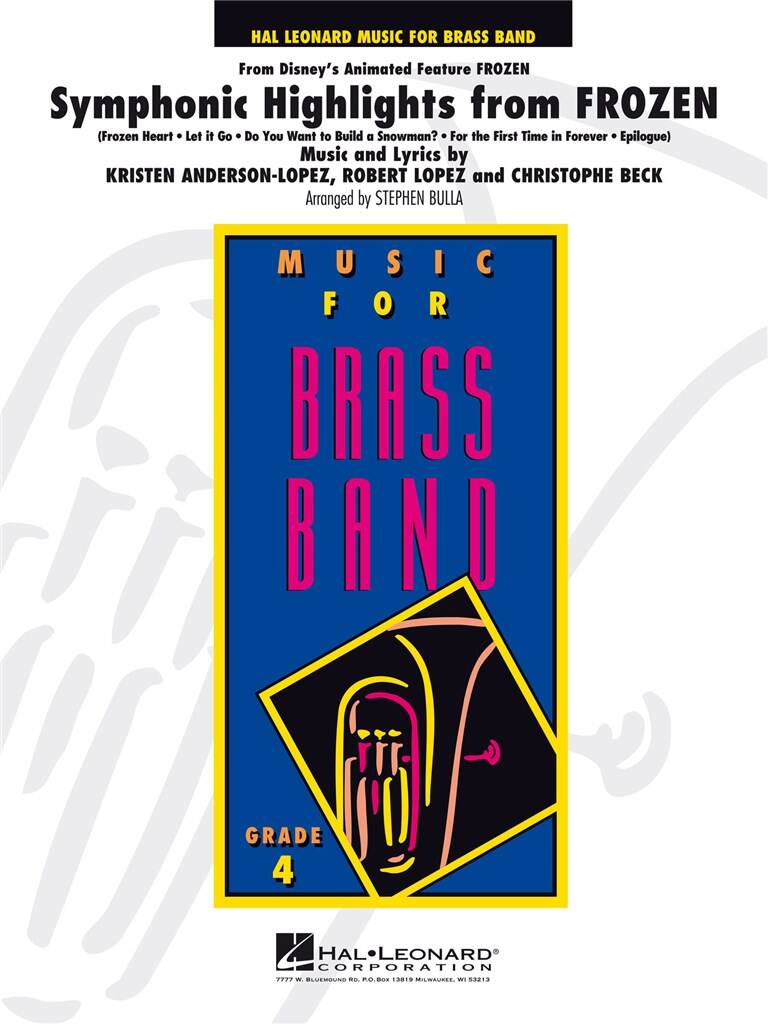 £84.99
Symphonic Highlights from Frozen - Stephen Bulla
Using excerpts from the soundtrack in addition to the familiar hit songs, Stephen Bulla has created a dramatic and exciting medley showcasing the best musical moments from this hit movie. Includes: Frozen Heart, Do You Want to Build a Snowman?, For the First Time in Forever, Epilogue, and of course Let It Go.
Estimated dispatch 5-14 working days
-
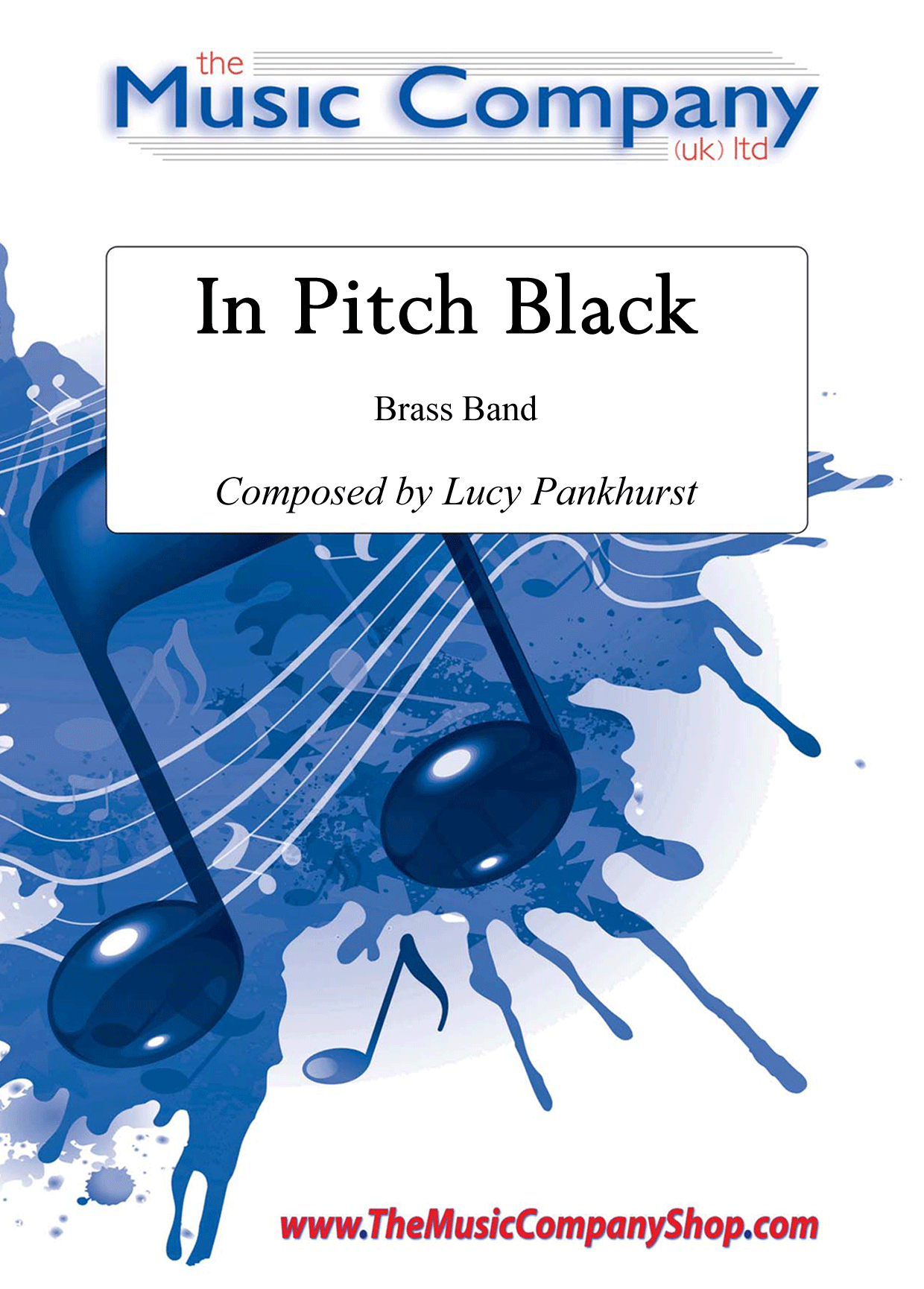 £35.00
In Pitch Black - Lucy Pankhurst
An extremely emotional and poignant work for brass band composed by Lucy Pankhurst, in memory and tribute to those affected by the Pretoria Pit disaster in Lancashire on 21st December 1910. The piece is chilling in its depiction of the tragic story, sensitively conveying the atmosphere and emotions as perceived before, during and after the event. Through its use of playing techniques, effects, sound combinations and even silences, In Pitch Black offers a powerfully reflective piece.Pritoria Pit DisasterLancashire's worst pit disaster and Britain's third largest loss of life from a single mining accident happened at the No. 3 Bank Pit belonging to the Hulton Colliery Company, just 4 days before Christmas 1910. The pit known as the 'Pretoria Pit' was situated on Hulton Parkland on the border of Atherton and Westhoughton. An explosion occurred at 7.50 am on Wednesday, 21 December 1910, resulting in the death of 344 men and boys, including many members of The Wingates Band.The Writing ExperienceDuring Lucy's research for this work, she acknowledges that she found the harsh reality from the shocking images and historical accounts of the event most disturbing, and is not embarrassed to disclose that it was wholly a very emotional experience in creating the composition. Consequently, she chose to create something to illustrate the true emotion of the situation. She wanted to pay tribute to the lives lost and the devastation which remained in their absence, by creating a piece of music which begins in darkness; desolate and claustrophobic, whilst still leaving the audience feeling uplifted and thoughtful in the final bars.The significance and musical appreciation for the creation of In Pitch Black was formally recognised by BASCA in 2011, when Lucy Pankhurst won the internationally acclaimed British Composer Award (the first time a brass band work had received the award, and the first time a female composer had won the category).Full programme notes are included in the product images.Look and Listen (performance courtesy of Manchester University Brass Band):
In Stock: Estimated dispatch 3-5 working days
-
£95.00
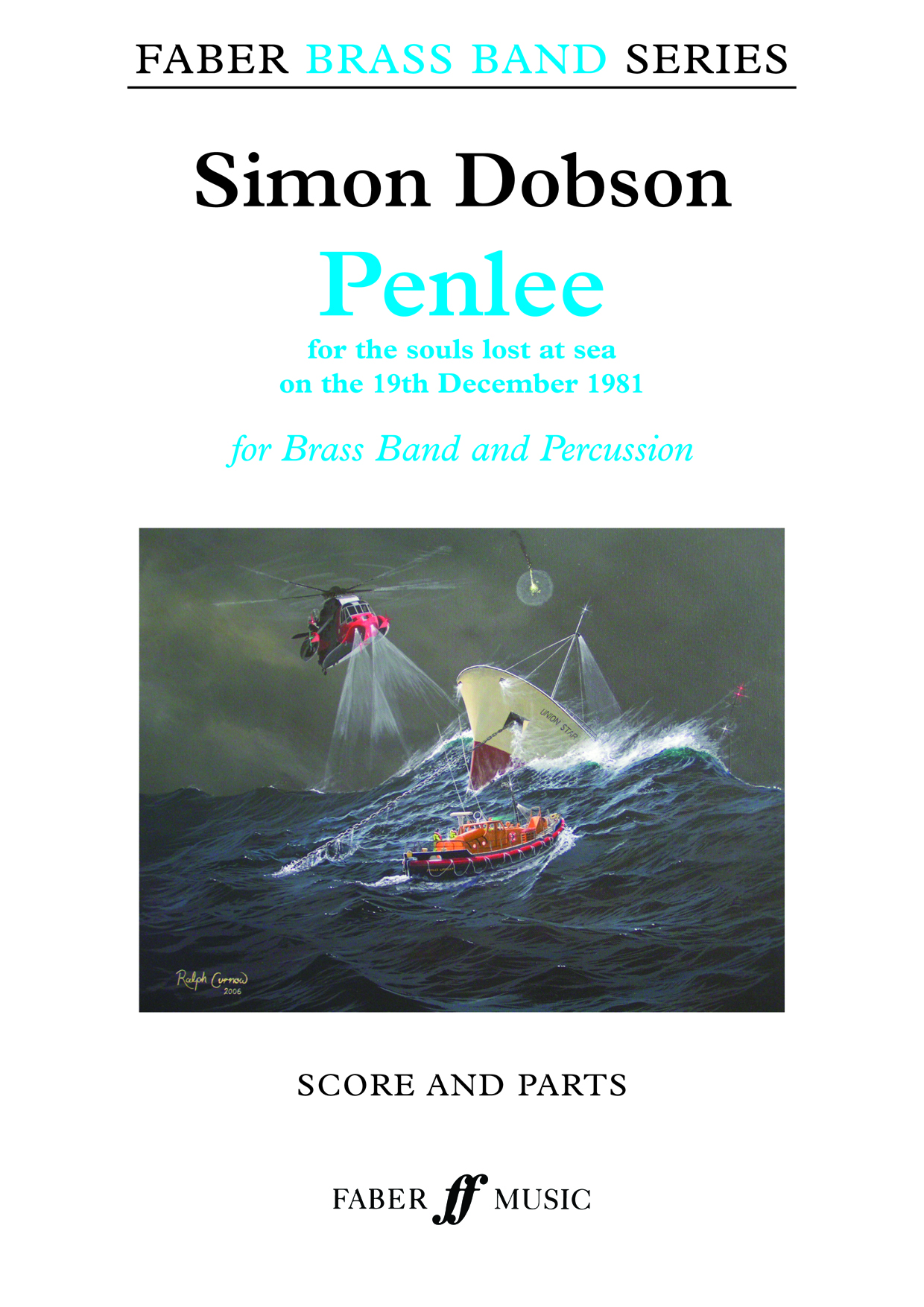
Penlee (Score & Parts) - Simon Dobson
To some, the tragic story of the Penlee lifeboat, Solomon Browne, would need no introduction, and to some the pain felt is still very much a reality. The composer, born just a few weeks before that fateful night on the 19th December 1981, has created this work as a musical homage to the bravery of the souls who lost their lives and has dedicated it to their memory.Penlee was commissioned by the Cornwall Youth Brass Band using funds bequeathed by Michael Pickett. The first performance was given by the Cornish Youth Brass Band, conducted by Ian Porthouse, at St. Michael's Church, Newquay, on 30th December 2008.Penlee has been voted into the Classic FM Hall of Fame 2011 at No.106. Not only is it the first time a brass work has been featured in the Hall of Fame, but it was also the highest new entry.The work has subsequently been recorded by the Leyland Band, conducted by Jason Katsikaris, on the CD entitled Penlee.Brass Band Grade 4: Advanced Youth and 3rd SectionDuration: 13 minutes
In Stock: Estimated dispatch 1-3 working days
-
 £30.00
A Short Ride in a Brass Machine
DescriptionA Short Ride in a Brass Machine was written in 2006 to mark the 140th anniversary of the Brighouse and Rastrick Band and first performed in the Central Methodist Church in Brighouse by Brighouse and Rastrick conducted by James Gourlay. The title refers to the orchestral composition A Short Ride in A Fast Machine by the American composer John Adams which provided some of the inspiration for the work. The music is a simple celebratory prelude consisting of two main ideas, an expansive melody full of open fifths (giving the music a slightly "American" feel) and a short fanfare figure. After these are both heard for the first time a brief development of the fanfare material leads to a broader, warm harmonisation of the opening melody and the pulse relaxes a little before tension builds to a reiteration of the fanfare and a final triumphant version of the opening theme.Performance Notes:Percussion instruments required are 4 Timpani, Snare Drum, Bass Drum, 3 Tom-toms, 3 Wood Blocks, Suspended Cymbal, Clash Cymbals, Tubular Bells, Glockenspiel, Tam-tam.Soprano, repiano, 2nd solo cornet, 2nd and 3rd cornets will require metal straight mutes; 2nd and 3rd cornets will require harmon mutes with the tubes removed (indicated by 'TR').Duration approximately 3'30"Follow the score in the preview video below!
Estimated dispatch 7-14 working days
-
 £44.95
Powerhouse (Brass Band - Score and Parts)
Spirit divine, come as of old. So begins the song by Brindley Boon (S.A.S.B. 311), and that phrase becomes the message of this piece, and an important motif in the music. It appears at the very beginning of the work and recurs at important points during the piece. The theme of the need for spiritual power is further underlined by the use of the hymns Show your power (S.A.S.B. 365), Wonder-working power (S.A.S.B. 451) and the very old chorus Send a new touch of power on my soul, Lord (S.A.S.B. 785).The composer first heard Boon's song Spirit Divine when it was sung by Parkhead Songsters in the Sunday morning meeting at his home Corps of Greenock Citadel. They were visiting for the weekend from Glasgow, and were conducted by Songster Leader Walter Chalmers, himself a beautiful lyric tenor soloist. They sang it in a moving fashion, unaccompanied, and such was the impact that, at the conclusion, many people went to the mercy seat. It made a huge impression on the young composer. It was the first time that Downie discovered the enormous power of music in worship. It also serves as a reminder to us all that young people of a tender age are very capable of grasping deeply significant events happening around them. This music was written for the 2020 UK Territorial Youth Band course.
Estimated dispatch 7-14 working days
-
 £89.99
Penlee (Brass Band - Score and Parts)
2013 Finals of the National Brass Band Championships of Great Britain - 3rd SectioTo some, the tragic story of the Penlee lifeboat, Solomon Browne, would need no introduction, and to some the pain felt is still very much a reality. The composer, born just a few weeks before that fateful night on the 19th December 1981, has created this work as a musical homage to the bravery of the souls who lost their lives and has dedicated it to their memory.Penlee was commissioned by the Cornwall Youth Brass Band using funds bequeathed by Michael Pickett. The first performance was given by the Cornish Youth Brass Band, conducted by Ian Porthouse, at St. Michael's Church, Newquay, on 30th December 2008.Penlee has been voted into the Classic FM Hall of Fame 2011 at No.106. Not only is it the first time a brass work has been featured in the Hall of Fame, but it was also the highest new entry.The work has subsequently been recorded by the Leyland Band, conducted by Jason Katsikaris, on the CD entitled Penlee.Suitable for Advanced Youth/3rd Section Bands and aboveDuration: 13:30
Estimated dispatch 7-14 working days
 View Music