Results
-
 £69.99
Fanfares and Love Songs (Brass Band - Score and Parts)
Fanfares and Love Songs was commissioned by the National Children's Brass Band of Great Britain for performance on 25th July 2009. Its three movements contrast the extrovert and lyrical qualities of the traditional brass band. The fanfare with which the work opens involves the whole cornet section. The second movement is reflective in mood, beginning somewhat pensively on muted brass, and building to an emotional climax before subsiding back to a distant pianissimo chord. The finale is a fast dance, which with a final recapitulation of the opening fanfare drives on to a breathless close.Suitable for Advanced Youth/3rd Section Bands and aboveDuration: 12.00
Estimated dispatch 7-14 working days
-
 £81.99
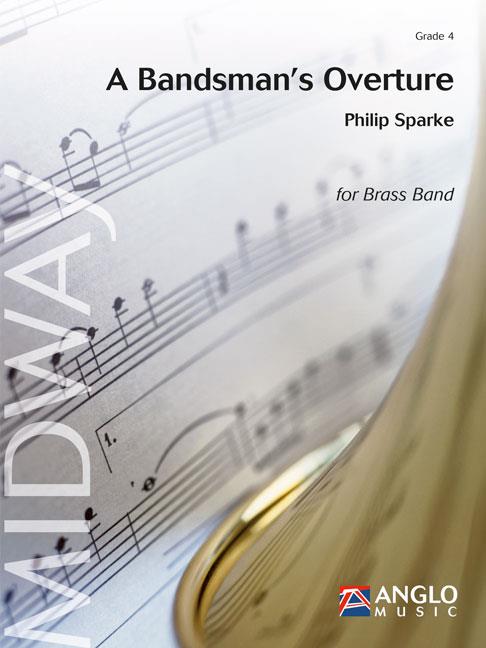
A Bandsman's Overture (Brass Band - Score and Parts)
A Bandsman's Overture was commissioned by British Bandsman magazine to celebrate its 125th anniversary in 2012. It was premiered by Black Dyke Band, conducted by Dr Nicholas Childs, at a special anniversary concert held in Symphony Hall, Birmingham, on July 1st.British Bandsman was for a period known as British Bandsman and Contest Field, following an amalgamation of two magazines. The then owner, John Henry Iles, celebrated this new title by commissioning Ord Hume to write the famous march, BB & CF. As a salute to this heritage A Bandsman's Overture starts with the four notes, B(b)-B(b)-C-F, a motive which permeates an opening fanfare, which contrasts a busy opening with a more legato central section. This gives way to a bustling Vivo, based on repeated staccato notes. A change of key heralds a central cantabile melody, first on euphoniums and baritone and then played by the full band, which is followed by a short development section. This leads to a transformed reprise and a return of the opening fanfare, decorated this time by florid muted cornets.Duration: 6:00
Estimated dispatch 7-14 working days
-
 £49.99
Signature (Brass Band - Score and Parts)
This opener was written for the 10th anniversary of Brass Band Midden Brabant (BBMB), the composer's own band. A soft and lyrical middle section follows on the powerful opening fanfare which, if the technical equipment is available, can be used as background music for a spoken text or presentation. The finale is distinctly rhythmical in character, and develops into a somewhat unusual ending. Here, the composer piles ten different notes on top of each other, representing the BBMB anniversary in a musical way. At a later date the composer made two new versions of Signature, namely for wind band and fanfare.Duration: 3:30
Estimated dispatch 7-14 working days
-
 £60.50
A Gallimaufry Suite (Score and Parts)
I - Fanfare & ThemeII - SongIII - HymnIV - Toccata & FinaleA Gallimaufry Suite consists of four movements, all thematically independent. The first movement consists of a sparkling Fanfare followed by a stately Theme which ends quietly. The second movement is a Children's Song; quirky but cute, and the Hymn which follows is a study in calm and tranquillity, featuring a quartet-group of cornet, baritone, trombone and euphonium. The last movement is a virtuosic Toccata which eventually begins to recall the other themes of the suite before a grand reprise of the first movement Theme brings the work to a dazzling conclusion.
Estimated dispatch 7-14 working days
-
 £89.95
Partita (Score and Parts)
Partita was written in 1989 to a commission from Eikanger/Bjrsvik Musikklag (Norway) who were European Champions at the time.There are three movements.1 The first movement is almost a miniature concerto for band. It opens with a relentless quaver passage in the basses, which builds until the whole band is involved. Horns and baritones are first to take centre-stage in close harmony and the euphoniums and basses follow them. These forces combine to introduce the cornets that have a 10-part fanfare to themselves before the trombones interrupt. The opening quaver figure returns, somewhat ominously, and, after the full band recalls previous material, brings the movement to a close.2. Starts with a cornet solo over a pulsating accompaniment after which the band builds to a noble tune on the trombones. The full band takes over and brings back the opening cornet tune with which the soloist, with the aid of a euphonium counter-melody, quietly ends the movement, leading directly into:3. A sparkling vivo, which opens with the fanfare-like figures throughout the band until a solo cornet, emerges with an acrobatic tune. The whole band takes this up until horns; baritones and trombones introduce an energetic second subject, which leads to a full band climax in the form of a jubilant chorale. This died away to reintroduce the opening fanfare against a new theme from the trombones, which eventually leads back to a recapitulation. We are then thrown headlong into a 12/8 presto, which hurtles to a coda, which recalls the opening themes.
Estimated dispatch 7-14 working days
-
 £44.95
Prelude and Fanfare - Dan Price
Prelude and Fanfare takes its inspiration from a piece of NASA Video footage, where a camera is attached to a piece of debris and jettisoned into space from the space shuttle. The work is a musical reflection of this journey,...
Estimated dispatch 5-7 working days
-
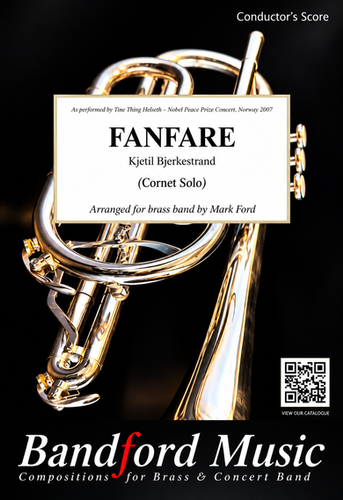 £29.88
Fanfare (Cornet Solo with Brass Band) Kjetil Bjerkestrand arr. Mark Ford
Capture the prestige and grandeur of one of the world's most celebrated stages. Originally composed by Kjetil Bjerkestrand, this stirring fanfare opened the 2007 Nobel Peace Prize Concert at the Oslo Spektrum. The piece was famously premiered by the acclaimed Norwegian trumpeter Tine Thing Helseth, marking a historic moment broadcast to millions. This arrangement brings that same professional brilliance to the brass band concert stage, featuring a soaring solo cornet part that embodies the spirit of peace and international honor. To view a rolling score video of the work please visit www.youtube.com/watch?v=aMfjKLu8BjA Duration: 1.30 minutes Difficulty Level: 4th Section + This PDF download includes the full score and parts. Sheet music available at www.brassband.co.uk (UK) or https://satradecentral.org (USA) Instrumentation: Cornet Soloist Bb Soprano Cornet Eb Solo Cornet Bb Repiano Cornet Bb 2nd Cornet Bb 3rd Cornet Bb Flugel Horn Bb Solo Horn Eb 1st Horn Eb 2nd Horn Eb 1st Baritone Bb 2nd Baritone Bb 1st Trombone Bb 2nd Trombone Bb Bass Trombone Euphonium Bb Bass Eb Bass Bb Timpani Sus. Cymbal Marimba
In Stock: Estimated dispatch 1-3 working days
-
£50.00
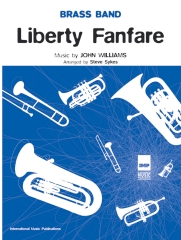
Liberty Fanfare (Score & Parts) - John Williams
Liberty Fanfare is one of John Williams' lesser-known works, simply because it is not a film theme! In fact, the orchestral original was written for the re-opening of the Statue of Liberty following extensive repairs. This took place 4th July 1986, hence the music's sense of celebration and national pride. Brass Band Grade 4: Advanced Youth and 3rd Section Duration: 5 minutes
In Stock: Estimated dispatch 1-3 working days
-
£40.00
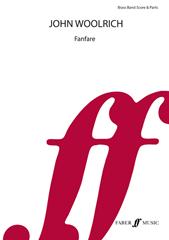
Fanfare - John Woolrich
This lively Fanfare was composed in 1994 for the brass band of the Guildhall School of Music and Drama Junior Department, which gave the first performance on 4 July 1994.Brass Band Grade 3: Youth and 4th SectionDuration: 4 minutes
In Stock: Estimated dispatch 1-3 working days
-
£34.95
FANFARE OF PRAISE, A (Ascalon) (Brass Band Set) - Robert Redhead
Robert Redhead's concert opener has become widely used by bands inside and outside the Salvation Army, particularly in hymn tune competitions. Starting with a simple statement of the tune 'Ascalon', this develops into an upbeat and exciting fanfare treatment.
Estimated dispatch 7-14 working days