
Results
-
 £60.99
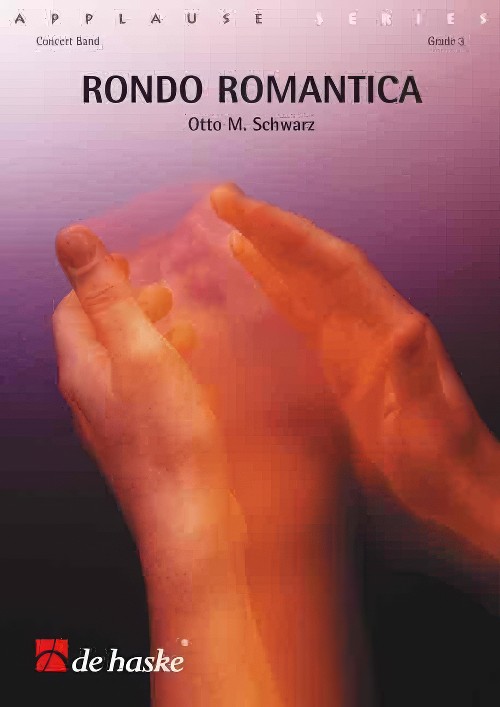
Rondo Romantica (Brass Band - Score and Parts) - Schwarz, Otto M.
Rondo Romantica is based on the Italian Rococo period. In this piece, Otto M. Schwarz depicts a colourful annual fair and the carefree atmosphere of the period. The piece also has undercurrents of modern elements, such as its diverse rhythms.Duration: 3:30
Estimated dispatch 7-14 working days
-
 £47.50
Fusion Factory (Brass Band - Score and Parts) - Hosay, James L.
At the end of the Sixties and the beginning of the Seventies, slowly but surely, a new exciting music style arose in pop music. Pop groups enlarged the musical spectrum by combining jazz harmonies with rock 'n' roll rhythms. These experiments are now known as fusion. Fusion Factory combines elements of early fusion with modern fusion sounds. Listen to the excellent result!Duration: 5.45
Estimated dispatch 7-14 working days
-
 £69.99
Homage (Brass Band - Score and Parts) - Van der Roost, Jan
In the most literal sense: a piece for an occasion. The actual occasion was Jan de Haan's twentieth anniversary as a conductor of the top Dutch brass band, "Soli Deo Gloria" (Leeuwarden). To mark the occasion, the band commissioned the Belgian composer Jan Van der Roost to create a surprise piece: without knowledge of the person being celebrated, a suitable source of inspiration was sought for. After some thought the chorale-theme from Camille Saint-Sans organ symphony was chosen, a piece with which Jan de Haan has a special bond. Apart from this chorale, Homage is also based on the names of notes taken from 'Jan de Haan' and 'Soli Deo Gloria', resulting in the tone row: DEGAH. Both elements are combined together and form a grand climax towards the end of the piece when the whole band unites in the Saint Sans' theme.Duration: 5:30
Estimated dispatch 7-14 working days
-
 £89.99
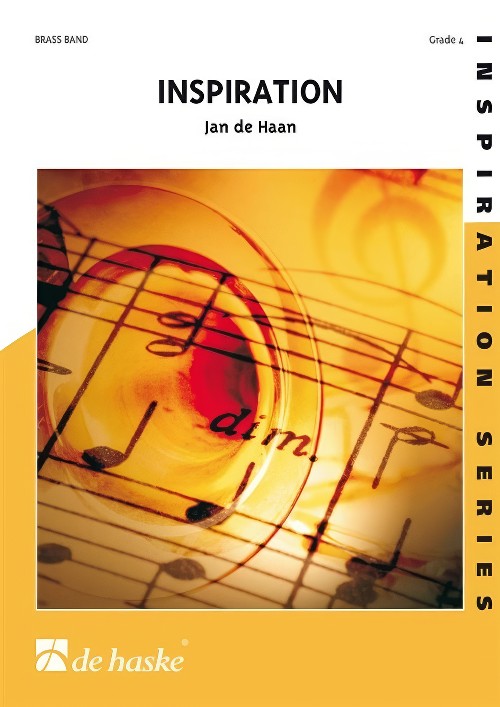
Inspiration (Brass Band - Score and Parts) - De Haan, Jan
This substantial work by Jan de Haan explores the many tonal qualities of the brass band. Following a quiet opening theme based on Phrygian tonality the band bursts into life with a massive climax. Following a jolly second theme characterised by large interval jumps peace and quiet is again restored. Both themes are developed with many poignant solo figures until we reach a resounding fortissimo climax with the solo cornet performing the first theme from the back of the auditorium. A spectacular concert work containing all the elements that bring out the best in brass band sound.Duration: 10:00
Estimated dispatch 7-14 working days
-
 £104.99
Toccata Festiva (Brass Band - Score and Parts) - Van der Roost, Jan
Toccata Festiva was commissioned in 1994 by the Dutch Brass Band Championships. The wind band version was made a year later by the composer himself. Historically speaking, the toccata is considered to be one of the first independent instrumental forms for keyboard instruments. Originally the toccata was typically more or less improvised, later this musical form was given a more regulated structure. Both elements are used in the Toccata Festiva: on the one hand the different themes are developed freely, on the other, the piece has an orderly structure. It is in a three part form (quick-slow-quick) and includes both strong rhythmical figures and broad melodic lines. Part of the composition is written in a more or less archaic tone idiom, referring to the period from which the toccata form originates (16th century).Duration: 13:30
Estimated dispatch 7-14 working days
-
 £76.99
Variazioni in Blue (Brass Band - Score and Parts) - De Haan, Jacob
Variazioni in Blue is a series of variations in which elements from the Blues, such as the specific blue notes, run throughout the piece. Following a stately introduction, which includes part of the theme, is an ornamental variation in classical style. We then hear a variation in Blues style, followed by a fast variation with an Eastern European folklore feel. The Andante con espressivo is particularly fine with its attractive harmonic changes. This variation develops into a repeat of the previous folklore variations with its major variation forming a climax towards the end.Duration: 6:30
Estimated dispatch 7-14 working days
-
 £76.99
Oregon (Brass Band - Score and Parts) - De Haan, Jacob
This fantasy tells the story of Oregon, one of America's north-western states. Traveling by train on the Northern Pacific Railroad, the listener is taken through the fascinating Oregon landscape. Indians, cowboys, golddiggers and hooded wagons will file past on this adventurous journey. The piece has some similarities with a soundtrack of a movie. Various melodies, which could be the main themes of a movie, pass the review.The piece begins in a slow movement, introducing the first theme in minor. Then we hear in the following fast movement the trombones imitate the train, whistling the steam-flute. We hear the characteristic minor theme again, but now in different variants (also in major). The rhythmic structure of "western" stile and rock succeed each other. This is leading to the slow movement, where the signals of horns and trumpets introduce a wonderful vocal melody. After this characteristic melody, the fast movement appears shortly again, the trombones whistling the steam-flute again (now in major). We hear also some musical elements, that plays a part in the following Presto. Barchanges, jazzy chords, interesting rhythmic patterns (with bongo) and an original theme are the characteristics of this Presto. After this, the horns announce the last section of the piece. Interesting is the fact that we hear in this Allegro section a variant of the vocal melody in the slow movement. Also the Presto theme returns shortly, followed by the Allargando, which is a grand characteristic end of a soundtrack. The movie of our travelling fantasy has come to an end.Duration: 9:10
Estimated dispatch 7-14 working days
-
 £40.00
Trittico (Brass Band - Score only) - Curnow, James
Trittico was commissioned by the Swiss Brass Band Association for their national championships in 1988.A trittico is a triptych or group of three paintings or musical compositions based on a common theme and presented or performed together. The present work is a set of three extended variations on the American shaped-note hymn Consolation.The work opens in grand style with motives based on intervals of the hymn tune. The opening motif, and smaller fragments of it reappear throughout the piece and serve as an underlying element alongside the theme itself.The first variation is essentially a scherzo which echoes the minor mood of the theme. The hemiolic opposition of compound and duple time is used to good effect and, again, the main motif is never far away. This is music with energy and forward movement.The second variation gives the soloists a chance to shine. The mood is tranquil, yet there is always some activity and the musical material pre-echoes the third variation.The third variation is another scherzo-like section, the main theme accompanied by a rhythmic ostinato. Toward the conclusion there is a short aleatoric passage - a variation within a variation allowing half the band to make their own variations in a cacophony of sound. An energetic coda draws together several elements to round off a work brim full of drive, energy, and self-propelled enthusiasm.Recorded on Polyphonic QPRL044D Brass from the ValleysDuration: 13:30
Estimated dispatch 7-14 working days
-
 £82.95
The Flowers of the Forest (Brass Band - Score and Parts) - Bennett, Richard Rodney - Hindmarsh, Paul
In a preface to the score, the composer explains that 'the folk song The Flowers of the Forest is believed to date from 1513, the time if the battle of Flodden, in the course of which the archers of the Forest (a part of Scotland) were killed almost to a man'. Bennett had already used the same tune in his Six Scottish Folksongs (1972) for soprano, tenor and piano, and it is the arrangement he made then that forms the starting-point for the brass-band piece. A slow introduction (Poco Adagio) presents the folk song theme three times in succession - on solo cornet, on solo cornets and tenor horns, and on muted ripieno cornets in close harmony - after which the work unfolds through five sections and a coda. Although played without a break, each of these five sections has its own identity, developing elements of the tune somewhat in the manner of variations, but with each arising from and evolving into the next. The first of these sections (Con moto, tranquillo) is marked by an abrupt shift of tonality, and makes much of the slow rises and falls characteristic of the tune itself. The tempo gradually increases, to arrive at a scherzando section (Vivo) which includes the first appearance of the theme in its inverted form. A waltz-like trio is followed by a brief return of the scherzando, leading directly to a second, more extended, scherzo (con brio) based on a lilting figure no longer directly related to the theme. As this fades, a single side drum introduces an element of more overtly martial tension (Alla Marcia) and Bennett says that, from this point on, he was thinking of Debussy's tribute to the memory of an unknown soldier (in the second movement of En Blanc et noir, for two pianos). Bennett's march gradually gathers momentum, eventually culminating in a short-lived elegiac climax (Maestoso) before the music returns full-circle to the subdued melancholy of the opening. The work ends with a haunting pianissimo statement of the original tune.
Estimated dispatch 7-14 working days
-
£44.95
The Flowers of the Forest (Brass Band - Score only) - Bennett, Richard Rodney - Hindmarsh, Paul
In a preface to the score, the composer explains that 'the folk song The Flowers of the Forest is believed to date from 1513, the time if the battle of Flodden, in the course of which the archers of the Forest (a part of Scotland) were killed almost to a man'. Bennett had already used the same tune in his Six Scottish Folksongs (1972) for soprano, tenor and piano, and it is the arrangement he made then that forms the starting-point for the brass-band piece. A slow introduction (Poco Adagio) presents the folk song theme three times in succession - on solo cornet, on solo cornets and tenor horns, and on muted ripieno cornets in close harmony - after which the work unfolds through five sections and a coda. Although played without a break, each of these five sections has its own identity, developing elements of the tune somewhat in the manner of variations, but with each arising from and evolving into the next. The first of these sections (Con moto, tranquillo) is marked by an abrupt shift of tonality, and makes much of the slow rises and falls characteristic of the tune itself. The tempo gradually increases, to arrive at a scherzando section (Vivo) which includes the first appearance of the theme in its inverted form. A waltz-like trio is followed by a brief return of the scherzando, leading directly to a second, more extended, scherzo (con brio) based on a lilting figure no longer directly related to the theme. As this fades, a single side drum introduces an element of more overtly martial tension (Alla Marcia) and Bennett says that, from this point on, he was thinking of Debussy's tribute to the memory of an unknown soldier (in the second movement of En Blanc et noir, for two pianos). Bennett's march gradually gathers momentum, eventually culminating in a short-lived elegiac climax (Maestoso) before the music returns full-circle to the subdued melancholy of the opening. The work ends with a haunting pianissimo statement of the original tune.
Estimated dispatch 7-14 working days
 View Music