
Results
-
 £54.95
The Journal of Phileas Fogg - Peter Graham
Commissioned in 2012 by Dr Nicholas Childs for the National Childrens Brass Band of Great Britain, Peter Graham has taken elements of Jules Vernes epic work, Around the World in Eighty Days, as the outline for a series of adventures recorded inan imaginary diary by the hero of the story, Phileas Fogg. The ensuing journey takes Phileas by boat and train to Paris (where he passes the Moulin Rouge), Russia (where he is chased by Cossacks), Vienna (at night), Spain (where he is a spectator ata bull fight) and a final circumnavigation by sea (when foreign lands are evoked), before he arrives back in London with rich memories of his trip.
Estimated dispatch 5-14 working days
-
 £154.99
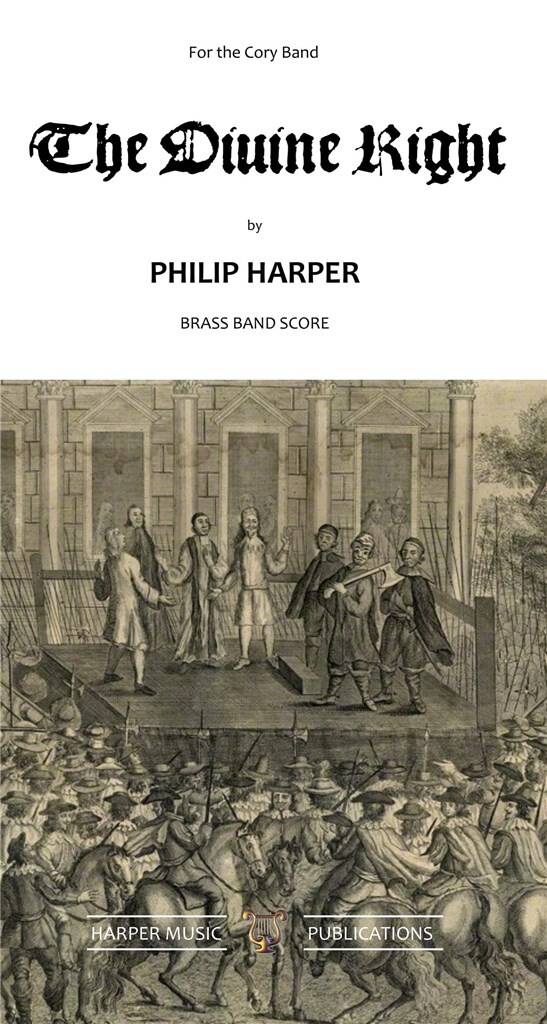
The Divine Right - Philip Harper
At the time of composing this piece, the Arab Spring was sweeping through the Middle East. It seemed that almost every week a new countrys people had risen up against the regimes and dictatorships which had prevailed for generations, leaving manynations at a defining crossroads in their history. There were so many possible ways ahead: so many hopes, yet so many uncertainties.My music is a depiction of these revolutionary times, and several musical themes are in turn presented, discussed, considered, fought over, altered, rejected or accepted. Most nations have had, or probably will have, their own Arab Spring, including my own, the United Kingdom. Events of 17th Century Britain provide the context for this piece, particularly those following the execution of the tyrant King Charles I on30 January 1649. The regicide was in part due to Charless steadfast belief in the Divine Right of Kings, and led to a tumultuous interregnum, where England stood at its own defining crossroads.The music begins turbulently, before King Charles appears and is led to the gallows outside Banqueting House in central London where he is brutally decapitated. From the assembled crowd rose, according to one observer, a moan as I never heard before and desire I may never hear again.The music descends to emptiness. The musical argument which follows is not strictly programmatic, but a number of musical themes are all thrown into the melting pot, representing ideas such as: religion; military force; reasoned Parliamentary debate; and the chattering,irrepressible voice of the people. Additionally, there are some quotations from the music of royalist composer Thomas Tomkins (1572-1656), who was often in tune with the feeling of the times. This defining episode in Englands history was brought to a close with the Restoration of the monarchy in 1660, and as the exiled King Charles II rode back into London the diarist John Evelyn wrote: Never was so joyful a day seen in this nation. I stood in the Strand and beheld it, and blessed God.At the end of the piece the bells ring out, and the musical appearance of the King has transformed from turbulent to triumphant. Philip Harper, 2013
Estimated dispatch 5-14 working days
-
 £115.60
Dream a Little Dream of Me - Gus Kahn - Reid Gilje
This song was written in 1931 by Fabian Andre and Wilbur Schwandt with lyrics by Gus Kahn. It's now one of the most popular songs from the Great American Songbook and it's also recorded in many versions. Ella Fitzgerald, Louis Armstrong and Nat King Cole are among the most famous ones that have recorded it. In later years singers like Michael Buble, Diana Krall land Robin Williams have all recorded "Dream a Little Dream of Me". This arrangement is inspired by the version by American band Chicago from their 1995 album release "Night & Day".
Estimated dispatch 5-14 working days
-
 £59.95
Essay - Edward Gregson
This work was specially commissioned as the test piece for a new brass band competition in 1971, held at the Royal Albert Hall, London. It is in three movements, the titles of which all have literary connotations. The first movement, Dialoguetakes the form of 'conversations' between the instruments. The second movement, Soliloquy is dedicated to the memory of Gilbert Vinter - a composer who did so much in the 1960s to bring the brass band into the modern world. The final movement,Epigram, creates strong rhythmic contrasts and exploits the more virtuoso character of the brass band.
Estimated dispatch 5-14 working days
-
£37.95
-
 £33.62
Les Chasseresses from 'Sylvia' (Brass Band) Delibes arr. Rob Bushnell
Clement Philibert Leo Delibes was a French composer, best known for his ballets and operas, including works such as Lakme (with its famous "Flower Duet"), Coppelia and Sylvia (both key works in the development of modern ballet). The latter started as a play, Aminta, by the Italian poet Torquato Tasso, which Delibes set to music. It was then adapted for the Paris Opera with rehearsals starting in August 1875. The premiere took place on 14 June 1876 and was the first ballet to be shown at the newly-built Opera Garnier. Whilst the scenery and costumes were created by top artists and designers (Cheret and Lacoste), it was Delibes's music that shown thrown, being said to have saved the production, preventing the ballet from drifting into obscurity.Sylvia is said to be one of the first modern ballets, with Tchaikovsky remarking to composer Sergei Taneyev upon its ingenuity: "... the first ballet, where the music constitutes not only the main, but the only interest. What charm, what elegance, what richness of melody, rhythm, harmony." Although Swan Lake, a contemporary to Sylvia, is considered one of the best ballets there is, Tchaikovsky preferred Sylvia to his own work, saying Swan Lake was "poor stuff in comparison". Tchaikovsky said to Taneyev, "I was ashamed. If I had known this music early then, of course, I would not have written Swan Lake". The music to Sylvia, rather than setting only the mood, also sets the action and is noted for its use of leitmotifs - Delibes was an admirer of Wagner - and more dominant use of brass and wind. The most famous piece from this ballet is the Pizzicati in the third act.Act I of the ballet takes place in sacred wood, where creatures are worshipping before Eros when Sylvia arrives with her huntresses to mock the god of love. Aminta, a lowly shepherd and infatuated with Sylvia, protects the deity and Sylvia is wounded by Eros's arrow. The hunter Orion kidnaps Sylvia, whilst Eros revives Aminta. Act II takes place in Orion's Island cave, where Sylvia tries to bribe Orion with jewels and wine. Unsuccessful, she appeals to Eros for help, who arrives and takes her to the temple of Diana (where the final act takes place). Orion and Aminta fight, Sylvia and Orion cause the goddess of the hunt, Diana, to be outraged, smiting Orion and denying the love of Aminta and Sylvia. Eros shows Diana a vision, which changes her mind and the couple finally come together.This brilliant and lively fanfare that introduces the huntresses in the first act is arranged here for the UK-style brass band, with alternative parts for horns in F and bass-clef lower brass. The piece has been lowered by a tone compared to the original. A recording of the original composition can be found here https://youtu.be/6yoGrUH38PI?si=0L0bFa1qXnYNvkR3 Duration: Approx. 3.10 minutes Difficulty Level: 1st Section + This PDF download includes the full score and parts. Includes alternative parts for soloist in Eb, horns in F and lower brass in bass clef. Sheet music available at www.brassband.co.uk (UK) or https://satradecentral.org (USA) Instrumentation: Soprano Cornet Eb Solo Cornet Bb Repiano Cornet Bb 2nd Cornet Bb 3rd Cornet Bb Flugel Horn Bb Solo Horn Eb 1st Horn Eb 2nd Horn Eb 1st Baritone Bb 2nd Baritone Bb 1st Trombone Bb 2nd Trombone Bb Bass Trombone Euphonium Bb Bass Eb Bass Bb Timpani Percussion - Triangle, Cymbal & Bass Drum
In Stock: Estimated dispatch 1-3 working days
-
 £29.95
Fanfare of a Nation - Christopher Bond
Fanfare of a Nation (2012) was commissioned by the Greater Gwent Youth Brass Ensemble as a short fanfare originally for ten players, and was performed in the presence of HM Queen Elizabeth II & The Duke of Edinburgh on the occasion of their visit to Wales to mark the Diamond Jubilee last year, under its original title The Royal Diamond Jubilee Fanfare. Since arranged for brass band and performed throughout the UK including by Black Dyke Band in Cardiff, this short work mesmerizes, dazzles and utilizes the fanfare effects so often associated with the brass family. Available to purchase for Brass Band or Brass Ensemble (10 players plus 1 percussion). The brass ensemble version is scored as follows: 4 x Trumpets, 1 x Horn in F, 3 x Tenor Trombones, 1 x Bass Trombone, 1 x Tuba, 1 x Percussion. Trumpet 1 is supplied in both E-flat & B-flat, Horn in F is supplied in E-flat, Tenor Trombone and Tuba parts are supplied in both bass and treble clef.
Estimated dispatch 10-14 working days
-
 £71.00
Three Pictures for Band - Oliver Waespi
This composition consists of three sound pictures. Numerous associations mutually link those parts as far as motifs and harmony are concerned. The motif of the ascending and descending fourth plays an important role in many a theme. There are many fourth chords by means of which I try to put a harmonic and unifying stamp on the composition as a whole. Moreover there are similar or identical, though varied, motifs in the successive parts. The first part 'Cortege' (Procession) describes the dignified majestic procession by means of simple, precise rhythms. At first, the music is scarcely audible, as if coming from a distance; it gradually comes nearer until it reaches its climax in large chords, before fading away again. At each quarter note one could imagine a step. The second part 'Dialogue' consists in broad outlines of dialogues between the different orchestral groups. Some instruments are asking questions, others are giving answers. After a rather sad passage, the music turns into a climax followed by a second passage that brings comfort and leads to a quiet ending. In the third part, there is a sudden movement coming up in the shape of 'Waves'. The principle of the wave, successively swelling and decreasing, dominates the entire musical structure of this part, even in the separate motifs.Oliver Waespi
Estimated dispatch 10-14 working days
-
£35.00
Alu - Peter Meechan
Alu was commissioned by Pat Herak for his wife Diana, for their 10th wedding anniversary. It was premiered by Diana and the Brass Band of Columbus, USA.It is a simple, reflective piece, which grows from a small idea first heard in the baritone and changes throughout, although the opening material is never far away.The solo part is equally suitable for baritone or euphonium.
Estimated dispatch 12-14 working days
-
 £61.99
Atlantis: The Lost Empire (Where The Dream Takes You) - Diane Warren & James Newton Howard - Frank Bernaerts
Estimated dispatch 10-14 working days
 View Music