
Results
-
 £68.90
Elisabeth - Michael Kunze - Erik Jansen
The life of the Austrian empress Elisabeth (1837-1898) which started as a fairy tale but ended as a tragedy, inspired the librettist Michael Kunze and the composer Silvester Levay to write a musical based on the life of the popular 'Sissi'. The musical was premiered in Vienna on 3 September 1992 and was very successful for many years. The story is told by Luigi Lucheni, Elisabeth's murderer. So death, represented by a mysterious and seductive young man, is omnipresent throughout the musical. Several songs have become hits and, of course, you can hear them in this fine selection by Peter Kleine Schaars who gathered various music and dance styles such as the rock shuffle, the jazz waltz and the classical Viennese waltz.
Estimated dispatch 5-14 working days
-
 £69.99
Go for Brass! - Jacob de Haan
Subtitled "A Young Person's Guide to the Brass Band", Go for Brass! is a musical introduction to the sound, instrumental groups and the individual instruments of the brass band. Your players will love this work as they stand to highlight their particular section with snippets of the sparkling up-tempo dance style theme. An extremely entertaining concert item with a little fun educational content!
Estimated dispatch 5-14 working days
-
 £60.99
Fanfare La Perie - Paul Dukas - Peter Wain
In 1911 the Russian impresario Diaghilev commisioned Paul Dukas to compose music for the famous ballet fairy-tale 'La Perie'by Jean Coralli.Fokine was to make a new choreography, so that the Russian ballet company 'Ballet Russes' would be able to perform the piece in Paris that same year. Due to a quarrel between Diaghilev and Dukas about who should dance the title-part, however, the ballet was not performed by the 'Ballet Russes'but by another company in 1912.The ballet 'La Perie' is Dukas' last symphonic work. In 1911 gaf de Russische impresario Diaghilev Paul Dukas opdracht om muziek te componeren voor het beroemde ballet sprookje 'La Perie' van Jean Coralli. Fokine was gevraagd om een nieuwe choreografie te maken, zodat het Russische balletgezelschap 'Ballet Russes' in staat zou zijn om het stuk in Parijs op te voeren in datzelfde jaar. Door een ruzie tussen Diaghilev en Dukas over de vraag wie de hoofdrol mocht dansen, werd het ballet in 1912 echter niet uitgevoerd door het 'Ballet Russes' maar door een ander gezelschap. Het ballet 'La Perie' is het laatste symfonische werk van Dukas.
Estimated dispatch 5-14 working days
-
£54.95
Northern Landscapes - Peter Graham
The four movements of Northern Landscapes provide musical mood pictures of various aspects of Northern working life. 1) Industry opens the suite with the bustle of factory machinery, followed attacca by 2) Seascapes which evokes the calmness of local waters during a fishing expedition. 3) Earth Dance references the mining industry where the blackness of the environment is mirrored by the darkness of the music while 4) Flight evokes the path of an aircraft on its maiden journey in this tribute to the aircraft industry. Northern Landscapes has its origins in music written for the Ulster Orchestra Brass Quintet. This revised and updated version for brass band was commissioned by the Boarshurst (Greenfield) Silver Band, with National Lottery funds, supported by the Arts Council of England. It was set as the 2003 National Brass Band Championships Area Third Section Test-Piece.
Estimated dispatch 5-14 working days
-
 £57.50
Superjet - Thierry Deleruyelle
Superjet is an energetic composition written in a jazz style, evoking the effervescence and vitality of a real big band. It is punctuated by three solos that showcase the creativity of each performer. Commissioned by the Orchestre d'Harmonie de Vesoul, this work pays tribute to Jean-Marie Goux, a former band conductor and unconditional jazz fan. Concise, dynamic, and rhythmic, it really makes you want to dance!
Estimated dispatch 5-14 working days
-
 £91.99
Hermitage - Jan de Haan
Jan de Haan drew inspiration for this work from five paintings exhibited in The Hermitage in Saint Petersburg, one of the largest and most versatile museums in the world. He used the melodious Andante cantabile from the String Quartet Op. 11 by the Russian composer Pyotr Ilyich Tchaikovsky as its starting point. Thus, he created his own musical painting, which is just as varied as the underlying canvases - from Cheerful Company by Dirck Hals to Dance II by Henri Matisse. A true work of art!
Estimated dispatch 5-14 working days
-
 £29.95
The Rothea Rag - Scott Joplin - Roger Nicholls
A cheerful dance tune, which features all sections of the band, and which ends with a Dixieland free-for-all. Not to be taken seriously.
Estimated dispatch 5-14 working days
-
 £154.99
Bulgarian Dances (Part II) - Franco Cesarini
Bulgarian folk music has a long tradition and numerous typical characteristics, such as particular dissonances and complex, irregular rhythms. In Bulgarian Dances (Part II) (which can be performed together with the previously published title Bulgarian Dances) Franco Cesarini has preserved the original spirit of Bulgarian folk music, yet has imbued it with a symphonic character and brought it into the concert hall. The three different movements give us a meditative, moving folksong and a lively dance, before a distinctly symphonic part leads to a glittering finale.
Estimated dispatch 5-14 working days
-
 £60.99
Where there's Muck - Peter Martin
The title is a popular saying in England. It means that's where the money is. "Where there's muck, there's power" is such a popular expression in the United Kingdom. The saying inspired Peter Martin to compose a highly attractive piece in four parts, consisting of contemporary dances that can also be performed separately. Let's dance!
Estimated dispatch 5-14 working days
-
 £64.30
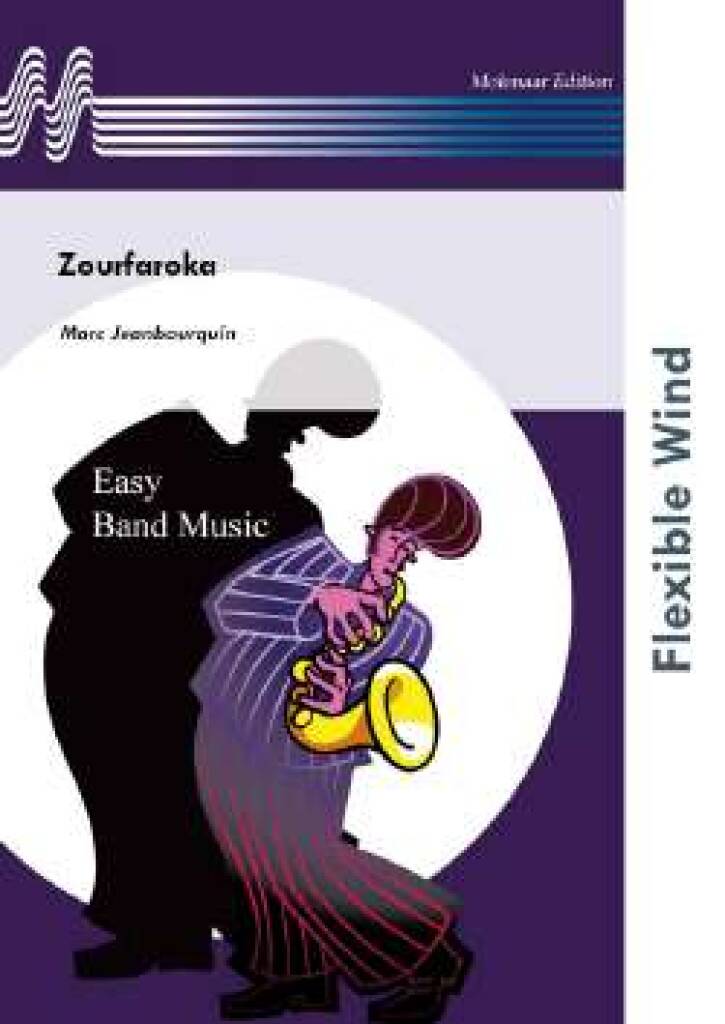
Zourfaroka - Marc Jeanbourquin
One morning everything went wrong in Zourfaroka. In this forest where thousands of magical beings live, everything sparkles and shines and is full of life. But not this morning, because the terrible troll Potugor has returned. This is the opening text for the musical fairy tale written by Lise Jeanbourquin and set to music by her husband Marc Jeanbourquin. The first part is a warlike setting, showing the preparations of Kirielo and the inhabitants of Zourfaroka for the battle with Potugor. On the way they meet the fairy Xeriole, and this meeting is put to music in the second part. The soloist's role in the first few bars is left to the choice of the conductor. And as in many fairy tales, with fairies, gnomes, and amazing magical creatures, the piece ends in the third part with everyone coming together in song and dance.
Estimated dispatch 5-14 working days
 View Music