
Results
-
 £12.50
Of Distant Memories (Music in an Olden Style) (Brass Band - Study Score) - Gregson, Edward
2013 Finals of the National Brass Band Championships of Great Britain - Championship Section.Of Distant Memories pays homage to the brass band composers that form the backbone of the brass band repertoire, and their music, and in the process summons up a kind of subconscious memory bank of the musical languages, styles and forms used by them. The music is conceived in the form of a 'traditional' tone poem, reflecting certain aspects (e.g. melodic, harmonic, textural) of those early test pieces. Although fairly traditional concepts have been kept in planning the architecture of the work, certain aspects of the instrumentation, or scoring, are more contemporary in colouristic terms, as befits a composer writing in the 21st century. However, the percussion requirements are fairly modest, similar to those used in the works of that period. The brass band tradition owes much to the composers of that period, for through their music they established a truly homogenous 'British' brass band sound which has spread throughout many parts of the world. That tradition flourishes today and remains important for today's composers, even if their musical language is far removed from that of their predecessors. Of Distant Memories is the composers own way of repaying that gratitude.Duration: 15.00
Estimated dispatch 7-14 working days
-
 £89.95
Of Distant Memories (Music in an Olden Style) (Brass Band - Score and Parts) - Gregson, Edward
Of Distant Memories pays homage to the brass band composers that form the backbone of the brass band repertoire and their music, and in the process summons up a kind of subconscious memory bank of the musical languages, styles and forms used by them. The music is conceived in the form of a 'traditional' tone poem, reflecting certain aspects (e.g. melodic, harmonic, textural) of those early test pieces. Although fairly traditional concepts have been kept in planning the architecture of the work, certain aspects of the instrumentation, or scoring, are more contemporary in colouristic terms, as befits a composer writing in the 21st century. However, the percussion requirements are fairly modest, similar to those used in the works of that period. The brass band tradition owes much to the composers of that period, for through their music they established a truly homogenous 'British' brass band sound which has spread throughout many parts of the world. That tradition flourishes today and remains important for today's composers, even if their musical language is far removed from that of their predecessors. Of Distant Memories is the composers own way of repaying that gratitude.Duration: 15.00
Estimated dispatch 7-14 working days
-
 £44.95
Of Distant Memories (Music in an Olden Style) (Brass Band - Score only) - Gregson, Edward
Of Distant Memories pays homage to the brass band composers that form the backbone of the brass band repertoire, and their music, and in the process summons up a kind of subconscious memory bank of the musical languages, styles and forms used by them. The music is conceived in the form of a 'traditional' tone poem, reflecting certain aspects (e.g. melodic, harmonic, textural) of those early test pieces. Although fairly traditional concepts have been kept in planning the architecture of the work, certain aspects of the instrumentation, or scoring, are more contemporary in colouristic terms, as befits a composer writing in the 21st century. However, the percussion requirements are fairly modest, similar to those used in the works of that period. The brass band tradition owes much to the composers of that period, for through their music they established a truly homogenous 'British' brass band sound which has spread throughout many parts of the world. That tradition flourishes today and remains important for today's composers, even if their musical language is far removed from that of their predecessors. Of Distant Memories is the composers own way of repaying that gratitude.Duration: 15.00
Estimated dispatch 7-14 working days
-
 £43.99
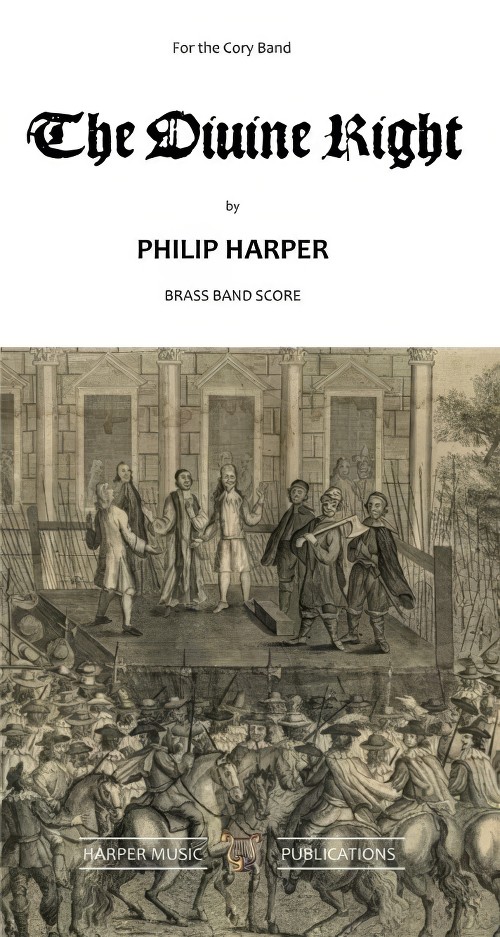
The Divine Right (Brass Band - Score only) - Harper, Philip
At the time of composing this piece, the Arab Spring was sweeping through the Middle East. It seemed that almost every week a new country's people had risen up against the regimes and dictatorships which had prevailed for generations, leaving many nations at a defining crossroads in their history. There were so many possible ways ahead: so many hopes, yet so many uncertainties.This music is a depiction of these revolutionary times, and several musical themes are in turn presented, discussed, considered, fought over, altered, rejected or accepted.Most nations have had, or probably will have, their own Arab Spring, including the United Kingdom. Events of 17th Century Britain provide the context for this piece, particularly those following the execution of the tyrant King Charles I on 30 January 1649. The regicide was in part due to Charless steadfast belief in the Divine Right of Kings, and led to a tumultuous interregnum, where England stood at its own defining crossroads. The music begins turbulently, before King Charles appears and is led to the gallows outside Banqueting House in central London where he is brutally decapitated. From the assembled crowd rose, according to one observer,a moan as I never heard before and desire I may never hear again.The music descends to emptiness.The musical argument which follows is not strictly programmatic, but a number of musical themes are all thrown into the melting pot, representing ideas such as: religion; military force; reasoned Parliamentary debate; and the chattering, irrepressible voice of the people. Additionally, there are some quotations from the music of royalist composer Thomas Tomkins (1572-1656), who was often in tune with the feeling of the times.This defining episode in England's history was brought to a close with the Restoration of the monarchy in 1660, and as the exiled King Charles II rode back into London the diarist John Evelyn wrote:Never was so joyful a day seen in this nation. I stood in the Strand and beheld it, and blessed God.At the end of the piece the bells ring out, and the musical appearance of the King has transformed from turbulent to triumphant.Duration: 17.00
Estimated dispatch 7-14 working days
-
£104.99
The Divine Right (Brass Band - Score and Parts) - Harper, Philip
At the time of composing this piece, the Arab Spring was sweeping through the Middle East. It seemed that almost every week a new country's people had risen up against the regimes and dictatorships which had prevailed for generations, leaving many nations at a defining crossroads in their history. There were so many possible ways ahead: so many hopes, yet so many uncertainties.This music is a depiction of these revolutionary times, and several musical themes are in turn presented, discussed, considered, fought over, altered, rejected or accepted.Most nations have had, or probably will have, their own Arab Spring, including the United Kingdom. Events of 17th Century Britain provide the context for this piece, particularly those following the execution of the tyrant King Charles I on 30 January 1649. The regicide was in part due to Charless steadfast belief in the Divine Right of Kings, and led to a tumultuous interregnum, where England stood at its own defining crossroads. The music begins turbulently, before King Charles appears and is led to the gallows outside Banqueting House in central London where he is brutally decapitated. From the assembled crowd rose, according to one observer,a moan as I never heard before and desire I may never hear again.The music descends to emptiness.The musical argument which follows is not strictly programmatic, but a number of musical themes are all thrown into the melting pot, representing ideas such as: religion; military force; reasoned Parliamentary debate; and the chattering, irrepressible voice of the people. Additionally, there are some quotations from the music of royalist composer Thomas Tomkins (1572-1656), who was often in tune with the feeling of the times.This defining episode in England's history was brought to a close with the Restoration of the monarchy in 1660, and as the exiled King Charles II rode back into London the diarist John Evelyn wrote:Never was so joyful a day seen in this nation. I stood in the Strand and beheld it, and blessed God.At the end of the piece the bells ring out, and the musical appearance of the King has transformed from turbulent to triumphant.Duration: 17.00
Estimated dispatch 7-14 working days
-
 £44.95
Deus Invictus - God Unconquered (Brass Band - Score and Parts) - Mackereth, Andrew
Deus Invictus draws its inspiration from well-known words from Romans 8: 38-39; 'For I am convinced that neither death nor life, neither angels nor demons, neither the present nor the future, nor any owers, neither height nor depth, nor anything else in all creation, can separate us from the love of God'. The music reflects the confidence and certainty of the scripture text while, as in everyday life, trials and tests come along which are reflected in a sequence of musical skirmishes. The work introduces the 19th century hymn 'St Albinus' to a wider audience and also includes references to the tunes 'St Margaret' and 'Rachie'. A setting of the Easter Hymn, 'Christ the Lord is risen today!', is heard followed by a final reprise of 'St Albinus'.
Estimated dispatch 7-14 working days
-
£22.50
Deus Invictus - God Unconquered (Brass Band - Score only) - Mackereth, Andrew
Deus Invictus draws its inspiration from well-known words from Romans 8: 38-39; 'For I am convinced that neither death nor life, neither angels nor demons, neither the present nor the future, nor any owers, neither height nor depth, nor anything else in all creation, can separate us from the love of God'. The music reflects the confidence and certainty of the scripture text while, as in everyday life, trials and tests come along which are reflected in a sequence of musical skirmishes. The work introduces the 19th century hymn 'St Albinus' to a wider audience and also includes references to the tunes 'St Margaret' and 'Rachie'. A setting of the Easter Hymn, 'Christ the Lord is risen today!', is heard followed by a final reprise of 'St Albinus'.
Estimated dispatch 7-14 working days
-
 £56.00
Leona (Brass Band - Score and Parts) - Wilkinson, Keith M.
Leopold A Zimmerman (1866 - 1935) was trombone soloist in the Sousa Band, succeeding Arthur Pryor in that position, in the early part of the 20th century. This famous solo dates from that period. The brass band arrangement has been requested by Brett Baker who gave the first performance of this version in August, 2012.
Estimated dispatch 7-14 working days
-
 £112.00
Zampa (Brass Band - Score and Parts) - Herold, Ferdinand - Wilkinson, Keith M.
The opera, Zampa, was first performed in Paris in 1831 and over the next 50 or so years enjoyed frequent performances and remained extremely popular. Since the dawn of the 20th century the popularity of the opera has waned somewhat but the overture has continued to be one of the composer's most famous works and is a staple of the orchestral repertoire.This brass band transcription was prepared for Brass Band Of The Western Reserve and it has been extremely well-received on their concerts.
Estimated dispatch 7-14 working days
-
 £26.95
To His Majesty (Brass Band - Score and Parts) - Savile, Jeremy - Wiffin, Rob
A brilliant concert prelude based on the seventeenth century English patriotic song Here's a Health unto His Majesty. It was composed by Jeremiah Savile and was first published in John Playford's The Musical Companion in 1667. This version is a thorough re-working of the tune and provides an exciting start to a programme.Duration: 3.30
Estimated dispatch 7-14 working days
 View Music