
Results
-
 £33.62
The Lord Bless You and Keep You (Brass Band) John Rutter arr. Andrew Wainwright
John Rutter's popular choral benediction is based on Numbers 6:24-26, and has here been arranged for brass band by Andrew Wainwright. It is a setting of a biblical benediction, followed by an extended 'Amen'. Rutter originally scored the piece for four vocal parts (SATB) and organ. He composed it in 1981 for the memorial service of Edward T. Chapman, the director of music at Highgate School, London, with whom he had studied when he attended the school. The arrangement sounds a semi-tone down from the original choral setting although otherwise maintains the same format, so can be performed with choir if they sing down a semi-tone. To view a rolling score video with Wellington Brass performing the work please visit www.youtube.com/watch?v=ijJ2Nir3wRQ PDF download includes score and parts. Additional parts (Horn in F and Baritone, Trombone, Euphonium & Tuba in Bass Clef) available here. Sheet music available from: UK - www.brassband.co.uk USA - https://satradecentral.org Difficulty Level: 4th Section + Length: 2.50 minutes Instrumentation: Soprano Cornet Eb Solo Cornet Bb 1st Cornet Bb 2nd Cornet Bb Flugel Horn Bb Solo Horn Eb 1st Horn Eb 2nd Horn Eb 1st Baritone Bb 2nd Baritone Bb 1st Trombone Bb 2nd Trombone Bb Bass Trombone Euphonium Bb Bass Eb Bass Bb Timpani Percussion
In Stock: Estimated dispatch 1-3 working days
-
 £33.62
The Piano Preludes (Brass Band) George Gershwin arr. Rob Bushnell
First performed by the composer at the Roosevelt Hotel in New York in 1926, The Piano Preludes (or Three Preludes) are a collection of short pieces by George Gershwin, show casing early-20th-century American classical music, as influenced by jazz. Gershwin originally planned to compose 24 preludes, wrote seven, performed only six publically and was further reduced to three when first published. The work was dedicated to friend and musical advisor Bill Daly. The first prelude begins with a five-note blues motif. It features syncopated rhythms based on the Brazilian baiao and minor-seventh chords throughout. The second prelude, which Gershwin said was "a sort of blues lullaby" consists of two sections: the first a "lazy" melody upon a steady beat of crotchets; the second the bass takes the melody, continuing with the steady beats. The third prelude was called "Spanish" by Gershwin, and features a question-and-answer type melody, starting in a minor tonality and ending in major one. This arrangement is for the British-style brass band, with alternative parts for horns in F and bass-clef lower brass. To view a follow-the-score video please visit www.youtube.com/watch?v=XqIQ0j1SWlc PDF download includes score and parts. Sheet music available from: UK - www.brassband.co.uk USA - www.solidbrassmusic.com Difficulty Level: 1st Section + Instrumentation: Soprano Cornet Eb Solo Cornet Bb Repiano Cornet Bb 2nd Cornet Bb 3rd Cornet Bb Flugel Horn Bb Solo Horn Eb 1st Horn Eb 2nd Horn Eb 1st Baritone Bb 2nd Baritone Bb 1st Trombone Bb 2nd Trombone Bb Bass Trombone Euphonium Bb Bass Eb Bass Bb Timpani Drum Kit Mallet Percussion
In Stock: Estimated dispatch 1-3 working days
-
 £33.62
There's no-one like Jesus (Brass Band) African Trad. arr. Andrew Wainwright
This popular African praise song exists in a staggering number of variations, depending on the country, language, and denominational background of the community singing it. This foot-tapping arrangement for brass band was made by Andrew Wainwright for the 2008 Zambia Territorial Music School of The Salvation Army. To view a video of the ULID BRASS performing the work please visit https://www.youtube.com/watch?v=q_EfH1t7NDY Length: 3.00 minutes PDF download includes score and parts. Sheet music available from www.brassband.co.uk Difficulty Level: 4th Section + Instrumentation: Soprano Cornet Eb 1st Cornet Bb 2nd Cornet Bb 1st Horn Eb 2nd Horn Eb 1st Baritone Bb 2nd Baritone Bb 1st Trombone Bb 2nd Trombone Bb Bass Trombone Euphonium Bb Bass Eb Bass Bb Percussion 1-2
In Stock: Estimated dispatch 1-3 working days
-
 £41.09
Verklarte Nacht (Brass Band) Arnold Schoenberg arr. Rob Bushnell
Composed in just three weeks in 1899, Verklarte Nacht (Transfigured Night) is a string sextet in one movement by Arnold Schoenberg. Whilst known better for tone rows, his dodecaphonic music and the Second Viennese School, Schoenberg was a master of harmony (writing a number of books on the subject) and, in his early life, was inspired by the music of Brahms and Wagner. This is his best-known tonal work. Its description as a tone poem is not surprising given it takes its inspiration from Richard Dehmel's poem of the same name, as well as Schoenberg's strong feelings towards his future wife, Mathilde Zemlinsky, sister of his teacher, Alexander von Zemlinsky. The work is said to have five sections, one for each of the stanzas in the poem. The poem, from 1896, describes a man and woman walking through a dark forest on a moonlit night. The woman shares a secret with him, that she is pregnant but not with his child. The man reflects upon this before warmly accepting (and forgiving) the news. The work premiered on 18 March 1902 in the Vienna Musikverein by the Rose Quartet. As was normal at the time, Schoenberg produced a string orchestra version that was premiered on 29 November 1916 in Prague, conducted by Zemlinsky, which was later revised in 1943 to better support the soloists, also adding more articulation and tempo markings. Whilst the piece was controversial at the time, both musically and due to the poem's "inappropriate" subject matter, Richard Dehmel himself was impressed, writing "I had intended to follow the motives of my text in your composition, but soon forgot to do so, I was so enthralled by the music." This arrangement is for the British-style brass band, with alternative parts for horns in F and bass-clef lower brass. To view a recording of the original composition please visit www.youtube.com/watch?v=vqODySSxYpc. Difficulty Level: 2nd Section + Duration: approx. 6.40 minutes Sheet music available from www.brassband.co.uk Instrumentation: Soprano Cornet Eb Solo Cornet Bb Repiano Cornet Bb 2nd Cornet Bb 3rd Cornet Bb Flugel Horn Bb Solo Horn Eb 1st Horn Eb 2nd Horn Eb 1st Baritone Bb 2nd Baritone Bb 1st Trombone Bb 2nd Trombone Bb Bass Trombone Euphonium Bb Bass Eb Bass BbTimpani Percussion 1-3
In Stock: Estimated dispatch 1-3 working days
-
 £33.62
Verleih Uns Frieden (Brass Band) Mendelssohn arr. Edward Mylechreest
Felix Mendelssohn's stunning Choral Cantata has here been adapted to the brass band by Edward Mylechreest. A setting of Martin Luther's sacred words, this short piece is a staple of the choral canon and is widely regarded as a choral masterpiece. The hymn tune melody repeats three times throughout the piece (first from the trombones, then the horns, followed by a full band chorale), each time an emploring prayer and statement of the text. This arrangement can also be used for accompaniment to the original Chorale, remaining in the original Eb major key signature. Knowledge of the original piece will be of great benefit to the performer and conductor alike. Sheet music available from: UK - www.brassband.co.uk USA - www.solidbrassmusic.com Difficulty Level: 4th Section + Instrumentation: Soprano Cornet Eb Solo Cornet Bb 1st Cornet Bb 2nd Cornet Bb Flugel Horn Bb Solo Horn Eb 1st Horn Eb 2nd Horn Eb 1st Baritone Bb 2nd Baritone Bb 1st Trombone Bb 2nd Trombone Bb Bass Trombone Euphonium Bb Bass Eb Bass Bb Percussion Tacet
In Stock: Estimated dispatch 1-3 working days
-
 £33.62
Waltz of the Flowers from The Nutcracker Suite - Brass Band (arr. Wilkinson)
VIEW SCORE PDF Step into the enchanting world of Tchaikovsky's beloved The Nutcracker with this delightful arrangement of Waltz of the Flowers from The Nutcracker Suite. Expertly adapted for brass band by Keith M. Wilkinson, this suite captures the festive spirit and magical charm of the original score, while showcasing the full power and brilliance of brass and percussion. The third of three movements, The Nutcracker Suite includes March, Trepak and Waltz of the Flowers. To purchase the full suite, please visit www.brookwrightmusic.com/product-page/the-nutcracker-suite-brass-band-tchaikovsky-arr-keith-wilkinson PDF download includes score and full set of parts. Sheet music available from: UK - www.brassband.co.uk USA - www.solidbrassmusic.com Difficulty Level: 2nd Section + Instrumentation: Soprano Cornet Eb Solo Cornet Bb Repiano Cornet Bb 2nd Cornet Bb 3rd Cornet Bb Flugel Horn Bb Solo Horn Eb 1st Horn Eb 2nd Horn Eb 1st Baritone Bb 2nd Baritone Bb 1st Trombone Bb 2nd Trombone Bb Bass Trombone Euphonium 1-2 Bb Bass Eb Bass Bb Timpani Percussion 1-2
In Stock: Estimated dispatch 1-3 working days
-
 £37.35
World War III (Brass Band) Joe Galuszka
This descriptive work for brass band by Joe Galuszka depicts the horrors of war. War is all around us. Every day, another life is lost. Myanmar, Sudan, Ethiopia, Ukraine, Colombia, Afghanistan, Somalia, Syria and Yemen. As time goes on, more and more countries are brought to the end of what is a diplomatic struggle - in where war seems to be the only option. 'War! Terror! Panic! captures the tumultuous and relentless nature of war. With driving rhythms, aggressive brass fanfares, and thundering percussion, the listener is immersed in the chaos of battle. Dissonance and clashing harmonies depict the discord that pervades war and takes us on a journey through the terror and panic that comes with the brutality of conflict. Remembrance (For Those That We Have Lost) provides a poignant and reflective interlude, allowing the audience to contemplate the human cost of war. Mournful melodies and expressive solos for trombone, euphonium and glockenspiel, convey the depth of sorrow and loss, serving as a powerful reminder of the toll war takes on individuals and communities. The final movement, Hymn for Peace and Hope is a testament to the enduring human spirit and the yearning for harmony - dissonance and conflict gradually give way to consonance and resolution. We celebrate the human capacity for unity and the triumph of peace over strife, as we imagine a world at piece. To listen to an audio demo of the work please visit https://on.soundcloud.com/Udt1AWRThgwuWnQv5 Duration: Approx. 5.00 mins Difficulty Level: 2nd Section + PDF download includes parts and score. Sheet music available from www.brassband.co.uk (UK) or https://satradecentral.org (USA) Instrumentation: Soprano Cornet Eb Solo Cornet Bb Repiano Cornet Bb 2nd Cornet Bb 3rd Cornet Bb Flugel Horn Bb Solo Horn Eb 1st Horn Eb 2nd Horn Eb 1st Baritone Bb 2nd Baritone Bb 1st Trombone Bb 2nd Trombone Bb Bass Trombone Euphonium Bb Bass Eb Bass Bb Timpani Percussion 1-3
In Stock: Estimated dispatch 1-3 working days
-
 £33.62
You're Always There (Brass Band) Lee Fisher arr. Andrew Wainwright
One of BrookWright's most popular titles, this piece is based on an original song by Lee Fisher which was written for Britain's Got Talent star Charlie Green. Originally arranged as a tenor horn solo with brass band, it is now available here as a standalone work for band. To view a follow-the-score video please visit www.youtube.com/watch?v=suzzgdxU_xU PDF download includes score and parts. Sheet music available from: UK - www.brassband.co.uk USA - https://satradecentral.org Difficulty Level: 4th Section + Length: 3.45 minutes Instrumentation: Soprano Cornet Eb Solo Cornet Bb Repiano Cornet Bb 2nd Cornet Bb 3rd Cornet Bb Flugel Horn Bb Solo Horn Eb 1st Horn Eb 2nd Horn Eb 1st Baritone Bb 2nd Baritone Bb 1st Trombone Bb 2nd Trombone Bb Bass Trombone Euphonium Bb Bass Eb Bass Bb Timpani Percussion 1-2
In Stock: Estimated dispatch 1-3 working days
-
 £30.00
Czardas. V. Monti. For E flat bass soloist & Brass Band
Recommended - Championship to 2nd Section An arrangement of the classic violin solo, Czardas, for E Flat Bass soloist and brass band. Includes score and parts Also see: Czardas for Brass Quintet (tuba solo) Czardas for Solo Tuba & Piano
-
 £42.00
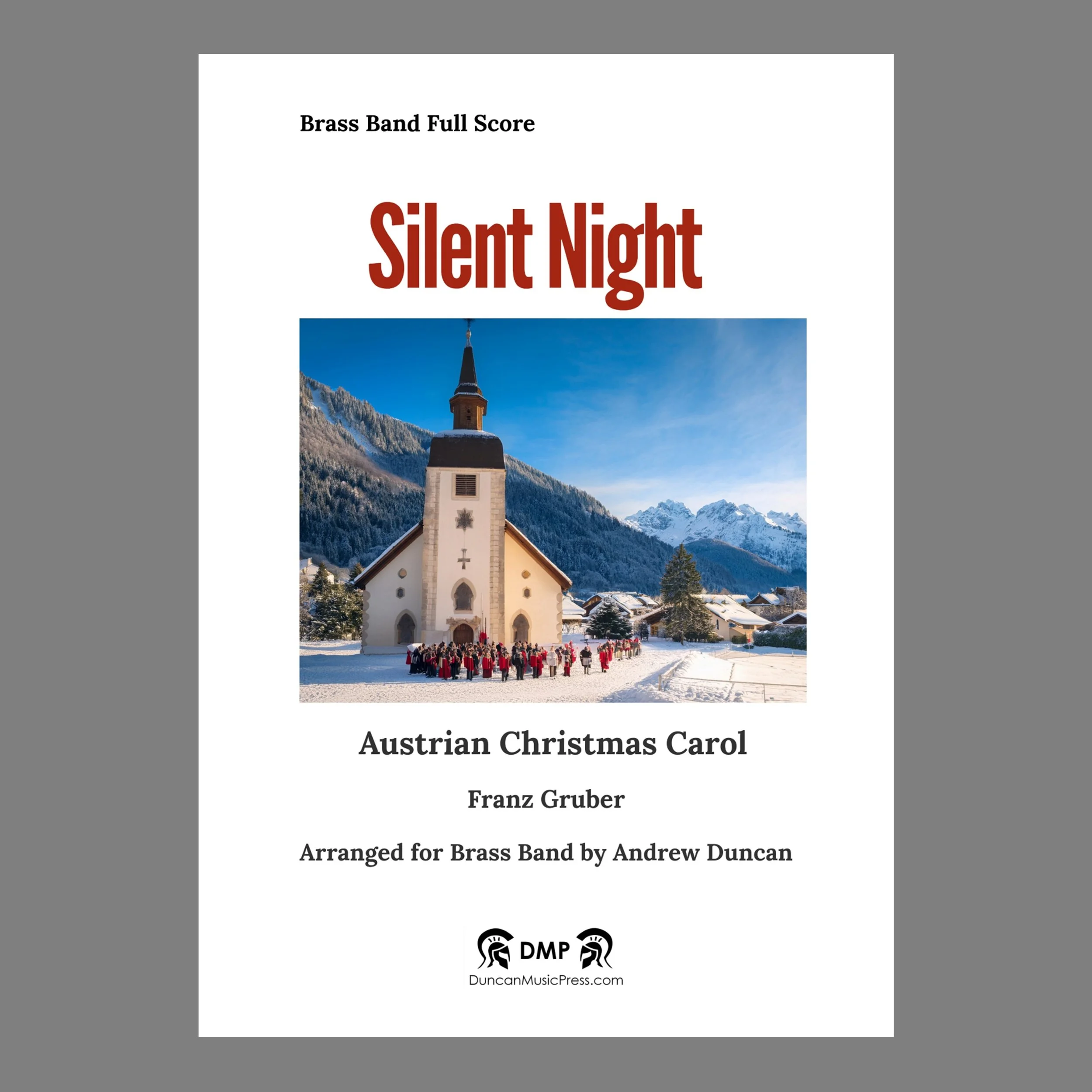
Silent Night. Franz Gruber arranged for brass band by Andrew Duncan
Silent Night is an Austrian Christmas Carol written by Franz Gruber, (1787-1863). Franz Gruber was an primary school teacher, organist and composer who lived in the village of Arndorf in Austria. Silent Night (Stille Nacht) has become one of the best loved Christmas Carols ever written. This arrangement for brass band imagines Christmas morning in a small Austrian village, such as Arndorf, with the sound of the local church bells ringing out along with the sound of a choir singing Silent Night accompanied by the local band.. The arrangement features the tubular bells playing a simple descending scale, which is also played by muted cornets (2nd and 3rd cornets). After 2 verses of the hymn the coda features a short trombone trio with a jazzy feel which leads into a final scale from the tubular bells and cornets bringing the piece to a peaceful close. To hear a sound file of Silent Night scroll down.
 Watch video