
Results
-
 £33.62
Disinformation! (Brass Band) Joe Galuszka
This atmospheric work by English composer Joe Galuszka is set in three movements: I. Fear II. Hope III. Solidarity (March for Truth) The composer writes: 'All around us is mistrust in the information we receive. Chinese misinformation. Russian disinformation. 'Fake News' in the United States. At every turn we doubt what we hear, what we see. Disinformation was composed in response to the ever-growing and all powerful misinformation campaigns worldwide that reached dizzying levels of influence, coming from some of the most eminent heads of states, during the turn of the 21st century. With division and disillusionment now rife and engrained in Western democracies, the unravelling of the social order is reflected in this short work for brass band. Opening with Fear, Disinformation starts with vast amounts of noise taking over the establishment and paints a world with people coming to terms with the cacophony of sound that is 'false information'. With a retreat to a brief moment of solace, Hope conjures up a calm escapism where on the outside, the brave and the wise look on to what is becoming of our new world. Maybe there is chance to pull together? Ending with a frenzied, brazen climax, the piece concludes with Solidarity - where people and the politicians come to loggerheads in a battle - where those who seek division are called out and the lies are laid bare for all to see, as we enter, once more, the unknown.' To listen to a recording of Solna Brassperforming the work please visit https://open.spotify.com/track/2gvPdCsvmykdWpm2yjz3Uk?si=68cc33805d16449c To view a rolling score video of this work please visit www.youtube.com/watch?v=z-0I47yfvM0 PDF download includes score and parts. Sheet music available from www.brassband.co.uk Difficulty Level: 1st Section + Length: 4.35 minutes Instrumentation: Soprano Cornet Eb Solo Cornet Bb Repiano Cornet Bb 2nd Cornet Bb 3rd Cornet Bb Flugel Horn Bb Solo Horn Eb 1st Horn Eb 2nd Horn Eb 1st Baritone Bb 2nd Baritone Bb 1st Trombone Bb 2nd Trombone Bb Bass Trombone Euphonium Bb Bass Eb Bass Bb Timpani Percussion 1-4 (Part 2 optional)
In Stock: Estimated dispatch 1-3 working days
-
 £67.24
Dreams of America (Brass Band) Derek Jenkins
Dreams of America was commissioned by the National Youth Brass Band of America. The concept of the 'American Dream' is an indelible part of the American psyche. Over time, notions of success, fame, and fortune have become synonymous with this idea. Some have achieved their personal 'American Dreams', and yet for others they often remain only a dream. Dreams of America takes a look at certain, generalised aspects of the 'American Dream' and pits them against the harsh realities faced by many, both in the past and present. To heighten these dichotomies, each movement is accompanied by a slideshow of historic and modern images related to the issues at hand. Movement 1: Yearning to Breathe Free explores the anger, fear, and subjugation that seems rampant in recent years, but has been present throughout the country's founding. Movement 2: Take my Stand looks at the role that change, protest, and equality has had and continues to have in our society. Movement 3: It Beckons and Beckons examines the beauty of nature and our role in preserving and protecting this country's natural wonders while illustrating the ease of which our environment can be ruined and destroyed. Movement 4: Sweet Land of Liberty reflects onthe composer's interpretation at what truly makes the United States of America a great country - the people who call this place home. The patriotic tune America the Beautiful has been woven throughout, in part for its poetic depiction of the American landscape and its call for "brotherhood from sea to shining sea!" Sheet music available from: UK - www.brassband.co.uk USA - www.solidbrassmusic.com Difficulty Level: 1st Section + Instrumentation: 1 Soprano Cornet (Eb) 9 Cornets (Bb) 1 Flugelhorn 3 Tenor Horns (Eb) 2 Baritones (Bb) 2 Trombones (Bb) 1 Bass Trombone 2 Euphoniums (Bb) 2 Basses (Eb) 2 Basses (Bb) 4 Percussion
In Stock: Estimated dispatch 1-3 working days
-
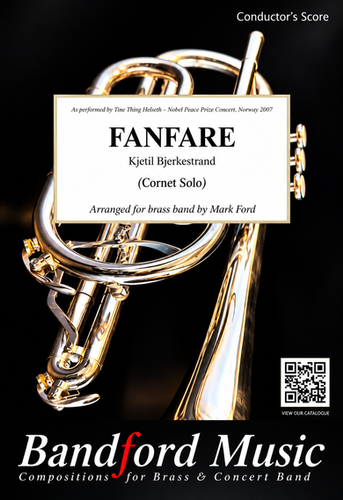 £29.88
Fanfare (Cornet Solo with Brass Band) Kjetil Bjerkestrand arr. Mark Ford
Capture the prestige and grandeur of one of the world's most celebrated stages. Originally composed by Kjetil Bjerkestrand, this stirring fanfare opened the 2007 Nobel Peace Prize Concert at the Oslo Spektrum. The piece was famously premiered by the acclaimed Norwegian trumpeter Tine Thing Helseth, marking a historic moment broadcast to millions. This arrangement brings that same professional brilliance to the brass band concert stage, featuring a soaring solo cornet part that embodies the spirit of peace and international honor. To view a rolling score video of the work please visit www.youtube.com/watch?v=aMfjKLu8BjA Duration: 1.30 minutes Difficulty Level: 4th Section + This PDF download includes the full score and parts. Sheet music available at www.brassband.co.uk (UK) or https://satradecentral.org (USA) Instrumentation: Cornet Soloist Bb Soprano Cornet Eb Solo Cornet Bb Repiano Cornet Bb 2nd Cornet Bb 3rd Cornet Bb Flugel Horn Bb Solo Horn Eb 1st Horn Eb 2nd Horn Eb 1st Baritone Bb 2nd Baritone Bb 1st Trombone Bb 2nd Trombone Bb Bass Trombone Euphonium Bb Bass Eb Bass Bb Timpani Sus. Cymbal Marimba
In Stock: Estimated dispatch 1-3 working days
-
 £33.62
For unto us a child is born from 'Messiah'(Brass Band) Handel arr. Kevin Norbury
Ever since the first performance in April 1742 in Dublin, Ireland, Messiah has been the iconic Christian oratorio. It is a work of genius with lyrics skillfully taken from the Bible by Charles Jennens and timeless music by G. F. Handel, and has been at the top of the Western musical canon for close to 300 years. For unto us a child is born comes roughly halfway through Part One of the oratorio and is one of its most popular choruses, being the prophecy of the birth of a Messiah (Jesus) found in Isaiah chapter nine. This excellent setting for brass band is by Kevin Norbury. To view a rolling score video of the work please visit https://www.youtube.com/watch?v=G63Tzi3L07U Duration: Approx. 4.00 minutes Difficulty Level: 2nd Section + PDF download includes parts and score. Sheet music available from www.brassband.co.uk Instrumentation: Soprano Cornet Eb Solo Cornet Bb Repiano Cornet Bb 2nd Cornet Bb 3rd Cornet Bb Flugel Horn Bb Solo Horn Eb 1st Horn Eb 2nd Horn Eb 1st Baritone Bb 2nd Baritone Bb 1st Trombone Bb 2nd Trombone Bb Bass Trombone Euphonium Bb Bass Eb Bass BbTimpani Snare Glockenspiel
In Stock: Estimated dispatch 1-3 working days
-
 £33.62
God so Loved the World (Brass Band) John Stainer arr. Keith M. Wilkinson
John Stainer's stellar anthem God so Loved the World from his oratorio, The Crucifixion, has here been arranged for brass band by Keith M. Wilkinson. This enduring work is possibly the most sublime musical expression of a beloved text from the Gospel of John. Although set as a standalone item and is a semi-tone below the original pitch, it will also work well as a choral accompaniment. Sheet music available from: UK - www.brassband.co.uk USA - www.solidbrassmusic.com Difficulty Level: 4th Section + Instrumentation: Soprano Cornet Eb Solo Cornet Bb Repiano Cornet Bb 2nd Cornet Bb 3rd Cornet Bb Flugel Horn Bb Solo Horn Eb 1st Horn Eb 2nd Horn Eb 1st Baritone Bb 2nd Baritone Bb 1st Trombone Bb 2nd Trombone Bb Bass Trombone Euphonium Bb Bass Eb Bass Bb Timpani Suspended Cymbal Triangle
In Stock: Estimated dispatch 1-3 working days
-
 £37.35
Good Friday Music (Brass Band) Wagner arr. Brian Bowen
This excerpt from Parsifal, the opera Wagner completed in 1882, is a poignant meditation on the chief themes contained in the musical drama: suffering, compassion and redemption. The affirmative six-note Dresden Amen is very present. Here it has been expertly set for brass band by Brian Bowen. Difficulty Level: 3rd Section + Sheet music available from: UK - www.brassband.co.uk USA - www.solidbrassmusic.com Instrumentation: Soprano Cornet Eb Solo Cornet Bb Repiano Cornet Bb 2nd Cornet Bb 3rd Cornet Bb Flugel Horn Bb Solo Horn Eb 1st Horn Eb 2nd Horn Eb 1st Baritone Bb 2nd Baritone Bb 1st Trombone Bb 2nd Trombone Bb Bass Trombone Euphonium Bb Bass Eb Bass Bb Timpani
In Stock: Estimated dispatch 1-3 working days
-
 £33.62
In the Bleak Midwinter (Brass Band) Holst arr. Mack Wilberg trs. Barrie Gott
A transcription for brass band of Mack Wilberg's popular setting of the much loved carol In the Bleak Midwinter, as sung by The King's Singers and The Choir of King's College, Cambridge at Carols from Kings in 2020. This is a reflective and beautiful arrangement of the classic Gustav Holst Christmas carol and remains faithful to the Wilberg choral setting. The arrangement underpins the well-loved melody with luscious, romantic harmonies, including moments of exquisite chromaticism. To view a rolling score video please visit www.youtube.com/watch?v=t2DbgNgezAQ PDF download includes score and parts. Sheet music available from: UK - www.brassband.co.uk USA - https://satradecentral.org Difficulty Level: 4th Section + Length: 5.10 minutes Instrumentation: Soprano Cornet Eb Solo Cornet Bb Repiano Cornet Bb 2nd Cornet Bb 3rd Cornet Bb Flugel Horn Bb Solo Horn Eb 1st Horn Eb 2nd Horn Eb 1st Baritone Bb 2nd Baritone Bb 1st Trombone Bb 2nd Trombone Bb Bass Trombone Euphonium Bb Bass Eb Bass Bb
In Stock: Estimated dispatch 1-3 working days
-
 £37.35
March - New Jerusalem (Brass Band) Kenneth Downie
This sprightly march was the result of a request for a march in traditional style, incorporating a sacred tune that is popular in Holland. It was commissioned by Egbert Scheffer and Brass Band Valerius. The mood is distinctly chirpy and jovial, with a lightness of touch and a generous dose of good humour. This item will be ideal for bands looking for a new modern-day march to freshen up their concert programmes. Sheet music available from: UK - www.brassband.co.uk USA - www.solidbrassmusic.com Difficulty Level: 4th Section + Instrumentation: Soprano Cornet Eb Solo Cornet Bb Repiano Cornet Bb 2nd Cornet Bb 3rd Cornet Bb Flugel Horn Bb Solo Horn Eb 1st Horn Eb 2nd Horn Eb 1st Baritone Bb 2nd Baritone Bb 1st Trombone Bb 2nd Trombone Bb Bass Trombone Euphonium Bb Bass Eb Bass Bb Percussion 1-2
In Stock: Estimated dispatch 1-3 working days
-
 £29.88
March - St. Julien (Brass Band) Arthur W. Hughes arr. Keith M. Wilkinson
St Julien is a town near the French/Belgian border which witnessed several battles during WW1. The composer Arthur W. Hughes (1870-1950) was born in Kingston, Ontario, and left home when he was quite young to perform with circus bands in US. He wrote several marches and a few other compositions but this one, dating from 1918, is the most well-known. The march also works as a fast circus march. Here it has been expertly arranged for brass band by Dr. Keith M. Wilkinson. Difficulty Level: 4th Section + Sheet music available from: UK - www.brassband.co.uk USA - www.solidbrassmusic.com Instrumentation: Soprano Cornet Eb Solo Cornet Bb Repiano Cornet Bb 2nd Cornet Bb 3rd Cornet Bb Flugel Horn Bb Solo Horn Eb 1st Horn Eb 2nd Horn Eb 1st Baritone Bb 2nd Baritone Bb 1st Trombone Bb 2nd Trombone Bb Bass Trombone Euphonium Bb Bass Eb Bass Bb Percussion 1-3
In Stock: Estimated dispatch 1-3 working days
-
 £33.62
Men of Harlech (Brass Band) Welsh Traditional arr. Alex McGee
This contemporary take by Alex McGee on the Welsh folk song Men of Harlech will be an entertaining addition to concert programmes. The arranger writes: 'Men of Harlech is perhaps one of the most well known of all traditional Welsh folk songs, but not like this. This setting was inspired by a composer who I first encountered as a 14-year-old playing in his first regional brass band, Gareth Wood. Upon learning of the death of Gareth I felt compelled to honour his memory and his music in composition. I struck upon the idea to do what he had done to the tune Sosban Fach to Men of Harlech, to take the tune as the raw material and try to craft it into something new yet recognisable, modern yet accessible. The work attempts to highlight what for me are the underlying characteristics of we Welsh; prone to melancholy but quick to find joy, contradictory, inviting, welcoming and warm but capable of housing a fierce streak of nationalistic pride. I dedicate this work to Gareth Wood and thank him for his music.' To view a rolling score video of the work please visit: https://www.youtube.com/watch?v=YSoZnpnhEjQ Duration: 3.30 minutes Difficulty Level: 3rd Section + PDF download includes parts and score. Sheet music available from www.brassband.co.uk Instrumentation: Soprano Cornet Eb Solo Cornet Bb Repiano Cornet Bb 2nd Cornet Bb 3rd Cornet Bb Flugel Horn Bb Solo Horn Eb 1st Horn Eb 2nd Horn Eb 1st Baritone Bb 2nd Baritone Bb 1st Trombone Bb 2nd Trombone Bb Bass Trombone Euphonium Bb Bass Eb Bass BbTimpani Percussion 1-2
In Stock: Estimated dispatch 1-3 working days
 Watch video