Results
-
 £31.95
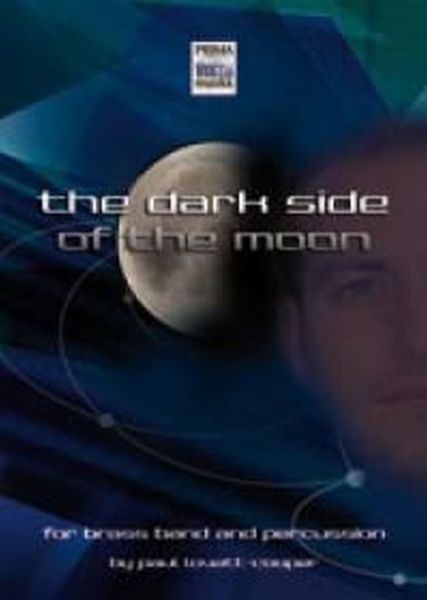
The Dark Side Of The Moon (Score Only)
This piece was commissioned by Dr. Nicholas Childs and Black Dyke Band on behalf of Rotary International and received its world premire performance at St. David's Hall, Cardiff on Saturday 27th January 2007. It is dedicated to the composer's father, Harry Cooper.The music was selected by the National Contesting Council as the 3rd section test piece for the 2008 Regional Brass Band Championships of Great Britain. A Note from the Composer...Have you ever thought of a holiday destination, tourist attraction, event, place, site or period in history and thought 'I wonder what it would be like?' - somwhere you have never been and can only let your imagination run wild on. What would the place be like, and all the things surrounding it such as the mood, feelings you get experiencing it, the temperature? Who would be there and what you would see? This piece is my musical imagination of the dark side of the moon. I know from news reports, the internet and other footage that the moon is a very desolate place, very barren and rugged. So from the start the piece gives the listener a musical picture of the rugged landscape with little light and warmth.However, the one place that has had me thinking about is the side of the moon that we don't see in our night skies, the side of the moon with no sun and no light pollution from civilisation. I can only imagine the eeriness one would feel being stood in complete darkness on the moon's surface looking around.As you slowly explore the surroundings and your eyes drift up to the night sky, there is an awesome sight unfolding in front of you - countless stars and galaxies, planets and different solar systems and all right in front of you glistening from the light of the sun beaming from the other side of the moon. The Dark Side of the Moon portrays a musical picture of the whole experience as seen in my imagination taking the listener from the rugged landscape to the awesome beauty that sits endlessly in front of you.Paul Lovatt-Cooper, September 2007
Estimated dispatch 7-14 working days
-
£40.00
A Hebridean Lullaby (Baritone Solo) - Harper, P
Composed for World Solo Champion Katrina Marzella and the Cornwall Youth Brass Band, A Hebridean Lullaby is a beautiful and haunting melody from the pen of Philip Harper, taking its inspiration from the music and folksong of the Hebrides; a cluster of islands off the west coast of Scotland. Commissioned through a BBC Fame Academy Bursary, this piece is one which is enjoyed and admired by both performers and audiences the world over. The atmosphere created by the score is simply stunning. It's an outstanding addition to the baritone horn's concert repertoire.4th section +
In Stock: Estimated dispatch 1-3 working days
-
 £48.56
A Christmas Fantasia - Brass Band (Andrew Wainwright)
Premiered in 2010 by Virtuosi GUS Band, this descriptive work features the carols 'Noel Nouvelet', 'God Rest Ye Merry Gentlemen', 'A Great and Mighty Wonder', 'The Infant King', 'Tomorrow Shall be my Dancing Day' and 'Of the Father's Heart Begotten'. "A Christmas Fantasia is a Salvation Army style selection - the kind of fusing of familiar carols that Ray Steadman-Allen and Leslie Condon were so good at. Andrew has learned well!" Paul Hindmarsh, British Bandsman magazine To view the Canadian Staff Band performing the work, please visit: https://www.youtube.com/watch?v=jFpQpLQSqUs Includes score and full set of parts. Sheet music available exclusively from World of Brass - www.worldofbrass.com Difficulty Level: 2nd Section + Instrumentation: Soprano Cornet Eb Solo Cornet Bb Repiano Cornet Bb 2nd Cornet Bb 3rd Cornet Bb Flugel Horn Bb Solo Horn Eb 1st Horn Eb 2nd Horn Eb 1st Baritone Bb 2nd Baritone Bb 1st Trombone Bb 2nd Trombone Bb Bass Trombone Euphonium Bb Bass Eb Bass Bb Timpani Percussion 1-2
In Stock: Estimated dispatch 1-3 working days
-
 £35.00
A Witches Sabbath. H. Berlioz.
Recommended - Championship & 1st Section A witches sabbath is from Symphonie Fantastique by Hector Berlioz. The music describes (through an opium induced fantasy that Berlioz had) him rescuing a woman he was madly in love with from a group of evil witches and other assorted ghouls. After descriptions of the eerie scenes, Berlioz triumphantly seizes his beloved, narrowly saving her from being sacrificed by the witches! Includes Score & Parts
-
£95.00
A Symphony Of Colours - Simon Dobson
A Symphony Of Colours contains four movements, which merge seamlessly together; Joy; Chroma (a journey through the composer's perception of synesthesia); Endless Time (where tuned percussion features alongside extended solos for the euphonium); and the final, climactic Ascent. This virtuoso score won a BASCA British Composer Award in the Brass & Wind Band category for its composer, Simon Dobson.Brass Band Grade 6: Championship.Duration: 17 Minutes.Large format scores are available on request.
In Stock: Estimated dispatch 1-3 working days
-
£125.00
Titan's Progress (Score & Parts) - Hermann Pallhuber
Commissioned by Austria's leading brass band, Brass Band Oberoesterreich, Titan's Progress is a series of descriptive, virtuoso episodes based on the principal character of the novel by Jean Paul. This was also the original subject of Mahler's Symphony No. 1, from which Hermann Pallhuber derives much of his material. The work has proved an exceptionally popular test piece all over the world. Titan's Progress was the selected test piece for the British Open Brass Band Championship, held at Symphony Hall, Birmingham on Saturday 12th September 2009. Brass Band Grade 6: Championship Duration: 17 minutes The score provided with this set is a larger format, B4 size.
In Stock: Estimated dispatch 1-3 working days
-
£95.00
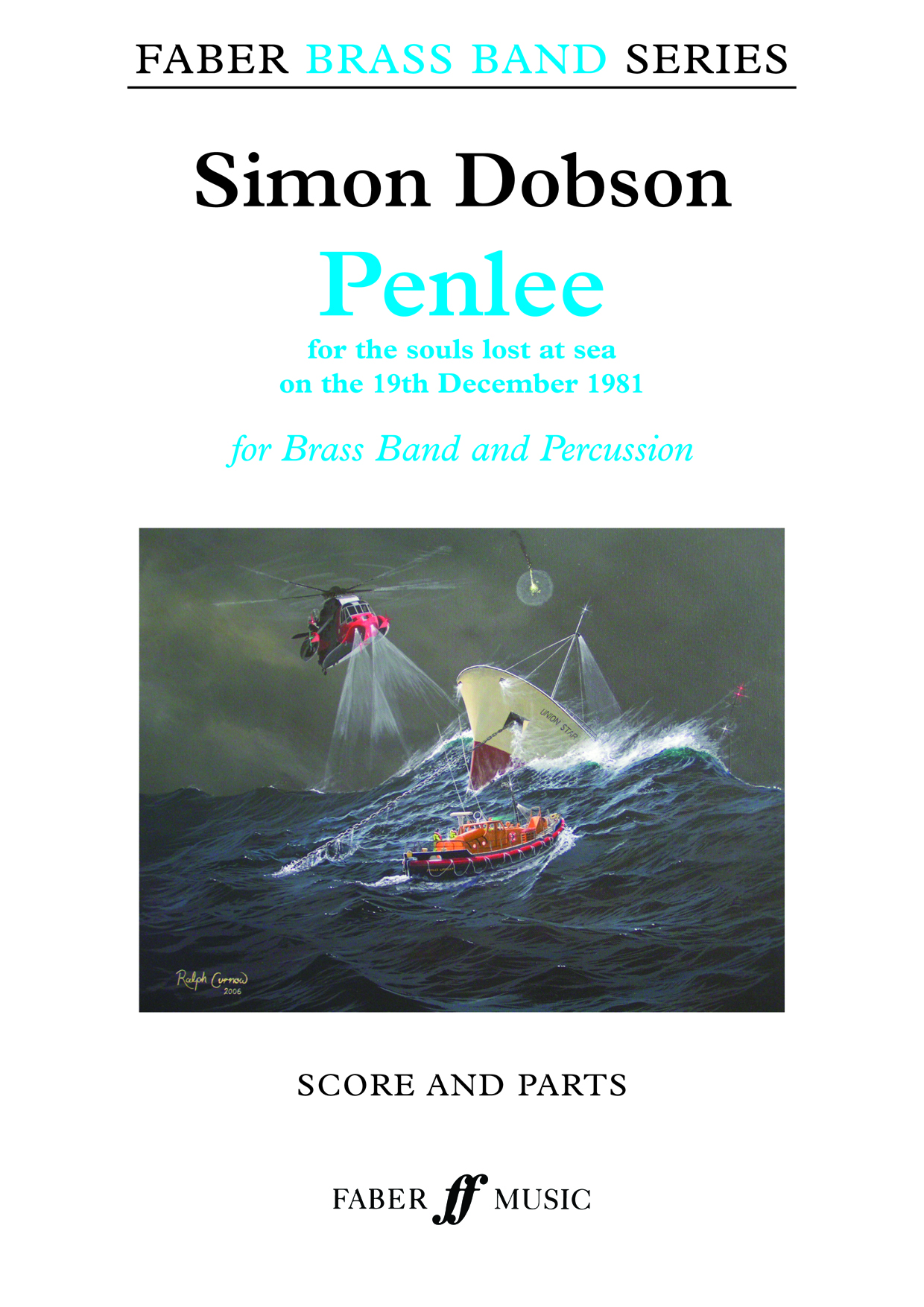
Penlee (Score & Parts) - Simon Dobson
To some, the tragic story of the Penlee lifeboat, Solomon Browne, would need no introduction, and to some the pain felt is still very much a reality. The composer, born just a few weeks before that fateful night on the 19th December 1981, has created this work as a musical homage to the bravery of the souls who lost their lives and has dedicated it to their memory.Penlee was commissioned by the Cornwall Youth Brass Band using funds bequeathed by Michael Pickett. The first performance was given by the Cornish Youth Brass Band, conducted by Ian Porthouse, at St. Michael's Church, Newquay, on 30th December 2008.Penlee has been voted into the Classic FM Hall of Fame 2011 at No.106. Not only is it the first time a brass work has been featured in the Hall of Fame, but it was also the highest new entry.The work has subsequently been recorded by the Leyland Band, conducted by Jason Katsikaris, on the CD entitled Penlee.Brass Band Grade 4: Advanced Youth and 3rd SectionDuration: 13 minutes
In Stock: Estimated dispatch 1-3 working days
-
£55.00
Mary Poppins Suite (Score & Parts) - Richard Sherman
Mary Poppins' mixture of live action and animation, together with the exceptional songs from Robert and Richard Sherman, provides a thoroughly entertaining movie spectacle. Julie Andrews's Oscar-winning performance as the title character is exceptional and Dick Van Dyke's Bert, the chimney sweep, is equally stunning (despite that comical cockney accent). Andrew Duncan has put together a very enjoyable symphonic suite of music from the film including Chim chim cher-ee; Feed the Birds, Let's go Fly a Kite, A Spoonful of Sugar, Sister Suffragette and the inimitable Supercalifragilisticexpialidocious! Brass Band Grade 4: Advanced Youth and 3rd Section. Duration: 5 minutes.
In Stock: Estimated dispatch 1-3 working days
-
 £119.95
Score and Parts: A�119.95 - Hardiman arr. Peter Graham
Additional Score: A�37.95
Estimated dispatch 3-7 working days
-
£124.95
B4 Score and Parts: A�124.95 - Symphonic Poem for Brass Band
Additional B4 Score: A�44.95
Estimated dispatch 3-7 working days
 View Music