
Results
-
 £48.56
Peace in Our Time (Brass Band) Andrew Wainwright
Commissioned by Armonico Consort to mark the 85th anniversary of the Coventry Blitz, Peace in Our Time is a profoundly moving reflection on humanity's enduring quest for reconciliation amidst turmoil. Originally scored for choir, orchestra, and organ, this masterful brass band transcription beautifully captures the emotional weight of John Oxenham's evocative poetry and the timeless plea of Psalm 122. The work opens in hushed reverence, where distant muted cornets, a dark bass pedal, and a fragile, militaristic snare drum set a shadowed, contemplative scene. Out of this delicate landscape emerges a poignant cornet solo that yields to the expressive voice of the solo flugel horn, carrying the opening text with quiet conviction before introducing the solemn reminder: "O pray for peace, peace in Jerusalem." As the piece progresses, the setting turns darker and more restless. Harmonic tension builds through rich brass textures to reflect the fears, divisions, and heavy costs of historical and modern conflict. From this emotional turbulence rises a bold, ceremonial fanfare that marks a dramatic turning point, ushering in a glorious, expansive setting of the poem's final verse. Yet rather than ending in simple triumph, the music gently recedes into a serene and tender stillness. The final bars leave performers and audiences alike with a quiet, lingering echo - a persistent hope for peace that resonates just as deeply today as it did 85 years ago. This substantial work is an extraordinary addition to any brass band library, serving as an ideal centerpiece for Remembrance Sunday, historical commemorations, church services or serious concert programming. To view a multimedia presentation of the piece with audio please visit www.youtube.com/watch?v=Y2BKI_GCegw The multimedia presentation is available on request withe purchase of this work - please email [email protected] to receive a link to download it. To view a video performance of the original work for choir, orchestra and organ please visit www.youtube.com/watch?v=m6o6PJJVKCo Duration: approx. 8.45 minutes Difficulty Level: 2nd Section + This PDF download includes the full score and parts. Sheet music available at www.brassband.co.uk (UK) or https://satradecentral.org (USA) Instrumentation: Soprano Cornet Eb Solo Cornet Bb Repiano Cornet Bb 2nd Cornet Bb 3rd Cornet Bb Flugel Horn Bb Solo Horn Eb 1st Horn Eb 2nd Horn Eb 1st Baritone Bb 2nd Baritone Bb 1st Trombone Bb 2nd Trombone Bb Bass Trombone Euphonium Bb Bass Eb Bass Bb Timpani Percussion 1-2
In Stock: Estimated dispatch 1-3 working days
-
 £33.62
Abide with me (Brass Band) William H. Monk arr. Greg Jasperse trs. Espen Haukas
VIEW SCORE PDF Greg Jasperse's choral setting of the much-loved hymn Abide with me has become very popular with choirs and has here been arranged for brass band by Norwegian composer Espen Haukas. The scoring is for standard brass band although the Repiano Cornet part is set as a second Flugel part. Optional cues are written for some upper register notes meaning the piece is playable by bands of all levels. To view a follow-the-score video with Bjorsvik Brass performing the work please visit: www.youtube.com/watch?v=lVHlQW_8Pao Sheet music available from: UK - www.brassband.co.uk USA - www.solidbrassmusic.com Difficulty Level: 4th Section + Instrumentation: Soprano Cornet Eb Solo Cornet 1&2 Bb Solo Cornet 3&4 Bb 2nd Cornet Bb 3rd Cornet Bb Flugel Horn 1&2 Bb Solo Horn Eb 1st Horn Eb 2nd Horn Eb 1st Baritone Bb 2nd Baritone Bb 1st Trombone Bb 2nd Trombone Bb Bass Trombone Euphonium 1&2 Bb Bass Eb Bass Bb Percussion 1-3
In Stock: Estimated dispatch 1-3 working days
-
 £7.46
£7.46Adoration (Cornet Solo with Brass Band - Additional Parts) Price arr. Wainwright
Florence Price was an American classical composer, pianist, organist and music teacher. She is noted as the first African-American woman to be recognised as a symphonic composer, and the first to have a composition played by a major orchestra. Price composed over 300 works: four symphonies, four concertos, as well as choral works, art songs, chamber music and music for solo instruments. In 2009, a substantial collection of her works and papers that had been previously considered lost was found in her abandoned summer home. Amongst these was this delightful work, Adoration, which had been composed in the 1950s for organ. According to IMSLP.org, the piece "failed to meet notice or renewal requirements to secure statutory copyright with no 'restoration' under the GATT amendments" and therefore is in the public domain. A version for violin and piano by Elaine Fine has become popular. This setting for cornet soloist with brass band has been arranged by Andrew Wainwright. It is also available as a Bb solo with piano here. The additional parts included in this download are for low brass in bass clef. The full brass band set is available here. To view a video of Andrew Roe performing the work, please visit: www.youtube.com/watch?v=_7UYlz8Fzxo Difficulty Level: 4th Section + Length: 3.15 minutes Sheet music available from: UK - www.brassband.co.uk USA - https://satradecentral.org Included in download: 1st Baritone B.C. 2nd Baritone B.C. 1st Trombone B.C. 2nd Trombone B.C. Euphonium B.C. Tuba B.C. (Eb Bass Part) Tuba B.C. (Bb Bass Part)
In Stock: Estimated dispatch 1-3 working days
-
 £29.88
Beaufort Fanfare (Brass Band) Friedrich Gattermann
Beaufort Fanfare, by German composer Friedrich Gattermann, is a dynamic and vibrant musical work inspired by the Beaufort scale, a system for estimating wind speeds. Originally composed for brass ensemble and percussion, it was created to showcase Orchestral Tools' Beaufort Brass sample library, recorded at the iconic AIR Studios in London. Here it has been set for brass band. A central element of Beaufort Fanfare is its exploration of musical density. The piece begins with a single motif and gradually builds in complexity and richness, reflecting the increasing strength of the wind. As it progresses, the music intensifies, with the development of density playing a crucial role in conveying the evolving character of the elements. Through intricate brass harmonies and rhythmic drive, Beaufort Fanfare captures both the awe-inspiring beauty and raw power of nature. More than just an auditory experience, this composition takes the listener on a journey through the elements, celebrating the force of wind in all its forms. To view a rolling score video of the work please visit www.youtube.com/watch?v=vdiIIERMSDY Duration: 2.15 minutes approx. Difficulty Level: 1st Section + PDF download includes parts and score. Sheet music available from www.brassband.co.uk Instrumentation: Soprano Cornet Eb Solo Cornet 1-3 Bb Solo Cornet 2-4 Bb Repiano Cornet Bb 2nd Cornet Bb 3rd Cornet Bb Flugel Horn Bb Solo Horn Eb 1st Horn Eb 2nd Horn Eb 1st Baritone Bb 2nd Baritone Bb 1st Trombone Bb 2nd Trombone Bb Bass Trombone Euphonium Bb Bass Eb Bass BbTimpani Percussion 1-3
In Stock: Estimated dispatch 1-3 working days
-
 £59.77
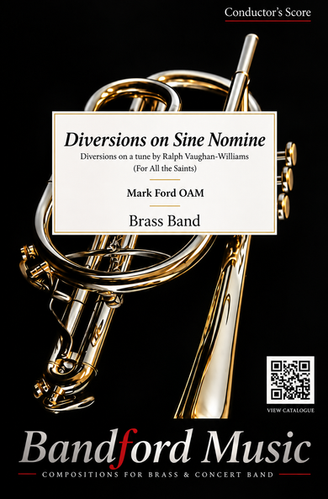
Diversions on Sine Nomine (Brass Band) Vaughan Williams arr. Mark Ford
Diversions on Sine Nomine is a substantial concert work for brass band, derived entirely from Ralph Vaughan Williams' celebrated hymn tune For All the Saints. Rather than a conventional set of variations, the work unfolds as a sequence of contrasting diversions, each reimagining aspects of the melody's character, harmony, and rhythmic potential. The opening establishes the noble and timeless quality of Sine Nomine before leading into episodes that explore a wide expressive range - from reflective and lyrical writing to passages of rhythmic energy and grandeur. Fragments of the hymn are continually transformed and re-contextualised, allowing the music to progress with clarity and purpose while maintaining a strong sense of structural coherence. Scored specifically with 3rd and 4th Section bands in mind, the work combines musical substance with practical playability. Idiomatic brass writing, transparent textures, and effective use of traditional band colours ensure musical impact without excessive technical demand. The final section brings the work to a broad and affirmative conclusion, reaffirming the dignity and enduring strength of Vaughan Williams' original melody. To view a rolling score video of the work please visit www.youtube.com/watch?v=Sth69ate-Cs Duration: 11.00 minutes Difficulty Level: 4th Section + This PDF download includes the full score and parts. Sheet music available at www.brassband.co.uk (UK) or https://satradecentral.org(USA) Instrumentation: Soprano Cornet Eb Solo Cornet 1&2 Bb Solo Cornet 3&4 Bb Repiano Cornet Bb 2nd Cornet Bb 3rd Cornet Bb Flugel Horn Bb Solo Horn Eb 1st Horn Eb 2nd Horn Eb 1st Baritone Bb 2nd Baritone Bb 1st Trombone Bb 2nd Trombone Bb Bass Trombone Euphonium Bb Bass Eb Bass Bb Timpani Percussion 1-2 Tuned Percussion
In Stock: Estimated dispatch 1-3 working days
-
 £29.88
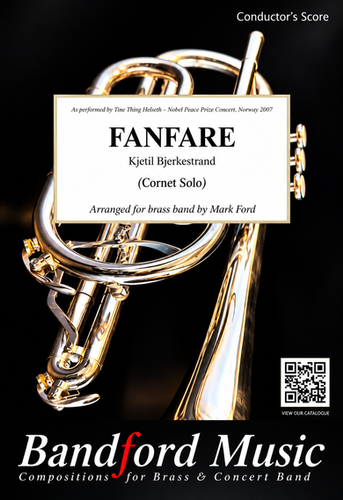
Fanfare (Cornet Solo with Brass Band) Kjetil Bjerkestrand arr. Mark Ford
Capture the prestige and grandeur of one of the world's most celebrated stages. Originally composed by Kjetil Bjerkestrand, this stirring fanfare opened the 2007 Nobel Peace Prize Concert at the Oslo Spektrum. The piece was famously premiered by the acclaimed Norwegian trumpeter Tine Thing Helseth, marking a historic moment broadcast to millions. This arrangement brings that same professional brilliance to the brass band concert stage, featuring a soaring solo cornet part that embodies the spirit of peace and international honor. To view a rolling score video of the work please visit www.youtube.com/watch?v=aMfjKLu8BjA Duration: 1.30 minutes Difficulty Level: 4th Section + This PDF download includes the full score and parts. Sheet music available at www.brassband.co.uk (UK) or https://satradecentral.org (USA) Instrumentation: Cornet Soloist Bb Soprano Cornet Eb Solo Cornet Bb Repiano Cornet Bb 2nd Cornet Bb 3rd Cornet Bb Flugel Horn Bb Solo Horn Eb 1st Horn Eb 2nd Horn Eb 1st Baritone Bb 2nd Baritone Bb 1st Trombone Bb 2nd Trombone Bb Bass Trombone Euphonium Bb Bass Eb Bass Bb Timpani Sus. Cymbal Marimba
In Stock: Estimated dispatch 1-3 working days
-
 £33.62
Have Yourself a Merry Little Christmas (Vocal or Flugel/Cornet Solo with Band)
This attractive Bossa Nova-style arrangement for vocal or flugel/cornet soloist with brass band has been made by Australian composer Sam Creamer. The key is suitable for male or female vocalists, or in the absence of a vocal soloist a part has been supplied for flugel horn or cornet soloist. A piano accompaniment that matches this band arrangement is also available here and may be used as an alternate accompaniment in the absence of a full band, or can be used simultaneously by a rhythm section alongside the brass band. Have Yourself a Merry Little Christmas has been a Christmas favourite to many since its first release, extensively featuring in Christmas movies, broadcasts and programming. It has also been recorded numerous times by artists including Judy Garland, Frank Sinatra, Tori Amos, Michael Buble, Christina Aguilera, and Chicago. To view a rolling score video of this piece please visit www.youtube.com/watch?v=sSZHxzsJheg Duration: Approx. 3.00 minutes Difficulty Level: Medium Easy PDF download includes parts and score. Sheet music available from www.brassband.co.uk or www.durhammusicshop.co.uk (UK) or https://satradecentral.org (US) Instrumentation: Vocal Soloist Cornet/Flugel Horn Soloist Bb Soprano Cornet Eb Solo Cornet Bb Repiano Cornet Bb 2nd Cornet Bb 3rd Cornet Bb Flugel Horn Bb Solo Horn Eb 1st Horn Eb 2nd Horn Eb 1st Baritone Bb 2nd Baritone Bb 1st Trombone Bb 2nd Trombone Bb Bass Trombone Euphonium Bb Bass Eb Bass BbPercussion I (Timpani, Vibraphone, Glockenspiel) Percussion II (Bongos, Shaker, Triangle) Percussion III(Drum Set)
In Stock: Estimated dispatch 1-3 working days
-
 £37.35
Horn Concerto No.1 1st Movement (Tenor Horn Solo with Band) Haydn arr. Wilson
Franz Joseph Haydn's Horn Concerto No.1 in D major was composed in 1762, when he was new to the Esterhazy court. It is a virtuosic concerto that showcases the beauty and range of the horn. The concerto was originally scored for solo horn and orchestra, and is one of Haydn's most popular works. Here it has been arranged by Duncan Wilson for tenor horn with brass band. His arrangement of the concerto is a faithful and effective adaptation of the original work. The movement opens with a lively tutti introduction, followed by the entrance of the solo horn. The horn plays a series of melodies and passages that are both lyrical and virtuosic. The band provides accompaniment and contrast, and the two interact in a lively dialogue. The movement builds to a climax and then concludes with a triumphant coda. To view a follow-the-score video please visit https://www.youtube.com/watch?v=Uo2K5tge6Fs PDF download includes score and parts. Sheet music available from: UK - www.brassband.co.uk USA - www.solidbrassmusic.com Difficulty Level: 2nd Section + Instrumentation: Tenor Horn Soloist Eb Soprano Cornet Eb Solo Cornet Bb Repiano Cornet Bb 2nd Cornet Bb 3rd Cornet Bb Flugel Horn Bb 1st Horn Eb 2nd Horn Eb 1st Baritone Bb 2nd Baritone Bb 1st Trombone Bb 2nd Trombone Bb Bass Trombone Euphonium Bb Bass Eb Bass Bb Timpani
In Stock: Estimated dispatch 1-3 working days
-
 £33.62
Love Eternal (Tenor Horn Solo with Brass Band) Jarrod Cooper arr.Gavin Lamplough
Love Eternal was written by Gavin Lamplough for Neil Blessett, who at the time of writing was the Principal Horn player of both Birmingham (UK) Citadel Band and the International Staff Band of The Salvation Army. The arranger uses Jarod Cooper's popular contemporary worship song King of Kings, Majesty as the basis for the work and the piece seeks to provide a vehicle for the rich timbres of the tenor horn to be enjoyed by the listener. The music reflects the Christian musician's desire to offer their talents to God to be used by Him, and the lyrics of the song are ones of contrast as the musical journey of this piece seeks to emulate the juxtaposition through contrasting moods. To view a video of Neil Blessett performing the solo with Birmingham (UK) Citadel Band please visit www.youtube.com/watch?v=Jx5G-MDpD_g This title is also available as a trombone solo with brass band here. PDF download includes score and parts. Sheet music available from: UK - www.brassband.co.uk USA - https://satradecentral.org Difficulty Level: 4th Section + Length: 5.00 minutes Instrumentation: Tenor Horn Soloist Eb Soprano Cornet Eb 1st Cornet Bb 2nd Cornet Bb Flugel Horn Bb 1st Horn Eb 2nd Horn Eb 1st Baritone Bb 2nd Baritone Bb 1st Trombone Bb 2nd Trombone Bb Bass Trombone Euphonium Bb Bass Eb Bass Bb Percussion 1-3
In Stock: Estimated dispatch 1-3 working days
-
 £37.35
Nocturne for Brass Band & Percussion: The Lady with the Lamp - Andy Wareham
VIEW SCORE PDF Nocturne for Brass Band & Percussion: The Lady with the Lamp was composed for the BrookWright International Brass Band Composer Competition 2020, the work later going on to be a finalist in the competition. The music celebrates the life and achievements of Florence Nightingale on the 200th anniversary of her birth. The work is structured in ternary form and is designed to be an engaging concert piece, accessible to both lower and upper section bands. Minimal percussion has been used and ossia passages have been added to accommodate all levels. The music imagines Miss Nightingale walking the wards at night with the contrasting sections representing her devotion to the care of others, the struggles and sacrifice of her service, and the lasting effect of her renowned achievements that are still felt to this day. Sheet music available from: UK - www.brassband.co.uk USA - www.solidbrassmusic.com Difficulty Level: 2nd Section + Instrumentation: Soprano Cornet Eb Solo Cornet 1&2 Bb Solo Cornet 3&4 Bb Repiano Cornet Bb 2nd Cornet Bb 3rd Cornet Bb Flugel Horn Bb Solo Horn Eb 1st Horn Eb 2nd Horn Eb 1st Baritone Bb 2nd Baritone Bb 1st Trombone Bb 2nd Trombone Bb Bass Trombone Euphonium 1&2 Bb Bass Eb Bass Bb Timpani Percussion 1-2
In Stock: Estimated dispatch 1-3 working days
 Watch video