Results
-
£55.00
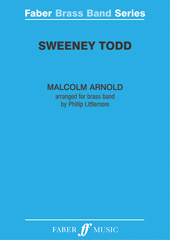
Sweeney Todd Suite - Malcolm Arnold
Malcolm Arnold's ballet, Sweeney Todd, was first staged in 1959 by The Royal Ballet Company with choreography by John Cranko. The music was later adapted as a concert work and it is from this version that this brass band arrangement, by Phillip Littlemore, is made. The original concert suite lasts some 20 minutes, but this version has been shortened to a more manageable eight minutes.The first performance of this arrangement was given on the 22nd October 2006 at the Malcolm Arnold Festival, Derngate, Northampton by the Rushden Windmill Band conducted by Richard Graves.Brass Band Grade 4: Advanced Youth and 3rd Section.Duration 8 minutes.
In Stock: Estimated dispatch 1-3 working days
-
 £30.00
Deus in Adjutorium
DescriptionMonteverdi's Vespro della Beata Vergine (Vespers for the Blessed Virgin) is a musical setting by Claudio Monteverdi of the evening vespers on Marian feasts, scored for soloists, choirs, and orchestra. It is an ambitious work in scope, style and scoring, and has a duration of around 90 minutes. Published in Venice with a dedication to Pope Paul V dated 1 September 1610 as Sanctissimae Virgini Missa senis vocibus ac Vesperae pluribus decantandae, cum nonnullis sacris concentibus, ad Sacella sive Principum Cubicula accommodata ("Mass for the Most Holy Virgin for six voices, and Vespers for several voices with some sacred songs, suitable for chapels and ducal chambers"), it is mercifully regularly shortened to Monteverdi's Vespers of 1610.Monteverdi was born and spent the first part of his working life in Cremona before moving to Mantua (where he composed the Vespers) and finally attaining one of the top jobs in Italian renaissance music as Maestro di Capella at the Basilica di San Marco in Venice. He is most famous for his vocal music, notably his madrigals and the earliest surviving opera, Orfeo.Watch a preview video of the brass band score below:
Estimated dispatch 7-14 working days
-
 £20.00
atrium phase
Descriptionatrium phase was inspired by listening to works performed at the 2013 Huddersfield Contemporary Music Festival in the atrium of the Huddersfield University Creative Arts Building. The atrium, despite being a functional area incorporating meeting areas and a cafe, has almost coincidentally evolved into a fantastic (if somewhat resonant) performance space. Performers can be positioned on three different sides and three different levels, making the atrium ideally suited to spatially separated performances of a variety of music from Gabrieli to Christian Wolff.In atrium phase the band is separated into four groups - ideally these should be positioned around the audience as follows: group A to the left of the audience, group B in front of the audience, group C to the right of the audience and group D (the four basses) behind the audience. The music "phases" between the groups in the manner of contemporary electroacoustic music, with the bass group acting as a kind of "subwoofer". Starting very slowly, the music accelerates using metrical modulations to finish at considerable speed.The music is intended to be performed without a conductor wherever possible - the three percussionists should set and control the tempo, and there are clear points of overlap for percussionists to allow synchronisation between groups.atrium phase won the inaugural Foden's Band Composition Competition in 2014 and the first performance was given on 24 January 2015 at the RNCM Festival of Brass by Foden's Band.Performance Notes:The band is separated into four groups - ideally these should be positioned around the audience as follows: group A to the left of the audience, group B in front of the audience, group C to the right of the audience and group D (the four basses) behind the audience. The music "phases" between the groups in the manner of contemporary electroacoustic music, with the bass group acting as a kind of "subwoofer". Starting very slowly, the music accelerates using metrical modulations to finish at considerable speed.Instruments in group A require cup mutes (soprano, 2 x cornets, horn, baritone, trombone, euph), group B harmon mutes (4 x cornets, baritone and trombone - the baritone should use a trombone mute) and group C require fibre straight mutes (3 x cornets, flugel, 2 x horns, euph., bass trom - NOT metal mutes if possible).Percussion instruments required are claves, wood block and 2 x temple blocks. The music is intended to be performed without a conductor wherever possible - the three percussionists should set and control the tempo, and there are clear points of overlap for percussionists to allow synchronisation between groups.Approximate duration 6'17"
Estimated dispatch 7-14 working days
-
 £10.00
Kopanitsa
DescriptionKopanitsa was commissioned by Gavin Pritchard, who is also the work's dedicatee and gave the first performance with the Tongwynlais Temperance Band conducted by Gareth Pritchard at the Butlins Mineworkers Championship on 20 January 2008, winning the prize for best soloist as a result. He has recorded it on the CD "Enter the Galaxies" accompanied by the Cory Band conducted by Robert Childs.Gavin had requested a virtuoso showpiece featuring as many instruments as possible. The solo part is therefore written for vibraphone (bowed and struck), 10 x tuned tom toms, 5 x suspended cymbals plus hi-hat and a xylophone. The soloist's 'choreography' therefore forms an integral part of the performance. This can be seen to great effect in Gavin's performance of the work at the 2013 Brass in Concert Championship with Tredegar Band, available on the DVD of the event from World of Brass. A 'kopanitsa' is a Bulgarian folk dance that traditionally features two slow beats and two quick beats, reflected in the central 10/8 section. The music is deliberately Balkan in character, using the characteristic modes of Greek and Bulgarian folk music, and accelerates regularly to finish at breakneck speed. The tom-tom section marked 'ad lib.' after [D] can be improvised if the soloist wishes.You can follow the score in the preview video below!
Estimated dispatch 7-14 working days
-
£59.95
ELLACOMBE CHRONICLES, The (Brass Band Set) - James Curnow
This piece was commissioned by Brass Band of Columbus for the occasion of the band's 25th anniversary in 2009. It is dedicated to current and former members of the band and its founding Director, Dr Paul Droste. The hymns of Isaac Watts (1674 - 1748) have been a source of inspiration for musical thought and development by composers for over 200 years. His glorious hymn 'I sing the mighty power of God' has been coupled with the hymn tune 'Ellacombe' in many hymnals over these two centuries. This work was created and inspired by Isaac Watts's text and chronicles the three verses of the hymn through a set of diverse variations on the hymn tune 'Ellacombe'. The opening fanfare is intended to capture the joy and exuberance of the first phrase of the first verse, 'I sing the mighty power of God that made the mountains rise'. The developmental material following the fanfare gives a hint of the three large variations that are extracted from the tune.
Estimated dispatch 7-14 working days
-
£44.95
TURRIS FORTISSIMA (Brass Band Set) - Steven Ponsford
The geographical position of Plymouth (the composer's home city) means that, at various times in history, the city has been the United Kingdom's first line of defence. A series of forts around the coast bears testimony to this and forts have featured on the city's coat of arms ever since. However, the city's forefathers believed that physical security was worthless without a faith in God's protection and this is reflected in the city motto; Turris fortissima est nomen Jehovah (The name of Jehovah is our strongest tower) (Proverbs 18:10). Written for Enfield Citadel Band's tour of the USA in 2007, the music attempts to portray this assurance with the use of the tune Ein' Fest Burg (A mighty fortress is our God) along with the more contemporary Blessed be the Name of the Lord and Shout to the Lord. There is also an apt reference to Dean Goffin's My Strength, My Tower as the music builds to its dramatic final bars.
Estimated dispatch 7-14 working days
-
 £30.00
Black Bottom Stomp - Jelly Roll Morton
Ferdinand Joseph LaMothe, professionally known as Jelly Roll Morton, was an American ragtime and early jazz pianist, bandleader and composer who started his career in New Orleans, Louisiana. Widely recognised as a pivotal figure in early jazz, Morton is perhaps most notable as jazz's first arranger, proving that a genre rooted in improvisation could retain its essential spirit and characteristics when notated. His composition "Jelly Roll Blues" was the first published jazz composition in 1915. Morton is also notable for writing such standards as "King Porter Stomp", "Wolverine Blues", "Black Bottom Stomp", and "I Thought I Heard Buddy Bolden Say". Notorious for his arrogance and self-promotion, Morton claimed to have invented jazz outright in 1902, much to the derision of fellow musicians and the critics. At the age of fourteen, Morton began working as a piano player in a brothel (or, as it was referred to back then, a sporting house). In that atmosphere, he often sang smutty lyrics and took the nickname "Jelly Roll". While working there, he was living with his religious, church-going great-grandmother; who he convinced that he worked as a night watchman in a barrel factory. After Morton's grandmother found out that he was playing jazz in a local brothel, she kicked him out of her house and told him that "devil music" would surely bring about his downfall. Born in downtown New Orleans, Louisiana, his exact birth date differs depending to whichever source you want to believe; his half-sisters claimed he was born in September 1885, but his World War 1 draft card showed September 1884 and his California death certificate listed his birth as September 1889. He died in 1941 in Los Angeles.
-
 £30.00
Fantasia on themes by Purcell - Ian Shepherd
Fantasia consists of three distinct sections that use thematic material from three separate pieces by Henry Purcell. The first section is based on the march from Funeral Music for Queen Mary which is dramatically dark and powerful but also uplifting. The Second section uses the devastatingly beautiful aria Dido's Lament or When I am laid in earth from the opera Dido and Aeneas as its basis and builds to enormous proportions, unlike the original aria. The third section begins with a haunting reference to the Rondo from Abdelazer. Gradually, this builds towards an exciting re-statement of the theme in the first section to the finale.
-
Paint It Black - Mick Jagger & Keith Richards - Len Jenkins
"Paint It Black" (originally released as "Paint It, Black") was written by Mick Jagger and Keith Richards, and first released as a single on 6 May 1966. It became the Rolling Stones' sixth number one in the UK and has remained influential as the first number one hit featuring a sitar. The song came at a pivotal period in The Rolling Stones' recording history, a time that saw the song-writing collaboration of Jagger and Richards assert itself as the principal composers of the band's original material. Its lyrics are for the most part meant to describe bleakness and depression and describe the extreme grief suffered by one stunned by the sudden and unexpected loss of wife, lover or partner. It famously plays during the end credits of the film Full Metal Jacket. Beginning in the style of an ironic minuet, which can be by-passed by starting at bar 54 where the heavy rock beat takes over, the piece is interesting and within the capabilities of 3rd or 4th section bands. For those bands with a drummer and one percussionist, an alternative percussion part is provided.
-
 £44.95
Judd: Turris Fortissima
The geographical position of Plymouth (the composer's home city) means that, at various times in history, the city has been the United Kingdom's first line of defence. A series of forts around the coast bears testimony to this and forts have featured on the city's coat of arms ever since. However, the city's forefathers believed that physical security was worthless without a faith in God's protection and this is reflected in the city motto; Turris fortissima est nomen Jehovah (The name of Jehovah is our strongest tower) (Proverbs 18:10). Written for Enfield Citadel Band's tour of the USA in 2007, the music attempts to portray this assurance with the use of the tune Ein' Fest Burg (A mighty fortress is our God) along with the more contemporary Blessed be the Name of the Lord and Shout to the Lord. There is also an apt reference to Dean Goffin's My Strength, My Tower as the music builds to its dramatic final bars.
Estimated dispatch 7-14 working days