
Results
-
.NOBOX-1.jpg) £40.00
£40.00Bass Trombone Concerto - Gareth Wood
Written in 2006 for Roger Argente, Gareth Wood brings his considerable experience of writing for brass, and brass bands in particular, to an instrument not often blessed with opportunities for solo exposure. It is scored for soloist accompanied by traditional brass band line-up, including timpani and two percussion, and follows the standard three-movement pattern. In the first movement, the soloist launches straight into the musical argument with a low-lying repeated quaver figure punctuated by the band. A lyrical second subject in the high register is also entrusted to the soloist, and the movement comes to a thrilling conclusion. The slow movement opens softly with the percussion, and a mournful bass line sets the mood for a thoughtful long melody. It reaches a powerful climax, which subsides to a return of the opening mood. In the march-like finale, the soloist is pitted against a number of solo instruments from the band and a driving ostinato carries the momentum through to the blazing ending.
-
 £42.00
Euphonium Music (Score only) - Brian Bowen
Written in 1978, the work is constructed in three movements and is virtually a concerto for euphonium and band. The first movement begins with an unaccompanied motto theme, which uses all twelve notes of the scale but with a tonal feel. The slow second movement is based on an original song melody by the composer - 'The Eyes of God' - and affords lyrical and richly expressive playing that is typically euphonium. Movement three follows without a break - a capricious movement which ends triumphantly. Now available in versions for piano, brass band, wind band, and orchestra, Euphonium Music can be seen as a major contribution to the literature for the instrument. Duration: 15 minutes An orchestral version is available on hire.
Estimated dispatch 7-9 working days
-
 £52.00
Euphonium Music (Parts only) - Brian Bowen
Written in 1978, the work is constructed in three movements and is virtually a concerto for euphonium and band. The first movement begins with an unaccompanied motto theme, which uses all twelve notes of the scale but with a tonal feel. The slow second movement is based on an original song melody by the composer - 'The Eyes of God' - and affords lyrical and richly expressive playing that is typically euphonium. Movement three follows without a break - a capricious movement which ends triumphantly. Now available in versions for piano, brass band, wind band, and orchestra, Euphonium Music can be seen as a major contribution to the literature for the instrument. Duration: 15 minutes An orchestral version is available on hire.
Estimated dispatch 7-9 working days
-
 £110.00
Diversions After Benjamin Britten (Brass Band - Score and Parts)
Suite by Lucy Pankhurst, Simon Dobson, Paul McGhee and Gavin HigginsHaving devised a collective centenary tribute for Michael Tippett at the 2006 RNCM Festival of Brass (Variations on a Theme of Michael Tippett by five eminent composers of brass band music, PHM002), I commissioned this companion piece as a Benjamin Britten tribute for the 2013 festival. In the late 1970s, while researching a book about the English composer, and Britten's first teacher, Frank Bridge (1879 - 1941), I came across a copy of the printed score of Benjamin Britten's Variations on a Theme of Frank Bridge (Op.10) for string orchestra, in which Britten had written descriptive titles for each of the variations suggesting appropriate character traits of his much loved mentor and guide. The character variations are cast in march, song and dance forms.Taking inspiration from Britten's youthful tribute, I invited four award-winning composers, who have all made significant contributions to the brass band medium, to create their own personal reflections on four aspects of Britten's character and music, designed to form a suite of Diversions after Benjamin Britten, but which can also be played separately.Lucy Pankhurst's hauntingly lyrical Prelude: His Depth refers to the emotional and symbolic subtexts that underpin Britten's operas, taking its musical cue from Britten's many arrangements of folk songs. The flugel horn takes a prominent role throughout.Simon Dobson's breathless Scherzo: His Vitality reminds us with its rapid passage work and leaping bass 'groove' that Britten loved tennis and fast cars in his younger days.Paul McGhee's evocative interpretation of the March: His Sympathy represents Benjamin Britten's pacifism, as the composer writes: 'We view the music through the eyes of a pacifist. Whilst war and violence surround us, we do not engage in it and though it continues to happen around us. With the use of muted effects in most of the band throughout the piece, the flugel horn is the lone voice of reason, standing firm against the mechanical and destructive society in which it is forced to live. As the machine of war continues around the lone voice, the voice is gradually dismissed and mocked as the war machine rumbles on into the distance.'In an extended finale, entitled Toccata: His Skill, Gavin Higgins celebrates Benjamin Britten's consummate creativity. For the RNCM Festival of Brass premiere, the four contrasting movements were framed and connected by Britten's Fanfare for St. Edmundsbury for three trumpets, with the trumpet soloists spaced round the hall. I am grateful to the Britten Estate and publishers Boosey & Hawkes for giving permission for the elements of Britten's fanfare to be incorporated in the collective work.- Paul HindmarshDuration: 19.30
Estimated dispatch 7-14 working days
-
£45.00
Diversions After Benjamin Britten (Brass Band - Score only)
Suite by Lucy Pankhurst, Simon Dobson, Paul McGhee and Gavin HigginsHaving devised a collective centenary tribute for Michael Tippett at the 2006 RNCM Festival of Brass (Variations on a Theme of Michael Tippett by five eminent composers of brass band music, PHM002), I commissioned this companion piece as a Benjamin Britten tribute for the 2013 festival. In the late 1970s, while researching a book about the English composer, and Britten's first teacher, Frank Bridge (1879 - 1941), I came across a copy of the printed score of Benjamin Britten's Variations on a Theme of Frank Bridge (Op.10) for string orchestra, in which Britten had written descriptive titles for each of the variations suggesting appropriate character traits of his much loved mentor and guide. The character variations are cast in march, song and dance forms.Taking inspiration from Britten's youthful tribute, I invited four award-winning composers, who have all made significant contributions to the brass band medium, to create their own personal reflections on four aspects of Britten's character and music, designed to form a suite of Diversions after Benjamin Britten, but which can also be played separately.Lucy Pankhurst's hauntingly lyrical Prelude: His Depth refers to the emotional and symbolic subtexts that underpin Britten's operas, taking its musical cue from Britten's many arrangements of folk songs. The flugel horn takes a prominent role throughout.Simon Dobson's breathless Scherzo: His Vitality reminds us with its rapid passage work and leaping bass 'groove' that Britten loved tennis and fast cars in his younger days.Paul McGhee's evocative interpretation of the March: His Sympathy represents Benjamin Britten's pacifism, as the composer writes: 'We view the music through the eyes of a pacifist. Whilst war and violence surround us, we do not engage in it and though it continues to happen around us. With the use of muted effects in most of the band throughout the piece, the flugel horn is the lone voice of reason, standing firm against the mechanical and destructive society in which it is forced to live. As the machine of war continues around the lone voice, the voice is gradually dismissed and mocked as the war machine rumbles on into the distance.'In an extended finale, entitled Toccata: His Skill, Gavin Higgins celebrates Benjamin Britten's consummate creativity. For the RNCM Festival of Brass premiere, the four contrasting movements were framed and connected by Britten's Fanfare for St. Edmundsbury for three trumpets, with the trumpet soloists spaced round the hall. I am grateful to the Britten Estate and publishers Boosey & Hawkes for giving permission for the elements of Britten's fanfare to be incorporated in the collective work.- Paul HindmarshDuration: 19.30
Estimated dispatch 7-14 working days
-
 £39.95
Judd: A Pastoral Symphony
This symphony for brass band seeks to explore the thought that 'the greatest need of any congregation is its pastor's personal holiness'. The first movement challenges the pastor 'to serve the present age', the tunes 'Majesty' and 'Lathbury' are used. The second movement expresses a priority to 'Seek...first the Kingdom of God'. The short third movement presents the question 'Except I am moved with compassion, how dwellest they Spirit in me?' before the triumphant finale reflects the desire of every Christian that his life and work will always be for the glory of God with the presentation of 'In my life Lord, be glorified'.
Estimated dispatch 7-14 working days
-
 £3.95
£3.95On the Face! (High Trombone/Euphonium BC)
Please note: This part is only for use when there is a Tuba in the ensemble.On the Face is a complete repertoire (warm-ups and 23 pieces) for beginner brass ensemble. Perfect material for school assemblies and music centres, it includes folk songs, famous classical themes, and exciting new jazz and pop numbers. Each piece is score for a basic trio of two trumpets/cornets and one trombone/euphonium (TC or BC). However, optional independent parts can also be added for horn in E flat or F; high trombone or euphonium (tenor part); tuba; and drum kit. The pieces work equally well either with one player to a part, or in larger group settings. With its appealing variety of musical styles and textures, On the Face is sure to make the young brass player's first experience of group playing both rewarding and fun.
Estimated dispatch 7-14 working days
-
 £3.95
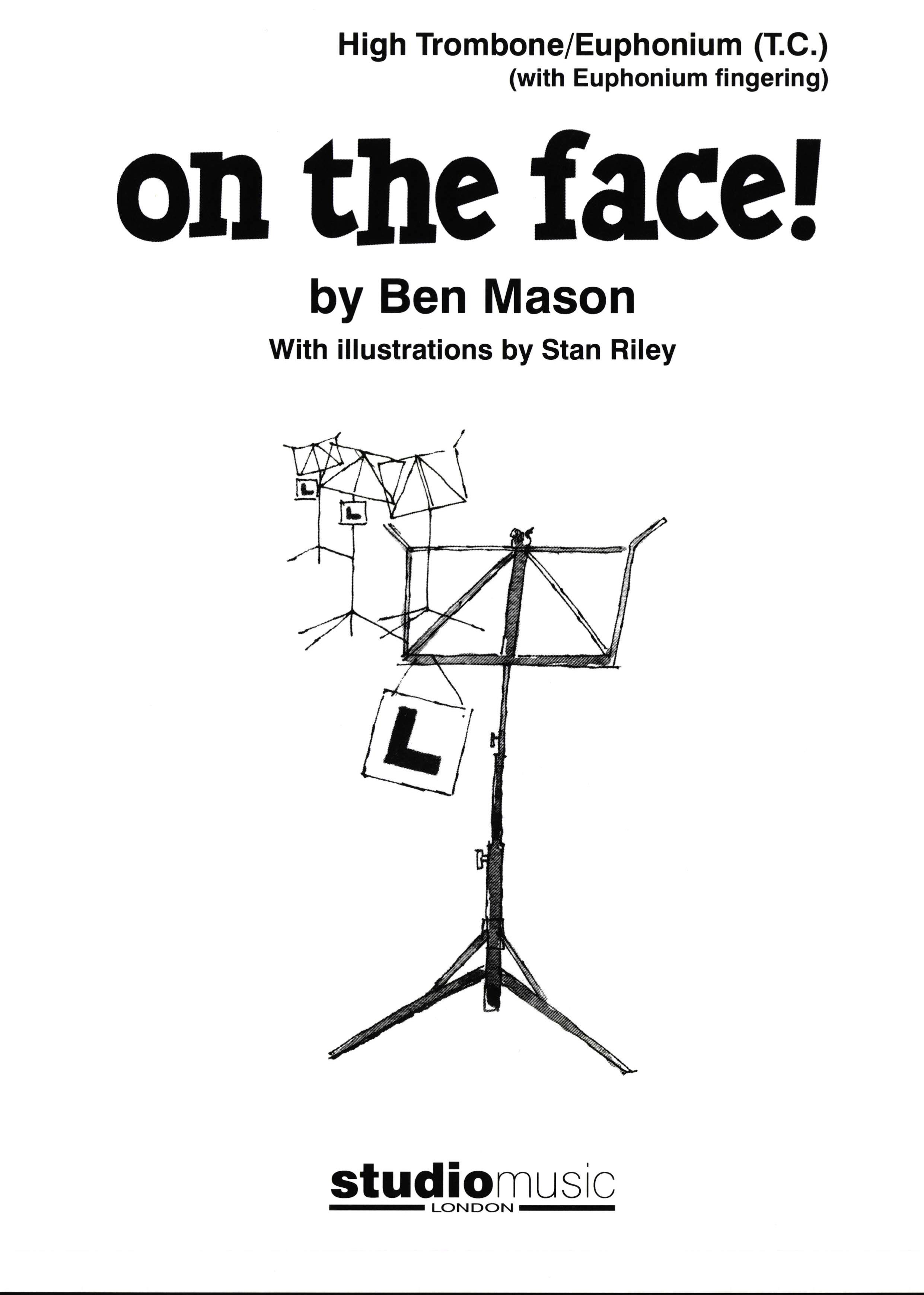
£3.95On the Face! (High Trombone/Euphonium TC)
Please note: This part is only for use when there is a Tuba in the ensemble.On the Face is a complete repertoire (warm-ups and 23 pieces) for beginner brass ensemble. Perfect material for school assemblies and music centres, it includes folk songs, famous classical themes, and exciting new jazz and pop numbers. Each piece is score for a basic trio of two trumpets/cornets and one trombone/euphonium (TC or BC). However, optional independent parts can also be added for horn in E flat or F; high trombone or euphonium (tenor part); tuba; and drum kit. The pieces work equally well either with one player to a part, or in larger group settings. With its appealing variety of musical styles and textures, On the Face is sure to make the young brass player's first experience of group playing both rewarding and fun.
Estimated dispatch 7-14 working days
-
 £99.95
Carols for Band (Brass Band - Score and Parts)
Designed to be playable by any combination from quartet to full brass band, wind band or orchestra, the arrangements in this book with provide a practical solution to all your carolling needs. Parts are divided into Soprano, Alto, Tenor and Bass so that any suitable instrumentation will sound well, providing an equal balance of players per voice is maintained. The carols are printed in alphabetical order so they are easy to find, and comprehensively indexed under both first line and name of tune.Score, Timpani and Percussion parts are available separately.Instrumentation is as follows: Brass BandWind BandStringsSopranoEb Soprano CornetSolo Bb CornetBb Repiano & Flugel1st Flute & Piccolo2nd FluteOboe1st Bb Clarinet1st Bb Trumpet/Cornet1st ViolinAlto2nd & 3rd Bb CornetSolo Eb Horn1st Bb Trombone2nd & 3rd Bb ClarinetsEb Alto Saxophone2nd Bb Trumpet/Cornet1st F Horn2nd ViolinTenor1st & 2nd Eb Horns1st & 2nd Bb Baritones2nd Bb Trombone1st Bb EuphoniumEb Alto ClarinetBb Tenor Saxophone2nd F Horn1st & 2nd TrombonesViolaBassBass Trombone2nd Bb EuphoniumEb BassBb BassBassoonBb Bass ClarinetEb Baritone SaxophoneBass TromboneEuphoniumTubaCello/BassTitles included:Angels from the Realms of GloryAs with Gladness Men of OldAway in a MangerBrightest and BestChristians AwakeCoventry CarolDeck the HallsDing Dong, Merrily on HighFirst NowellGod Rest ye Merry, GentlemenGood King WenceslasHark the Glad SoundHark, the Herald Angels SingHolly and the IvyI Saw Three ShipsIn Dulci JubiloIn the Bleak Mid-WinterInfant HolyInfant KingIt Came Upon a Midnight ClearJingle BellsLo, He Comes with Clouds DescendingLove Came Down at ChristmasO Come, All ye FaithfulO Come, O Come, EmmanuelO Little Town of BethlehemOf the Father's Love BegottenOnce in Royal David's CitySans Day CarolSee Amid the Winter's SnowSilent NightSussex CarolThou Didst Leave Thy ThroneUnto Us is Born a SonWe Wish You a Merry ChristmasWhile Shepherds WatchedThe Brass Band Set consists of 25 Parts:1 x Eb Soprano Cornet4 x Solo Bb Cornet2 x Bb Repiano & Flugel4 x 2nd & 3rd Bb Cornet1 x Solo Eb Horn2 x 1st & 2nd Eb Horn2 x 1st & 2nd Bb Baritone1 x 1st Bb Trombone1 x 2nd Bb Trombone1 x Bass Trombone1 x 1st Bb Euphonium1 x 2nd Bb Euphonium2 x Eb Bass2 x Bb Bass
Estimated dispatch 7-14 working days
-
 £55.00
Italia
ABOUT THIS PIECE: Romance. Elegance. This is an exquisite arrangement of the song originally performed by Chris Botti and Andrea Bocelli: Italia. Composed by Chris Botti and David Foster, Italia is a heartfelt tribute to the beauty and passion of Italy, blending lush melodies with a sense of timeless sophistication. The original, featuring Botti's soaring trumpet lines and Bocelli's rich tenor voice, is celebrated for its emotional depth and breathtaking lyricism. This arrangement adapts those qualities for solo cornet, solo trombone, and brass band, offering a wonderful opportunity to explore the piece's expressive range and captivating musicality. ENSEMBLE: Cornet and Trombone with British Brass Band Accompaniment WHEN YOU BUY THIS PRODUCT, YOU GET: High-quality printed score and parts - DUE TO COPYRIGHT LAW THIS WORK IS ONLY AVAILABLE IN THE UK AND EUROPE LEVEL: 2 LISTEN: DURATION: 3-minutesEXAMPLE SCORE: Click here LEVEL GUIDE: Level 1- Accessible to all Level 2 - c. UK third section and higher Level 3 - c. UK second section and higher Level 4 - c. UK first section and higher Level 5 - c. UK championship section level
Estimated dispatch 5-7 working days