
Results
-
£54.99
When Time Will Be No More - James Curnow
This work was commissioned in memory of Peter J. Swanson, a trumpet and cornet player who tragically died at the tender age of fourteen. Peter's favorite gospel song, Just a Closer Walk with Thee, has been used as the basis for this piece of contrasts which takes the listener through many styles and moods. The spiritual character of the original song resounds gloriously in When Time Will Be No More.
Estimated dispatch 5-14 working days
-
 £34.95
Judd: Flourish
This solo was written for Philip Cobb and takes its inspiration from Virtuosity, a trumpet solo by Kenny Baker. The song Hand me down my silver trumpet is referred to in the two outer sections while the laid-back, jazzy central section features the song When the roll is called up yonder. The reason for including this song is the first line of the first verse which reads When the trumpet of the Lord shall sound.
Estimated dispatch 7-14 working days
-
 £127.95
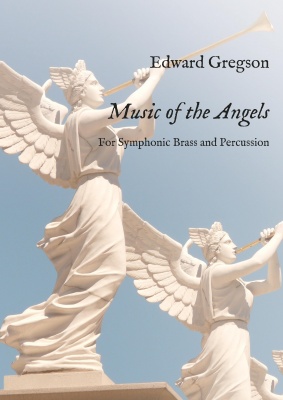
Music of the Angels (Symphonic Brass Ensemble - Score and Parts)
In 1998 Gregson was commissioned by conductor Martyn Brabbins to write a short concert opener with choir to mark his debut as Music Director of the Huddersfield Choral Society. Entitled ...and the seven trumpets... this ten minute flourish is founded on a verse from Chapter 8 of the Revelation To John (The Apocalypse), the last book in the Bible: 'and I saw the seven Angels which stood before God: and to them were given seven trumpets'. The performance employed the full power of the Huddersfield Town Hall organ and the brass section of the BBC Philharmonic, including seven trumpets and four horns placed strategically around hall.The following year, when Gregson received a commission from the Cheshire-based Foden's Brass Band (conducted at that time by Nicholas Childs) for a work to mark its centenary in 2000, he turned to the first portion of ...and the seven trumpets... as the basis for an ambitious celebratory work entitled The Trumpets of the Angels. "The opportunity to create an extended work which would break out of the brass band mould was an important milestone for me," the composer says. In 2015 he was asked by Nicholas Childs to create a new performing edition without organ for the Black Dyke Band. This received its first performance in April 2016 at the European Brass Band Festival in Lille. In 2018, Gregson revisited the music for a third time, returning the opening fanfares to orchestral brass and transforming substantial portions of the 'Black Dyke' version to create Music of the Angels, a dramatic canvas for symphonic brass and percussion.An array of bells and gongs offer an unmistakable key to the source of Gregson's inspiration. Inscribed In tribute to Olivier Messiaen, the work's principal material and its sound world, but crucially not the underlying musical processes, are influenced by Messiaen's masterpiece for wind and percussion, Et exspecto ressurectionem mortuorum (1964). Music of the Angels begins with braying of horns suggestive of the start of an ancient ritual. Six 'angel' trumpeters, set behind the ensemble, answer in sequence, with the evocative sound of tam-tams creating the Messiaen-like aura. Once the horns have reached the performing space, four of the trumpeters deliver highly contrasting fanfare cadenzas. At the climax of this episode, the individual fanfares are presented together, as if, perhaps, to reflect the Biblical writer's apocalyptic visions of hail, fire, seas of blood and the cataclysmic destruction of man and beast.This powerful vision of death and destruction gives way to a prayerful lament, re-imagining a sung Kyrie Eleison from the 'Black Dyke' edition, with flugel horn and euphonium obligati. The hushed atmosphere is broken by tenor and side drums, and trumpets five and six, which gallop away like the Horsemen of the Apocalypse. In the biblical account their steeds had 'heads like lions with fire and smoke and sulphur issuing from their mouths'.As the reverberation of a dramatic climax dies we hear the entry of the seventh trumpet, from 'on high', blazing forth with a version of the main that extends across the entire compass of the instrument - almost three octaves. Supported by a 'holy trinity' of gongs, an 'epic' final cadenza introduces new material which is further developed in a frenetic final section. This is announced by two sets of timpani, to the left and right. Braying brass (euphoniums and horns) once more adds an air of foreboding. As the music builds towards a magisterial conclusion, the Messiaen-inspired tritones of the principal motif are smoothed out into perfect 5ths and combined with the earlier material in a full-voiced chorale, over which the seventh trumpet blazes in triumph.- Programme note by Paul HindmarshScored for1 Trumpet in E flat (Trumpet 5)6 Trumpets in B flat (Trumpet 4 doubling Flugel Horn)4 Horns in F3 Tenor Trombones1 Bass TromboneEuphonium2 Tubas2 Timpani (Percussion 3 doubles Timpani 2)Percussion (3 players): 3 Tam-tams, 3 Suspended Cymbals, Bass Drum, Tenor Drum, Snare Drum, Tubular Bells.Duration: 16.00
Estimated dispatch 7-14 working days
-
 £39.95
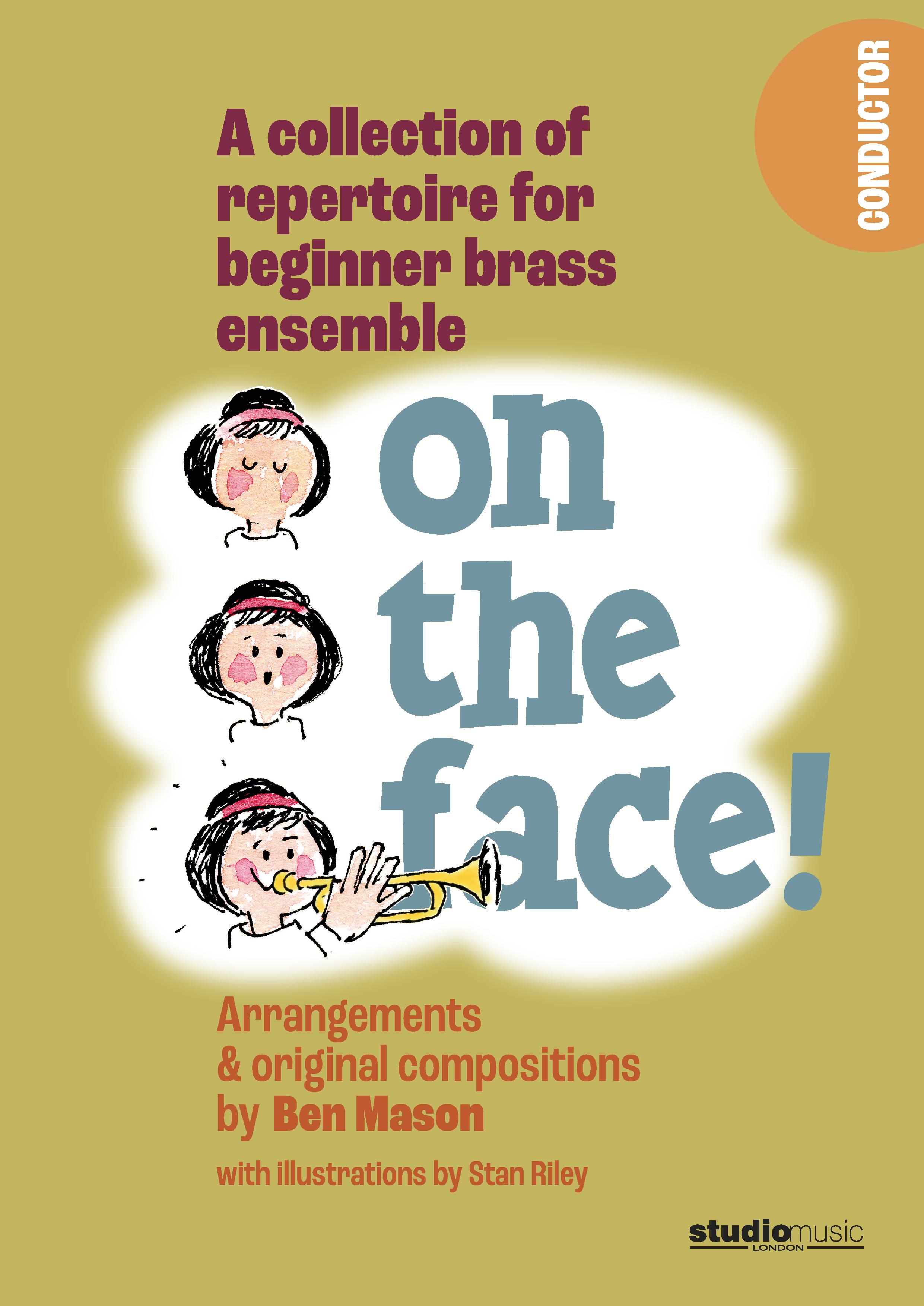
On the Face! (Value Set)
The Value Set contains the score and one of each part:1st B flat Trumpet/Cornet2nd B flat Trumpet/CornetTrombone/Euphonium/Baritone BCTrombone/Euphonium/Baritone TCHorn in E flatHorn in FHigh Trombone/Euphonium/Baritone TC*High Trombone/Euphonium/Baritone BC*E flat Bass/Tuba TCE flat Bass/Tuba TCPercussion and occasional Aux. Percussion(* for use only when there is a Tuba in the ensemble)Additional scores and parts are available individually.On the Face is a complete repertoire (warm-ups and 23 pieces) for beginner brass ensemble. Perfect material for school assemblies and music centres, it includes folk songs, famous classical themes, and exciting new jazz and pop numbers. Each piece is score for a basic trio of two trumpets/cornets and one trombone/euphonium (TC or BC). However, optional independent parts can also be added for horn in E flat or F; high trombone or euphonium (tenor part); tuba; and drum kit. The pieces work equally well either with one player to a part, or in larger group settings. With its appealing variety of musical styles and textures, On the Face is sure to make the young brass player's first experience of group playing both rewarding and fun.
Estimated dispatch 7-14 working days
-
 £116.40
Decennium - Eric Swiggers
'Decennium' was composed in 2003 as a commission by the municipality of Berheze for its tenth anniversary. The composition describes the history of this town in the Province of Brabant, consisting of 6 different villages: Heesch, Heeswijk, Dinther, Nistelrode, Loosbroek and Vorstenbosch. The composition starts with a slow introduction, Adagio Misterioso, suggesting the atmosphere in long-ago days when the area consisted mainly of swamps, meres and low woods. (The word 'Bern' is a synonym of 'Born' meaning source or water, whereas 'Hese' is derived from 'Haisjo' meaning brushwood ). Above the dark sounds we hear far away trumpet signals announcing the Middle Ages. After a piercing crescendo, we hear the full sound of festive trumpets. A medieval dance, as was to be heard in the Heeswijk castle, follows. This dance gets a more and more stirring character and finally turns into a merry popular dance ending with a burst of laughter reproduced by descending scales with the muted trombones and trumpets. A slow transition with a quotation from a Gregorian plainsong (Domine Deus) and church bell ringing, referring to the Abbey of Berne, brings us to a romantic Larghetto. This part describes the quiet rural life in a beautiful natural surrounding. The last dying note contrasts with the threatening ostinato, referring to the rise of the industrialization, which provoked quite some resistance with the local people. Once more we hear the 'Domine Deus' but much more powerful this time. When the resistance calms down, the work concludes with an Alla Marcia. The first notes of the main theme could be heard all through the composition and now we hear the complete main theme again. The new town is born. A festive conclusion refers both to the tenth anniversary and the optimism and confidence as to the future.
Estimated dispatch 5-14 working days
-
 £119.00
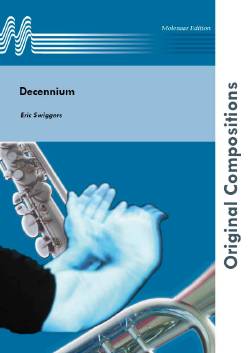
Decennium - Eric Swiggers
'Decennium' was composed in 2003 as a commission by the municipality of Berheze for its tenth anniversary. The composition describes the history of this town in the Province of Brabant, consisting of 6 different villages: Heesch, Heeswijk, Dinther, Nistelrode, Loosbroek and Vorstenbosch. The composition starts with a slow introduction, Adagio Misterioso, suggesting the atmosphere in long-ago days when the area consisted mainly of swamps, meres and low woods. (The word 'Bern' is a synonym of 'Born' meaning source or water, whereas 'Hese' is derived from 'Haisjo' meaning brushwood ). Above the dark sounds we hear far away trumpet signals announcing the Middle Ages. After a piercing crescendo, we hear the full sound of festive trumpets. A medieval dance, as was to be heard in the Heeswijk castle, follows. This dance gets a more and more stirring character and finally turns into a merry popular dance ending with a burst of laughter reproduced by descending scales with the muted trombones and trumpets. A slow transition with a quotation from a Gregorian plainsong (Domine Deus) and church bell ringing, referring to the Abbey of Berne, brings us to a romantic Larghetto. This part describes the quiet rural life in a beautiful natural surrounding. The last dying note contrasts with the threatening ostinato, referring to the rise of the industrialization, which provoked quite some resistance with the local people. Once more we hear the 'Domine Deus' but much more powerful this time. When the resistance calms down, the work concludes with an Alla Marcia. The first notes of the main theme could be heard all through the composition and now we hear the complete main theme again. The new town is born. A festive conclusion refers both to the tenth anniversary and the optimism and confidence as to the future.
Estimated dispatch 10-14 working days
-
 £24.95
Prelude and Capriccio (Cornet Solo with Brass Band)
A condensed score is included with this workGregson wrote his Prelude and Capriccio in 1972. It exists in two versions: one for cornet and band and the other for cornet or trumpet and piano.The work began life in the early sixties, the Capriccio being composed when the composer was 17. A Prelude was added to complete the work, which lasts for approximately 8 minutes. The Prelude is reflective in character and uses long melodic lines over undulating chromatic harmony. The music reaches a climax before a brief reprise of the opening. The Capriccio is somewhat jazzy in its opening syncopated rhythms, but has a more lyrical middle section before a finale exploiting the virtuoso character of the instrument.
Estimated dispatch 7-14 working days
-
 £24.95
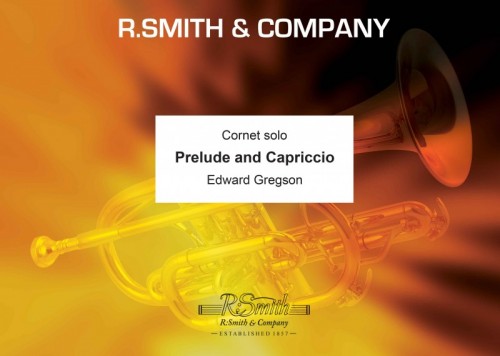
Prelude and Capriccio (Cornet Solo with Brass Band) - Gregson, Edward
A condensed score is included with this workGregson wrote his Prelude and Capriccio in 1972. It exists in two versions: one for cornet and band and the other for cornet or trumpet and piano.The work began life in the early sixties, the Capriccio being composed when the composer was 17. A Prelude was added to complete the work, which lasts for approximately 8 minutes. The Prelude is reflective in character and uses long melodic lines over undulating chromatic harmony. The music reaches a climax before a brief reprise of the opening. The Capriccio is somewhat jazzy in its opening syncopated rhythms, but has a more lyrical middle section before a finale exploiting the virtuoso character of the instrument.
Estimated dispatch 7-14 working days
-
 £15.00
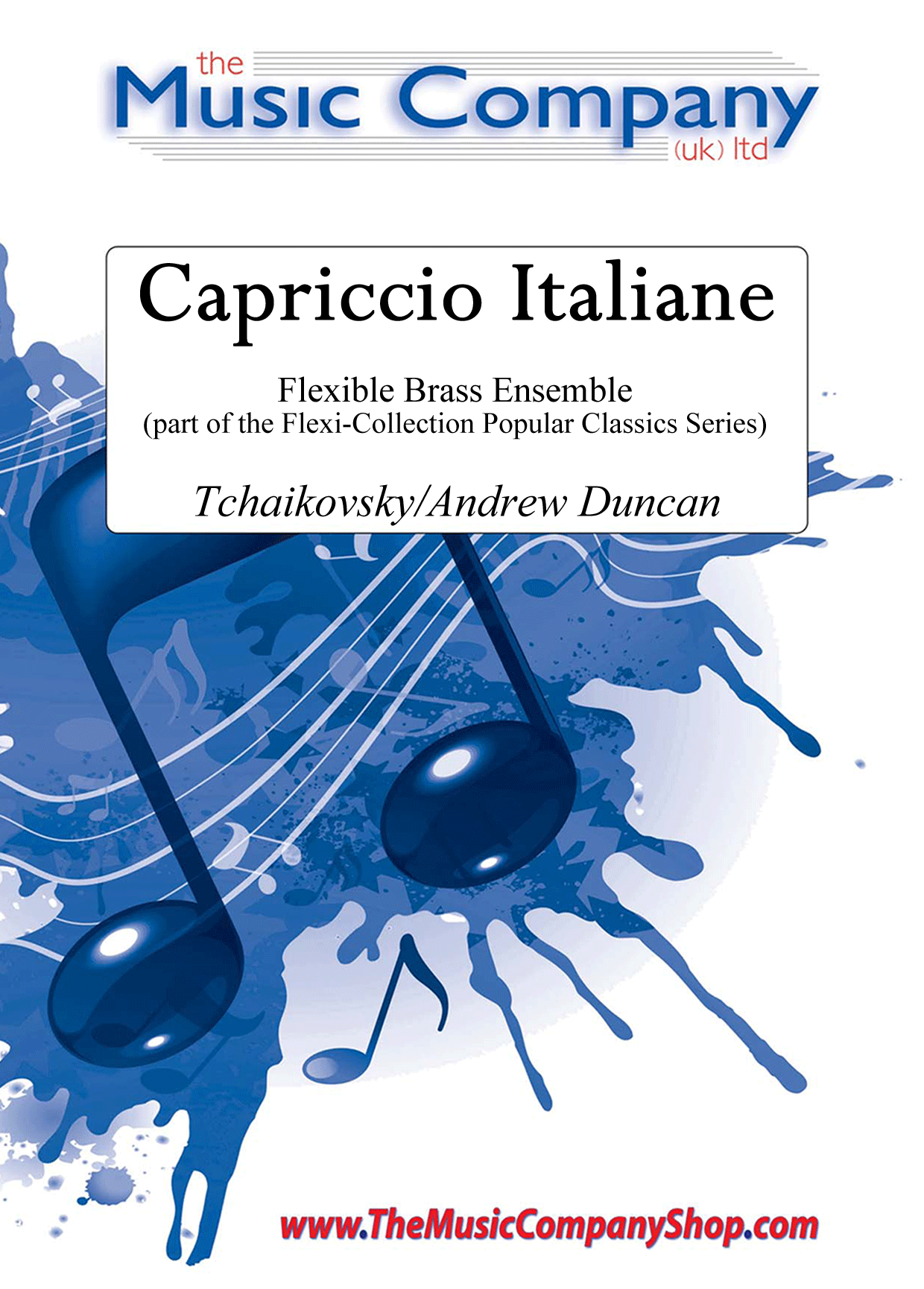
Capriccio Italiane - Tchaikovsky
Programme Notes by Andrew Duncan:This arrangement is fairly simple and the strong melodic and rhythmic lines should help introduce inexperienced players to the concept of playing in 3 time. The triplets in the 3rd cornet/trumpet part and the 1st Baritone/Euphonium/Trombone part (and in the tambourine part) are played in unison and will greatly help to move the rhythm forward.The tune is in the 1st cornet/trumpet part up until letter B when it is played by the horns (in unison) and in harmony by the 1st Baritone/Euphonium/Trombone part, so there is plenty for all to play throughout the piece.The Percussion part is written for a Tambourine, and although it is optional, it would add colour to a performance of the arrangement.The Flexi-Collection ApproachFlexible scoring tailored to your needs - A perfect solution for expanding the repertoire of training and junior brass bands. The Flexi-Collection currently offers two series - Popular Classics and World Tour. Based on four-part harmony, these collections provide groups with the advantage of complete flexibility when they may not be balanced. If players or instruments are missing, the show can still go on!The Flexi-Collection - Popular Classics Series, encapsulates all that is great about the wonderful range of musical styles produced by Holst, Elgar, Handel, Verdi, Tchaikovsky, Grieg, Bizet and Parry.The thoughtful scoring and arranging by Andrew Duncan now means that groups of all abilities have access to a truly flexible set of music for their needs. With world parts, rudimentary theory, terminology translations and large format typesetting, The Flexi-Collection ticks all the boxes when it comes to bringing interesting music to the training and junior band/brass group environment.Available individually or as part of the money-saving Flexi-Collection Popular Classics Album. Scored for Brass Band and supplied with additional Easy Bb, Easy Eb and world parts - The Flexi-Collection offers flexibility in every sense of the word.
In Stock: Estimated dispatch 3-5 working days
-
 £18.15
Anvil Chorus from Il Trovatore - Verdi
Programme Notes from Andrew Duncan:Like many of the arrangements in the Flexi-Collection - Popular Classics Series I have simplified the rhythms and time signature, etc. I have also omitted trills for ease of playing.Dynamics form a very important aspect of this arrangement and it is important to observe these, especially the p markings. Every dynamic from p through to ff is used as well as some crescendos.The 1st Cornet/Trumpet part is perhaps more difficult than in some of the other arrangements in the series, but the other parts are fairly simple in comparison.The Percussion part (which is optional) is unusual in that it calls for two 'Anvils' to be played. However if these are not available then a good effect can be obtained by hitting two pieces of metal with metal hammers.The Flexi-Collection ApproachFlexible scoring tailored to your needs - A perfect solution for expanding the repertoire of training and junior brass bands. The Flexi-Collection currently offers two series - Popular Classics and World Tour. Based on four-part harmony, these collections provide groups with the advantage of complete flexibility when they may not be balanced. If players or instruments are missing, the show can still go on!The Flexi-Collection - Popular Classics Series, encapsulates all that is great about the wonderful range of musical styles produced by Holst, Elgar, Handel, Verdi, Tchaikovsky, Grieg, Bizet and Parry.The thoughtful scoring and arranging by Andrew Duncan now means that groups of all abilities have access to a truly flexible set of music for their needs. With world parts, rudimentary theory, terminology translations and large format typesetting, The Flexi-Collection ticks all the boxes when it comes to bringing interesting music to the training and junior band/brass group environment.Available for Brass Band - The Flexi-Collection offers flexibility in every sense of the word.(Available individually or as part of the money-saving Flexi-Collection Popular Classics Album)
In Stock: Estimated dispatch 3-5 working days
 View Music