
Results
-
£35.00
Calon Lan - Hughes, J - Harper, P
Calon Ln is among the most popular of traditional Welsh melodies. This arrangement is simple but beautiful, beginning with a lone trombone voice, expanding to a trio, before the tenor horn is featured. After a heartfelt but brief climax, the trombone regains the spotlight and the music ends in peace and tranquility.4th section +Duration 2.30 minsListen to Cory BandCourtesy of World of Brass
In Stock: Estimated dispatch 1-3 working days
-
 £37.95
The Year of the Dragon (Score Only)
The highlight of Cory's centenary celebrations throughout 1984 was a concert held in St. David's Hall, Cardiff, in March. The band, with the aid of funds provided by the Welsh Arts Council, commissioned Philip Sparke to write a work for first performance at this concert. The result was "The Year of the Dragon" of which the composer writes:"At the time I wrote The Year of the Dragon, Cory had won two successive National Finals and I set out to write a virtuoso piece to display the talents of this remarkable band to the full."The work is in three movements:TOCCATA opens with an arresting side drum figure and snatches of themes from various sections of the band, which try to develop until a broad and powerful theme from the middle of the band asserts itself. A central dance-like section soon gives way to the return of this theme, which subsides until faint echoes of the opening material fade to a close.INTERLUDE takes the form of a sad and languid solo for trombone. A chorale for the whole band introduces a brief spell of optimism but the trombone solo returns to close the movement quietly.FINALE is a real tour-de-force for the band with a stream of rapid semi-quavers running throughout the movement. The main theme is heroic and march-like but this is interspersed with lighter, more playful episodes. A distant fanfare to the sound of bells is introduced and this eventually returns to bring the work to a stirring close.
Estimated dispatch 7-14 working days
-
 £42.00
The Golden Carol. Arranged for brass band by Lynda Nicholson
Arranged for brass band by by Lynda Nicholson The Golden Carol is a traditional Old English Christmas Carol. The words tell of the Three Kings following the Star to Bethlehem to see Jesus on Christmas morning. The tune is anonymous, but has a medieval feel, similar to other carols, such as I Saw three Ships. The Golden Carol begins in a 5/4 jazz waltz rhythm with a solo Eb Bass being joined a few bars later by by a solo trombone then a solo horn, before more instruments (including percussion) are added and the tune plays out in the cornets and soprano cornet. The second section goes into 4/4 with a strong Rock/Big Band feel driven along rhythmically by the kit drummer. This section then leads to a rousing close for the full band. The Golden Carol is part of the Lynda Nicolson Collection . To hear a sound recording of The Golden Carol scroll down.
-
 £89.95
Songs of Ascent - Jonathan Bates
DURATION: 14 minutes. DIFFICULTY: Championship. 'Songs of Ascent' was composed for the Royal Northern College of Music Brass Band, as part of their programme for the 2019 RNCM Festival of Brass. In my view, the festival itself is the leading showcase for original contemporary music for the medium (in a concert setting) in the world and therefore an ideal place to explore new ideas and sounds, which was a notion fundamental to the construction of this work. The piece is subtitled 'Out of the Depths, I cry to you, O Lord'; the opening line of Psalm 130 (which forms part of a set of 15 psalsm, 120-134 known as the Songs of Ascent") which forms the main inspiration for much of the musical material. Following an extended opening for four individual tuba lines, there are a number of solos for members of the band off stage, with bleak and deep accompaniment lines, reflecting the words of Psalm 130. Amongst these 'songs of ascents', the most common and strong themes are repentance and redemption; with the central core of this work emerging 'from the depths' to reveal one of very few calming and reflective passages of the work utilising the tune of 'Guide Me O Thy Great Redeemer' in a new setting, featuring the Solo Horn and Bass Trombone, before returning to the ethereal and dark timbres that form much of the music up to this point. In terms of compositional technique, this work is solely based on a set of 4 9-note scales in their various unique transpositions (below). Each of these scales provide a set of 2 whole tone scales, 6 minor triads, 6 major triads and is built on 9 augmented triads. Whilst most of the music in this work is based melodically on the set of notes (heard right at the outset in the motif in the tuba line), the central section delves into the harmonic capabilities of these 'modes', using a number of the 7 'keys' which can be derived from the minor & major chords derived in each scale. All 4 scales are used independantly to each other, with whole sections of the work focussing on each mode. 'Songs of Ascent' was selected as the set work for the Championship Section at the Butlin's Mineworker's Championships in 2020.
In Stock: Estimated dispatch 1-3 working days
-
 £38.00
Blewz (Brass Band - Score and Parts) - Anderson, Keiron
There are many harmonic forms of the blues from a standard chord sequence to a more complex set with a circle of fifths. This bright, entertaining work is fun to play and easy to programme with a hint of jazz and a swing feel, complete with a little interplay section for bass trombone and tuba, which adds to the entertainment value of this piece. Duration: 3.30. Suitable for 1st Section Bands and above
Estimated dispatch 7-14 working days
-
 £24.95
Lloyd (Brass Band - Score and Parts) - Howard, Cuthbert - Coles, Bramwell
The first presentation of the theme can be used for the purpose of accompanying congregational singing. At Section A the second presentation of the tune appears in the key of the dominant, the melody being given throughout to Solo Horn, with First Horn, First Trombone, Soprano and Flugel reinforcing the melody in the various phrases. Incidentally, see that the players do not break these phrases; it should be possible to take the four bars in one breath quite easily. Take due care of the light and shade which should be delicately applied. In the last bar the music gathers strength as we pass back into the original key for the last verse; pay particular attention to the part allotted to Second Baritone and Euphonium which needs to be slightly stressed. For the last appearance of the tune at Section B the full Band is used, apart from the third phrase which is given solo by Solo Comet with a light accompaniment above a bass pedal. Notice the rit. operating from the end of the eleventh bar and also the short swell effect on the fourth beat of the fourteenth bar.
Estimated dispatch 7-14 working days
-
£12.50
Lloyd (Brass Band - Score only) - Howard, Cuthbert - Coles, Bramwell
The first presentation of the theme can be used for the purpose of accompanying congregational singing. At Section A the second presentation of the tune appears in the key of the dominant, the melody being given throughout to Solo Horn, with First Horn, First Trombone, Soprano and Flugel reinforcing the melody in the various phrases. Incidentally, see that the players do not break these phrases; it should be possible to take the four bars in one breath quite easily. Take due care of the light and shade which should be delicately applied. In the last bar the music gathers strength as we pass back into the original key for the last verse; pay particular attention to the part allotted to Second Baritone and Euphonium which needs to be slightly stressed. For the last appearance of the tune at Section B the full Band is used, apart from the third phrase which is given solo by Solo Comet with a light accompaniment above a bass pedal. Notice the rit. operating from the end of the eleventh bar and also the short swell effect on the fourth beat of the fourteenth bar.
Estimated dispatch 7-14 working days
-
 £64.95
Music for Greenwich (Brass Band - Score and Parts) - Gregson, Edward
Music for Greenwich was commissioned in 1980 by the Greenwich Theatre, London, for a new production of Peter Buckman's play 'All Together Now'.In this play, about a down-at-heels brass band in the North of England brought to a new level of self-confidence and achievement by an incoming conductor, the whole cast performed a test piece on stage every night (i.e. Music for Greenwich), in readiness for a competition which they have entered and, of course, win. Although the play is as much a social commentary as anything to do with music-making, every member of the cast had to be able to play a brass instrument to a greater or lesser extent (a difficult challenge for the casting Director!).For obvious reasons, the music is not technically difficult. The work is structured as follows: a brief fanfare-like opening is followed by an allegro section, rhythmic and playful; a slow lyrical section is then introduced (a suitably nostalgic melody featuring solos for cornet and trombone), before a return to the fast music, a hint of the fanfare, and finally a climactic flourish to round things off. This is music to be enjoyed, as hopefully it was every night by the audience and actors alike.Duration: 5.00
Estimated dispatch 7-14 working days
-
£24.95
Music for Greenwich (Brass Band - Score only) - Gregson, Edward
Music for Greenwich was commissioned in 1980 by the Greenwich Theatre, London, for a new production of Peter Buckman's play 'All Together Now'.In this play, about a down-at-heels brass band in the North of England brought to a new level of self-confidence and achievement by an incoming conductor, the whole cast performed a test piece on stage every night (i.e. Music for Greenwich), in readiness for a competition which they have entered and, of course, win. Although the play is as much a social commentary as anything to do with music-making, every member of the cast had to be able to play a brass instrument to a greater or lesser extent (a difficult challenge for the casting Director!).For obvious reasons, the music is not technically difficult. The work is structured as follows: a brief fanfare-like opening is followed by an allegro section, rhythmic and playful; a slow lyrical section is then introduced (a suitably nostalgic melody featuring solos for cornet and trombone), before a return to the fast music, a hint of the fanfare, and finally a climactic flourish to round things off. This is music to be enjoyed, as hopefully it was every night by the audience and actors alike.Duration: 5.00
Estimated dispatch 7-14 working days
-
 £35.00
BLUES ON THE MARCH (Brass Band) - Barry, Darrol
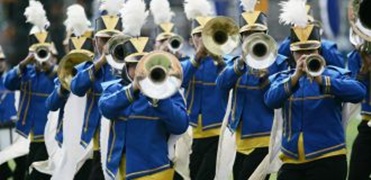
Traditional marches are great, but sometimes you want something different to kick off your concert. This piece gives your band a chance to get into the 'swing' of things, based on the traditional twelve bar blues it features a contrasting middle section with a trombone trio and a flugel (cornet) obligato. Grade: 4th section +. Duration: 3:50
Estimated dispatch 7-14 working days
 View Music