
Results
-
.png) £34.95
£34.95A King is Born! - Jonathan Bates
DURATION: 3'00". DIFFICULT: 1st+. 'A King is Born!' was composed for Skelmanthorpe Band's programme of music celebrating the 30th anniversary of Walt Disney's 'The Lion King' at the 2024 Red Admiral Entertainment Championships. The baking sun rises slowly over the savannah, as the newly born heir to the throne - Simba - sleeps peacefully ahead of his triumphant presentation to the animals as the future Lion King.
In Stock: Estimated dispatch 1-3 working days
-
 £79.95
Grieg Variations - Jonathan Bates
DURATION: 12'30". DIFFICULTY: 2nd+. . 'Grieg Variations' is a through-composed work in the traditional style of a 'theme & variations'. The work opens with the main melodic fragment featured throughout Grieg Variations which comes from Grieg's Peer Gynt Suite No.2; the final movement - 'Solveig's Song'. . This theme is followed by a set of 9 variations, each taking inspiration from various melodies and styles found within the Peer Gynt Suite. The first variation, a light-footed scherzo based upon the tonal line of Solveig's Song is followed by an 'Alla marcia' variation - in which the music is inspired by the 2nd movement - 'Arab Dance' - of the original suite. The 3rd variation takes a far darker and more aggressive turn in a variation set around the music of the 1st movement of the Peer Gynt Suite before a relaxation into a solemne revisiting of the original theme. Opening with a sombre and longing solo for Flugel horn, the focal point of this 4th variation is an extended solo for the Solo Euphonium, marked 'molto espressivo'. The new material here is used as a theme throughout this variation, being reprised by the full band immediately after as the music builds to a climax point at the top of the musical line. . Following this, there are 2 cadenzas for the Solo Horn and Solo Cornet respectively; the former inspired by the thematic material of Solveig's Song, and the latter from the Oboe cadenza at the beginning of Grieg's '2 Lyric Pieces, Op.68'. These cadenzas lead swiftly into the 7th variation, a bustling rhyhm-driven movement set in complex time. The 3rd movement of the Peer Gynt Suite No.2 - 'Peer Gynt's Homecoming' - makes it's first appearance in variation 8 in a triumphant battle-like setting before a combination of both this material and the Solveig's Song combine to bring Grieg Variations to it's close -not without a little nod to potentially Grieg's most famous work - In The Hall of the Mountain King. . .
In Stock: Estimated dispatch 1-3 working days
-
 £30.00
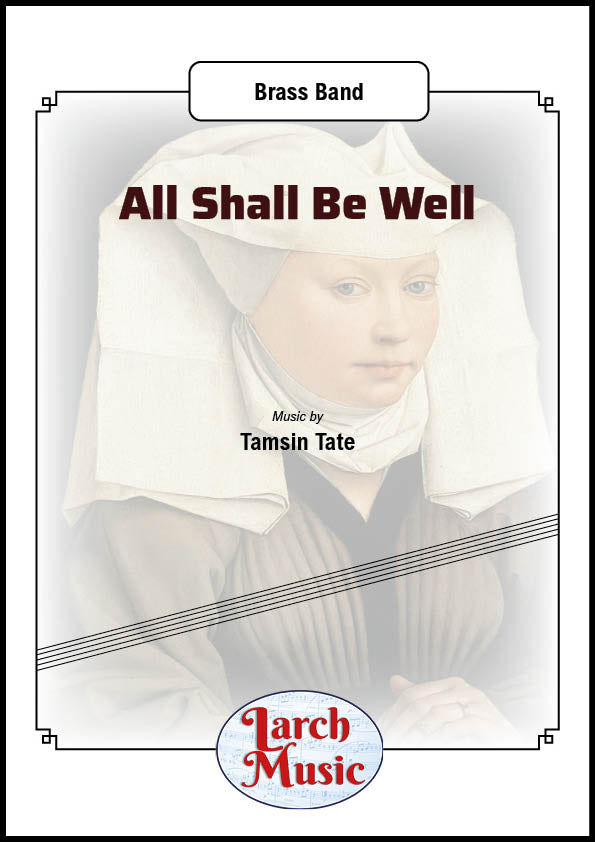
All Shall Be Well - Brass Band Sheet Music Full Score & Parts - LM931
COMPOSER: Tamsin TateCOMPOSERS NOTE"All shall be well" was composed during the first lockdown of the Covid crisis, from May 2020.This was a worrying time for many and a time of great anxiety and sadness for some.I have always tried to be practically optimistic in trying times, but still I needed hope.I am lucky to have a faith in God which gives me hope and assurance that things will be better,and I also know that music, particularly playing it, can help express some of these emotions.Certainly, music through the crisis was a wonderful, enjoyable escape for meand one I shared with my family and my band family through our online recordings.Julian of Norwich was an anchoress in the 14th Century.She set herself apart for God and spent a lot of time in prayer.Interestingly, she was the first published woman in the English language.Julian of Norwich is quoted as saying "all shall be well, all shall be well,and all manner of thing shall be well." The paraphrase of this spurred me on to develop this piece for brass band.Hopefully you will also find that the music portrays the worries and trials of this uniquetime through the natural minor key, with the rhythm hinting towards the phrase"All shall be well" and then the dawning transition to the major keyfollowed by a triumphant ending with the whole band joining together.Thanks to Adam Cable and the Martlesham Brass family for support and encouragement always.Thanks also to Alan Fernie and his supportive critique of my initial efforts.LM931 - ISMN : 9790570009312
In Stock: Estimated dispatch 3-5 working days
-
 £70.00
Festa Latina - Peter Boris Koval
An up-tempo rhythmic Latin-style piece, with lots of incidental percussion to propel the music to a triumphant climax. Melody and harmony are key elements, and every instrument group has something interesting to contribute in this sparkling arrangement.
Estimated dispatch 10-14 working days
-
 £30.00
A Short Ride in a Brass Machine
DescriptionA Short Ride in a Brass Machine was written in 2006 to mark the 140th anniversary of the Brighouse and Rastrick Band and first performed in the Central Methodist Church in Brighouse by Brighouse and Rastrick conducted by James Gourlay. The title refers to the orchestral composition A Short Ride in A Fast Machine by the American composer John Adams which provided some of the inspiration for the work. The music is a simple celebratory prelude consisting of two main ideas, an expansive melody full of open fifths (giving the music a slightly "American" feel) and a short fanfare figure. After these are both heard for the first time a brief development of the fanfare material leads to a broader, warm harmonisation of the opening melody and the pulse relaxes a little before tension builds to a reiteration of the fanfare and a final triumphant version of the opening theme.Performance Notes:Percussion instruments required are 4 Timpani, Snare Drum, Bass Drum, 3 Tom-toms, 3 Wood Blocks, Suspended Cymbal, Clash Cymbals, Tubular Bells, Glockenspiel, Tam-tam.Soprano, repiano, 2nd solo cornet, 2nd and 3rd cornets will require metal straight mutes; 2nd and 3rd cornets will require harmon mutes with the tubes removed (indicated by 'TR').Duration approximately 3'30"Follow the score in the preview video below!
Estimated dispatch 7-14 working days
-
 £32.00
The Cistercians
DescriptionThe Cistercianswas written during December 2003 and January 2004 as an entry for Morecambe Band's Centenary New Music Competition, which it went on to win. The first two performances were at the final of this competition, part of the band's 100th Anniversary Concert at The Dome in Morecambe on 9 July 2004.The music was inspired by visits to three of Britain's great Cistercian Abbeys; Valle Crucis, Fountains and Rievaulx. The Cistercian Order was founded at Citeaux in France in the 11th Century and was based on the principles of austerity, humility and piety. Cistercian Abbeys were deliberately sited in remote, difficult areas. Despite this many of them, especially Rievaulx, became immense centres of commerce and power, with ever more complex administration and hierarchies.In a way the music reflects this; all the material in the piece is derived from two simple motifs played by flugel and solo horn in the opening bars and becomes more complex and further removed from the original material as the piece develops. After a tranquil opening section a fugal chorale develops over a medieval-style "tenor" - a stretched out version of one of the original motifs. A burst of semiquavers leads into a faster, folk-dance type section - our medieval abbey has become a bustling trade centre - before rhythmic quaver pulses in the horns and cornets accompany powerful chords in the low brass; this is another "tenor" derived from the opening motifs. A short development section, including the folk dance "hocketing" round the band and a slightly disjointed 10/8 section leads to a restatement of the fugal chorale from the beginning before a frenetic coda brings the work to a triumphant conclusion.Performance Notes:Percussion instruments required are Bass Drum, Suspended Crash Cymbal, Glockenspiel, 2 x Tom-toms, Snare Drum, Tambourine, Tam-Tam, 2 x Timpani (G-C, C-F), Triangle, Wood Block. All cornets will require metal stratight mutes and all except soprano require cup mutes. All trombones require cup and metal straight mutes.You can follow a preview of the score in the video below.
Estimated dispatch 7-14 working days
-
 £22.50
Edward Gregson: Concertante for Piano and Brass Band
DescriptionProgramme NoteThe Concertante for Piano and Brass Band was written in 1966, when the composer was an undergraduate student at the Royal Academy of Music in London. It received its first public concert performance in 1967 at the Royal Festival Hall, London, when the composer was the soloist with the International Band of the Salvation Army, conducted by Bernard Adams. It was one of the first major works to be written for this particular combination.The Concertante is unashamedly romantic in idiom and is in three movements: Prelude, Nocturne and Rondo. The Prelude is cast in sonata form and opens with a short cadenza-like flourish from the soloist, followed by two main ideas - the first sweepingly dramatic, the second highly lyrical. The interplay between these two themes forms the main focus of the movement, and after a return to the opening theme, an exuberant codetta brings the music to a close, albeit a quiet one. https://morthanveld.com/wp-content/uploads/2017/09/Gregson-Concertante-1st-movt-clip.mp3The tender Nocturne opens with an introduction from the band that contains precursors of the two main ideas to follow. The solo piano announces the main theme, which has a slightly 'bluesy' character with its flattened third and seventh notes of the scale, and is a love song dedicated to the composer's wife-to-be. The band enters with phrases of a chorale already hinted at in the introduction - Ray Steadman-Allen's hymn tune 'Esher' - but never quite presented in its complete state. Both ideas are developed alongside each other, with eventually the first theme returning, this time with piano and band together, and building to a majestic climax, before subsiding to a peaceful coda - a return to the very opening of the movement. https://morthanveld.com/wp-content/uploads/2017/09/Gregson-Concertante-movt-2-clip.mp3The final Rondo is full of energetic rhythms and changing time patterns. The main theme is playful in character, with much interplay between soloist and band, whilst the middle section presents a new theme, and one that has more than a hint of the hymn tune 'Onward Christian Soldiers', in what amounts to a good humoured parody. The opening Rondo theme returns, this time leading to a powerful and dissonant climax from the band. This is followed by an extended piano cadenza, underlying the virtuoso aspect of the work, and leading to an energetic and life-affirming coda, which brings the work to a triumphant conclusion. https://morthanveld.com/wp-content/uploads/2017/09/Gregson-Concertante-movt-3-clip.mp3Duration: 18 minutesInstrumentation:Please note that there is no 1st/Repiano Cornet part in this work. The 1st/Repiano Cornet player should join the Solo Cornet bench. As such an extra Solo Cornet part is provided in the set of parts.Version for two pianosA version of the Concertante for two pianos is available for rehearsal purposes. Piano 1 is the solo part and Piano 2 the band reduction. However, for those pianists not needing to rehearse the work in this way, a solo piano part is also provided with the main set of band parts.To view a preview of the solo part for the first movement click here.The youthful Gregson (his work was written as a third year undergraduate) was seemingly a bit of a musical magpie - but one heck of a skilful one at that.These were shiny baubles of poise, panache and pastiche, with affectionate, remarkably mature nods of appreciation towards Gershwin, Rachmaninov, Ireland and even Elmer as well as Leonard Bernstein.The rich colour palette and flowing lines (with the tenderest of central Nocturnes) were a joy - as were the little buds of motifs that dotted the score like seeds ready to be planted on a future fertile brass band compositional field. - Iwan Fox, 4Barsrest.com, June 2019For more information on Edward Gregson's music please visit the composer's website: www.edwardgregson.com
Estimated dispatch 7-14 working days
-
 £30.00
Edward Gregson: Music of the Angels, for Symphonic Brass and Percussion
DescriptionProgramme NoteMusic of the Angels is a dramatic work of some 16 minute's duration, scored for a large symphonic brass ensemble, including seven trumpets, and percussion. The percussion section deploys 'dark' instruments such as three tam-tams, a bass drum and two sets of timpani.The title of the work is based on a quotation from the Book of Revelations:And I saw the seven angels which stood before God; and to them were given seven trumpetsThus, the idea behind the work is a dramatic one and the composer has emphasised this by the partial spatial arrangement of the ensemble, with six solo trumpets standing centre stage, but behind the main ensemble, and the seventh trumpet off-stage throughout.The work opens with a four-note motif, dominant throughout the work, announced initially by four off-stage horns and answered by fanfare figures on four solo trumpets. Then in turn each of the first four solo trumpets announce their own cadenzas before joining together, independently playing their own music. This reaches an intense climax before subsiding into slow music which might be described as a Kyrie eleison - a lament for humanity - a cantilena for flugel horn and euphonium, accompanied by trombones. The drama soon returns with the entry of trumpets 5 and 6, playing music that is fast, more urgent and foreboding, and describing in musical terms the horsemen of the Apocalypse.At the climax of this section trumpet 7 enters dramatically, representing the words of the seventh angel ... and time shall be no more. The opening four-note motif is here transformed into a cadenza of epic proportions, to the partial accompaniment of three tam-tams (representing the Holy Trinity). The ensuing scherzo, scored for the ensemble, is fast and furious, but despite the somewhat desolate mood of this music (briefly interrupted by the re-appearance of trumpet 7), it slowly moves towards a more optimistic conclusion, transforming the 'lament for humanity' music into an affirmative and triumphant climax.This work has been commercially recorded on a critically acclaimed CD from London Brass on the Chandos label, available HERE.For more information on Edward Gregson's music please visit the composer's website: www.edwardgregson.com
Estimated dispatch 7-14 working days
-
£34.95
SOUTHERN CROSS, The (Brass Band Set) - Brian Bowen
The Southern Cross is one of several excellent marches by Brian Bowen in which he carried on the more sophisticated pattern of British marches by Wilfred Heaton, Leslie Condon and Ray Steadman-Allen. It was written for the Box Hill (Australia) Corps jubilee celebrations in 1970 and formed part of the band's repertoire when it toured Great Britain in the same year. The first half of the march features part of the song, 'March on!' by Klaus Ostby, an early pioneer of Salvation Army music in Scandinavia. The contrapuntal layering of melodies in the trio, especially in the finale where 'March on!' sounds one more triumphant time, is notable, as is the shift to a slower, more stately tempo. The harmonic and rhythmic style also represents the more modern sounds of Salvation Army brass band music in the late 1960s and early 1970s. Right from the opening gestures, listeners at early performances knew that a page had turned in the evolution of the Salvation Army march.
Estimated dispatch 7-14 working days
-
£29.95
PAEAN (Brass Band Set) - Dudley Bright
Commissioned by the Swiss Christian Brass Band Association in celebration of their 150th anniversary, the title 'Paean' means a shout of thanksgiving and praise. It is also the composer's personal expression of gratitude to God following major surgery. Although 'Paean' includes three fairly contemporary Christian songs, it is not intended to be played in any kind of rock or jazz style. The idiom is quite firmly rooted in brass band tradition. The opening fanfare-like section begins in celebratory mood before becoming more contemplative through the song 'Father God, I wonder'. A change of tempo heralds the statement of the thematically significant song 'Hosanna' before immediately moving to 'Faithful God'. Following a fugato the music retraces its steps to a triumphant restatement of the opening music.
Estimated dispatch 7-14 working days
 View Music