
Results
-
 £40.00
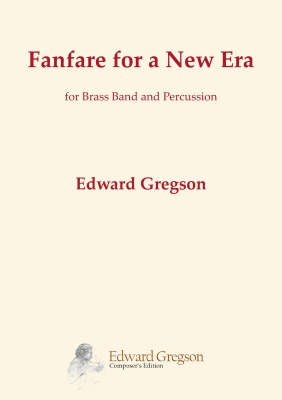
Fanfare for a New Era (Brass Band - Score and Parts)
Fanfare for a New Era is the most substantial of Edward Gregson's fanfares and was the result of a private commission by Lady Sheila Stoller to celebrate the opening in April 2017 of the Stoller Hall at Chetham's School of Music, Manchester. Gregson dedicated it to Sir Norman Stoller, who donated the funding for the new concert hall. The Fanfare was designed to fill the whole space, with separate brass choirs - trumpets, horns, trombones and tuba - playing their own music. A solo trumpeter playing 'on high' announces first the four horns and timpani, who enter with a stately measure. Next the herald trumpeter ushers in trombones, tuba and drums, with a faster dance. Finally, the remaining three trumpets amplify the peeling of bells. All four elements then come together, surrounding the audience with a 'joyful noise' of festive brass and percussion.Duration: 3.00
Estimated dispatch 7-14 working days
-
 £65.00
Music for Jock Tamson (Brass Band - Score and Parts)
Scottish Dances Set 2An original suite in three movements:Nyah Fearties!InchkeithWha's Like Us?This work was one of twelve works commissioned by the Scottish Brass Band Association and Funded by Creative Scotland Targeted Fund - 2021 to aid Covid Recovery and support composers in Scotland.Jock Tamson - a Scottish name explained... The phrase more often occurs in an extended form: We're a' Jock Tamson's bairns. This is interpreted in a metaphorical sense as a statement of egalitarian sentiments equivalent to "we're all the same under the skin" or "we are all God's children". i.e. This is music for everyone!
Estimated dispatch 7-14 working days
-
£74.95
Music for a Festival (Score and Parts)
This work was written as a commission by Boosey & Hawkes Band Festivals for the Youth Section of the National Brass Band Championships of great Britain 1985. In one continuous movement, it has three distinct sections: An opening extended fanfare which
Estimated dispatch 7-14 working days
-
£37.95
Music for a Festival (Score Only)
This work was written as a commission by Boosey & Hawkes Band Festivals for the Youth Section of the National Brass Band Championships of great Britain 1985. In one continuous movement, it has three distinct sections: An opening extended fanfare which
Estimated dispatch 7-14 working days
-
£74.95
Three Impressions for Brass (Score and Parts)
Great writing and musical imagery for Brass Band - bands will love it and audiences too!Includes: Wylam Colliery 1839; Deserted Farm 1840; The Royal Border Bridge, Berwick Upon Tweed 1859.
Estimated dispatch 7-14 working days
-
£37.95
Three Impressions for Brass (Score Only)
Great writing and musical imagery for Brass Band - bands will love it and audiences too!Includes: Wylam Colliery 1839; Deserted Farm 1840; The Royal Border Bridge, Berwick Upon Tweed 1859.
Estimated dispatch 7-14 working days
-
 £75.00
Cantata for brass band and percussion. Composed by Andrew Duncan
Cantata was commissioned by The Fodens Band who gave the first performance in 2014. Cantata was used as the test piece for the Scottish Open in 2014 and was played by the Whitburn Band as their own choice piece at the European Brass Band Championships in 2016. Cantata is in three movements and fully explores the textures, technique and musicality of a top section brass band and its soloists. Composer: Andrew Duncan Difficulty: Championship Section Duration: 16 mins Score and parts Publisher: The Music Company Released: 2014
-
 £48.00
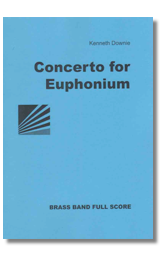
Concerto for Euphonium - Kenneth Downie
An accessible and enjoyable showpiece for soloists of all ages. The concerto's three movements are in a tuneful, melodic style and bravura passages are mixed with others designed to exploit the singing qualities of the instrument. The first movement is a vigorous allegro in which the short, pithy motifs of the opening theme contrast with the broad sweep of the second subject. A short cadenza-like passage yields to a high-spirited episode before a reprise of the opening ends the movement quietly. The second movement opens with a warm, romantic melody which is soon taken up by the soloist. A short animated section gives way to the earlier tutti theme, this time with passionate decoration from the soloist before the music gently unwinds in a tranquil coda. The finale has a bouncy, festive feel. After the first subject runs its course there is a brief journey through a more contrapuntal style, before a spirited presto moves into a compound episode before returning to the opening idea. A jubilant coda brings the work to a conclusion.
Estimated dispatch 7-9 working days
-
 £60.00
Concerto for Euphonium (Parts only) - Kenneth Downie
An accessible and enjoyable showpiece for soloists of all ages. The concerto's three movements are in a tuneful, melodic style and bravura passages are mixed with others designed to exploit the singing qualities of the instrument. The first movement is a vigorous allegro in which the short, pithy motifs of the opening theme contrast with the broad sweep of the second subject. A short cadenza-like passage yields to a high-spirited episode before a reprise of the opening ends the movement quietly. The second movement opens with a warm, romantic melody which is soon taken up by the soloist. A short animated section gives way to the earlier tutti theme, this time with passionate decoration from the soloist before the music gently unwinds in a tranquil coda. The finale has a bouncy, festive feel. After the first subject runs its course there is a brief journey through a more contrapuntal style, before a spirited presto moves into a compound episode before returning to the opening idea. A jubilant coda brings the work to a conclusion.
Estimated dispatch 7-9 working days
-
 £30.00
I Saw Three Ships - Traditional
This is a traditional English carol rumoured to have originated in Derbyshire. The earliest printed version is from the 17th century and the familiar version was later published in William Sandys' collection of 'Christmas Carols Ancient and Modern' in 1833. There are numerous theories as to the meaning of the carol's words; after all, Bethlehem, the place of Jesus' birth is not a coastal location. It has been suggested that the ships are actually camels (ships of the desert) used by the Magi for their visit to the baby Jesus. My arrangement takes advantage of the traditional 'jig' style of this carol to add a little 'Celtic' flavour.