
Results
-
 £68.99
Selections from Wicked - Jay Bocook
Rarely has a musical in modern times taken Broadway by storm the way this huge hit from Stephen Schwartz has done. The story line of the Wicked Witch of the West is intriguing and the music is filled with depth and beauty. This powerful medley includes No One Mourns The Wicked Dancing Through Life No Good Deed For Good Defying Gravity.
Estimated dispatch 5-14 working days
-
 £119.50
Me and Mrs. Jones - Kenneth Gamble - David Hveem
Me and Mrs. Jones was written by Kenny Gamble, Leon Huff and Cary Gilbert in 1972, and was first recorded by Billy Paul on the album 360 Degrees of Billy Paul. The song is about a man who has an affair with Mrs. Jones, and how the two secretly meet every day in the same cafe, even though they may know it's not quite right: "We got a thing going on/we both know that it's wrong/but it's much too strong/to let it go now." Paul has stated that he was sure the song was going to be a hit even before it was released, as "it's a song everyone can relate to", but already from the start the lyrics were considered somewhat controversial and the song were banned from several radio stations. Nevertheless, it became one of the best-selling singles of 1972 and Paul received a Grammy for Best Male R&B Vocal Performance.Well known is also Michael Buble's version of the song, released on the album Call Me Irresponsible in 2007. It is his version that has been the inspiration for this arrangement, which brings out even more of the jazz elements Buble has found in the song. The arrangement is quite demanding for the ensemble, and requires great rhythmic precision in particular.
Estimated dispatch 5-14 working days
-
 £104.99
Friendly Takeover - Oliver Waespi
Friendly Takeover was composed for the 2016 Swiss Wind Band Convention in Montreux. In this three movement piece the composer experiments with lyrical motives combined with rhythmical pulses in different meters throughout the piece. In the finale, the musical scene is taken over completely by groove-based rhythms. This takeover, however, is of a friendly nature, as the various beats are not being conceived as rivals of the lyrical motives, but are rather supposed to infuse energy and vitality to the latter. Thus, one gets the impression of an ongoing acceleration throughout the piece.
Estimated dispatch 5-14 working days
-
 £109.99
Nordic Moods - Tom Brevik
The composer:1st movement: Reflections by the Fjord.Overlooking one of the mighty fjords of Norway, my mind and thoughts are with an old religious Norwegian folk-tune, with words by the famous parson Peter Dass.The majestic fanfare-likeopening reflects the power of God our Father, the choral itself heard for the first time on flugelhorn. The choral is repeated a few times, separated only by some short variations. The movement ends in thriumph, with fanfares and the choral broughttogether.2nd movement: Reflections in the Old Church.In this movement my associations of a summer day, finding myself alone in an old deserted stone church. From the old walls I hear folk songs, perhaps like the ones sung in the church bypoor fishermen and farmers in days gone by. Suddenly the light from the sun breakes through the small circular window above the altar, and a lovely melody is heard, before the original figures take us to the end of the movement.3rd movement:Festive Reflections.Any festive occasion can be reflected in this movement. from the bonfire at midsummer-night to the children celebrating the return of the sun in the northern part of Norway. from the traditional sleigh-riding at Christmas tothe Celebrations of the National Day on the 17th of May each year.
Estimated dispatch 5-14 working days
-
 £68.90
Three Pictures for Band - Oliver Waespi
This composition consists of three sound pictures. Numerous associations mutually link those parts as far as motifs and harmony are concerned. The motif of the ascending and descending fourth plays an important role in many a theme. There are many fourth chords by means of which I try to put a harmonic and unifying stamp on the composition as a whole. Moreover there are similar or identical, though varied, motifs in the successive parts. The first part 'Cortege' (Procession) describes the dignified majestic procession by means of simple, precise rhythms. At first, the music is scarcely audible, as if coming from a distance; it gradually comes nearer until it reaches its climax in large chords, before fading away again. At each quarter note one could imagine a step. The second part 'Dialogue' consists in broad outlines of dialogues between the different orchestral groups. Some instruments are asking questions, others are giving answers. After a rather sad passage, the music turns into a climax followed by a second passage that brings comfort and leads to a quiet ending. In the third part, there is a sudden movement coming up in the shape of 'Waves'. The principle of the wave, successively swelling and decreasing, dominates the entire musical structure of this part, even in the separate motifs.Oliver Waespi
Estimated dispatch 5-14 working days
-
 £154.60
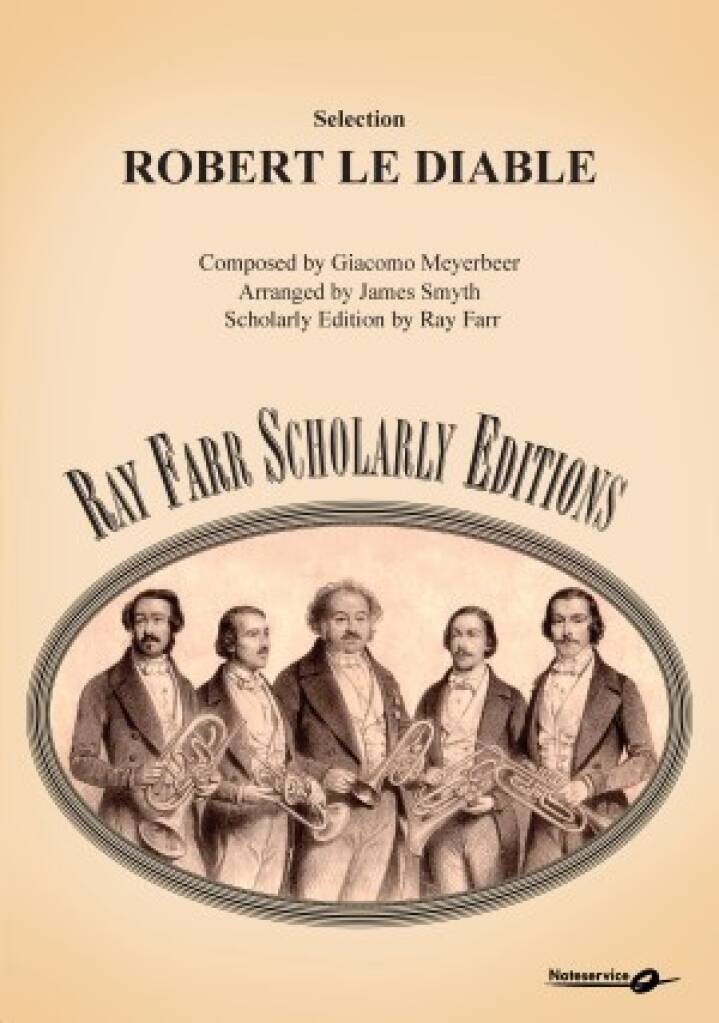
Selection Robert Le Diable - Giacomo Meyerbeer - Ray Farr
This Selection from Giacomo Meyerbeers opera Robert le Diable was arranged by James Smyth. Enderby Jackson commissioned the arrangement which was used as the test piece for the third National Brass Band Contest held at the Crystal Palace, London in 1862.The purpose of this scholarly edition is to produce a performing version, clearing ambiguities and errors, that can be enjoyed by today's performers and listeners, bearing in mind the original function and context. At the same time the edition is an analytical, musicological study of one of the rare treasures of the brass band repertory.
Estimated dispatch 5-14 working days
-
 £105.20
Ungarsk marsj - Hector Berlioz - Bjorn Morten Kjaernes
The "Rakoczi March" (Hungarian March) was the unofficial state anthem of Hungary before Ferenc Kolcsey wrote the Himnusz which is today the official national anthem of Hungary. The first version of this march-song was probably created around 1730 by one or more anonymous composers, although tradition says that it was the favorite march of Francis Rakoczi II. That early version called back Francis Rakoczi II to save his people. It was very popular in the 18th century but in the 19th century the more refined Rakoczi March became prevalent. Hector Berlioz included the music in his composition "La Damnation de Faust" in 1846, and Franz Liszt wrote a number of arrangements, includinghis Hungarian Rhapsody No. 15, based on the theme. The march gave its name to a 1933 Austrian-Hungarian feature film - Rakoczy-Marsch This arrangement is based on Berlioz instrumentation and phrasing from his Hungarian March, but in the form of the 19th century Rakoczi March
Estimated dispatch 5-14 working days
-
 £115.60
Josefs Julevise - Halvdan Sivertsen - John Philip Hannevik
Halvdan Sivertsen (born 1950) is one of the most popular singer/ songwriters in Norway. He is well know as a first-class storyteller, and he has a strong melodic line in all his music. This Christmas song was first recorded in 1991 and it has become a Norwegian classic. The lyrics tell the story of a couple travelling through time to find a city with bright lights, where they hear people sing about the couple who are about to have their first baby. But still this couple can not find anybody willing to help them, and they are forced to go back 2000 years, to find the stable where they find some shelter. Maybe they should have travelled further ahead in time in the firstplace, to find people willing to open their door to the poor and needing?
Estimated dispatch 5-14 working days
-
£87.10
Ghostbusters - Ray Parker Jr. - Idar Torskangerpoll
The title song from the 1984 movie "Ghostbusters" is one of the greatest successes of 80s pop music. Written and performed by Ray Parker, Jr., the song was nominated for a Grammy as best original song. This easy but catchy pop song, typical of the80s, reached the top of the charts both in the US and the UK. This Young Band arrangement is also playable for bands with limited instrumentation. Sure to be a hit at your next show! Also published for Concert Band (Item number 9790261702607).
Estimated dispatch 5-14 working days
-
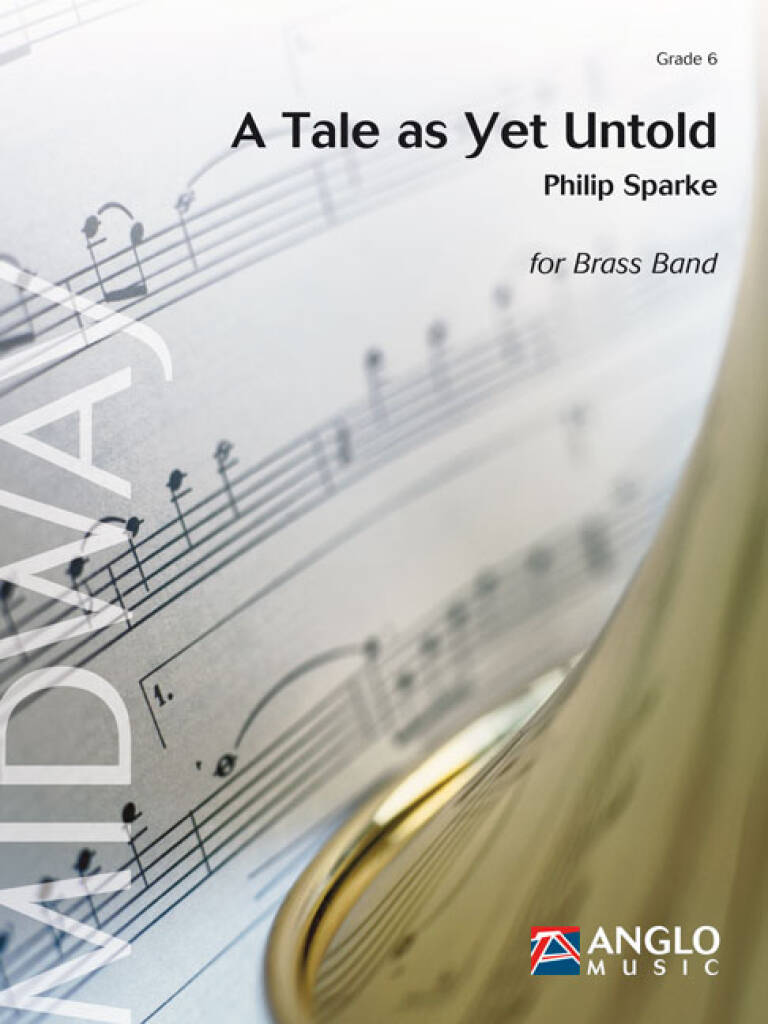 £168.50
A Tale as Yet Untold - Philip Sparke
A Tale as Yet Untold was commissioned by the Cory Band for the European Brass Band Championships in Linz, Austria, 2010, and their winning performance gave them a hattrick of victories at the competition. The theme of this impressive work, which is set in three movements, is one that recurs again and again throughout the music of Philip Sparke, the power of the human spirit to overcome adversity and how the beauty of music can help in this respect.
Estimated dispatch 5-14 working days
 View Music