
Results
-
 £33.20
Les Chasseresses from 'Sylvia' (Brass Band) Delibes arr. Rob Bushnell
Clement Philibert Leo Delibes was a French composer, best known for his ballets and operas, including works such as Lakme (with its famous "Flower Duet"), Coppelia and Sylvia (both key works in the development of modern ballet). The latter started as a play, Aminta, by the Italian poet Torquato Tasso, which Delibes set to music. It was then adapted for the Paris Opera with rehearsals starting in August 1875. The premiere took place on 14 June 1876 and was the first ballet to be shown at the newly-built Opera Garnier. Whilst the scenery and costumes were created by top artists and designers (Cheret and Lacoste), it was Delibes's music that shown thrown, being said to have saved the production, preventing the ballet from drifting into obscurity.Sylvia is said to be one of the first modern ballets, with Tchaikovsky remarking to composer Sergei Taneyev upon its ingenuity: "... the first ballet, where the music constitutes not only the main, but the only interest. What charm, what elegance, what richness of melody, rhythm, harmony." Although Swan Lake, a contemporary to Sylvia, is considered one of the best ballets there is, Tchaikovsky preferred Sylvia to his own work, saying Swan Lake was "poor stuff in comparison". Tchaikovsky said to Taneyev, "I was ashamed. If I had known this music early then, of course, I would not have written Swan Lake". The music to Sylvia, rather than setting only the mood, also sets the action and is noted for its use of leitmotifs - Delibes was an admirer of Wagner - and more dominant use of brass and wind. The most famous piece from this ballet is the Pizzicati in the third act.Act I of the ballet takes place in sacred wood, where creatures are worshipping before Eros when Sylvia arrives with her huntresses to mock the god of love. Aminta, a lowly shepherd and infatuated with Sylvia, protects the deity and Sylvia is wounded by Eros's arrow. The hunter Orion kidnaps Sylvia, whilst Eros revives Aminta. Act II takes place in Orion's Island cave, where Sylvia tries to bribe Orion with jewels and wine. Unsuccessful, she appeals to Eros for help, who arrives and takes her to the temple of Diana (where the final act takes place). Orion and Aminta fight, Sylvia and Orion cause the goddess of the hunt, Diana, to be outraged, smiting Orion and denying the love of Aminta and Sylvia. Eros shows Diana a vision, which changes her mind and the couple finally come together.This brilliant and lively fanfare that introduces the huntresses in the first act is arranged here for the UK-style brass band, with alternative parts for horns in F and bass-clef lower brass. The piece has been lowered by a tone compared to the original. A recording of the original composition can be found here https://youtu.be/6yoGrUH38PI?si=0L0bFa1qXnYNvkR3 Duration: Approx. 3.10 minutes Difficulty Level: 1st Section + This PDF download includes the full score and parts. Includes alternative parts for soloist in Eb, horns in F and lower brass in bass clef. Sheet music available at www.brassband.co.uk (UK) or https://satradecentral.org (USA) Instrumentation: Soprano Cornet Eb Solo Cornet Bb Repiano Cornet Bb 2nd Cornet Bb 3rd Cornet Bb Flugel Horn Bb Solo Horn Eb 1st Horn Eb 2nd Horn Eb 1st Baritone Bb 2nd Baritone Bb 1st Trombone Bb 2nd Trombone Bb Bass Trombone Euphonium Bb Bass Eb Bass Bb Timpani Percussion - Triangle, Cymbal & Bass Drum
In Stock: Estimated dispatch 1-3 working days
-
 £33.20
Love Divine (Blaenwern) (Brass Band) William Rowlands arr. Kenneth Downie
This delightful setting for brass band by Kenneth Downie is based on the much loved hymn Love Divine, All Loves Excelling, alternatively known as Blaenwern. An optional organ part which will enhance the last verse is included. Kenneth Downie writes: 'It has been a delight to work on this wonderful Welsh hymn tune called Blaenwern, a tune which perfectly suits the majestic words by Charles Wesley, 'Love divine, all loves excelling'. This hymn is all about a big, expansive, all-embracing God, and I have tried to capture this aspect of the words. The rising interval in the introduction is an important feature in developing the notion of a 'big God', and its reappearance near the end is intended to be very significant. The hymn is full of memorable phrases which will hopefully inspire players, singers and conductors as they contemplate the text in preparation for any performance. 'Joy of Heaven, to earth come down', 'Enter every longing heart', 'Finish then thy new creation', and then the last amazing four lines: 'Changed from glory into glory, Till in Heaven we take our place, Till we cast our crowns before thee, Lost in wonder, love and praise'. The addition of the organ in the last verse, by special request of Peggy and Scott Thomas who commissioned the arrangement, should add to the majesty of the music, but of course, it is not fundamental to any performance. May this music bring honour to our amazing God!' To view a video of the Melbourne Staff Band playing the piece please visit www.youtube.com/watch?v=BUszRQh40lQ A rolling score video can be viewed here: www.youtube.com/watch?v=y4dM0fZaVug Sheet music available from www.brassband.co.uk Difficulty Level: 4th Section + Length: 4.00 minutes Instrumentation: Soprano Cornet Eb Solo Cornet Bb Repiano Cornet Bb 2nd Cornet Bb 3rd Cornet Bb Flugel Horn Bb Solo Horn Eb 1st Horn Eb 2nd Horn Eb 1st Baritone Bb 2nd Baritone Bb 1st Trombone Bb 2nd Trombone Bb Bass Trombone Euphonium Bb Bass Eb Bass Bb Timpani Percussion 1-2 Organ (optional)
In Stock: Estimated dispatch 1-3 working days
-
 £30.00
Edward Gregson: Music of the Angels, for Symphonic Brass and Percussion
DescriptionProgramme NoteMusic of the Angels is a dramatic work of some 16 minute's duration, scored for a large symphonic brass ensemble, including seven trumpets, and percussion. The percussion section deploys 'dark' instruments such as three tam-tams, a bass drum and two sets of timpani.The title of the work is based on a quotation from the Book of Revelations:And I saw the seven angels which stood before God; and to them were given seven trumpetsThus, the idea behind the work is a dramatic one and the composer has emphasised this by the partial spatial arrangement of the ensemble, with six solo trumpets standing centre stage, but behind the main ensemble, and the seventh trumpet off-stage throughout.The work opens with a four-note motif, dominant throughout the work, announced initially by four off-stage horns and answered by fanfare figures on four solo trumpets. Then in turn each of the first four solo trumpets announce their own cadenzas before joining together, independently playing their own music. This reaches an intense climax before subsiding into slow music which might be described as a Kyrie eleison - a lament for humanity - a cantilena for flugel horn and euphonium, accompanied by trombones. The drama soon returns with the entry of trumpets 5 and 6, playing music that is fast, more urgent and foreboding, and describing in musical terms the horsemen of the Apocalypse.At the climax of this section trumpet 7 enters dramatically, representing the words of the seventh angel ... and time shall be no more. The opening four-note motif is here transformed into a cadenza of epic proportions, to the partial accompaniment of three tam-tams (representing the Holy Trinity). The ensuing scherzo, scored for the ensemble, is fast and furious, but despite the somewhat desolate mood of this music (briefly interrupted by the re-appearance of trumpet 7), it slowly moves towards a more optimistic conclusion, transforming the 'lament for humanity' music into an affirmative and triumphant climax.This work has been commercially recorded on a critically acclaimed CD from London Brass on the Chandos label, available HERE.For more information on Edward Gregson's music please visit the composer's website: www.edwardgregson.com
Estimated dispatch 7-14 working days
-
 £44.27
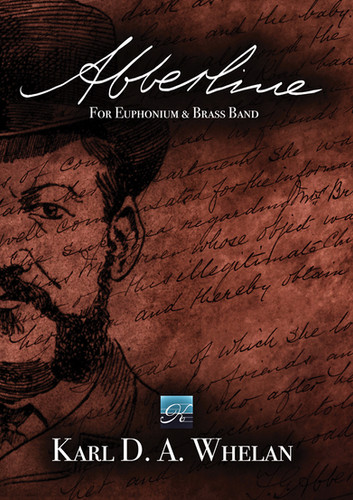
Abberline (Euphonium Solo with Brass Band) Karl Whelan
Inspired by the infamous investigation into Jack the Ripper, Abberline follows Detective Inspector Frederick Abberline through the mist-shrouded streets of Victorian London in his desperate pursuit of a killer who remains forever just out of reach. Scored for brass band and solo euphonium, the piece blends atmospheric textures, shifting musical identities, and virtuosic demands to capture a narrative that is as haunting as it is unresolved. The piece opens in a world of shadows - the foggy alleys of Whitechapel - where tension simmers beneath the surface. The euphonium enters cautiously, as if stalking unseen figures, echoing the danger and uncertainty that cloaked the city in fear. This eerie calm is broken suddenly: the Ripper strikes. The moment is brief but brutal, leaving only silence and horror in its wake. From here, the music shifts into an uneasy, angular waltz: the figure of Abberline takes center stage, portrayed by the soloist as he investigates the aftermath. The waltz is melodically off-kilter and harmonically unstable, capturing both the grotesque nature of the crime and the detective's mental burden. The scene then returns to the streets - but this time, the musical material is more intricate, fragmented, and tense. The threat has deepened, and again the silence is shattered by violence. A second, slightly altered waltz follows, further reflecting Abberline's obsessive descent into the case. In the final section, the chase begins in earnest. Themes from earlier return in quick succession, intensified and overlapping as time runs out. The ancient Dies Irae chant is woven into the texture, evoking fate and judgment. In a final, erratic surge, the euphonium and band race toward an ending that is breathless and unresolved - a reflection of history's unanswered questions and the ghost that always stayed one step ahead. To view a rolling score video of the work please visit https://www.youtube.com/watch?v=i59xYzJRMaI Duration: approx. 7.30 minutes This PDF download includes parts and score. Sheet music available at www.brassband.co.uk (UK) or https://satradecentral.org (USA) Instrumentation: Euphonium Soloist Bb Soprano Cornet Eb Solo Cornet 1-2 & 3-4 Bb Repiano Cornet Bb 2nd Cornet Bb 3rd Cornet Bb Flugel Horn Bb Solo Horn Eb 1st Horn Eb 2nd Horn Eb 1st Baritone Bb 2nd Baritone Bb 1st Trombone Bb 2nd Trombone Bb Bass Trombone Euphonium (tutti) Bb Bass Eb Bass Bb Timpani Percussion 1-3
In Stock: Estimated dispatch 1-3 working days
-
 £36.89
Drink to me only (Flugel Solo with Brass Band) Trad. English Melody arr. Bowen
Enhance your solo repertoire with this evocative and timeless setting for flugel horn. Originally arranged for the New York Staff Band in 1991, this piece offers a lyrical and deeply expressive showcase for the soloist. This arrangement draws from a rich heritage, blending secular and sacred traditions. The melody, famously attributed to Colonel R. Mellish (1777-1817), is inspired by the classic 17th-century poem by Ben Johnson. Within The Salvation Army tradition, this beloved tune is paired with the sacred lyrics of William Drake Pennick, "There is a holy hill of God, its heights by faith I see" (The Salvation Army Song Book, No. 627), making it a versatile choice for both concert and worship settings. This setting is celebrated for its warm, melodic lines, perfectly suited to the mellow tonal qualities of the flugel horn. For those interested in studying the interpretation of this work, the New York Staff Band featured this arrangement on their 1992 recording, Under Three Flags (Triumphonic TRCD 1050). To view a rolling score video featuring Donald Spencer (Flugel Horn Soloist) with the New York Staff Band please visit: www.youtube.com/watch?v=ZRocgjTrli4 Sheet music available from: UK - www.brassband.co.uk USA - www.solidbrassmusic.com Difficulty Level: 4th Section + Instrumentation: Flugel Horn Soloist Bb Soprano Cornet Eb Solo Cornet Bb Repiano Cornet Bb 2nd Cornet Bb 3rd Cornet Bb Solo Horn Eb 1st Horn Eb 2nd Horn Eb 1st Baritone Bb 2nd Baritone Bb 1st Trombone Bb 2nd Trombone Bb Bass Trombone Euphonium Bb Bass Eb Bass Bb Timpani Glockenspiel
In Stock: Estimated dispatch 1-3 working days
-
 £11.06
I was glad (Brass Band with Organ - Additional Parts) Parry trs. Wainwright
I was glad was originally a choral introit which is a popular piece in the musical repertoire of the Anglican church. It is traditionally sung in the Church of England as an anthem at the coronation of the British monarch, most recently that of King Charles III in May 2023. This transcription for brass band combines the choral and accompaniment parts meaning it is playable as a standalone arrangement. An optional organ part is included to augment the brass. The cornet section is divided into two choirs to create an antiphonal effect. The 'Vivats' are included in this transcription but an optional cut is provided for that section. To view a follow-the-score video please visit www.youtube.com/watch?v=Vx95uSp1yU8 PDF download includes additional parts. Purchase the full score and brass band parts here. Sheet music available from: UK - www.brassband.co.uk USA - www.solidbrassmusic.com Difficulty Level: 2nd Section + Parts included in this download: Solo Horn F 1st Horn F 2nd Horn F 1st Baritone Bass Clef 2nd Baritone Bass Clef 1st Trombone Bass Clef 2nd Trombone Bass Clef Euphonium Bass Clef Tuba 1 Bass Clef (Bass Eb equivalent) Tuba 2 Bass Clef (Bass Bb equivalent)
In Stock: Estimated dispatch 1-3 working days
-
 £33.20
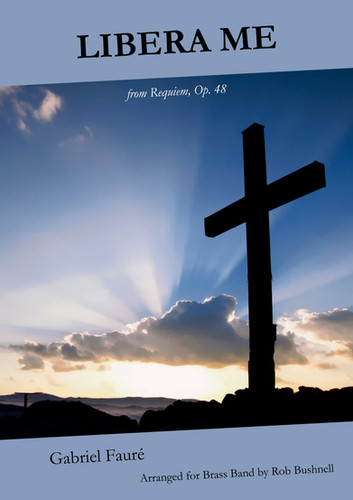
Libera Me from 'Requiem' (Brass Band) Faure arr. Rob Bushnell
Composed between 1887 and 1890, Gabriel Faure's Requiem is not only one of his best-known works but one of the most popular piece of choral music in the Classical repertoire, coming 23rd in the Classic FM's Hall of Fame 2024. Believed to be a tribute to his father (who died in 1885), Faure himself said "My Requiem wasn't written for anything - for pleasure, if I may call it that!" It started life as a five-movement work but was later expanded to be the final seven-movement work we know today. The first version (which Faure called "un petit Requiem") was first performed on 16 January 1888, with Faure conducting, a second version premiered on 21 January 1893 before the final version (reworked for full orchestra) was played on 12 July 1900; the Requiem was performed at the composer's own funeral in 1924.The Libera Me, or Deliver Me, was actually written in 1877 and is the sixth part of the Requiem.Faure once said of the work, "Everything I managed to entertain by way of religious illusion I put into my Requiem, which moreover is dominated from beginning to end by a very human feeling of faith in eternal rest." Upon interview, he also said, "It has been said that my Requiem does not express the fear of death and someone has called it a lullaby of death. But it is thus that I see death: as a happy deliverance, an aspiration towards happiness above, rather than as a painful experience. The music of Gounod has been criticised for its inclination towards human tenderness. But his nature predisposed him to feel this way: religious emotion took this form inside him. Is it not necessary to accept the artist's nature? As to my Requiem, perhaps I have also instinctively sought to escape from what is thought right and proper, after all the years of accompanying burial services on the organ! I know it all by heart. I wanted to write something different."This arrangement is for the British-style brass band, with alternative parts for horns in F and bass-clef lower brass. The tenor solo is featured on the euphonium. A recording of the original composition can be found here: www.youtube.com/watch?v=fXwFNoBHCf0 Duration: 4.20 minutes approx. Difficulty Level: 4th Section + PDF download includes parts and score. Sheet music available from www.brassband.co.uk Instrumentation: Soprano Cornet Eb Solo Cornet Bb Repiano Cornet Bb 2nd Cornet Bb 3rd Cornet Bb Flugel Horn Bb Solo Horn Eb 1st Horn Eb 2nd Horn Eb 1st Baritone Bb 2nd Baritone Bb 1st Trombone Bb 2nd Trombone Bb Bass Trombone Euphonium Bb Bass Eb Bass BbTimpani
In Stock: Estimated dispatch 1-3 working days
-
 £36.89
The First Nowell (Brass Band, opt. Choir & Piano) Traditional arr. Barrie Gott
This charming setting by Australian composer Barrie Gott is of the favourite carol The First Nowell. Although this version is for brass band, choir and piano, it is orchestrated such that it will work for standalone brass band. The arranger writes: 'I have always been fascinated with the words and music of this majestic carol. It was first written for choir and piano and then orchestrated for the Brisbane Lord Mayor's Carols with the Queensland Pops Orchestra. A further arrangement for brass band was prepared for a Salvation Army event. The setting is for four verses (1,2,5 and 6) and tells the Gospel story in a nutshell. It starts very simply and builds to a spectacular climax.' To view a rolling score video of this work please visit www.youtube.com/watch?v=2KH6u0MUiaY Duration: 4.45 minutes approx. Difficulty Level: 3rd Section + PDF download includes parts and score. Sheet music available from www.brassband.co.uk or www.durhammusicshop.co.uk (UK) or https://satradecentral.org (US) Instrumentation: Soprano Cornet Eb Solo Cornet Repiano Cornet Bb 2nd Cornet Bb 3rd Cornet Bb Flugel Horn Bb Solo Horn Eb 1st Horn Eb 2nd Horn Eb 1st Baritone Bb 2nd Baritone Bb 1st Trombone Bb 2nd Trombone Bb Bass Trombone Euphonium Bb Bass Eb Bass BbTimpani Percussion 1-2 SATB Choir (optional) Piano (optional)
In Stock: Estimated dispatch 1-3 working days
-
 £33.20
Adagietto from Symphony No.5 (Brass Band) Mahler arr. Keith M. Wilkinson
Gustav Mahler's Symphony No. 5 is arguably his best known and most loved composition. The Adagietto from that symphony, often performed on its own, is scored for strings and harp only and is widely regarded as one of the most beautiful tunes ever written. It is marked sehr langsam (very slow) and is immensely serene and tranquil, often performed at commemorative events such as the concert following the events of September 11th, 2001. It has been said that the movement is a love song to the composer's wife, Alma. The symphony was composed in 1901 and 1902 and this movement received its British premiere in 1909 at a Promenade concert directed by Henry Wood. The Adagietto received additional popularity when used in the 1971 film Death In Venice. This arrangement by Keith M. Wilkinson shortens the movement slightly and now gives brass bands the opportunity to programme this delightful work. To view a rolling score video of the work please visit https://www.youtube.com/watch?v=PxQRQy534lM Duration: Approx. 5.20 minutes Difficulty Level: 4th Section + PDF download includes parts and score. Sheet music available from www.brassband.co.uk (UK) or https://satradecentral.org (USA) Instrumentation: Soprano Cornet Eb Solo Cornet Bb Repiano Cornet Bb 2nd Cornet Bb 3rd Cornet Bb Flugel Horn Bb Solo Horn Eb 1st Horn Eb 2nd Horn Eb 1st Baritone Bb 2nd Baritone Bb 1st Trombone Bb 2nd Trombone Bb Bass Trombone Euphonium Bb Bass Eb Bass BbTimpani Percussion 1-2
In Stock: Estimated dispatch 1-3 working days
-
 £59.03
Caprice (Euphonium Solo with Brass Band) Andrew Batterham
VIEW SCORE PDF Caprice was written for Matthew van Emmerik, to showcase his virtuosity in an engaging piece of concert music. The work is in theme and variation form, with the primary material being the theme from the last of Paganini's Ventiquattro Capricci per violino solo, a collection of 24 caprices for solo violin. This theme has been the inspiration for similar works by many composers since it was first published, including Liszt, Brahms, Rachmaninov, Benny Goodman and Andrew Lloyd Webber. In this work, the famous theme is treated to a more contemporary approach. The first variation, Capricious, relies on motor rhythms and jagged dialogues between the soloist and the band. It is couched in an organic scale reminiscent of the Phrygian mode. The second variation, Sad, is in direct contrast, acting as a traditional ballad and allowing the soloist to explore the expressive side of the instrument. The third variation, Energetic, is a micro set of variations in itself, designed to display the soloist's innovative technique and stamina. Each section is more challenging than the last, until the work concludes with a whirlwind dance at breakneck speed. Like all of Batterham's recent work, the musical language of Caprice draws upon classical, jazz, funk and ska elements to create a unique sound where anything can happen, and probably will. This arrangement was made possible through Matt's instigation and generosity. To view a video of Matthew van Emmerik performing the version with brass band please visit www.youtube.com/watch?v=D0hsvux_a5o To view a video of Fletcher Mitchell performing the version with piano please visit www.youtube.com/watch?v=NOZ6KRldDVo Sheet music available from: UK - www.brassband.co.uk USA - www.solidbrassmusic.com Instrumentation: Euphonium Soloist Soprano Cornet Eb Solo Cornet Bb Repiano Cornet Bb 2nd Cornet Bb 3rd Cornet Bb Flugel Horn Bb Solo Horn Eb 1st Horn Eb 2nd Horn Eb 1st Baritone Bb 2nd Baritone Bb 1st Trombone Bb 2nd Trombone Bb Bass Trombone Euphonium Bb Bass Eb Bass Bb Percussion 1-3
In Stock: Estimated dispatch 1-3 working days