
Results
-
 £90.00
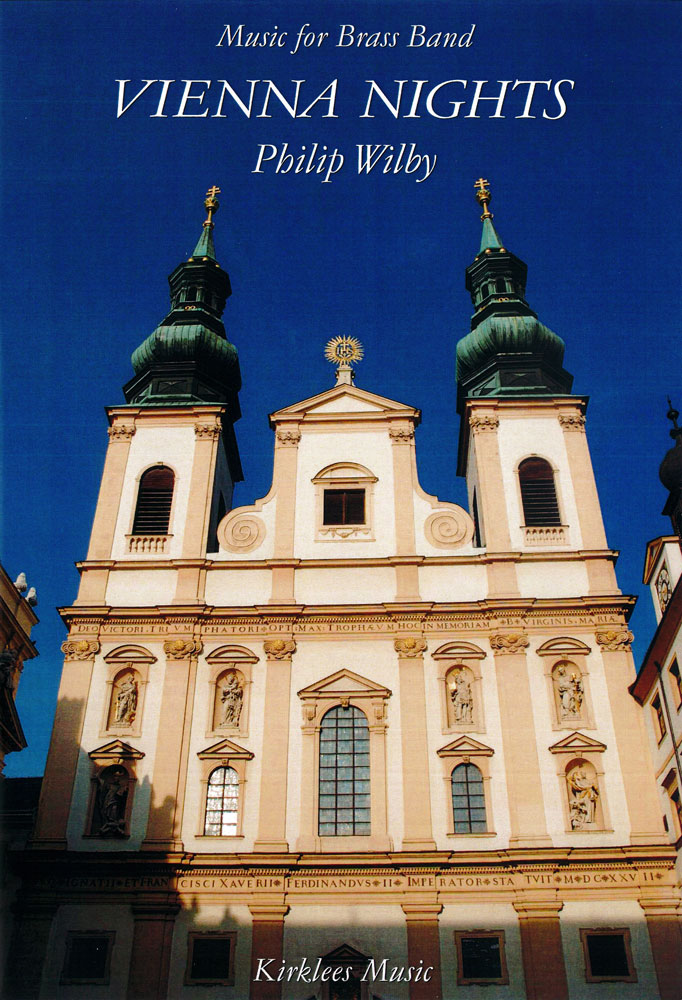
Vienna Nights (Brass Band - Score and Parts)
The City of Vienna stands at one of the historic crossroads of the world, linking east and west and embracing artistic influences from all sides. In the 250th anniversary year of Mozart's birth, this fantasy on Mozart's celebrated Piano Sonata in A (K331), has been composed true to the form and content of the original, but also to the underlying substance of the conception.One of Mozart's distinguishing features, and one that links him to later music by Beethoven, Schubert, Mahler and Schoenberg, is the breadth of his musical vision. His music links intellectual rigour with ecstatic utterance and darker preoccupations. It is, perhaps, this shadow-laden side of his musical nature which gives his work a profundity often absent in the work of his contemporaries. Admirers of his Requiem Mass or the Statue music in Don Giovanni will recognise that it is this extra sense of reality which makes Mozart so relevant to the modern age, and where he may link hands with the other great Viennese thinkers such as Berg, Webern and Adorno.The composer follows the three movement plan of the Sonata closely. The original begins with a Theme and Variations which is freely quoted. His Minuet is mirrored in the Recitative and Notturno, where each section of the band lays down a metaphoric rose to his memory. Famously, the sonata ends in populistic style with a Turkish Rondo. Ever since the Hapsburg-Ottoman Wars, which came to an end in the seventeenth century, Viennese composers have included Turkish elements in their music, not least in the use of certain percussion instruments. Vienna Nights is thusly a homage.It celebrates the world's greatest composer, but also the city which fostered his work. Here, in your imagination, you might easily conjure up a caf table near the Opera House, where Mozart, Mahler and Sigmund Freud, observed by us all from a discreet distance, may meet as old friends.
Estimated dispatch 7-14 working days
-
£12.00
Vienna Nights (Brass Band - Study Score)
The City of Vienna stands at one of the historic crossroads of the world, linking east and west and embracing artistic influences from all sides. In the 250th anniversary year of Mozart's birth, this fantasy on Mozart's celebrated Piano Sonata in A (K331), has been composed true to the form and content of the original, but also to the underlying substance of the conception.One of Mozart's distinguishing features, and one that links him to later music by Beethoven, Schubert, Mahler and Schoenberg, is the breadth of his musical vision. His music links intellectual rigour with ecstatic utterance and darker preoccupations. It is, perhaps, this shadow-laden side of his musical nature which gives his work a profundity often absent in the work of his contemporaries. Admirers of his Requiem Mass or the Statue music in Don Giovanni will recognise that it is this extra sense of reality which makes Mozart so relevant to the modern age, and where he may link hands with the other great Viennese thinkers such as Berg, Webern and Adorno.The composer follows the three movement plan of the Sonata closely. The original begins with a Theme and Variations which is freely quoted. His Minuet is mirrored in the Recitative and Notturno, where each section of the band lays down a metaphoric rose to his memory. Famously, the sonata ends in populistic style with a Turkish Rondo. Ever since the Hapsburg-Ottoman Wars, which came to an end in the seventeenth century, Viennese composers have included Turkish elements in their music, not least in the use of certain percussion instruments. Vienna Nights is thusly a homage.It celebrates the world's greatest composer, but also the city which fostered his work. Here, in your imagination, you might easily conjure up a caf table near the Opera House, where Mozart, Mahler and Sigmund Freud, observed by us all from a discreet distance, may meet as old friends.
Estimated dispatch 7-14 working days
-
 £38.95
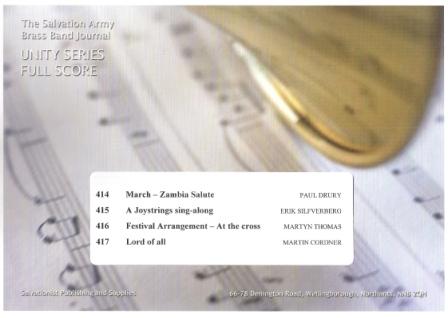
Unity Series Band Journal February 2014 Numbers 414-417
No.414 March - Zambia Salute (Paul Drury)In April 2009, a group from Chelmsford Citadel Corps visited Zambia. The purpose of the visit was to assist in the leadership of the Zambian Territorial Music School, held at Chikankata. This march was written to commemorate the event and received its premiere performance at the final festival. The melody featured is the chorus of the song, I know not why Dod's wondrous grace (S.A.S.B. 730).No.415 A Joystrings sing-along (Erik Silfverberg O.F.)This piece represents the first published work since the sudden Promotion to Glory of Bandmaster Erik Silfverberg O.F. The Joystrings made Salvation Army history about fifty years ago, introducing rock music on the Christian music scene. Many of their songs have become classics and have been used as thematic material in our brass music. Here is a selection of three of their songs, to be used either as a band piece or as accompaniment to a sing-along. The three songs are:- 'I want to sing it', 'It's an open secret' and 'Have faith in God'.No.416 Festival Arrangement - At the cross (Martyn Thomas)The well-known song, 'At the cross' (T.B. 580), is given a lively new setting by Martyn Thomas. The rock and swing treatment of this old melody should appeal to many!No.417 Lord of all (Martin Cordner)This piece was written for the 120th Anniversary of Balham corps (London Central Division) in 2011. In terms of a theme, the anniversary occasion prompted the primary thought that the piece should first be a praise-offering to God, acknowledging him for who he is. Therefore songs referenced in the piece are praide songs: 'Lord, reign in me', 'He is Lord', 'All hail the Lamb', along with a song of testimony, 'I'm a soldier bound for Glory' (T.B. 382),which speaks of the Christian hope in Heaven and challenges Salvationists to influence others by living out that hope. There is also a brief reference to the National Anthem of the Democratic Republic of Congo (4 bars before D)- man acknowledgement to the faithfulness of corps soldiers who in recent years have arrived from that country.
Estimated dispatch 7-14 working days
-
 £39.95
Judd: All the Nations
September 2017 ReleaseAll the Nations (Roger Trigg)Originally written for the Melbourne Staff Band 125th Anniversary, the central theme of the music is from Psalm 86 verse 9. The tune is derived from 'Lobe den herren' before a setting of the tune 'St Peter' in a more reflective manner is presented. An invitation to worship as a group of Gods people is presented in the contemporary song 'Come, now is the time to worship' before the original material is presented and the tune 'St Peter' is heard in a full, exciting conclusion.
Estimated dispatch 7-14 working days
-
 £44.95
Judd: Music of a Legacy - Contest Version - Steven Ponsford
Newly edited contest version.This piece pays tribute to the vast heritage of Salvation Army brass band music. Written in one movement, it is rhapsodic in nature and quotes references from just a few of the many iconic pieces from the past, progressing naturally through the different styles of music; firstly marches, followed by meditations, major works and then solos. The underpinning theme that binds the work together is the much-loved hymn, by Timothy Dudley-Smith, drawing particular attention to the last line of the first verse; Lord for the years, we bring our thanks today. This is music of thanksgiving to the rich inheritance that inspires writers today to continue the mission of the gospel through this very special and unique genre.
Estimated dispatch 7-14 working days
-
 £44.95
Judd: Music of a Legacy - Original Version - Steven Ponsford
This piece pays tribute to the vast heritage of Salvation Army brass band music. Written in one movement, it is rhapsodic in nature and quotes references from just a few of the many iconic pieces from the past, progressing naturally through the different styles of music; firstly marches, followed by meditations, major works and then solos. The underpinning theme that binds the work together is the much-loved hymn, by Timothy Dudley-Smith, drawing particular attention to the last line of the first verse; Lord for the years, we bring our thanks today. This is music of thanksgiving to the rich inheritance that inspires writers today to continue the mission of the gospel through this very special and unique genre.
Estimated dispatch 7-14 working days
-
 £34.95
Tribute Music (Brass Band - Score and Parts)
The composer writes: Having received delightful reports about Neil Ferguson from his colleagues in Granite City Brass, I thought it might be a good idea to incorporate the musical initials from his name, EFEG, in the opening idea of the music. I used this short idea as a motif during the piece. A recurring comment in the tributes referred to his dry sense of humour, and particularly his ability to deliver a one-liner when least expected. The music does therefore contain a few surprises and sudden changes of direction. I also thought that it might be in character for me to include a little "joke" of my own, which is there to be heard by the very careful listener! Such listeners would do well to remember that the Granite City Brass, the commissioning band, is based in Aberdeen. The idea of commemorating such a faithful member of the band with a piece of music led me to try and write a noble, upright theme, which might be remembered as a melody in the future. I hope that it is a fitting tribute.
Estimated dispatch 7-14 working days
-
 £49.95
Bestowal of a Century (Tenor Horn Solo)
Tenor Horn Solo with Brass BandBestowal of a Century (2014) was commissioned by Lowenna Taylor, and funded through her Harry Mortimer Trust award which she was presented with at the 2013 British Open Championship following the completion of her studies at the Royal Welsh College of Music in Cardiff. The 15-minute work received its world premiere at the Cornwall Youth Brass Band Christmas concert in 2014 with solosit, Lowenna, working alongside the band under the baton of Les Neish.The Bestowal refers to the presentation of the Royal Trophy by the then Prince of Wales to the famous West of England Bandsman's Festival in Bugle in 1913. Over the years it has been won by some of the greatest names in brass banding, including Black Dyke and Munn & Feltons - although more recently it has become a wonderful open festival that includes sections for local bands as well as visitors from all over the banding globe. 2014 marked the one-hundredth anniversary of the presentation of the trophy, which is the only brass band trophy to have the official seal of royal patronage.The work, in three distinct sections, opens in a mysterious way, building progressively with interjections from the horn. The composer notes its as though one can imagine different part of the trophy being put together, piece by piece, until the trophy is complete and a climax is reached. Following this, a playful theme is presented which is developed throughout the first section and interacting between soloist and band.The second movement, in complete contrast, is a lyrical melody; heart-wrenching throughout, and sits well both as part of the concerto and also as a stand-alone solo item. The third movement is light-hearted and virtuosic, demonstrating the technical capabilities of the instrument with fast and virtuosic playing, and a cadenza towards the end of the work.
Estimated dispatch 7-14 working days
-
 £29.95
St. Andrew's Variations (Score Only)
This piece, written for the East Anglian Brass Band Festival in 1998, takes the form of eight variations and a finale, loosely based on the descending third motif heard in the initial theme. It was initially composed for junior band, and expanded and rescored for full band in 2006. There is no significance in the title, other than the fact it was written by a Scotsman to be played in the St Andrew's Hall, in Norwich!Alan Fernie was born and brought up in the Scots mining village of Newtongrange. From the age of 13 he learned to play the trombone both at school and with the local brass band, going on to study music in Glasgow and London. After a short period working as an orchestral musician, Alan moved into instrumental education, spending over 20 years teaching brass in schools all over the East of Scotland. It was during this time that he began to conduct and he has since directed bands at all levels, winning many awards. He first wrote for brass whilst still a student, and his music is now played, recorded and published throughout the world.In 2009, Alan was honoured with the "President's Award" from the Scottish Brass Band Association for services to banding. He is also proud to be associated as composer in residence with the acclaimed charity "Brass for Africa", with whom he spent two months recently teaching in Kampala, Uganda. Living in the Scottish Borders, Alan now works as a freelance musician, finding time to write, teach, conduct, judge, perform and act as compere throughout the UK and beyond.
Estimated dispatch 7-14 working days
-
 £33.62
The Hewer's Prayer (Brass Band) Steve Gibson
This music was inspired by stories of those working in the dark and dangerous conditions of the coal mines, and particularly those hewers right at the coal face. Based around an original theme, the music captures a hymn-like setting of a miner's prayer for safety. Depictions of industry and difficult times follow, but resolve into a triumphant conclusion where dark imagery give way to light. The music is the composer's proud tribute to the industrial heritage of his forebears. Sheet music available from: UK - www.brassband.co.uk USA - www.solidbrassmusic.com Difficulty Level: 4th Section + Instrumentation: Soprano Cornet Eb Solo Cornet Bb Repiano Cornet Bb 2nd Cornet Bb 3rd Cornet Bb Flugel Horn Bb Solo Horn Eb 1st Horn Eb 2nd Horn Eb 1st Baritone Bb 2nd Baritone Bb 1st Trombone Bb 2nd Trombone Bb Bass Trombone Euphonium Bb Bass Eb Bass Bb Timpani Percussion Glockenspiel
In Stock: Estimated dispatch 1-3 working days
 Watch video