
Results
-
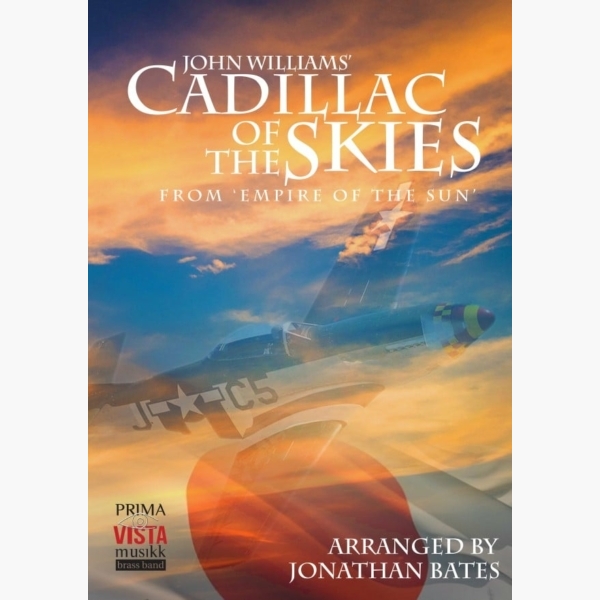 £34.95
Cadillac of the Skies - John Williams - Jonathan Bates
Cadillac of the Skies is taken from the score of the 1987 film Empire of the Sun, by John Williams. As Jim, played by a young Christian Bale, watches in amazement as a P-51 aircraft attacks the camp where he...
Estimated dispatch 5-7 working days
-
 £74.95
The Golden Apples of the Sun - Rodney Newton
This work was commissioned in 2012 by the percussionist, Yasuaki Fukuhara, and takes its title from the final verse of W.B.Yeats' poem, The Song of Wandering Aengus; Though I am old with wandering, Through hollow lands and hilly lands, I...
Estimated dispatch 5-7 working days
-
 £28.50
Island of the Setting Sun - Richard Rock
Premiered by the Salford University Brass Band and performed at the Europeans in 2010. Inspired by a book of the same name from Mythical Ireland (www.mythicalireland.com)
Titles No Longer Available
-
 £124.20
The House Of The Rising Sun - Traditional
Estimated dispatch 5-14 working days
-
 £105.80
Tears Of The Sun - Hans Zimmer - John Glenesk Mortimer
Estimated dispatch 5-14 working days
-
 £168.50
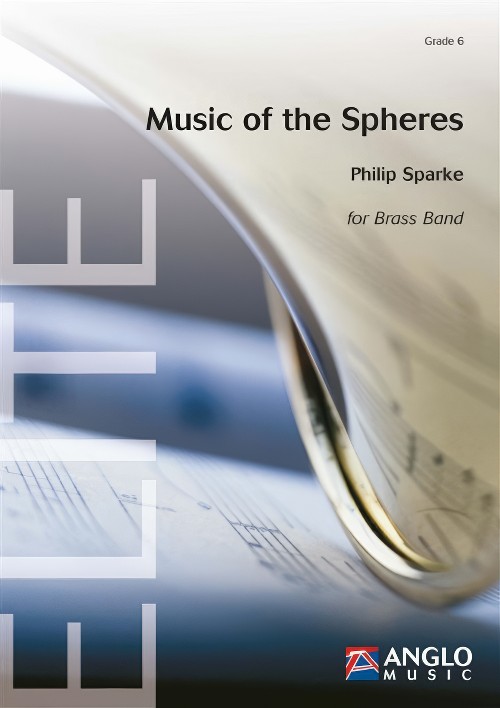
Music of the Spheres (Brass Band - Score and Parts) - Sparke, Philip
Music of the Spheres was commissioned by the Yorkshire Building Society Band and first performed by them at the European Brass Band Championships in Glasgow, May 2004. The piece reflects the composers fascination with the origins of the universe and deep space in general. The title comes from a theory, formulated by Pythagoras, that the cosmos was ruled by the same laws he had discovered that govern the ratios of note frequencies of the musical scale. ('Harmonia' in Ancient Greek, which means scale or tuning rather than harmony - Greek music was monophonic). He also believed that these ratios corresponded to the distances of the six known planets from the sun and thatthe planets each produced a musical note which combined to weave a continuous heavenly melody (which, unfortunately, we humans cannot hear). In this work, these six notes form the basis of the sections Music of the Spheres and Harmonia. The pieces opens with a horn solo called t = 0, a name given by some scientists to the moment of the Big Bang when time and space were created, and this is followed by a depiction of the Big Bang itself, as the entire universe bursts out from a single point. A slower section follows called The Lonely Planet which is a meditation on the incredible and unlikely set of circumstances which led to the creation of the Earth as a planet that can support life, and the constant search for other civilisations elsewhere in the universe. Asteroids and Shooting Stars depicts both the benign and dangerous objects that are flying through space and which constantly threaten our planet, and the piece ends with The Unknown, leaving in question whether our continually expanding exploration of the universe will eventually lead to enlightenment or destruction.Duration: 18:00
Estimated dispatch 7-14 working days
-
£42.50
Music of the Spheres (Brass Band - Score only) - Sparke, Philip
Music of the Spheres was commissioned by the Yorkshire Building Society Band and first performed by them at the European Brass Band Championships in Glasgow, May 2004. The piece reflects the composers fascination with the origins of the universe and deep space in general. The title comes from a theory, formulated by Pythagoras, that the cosmos was ruled by the same laws he had discovered that govern the ratios of note frequencies of the musical scale. ('Harmonia' in Ancient Greek, which means scale or tuning rather than harmony - Greek music was monophonic). He also believed that these ratios corresponded to the distances of the six known planets from the sun and thatthe planets each produced a musical note which combined to weave a continuous heavenly melody (which, unfortunately, we humans cannot hear). In this work, these six notes form the basis of the sections Music of the Spheres and Harmonia. The pieces opens with a horn solo called t = 0, a name given by some scientists to the moment of the Big Bang when time and space were created, and this is followed by a depiction of the Big Bang itself, as the entire universe bursts out from a single point. A slower section follows called The Lonely Planet which is a meditation on the incredible and unlikely set of circumstances which led to the creation of the Earth as a planet that can support life, and the constant search for other civilisations elsewhere in the universe. Asteroids and Shooting Stars depicts both the benign and dangerous objects that are flying through space and which constantly threaten our planet, and the piece ends with The Unknown, leaving in question whether our continually expanding exploration of the universe will eventually lead to enlightenment or destruction.Duration: 18:00
Estimated dispatch 7-14 working days
-
 £64.95
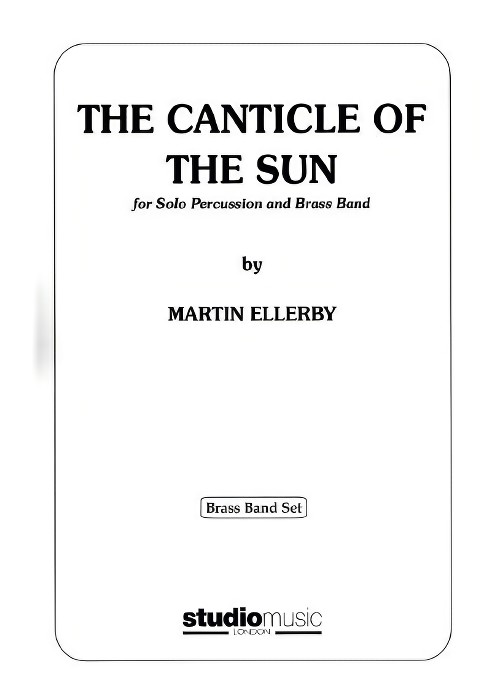
Canticle of the Sun (Percussion Solo with Brass Band - Score and Parts) - Ellerby, Martin
The Canticle of the Sun was commissioned by Birmingham Symphonic Winds conductor Keith Allen for Simone Rebello. The work is based on the canticle written by St. Francis of Assisi (1182-1226) whose ideas that nature and the material world were gifts from God and should be valued and appreciated. The brass band version was made especially for a studio recording by the Black Dyke Band conducted by Nicholas J. Childs with Simone Rebello on percussion. Duration: 13.00
Estimated dispatch 7-14 working days
-
 £24.95
SNARING OF THE SUN, The (Brass Band Extra Score) - Roberts, Stephen
2015 National Championships Finals Testpiece - Second Section - Extra Score. The Graces of Love (Le Gratie d'Amore) is the title of a book published in 1602 by Cesare Negri, the famous dance master of the Milan court in the Renaissance. It contains numerous dance tunes and precise descriptions of courtly dances. It also includes the tune Il bianco fior (The White Flower) on which the first movement of the present piece is based. A vigorous dance in three-four, it leads to an acceleration and a sudden shift to an even meter towards the end. The second movement, calm and contemplative in character, features the tune Vaghe bellezze ... (Veiled Beauty ...). Widely spaced melodic parts surround two solos during which the tune is varied and developed. Finally, the third movement contains a saltarello with a hypnotic rhythm, ending the work with flair and gusto. Duration: 11:30
Estimated dispatch 7-14 working days
-
£99.95
SNARING OF THE SUN, The (Brass Band Set) - Roberts, Stephen
2015 National Championships Finals Testpiece - Second Section. The Graces of Love (Le Gratie d'Amore) is the title of a book published in 1602 by Cesare Negri, the famous dance master of the Milan court in the Renaissance. It contains numerous dance tunes and precise descriptions of courtly dances. It also includes the tune Il bianco fior (The White Flower) on which the first movement of the present piece is based. A vigorous dance in three-four, it leads to an acceleration and a sudden shift to an even meter towards the end. The second movement, calm and contemplative in character, features the tune Vaghe bellezze ... (Veiled Beauty ...). Widely spaced melodic parts surround two solos during which the tune is varied and developed. Finally, the third movement contains a saltarello with a hypnotic rhythm, ending the work with flair and gusto. Duration: 11:30
Estimated dispatch 7-14 working days
 View Music