
Results
-
 £30.00
Exegesis - Tim Paton
An exciting, original composition for brass band by Tim Paton. A complex work which entwines melodic lyricism amidst contemporary harmonies and scoring. A tour de force of Tim's creativity and a rewarding challenge for the performers and audience.Tim comments: The term exegesis is applied to a study which works out the meaning of something, an interpretation of a series of events, a comparison of ideas within a given medium, for example, "Biblical exegesis". This brass band piece is a musical exegesis.Section one is made up of three main themes, and although these themes are tonal within themselves, there is a sense that they are trying to understand one another. From the very beginning of this section, there is an element of bi-tonality and dissonance.The middle section is ponderous, where we hear elements of these three themes. It could be called the 'thinking section'.Section three almost interrupts this middle section, with fanfares displaying a realisation, still containing bi-tonality, but in harmony! We are soon led in to a hymn like celebration, followed by a determined, militaristic section for the percussion. Finally, the fanfares which opened this third section, reappear, taking us to a final conclusion.
In Stock: Estimated dispatch 3-5 working days
-
£67.50
Tone Builders for Developing Bands - James Curnow
Exceptionally useful! This collection of 24 etudes is specifically designed to help develop good individual and ensemble tone production and intonation. Citing tone production as one of the most important facets of good playing, Jim Curnow starts beginning players with material they have learned in their beginning method books, and then moves on to new and more advanced concepts. A great aid for your program!
Estimated dispatch 5-14 working days
-
 £109.99
Modern Times - Etienne Crausaz
Modern Times is a concert suite from the musical and theatrical show Le Temps de Lyre, written and directed by Nicolas Bussard. The work was commissioned for the 100th anniversary of the Lyre de La Roche, directed by Marc-Olivier Broillet, with the premiere taking place in July 2024 in front of an audience of over 2,000.This suite highlights three of the dozen tableaux in the show. After an introduction evoking a sort of journey back in time, the first tableau (bar 20) illustrates various disasters that have occurred in the village over the years. The sky darkens, the thunder rumbles, the rain lashes down, and violent gusts of wind are unleashed on this corner of the country. The storm finally calms down, giving way to great desolation.The second tableau (bar 117) describes the resilience of the villagers, who summon up all their courage to repair the damage. The music is soft, calm, and hopeful.On the strength of this new beginning, the village can embrace modernity: motor vehicles replace horses, a dam is built, and tourism develops, encouraging a society open to other cultures. The third tableau in this suite illustrates all these advances (bar 177). Musically, this final section pays tribute to George Gershwin and Leonard Bernstein, two of the 20th century's great musicians and composers, who worked during the fascinating period of modern times and well beyond.
Estimated dispatch 5-14 working days
-
 £84.99
Christmas Brass - Richard Peaslee
Christmas Brass is a fantasy on six carols, originally commissioned by Mark Freeh for the Manhattan Brass Choir. Duration: 16:30The well-known tune, O Come, O Come Emmanuel, a hymn originally based on a plainsong melody, is here set in 5/4 meter. Modal harmonies are combined with big band style as the piece gains momentum, greatly accentuating the mood of the words, "Rejoice! Rejoice! Emmanuel." The opening 5/4 statement of the theme returns, and the piece ends quietly.In Beautiful Savior (also known by the title Fairest Lord Jesus), a hushed beginning featuring horns, euphoniums, and a muted trumpet, leads through a key change to a satisfying, chorale-likeclosing passage.In Away in a Manger, Peaslee sets two tunes, Cradle Song and Away in a Manger. Following a straightforward presentation of each melody, Peaslee plays them against one another. The music swells to a full climax followed by a hushed ending.Peaslee employs a gentle hand in It Came Upon a Midnight Clear, using flugelhorn solos and duets in a jazz-waltz style.In Silent Night, the traditional carol gets an untraditional harmonization, propelled forward by give-and-take between the two groups of brass instruments in the brass choir: trumpets and trombones versus horns, euphoniums, and tuba.Hark! The Herald Angels Sing begins with a humorous blast of discordant harmonies as multiple carols are sounded at the same time. An up-tempo 4/4 announcement of the melody in the trombone is followed by a metrical modulation in 6/8-3/4 time. An additional metrical modulation bring the music back into 4/4, but at a slower tempo and in a pronounced jazz style. Tempo I returns, and the set of six pieces closes with a big ending.Instrumentation: 4 Trumpets, 2 Horns in F, 4 Trombones, 2 Euphoniums, Tuba, Guitar, Bass, Percussion
Estimated dispatch 5-14 working days
-
 £85.00
Alchymist's Journal. - Kenneth Hesketh
'The Alchymist's Journal' gets its title from the book of the same name by American author Evan S. Connell. The book fictionalises a number of famous Alchemist's writings, each one developing another's thoughts thuscontinuing one idea but changing it subtly to provide a new view point or way of thinking. This process is, in fact, alchemical as one idea transmutes into another. This idea is parallel to the processes at work within thesevariants. The whole work is constructed from 6 notes (C, A, B flat, E flat, F sharp, E) and is presented in nine different sections, each individual in mood but still based upon the original pitches. This is not a thematic setofvariations, as the themes are developed one at a time from small segments of the six notes. For example, the opening theme is the complete number of pitches, the second theme uses three notes transposed then repeated at theoriginal level, and so on. Harmonically, the six notes can be divided into two triads, A minor and E flat minor - each key beginning and ending the piece respectively. Whilst this is essentially abstract music with noprogramme there is an introduction, menacing scherzo, slow reflective section followed by a recap of the scherzo and final coda. 'The Alchymist's Journal' was commissioned by the Brass Band Heritage Trust at the suggestionof Paul Hindmarsh, to whom the work is dedicated.
Estimated dispatch 5-14 working days
-
 £59.99
A Lyrical Duet - Bert Appermont
This attractive composition focuses on the lyrical qualities of two solo instruments: tenor horn and baritone. An expressive theme is initially performed by the baritone; then the tenor horn takes over this melody. A rich dialogue arises, in which the soloists make music in sweet harmony, and then in a 'call-and-response game'. In the B section, the lyricism becomes more virtuosic, and a more playful character comes to light. There is then a gradual build-up to a grand tutti in which the opening theme resounds again. The work ends in a reverie, echoing the dreamy beginning.A Lyrical Duet was commissioned by tenor horn artist, conductor, and teacher Tim De Maeseneer, and is dedicated to him and Katrina Marzella. The work can be heard on Tim's solo CD, Beyond the Paradox, a project that was created in collaboration with Brass Band Willebroek and its conductor Frans Violet.
Estimated dispatch 5-14 working days
-
 £174.10
Three Gentle Giants - Svein H. Giske
Three Gentle Giantswas commissioned by Grenland International Brass Festival as a test piece for the 2nd division in 2008.Three Gentle Giants. The three giants each have their own monologue which leads into a conversation. They gather recognition and respect from each others views as the dialogue evolves. Eventually they find a more nutual and singular expression to their conversation.The giants are old with a long life behind them. This can be heard through a slow, melancholic waltz. A waltz is dance commonly linked to festiveoccasions, such as weddings, but for the giants it holds much more significance. It gives room to think about people they have met, placesthey have been, and all that life has given them.Quietly it ends, more or less like it began. We hear echoes of the past, before it all fades out.The giants wander off into a new beginning.Svein H. Giske- January 2023 -In Memoriam Thorvald, Finn and Thor Louis
Estimated dispatch 5-14 working days
-
 £70.00
Smoke Sketches - Daniel Hall
Smoke Sketches is Daniel Hall's first original work to be published in the Faber Music Brass Band Series. Daniel is one of the most gifted of the rising generation of composers writing for brass bands. Smoke Sketches was composed at the invitation of Brass Bands England for the Intermediate Section of the 2017 National Youth Brass Band Championships of Great Britain. This colourful, jazzy suite draws inspiration from the ancient art of gazing into smoke from fire to find stories through the act of divination. Into the Blaze suggests someone briskly fire-walking, barefoot, with unexpected sparks fizzling from the ground. A Lonesome Ember capturesthe fleeting life of a small ember, beginning insignificantly and gradually evolving into a larger being before disappearing into ash, while Spark of Light bristles with life and energy. Band Grade 3/4, duration 8 minutes.
Estimated dispatch 5-14 working days
-
 £80.00
Fanfares and Love Songs - Gavin Higgins
Fanfares and Love Songs was commissioned by the National Children's Brass Band of Great Britain for performance on 25th July 2009. Its three movements contrast the extrovert and lyrical qualities of thetraditional brass band. The fanfare with which the work opens involves the whole cornet section. The second movement is reflective in mood, beginning somewhat pensively on muted brass, and building to an emotional climax beforesubsiding back to a distant pianissimo chord. The finale is a fast dance, which with a final recapitulation of the opening fanfare drives on to a breathless close. Brass Band Grade 4: Advanced Youth and 3rdSectionDuration: 12 minutes
Estimated dispatch 5-14 working days
-
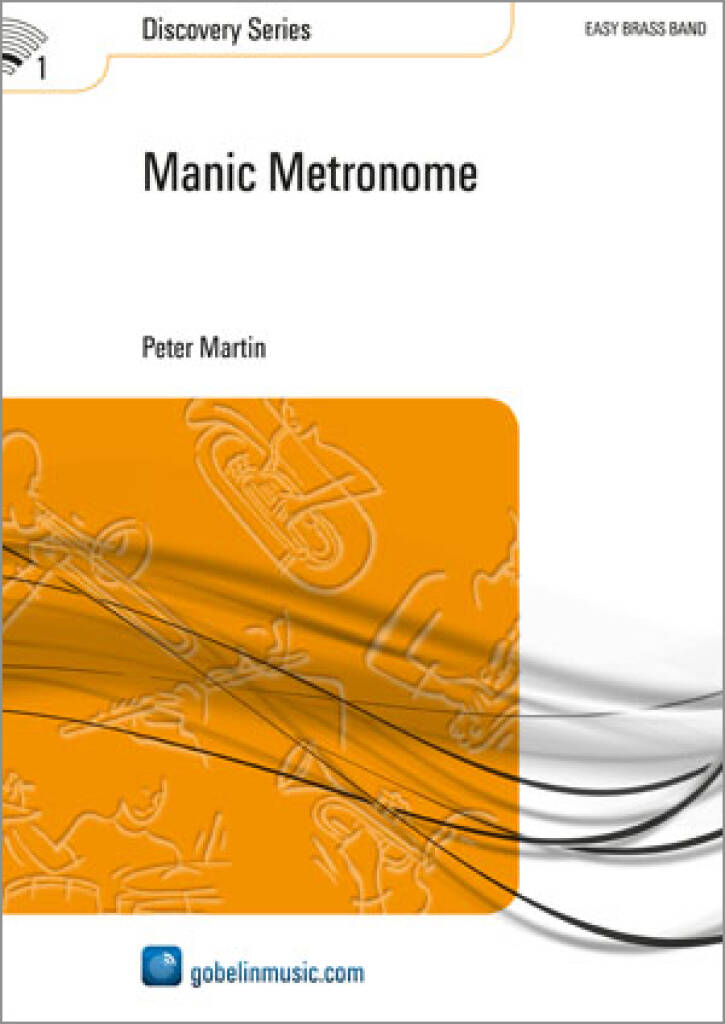 £54.99
Manic Metronome - Peter Martin
A metronome can drive you crazy, particularly when the tempo is fairly quick. But what would you think of a metronome that goes crazy itself? From the very beginning of this fun piece, the machine tries to put the band on the wrong track, and it almost works. Composer Peter Martin created a charming piece of music, but the question is, does it all end well? Use your imagination and creativity in Manic Metronome!
Estimated dispatch 5-14 working days
 View Music