
Results
-
 £40.00
Last Night of the Proms Medley - Traditional
The quintessential most English of English classical music concerts and the self-styled world's largest and most democratic musical festival". The "Proms", originally known as The Henry Wood Promenade Concerts are an eight-week summer season of daily orchestral classical music concerts and other events held annually, predominantly in the Royal Albert Hall in London. Founded in 1895, each season now consists of more than 70 concerts in the Albert Hall, a series of chamber concerts at Cadogan Hall, additional Proms in the Park events across the United Kingdom on the last night, and associated educational and children's events. Often held as outdoor concerts in London's pleasure gardens, where the audience was free to stroll around while the orchestra was playing, this tradition has once again been revived in parks and stately homes not only in the UK, but across the world. The first series of promenade concerts were held indoors at the Queen's Hall in Langham Place. The idea was to encourage an audience for concert hall music who, though not normally attending classical concerts, would be attracted by the low-ticket prices and more informal atmosphere. In addition to "promenading" or "promming"; eating, drinking and smoking was all allowed. Many people's perception of the "Proms" is taken from the "Last Night", although this concert is very different from the others. The concert is traditionally of a lighter vein, with popular classics being followed by a series of British patriotic pieces in the second half of the concert. This second half sequence traditionally includes most of the works included in this medley. Many in the audience use the occasion for an exuberant display of Britishness. Union Jack Flags are carried and waved by the "Prommers", especially during "Rule, Britannia!". Balloons and party poppers are also in abundance.
-
The Giddy Goat - Traditional Swiss - Daniel von Siebenthal
The Giddy Goat is a silly folk song that everyone knows in Switzerland. It is about a white goat that does not want to get milked, so she kicks the milker. Thinking that this is because the goat is white, the owner decides that he will buy a brown one instead. From there on, people make up their own verses in which the goat is often replaced with past loves, enemies, and anyone or anything worthy of ridicule. Daniel, the arranger, lives in Gstaad in the Saanen district and the "Saanen goat" is a breed of white goat known throughout the world. As a farm boy, he did his share of goat milking and received the occasional hoof under his chin for his trouble. So, this piece is a tribute to a local breed that became world-famous, especially in America where the tune also meets its counterpart Billy Grogan's Goat (a similar silly song). The Giddy Goat should always be played as a "silly song" reflecting the goat's nature; capricious and cantankerous. The low bass line is important in Swiss folk music and should approximate to a plucked string-bass whose strings are dampened, to give it a pulsating feel. For those who would like to yodel we include the following Swiss tongue twister:- Holeduli duliduli, holeduli duli duli duuli, Holeduli duliduli, holeduli duli duli duu
-
Tiger In The Night - Mike Batt - Len Jenkins
"Tiger in the Night" is a song made popular by Colin Blunstone and Katie Melua, and takes its inspiration from the poem by William Blake.It features in the soundtrack of the 1997 film 'Keep the Aspidistra Flying' which was based on the 1936 book by George Orwell. The title of the book is a reference to 'Keep the Red Flag Flying' but applied to the stuffiness of the British Middle Class. The music for the film was composed by Mike Batt who was also responsible for "The Wombling Song" and "Wombling Merry Christmas" which we also publish for brass.
-
 £62.00
The Night To SIng (Score only) - Bramwell Tovey
The piece takes its inspiration from the VE Day celebrations of 1945. On 8 May 1945 the end of the war in Europe was celebrated in Great Britain. VE day (Victory in Europe day) gave rise to extraordinary public celebrations all over the country, from street parties to services of thanksgiving, to impromptu singing and community music-making. Contemporary reports mention Victorian ballads and Edwardian music hall songs, as well as the latest popular craze - the Conga. Festivities continued until dawn whereupon, finally surrendering to fatigue, the remnants of the crowd headed home on foot, long after the last bus. Some felt the celebrations to be inappropriate - much of Europe lay in ruins and war still raged in Asia. Almost everyone lamented the loss of somebody who had not survived. Duration: 16:50
Estimated dispatch 7-9 working days
-
 £74.00
The Night To SIng (Parts only) - Bramwell Tovey
The piece takes its inspiration from the VE Day celebrations of 1945. On 8 May 1945 the end of the war in Europe was celebrated in Great Britain. VE day (Victory in Europe day) gave rise to extraordinary public celebrations all over the country, from street parties to services of thanksgiving, to impromptu singing and community music-making. Contemporary reports mention Victorian ballads and Edwardian music hall songs, as well as the latest popular craze - the Conga. Festivities continued until dawn whereupon, finally surrendering to fatigue, the remnants of the crowd headed home on foot, long after the last bus. Some felt the celebrations to be inappropriate - much of Europe lay in ruins and war still raged in Asia. Almost everyone lamented the loss of somebody who had not survived. Duration: 16:50
Estimated dispatch 7-9 working days
-
 £15.00
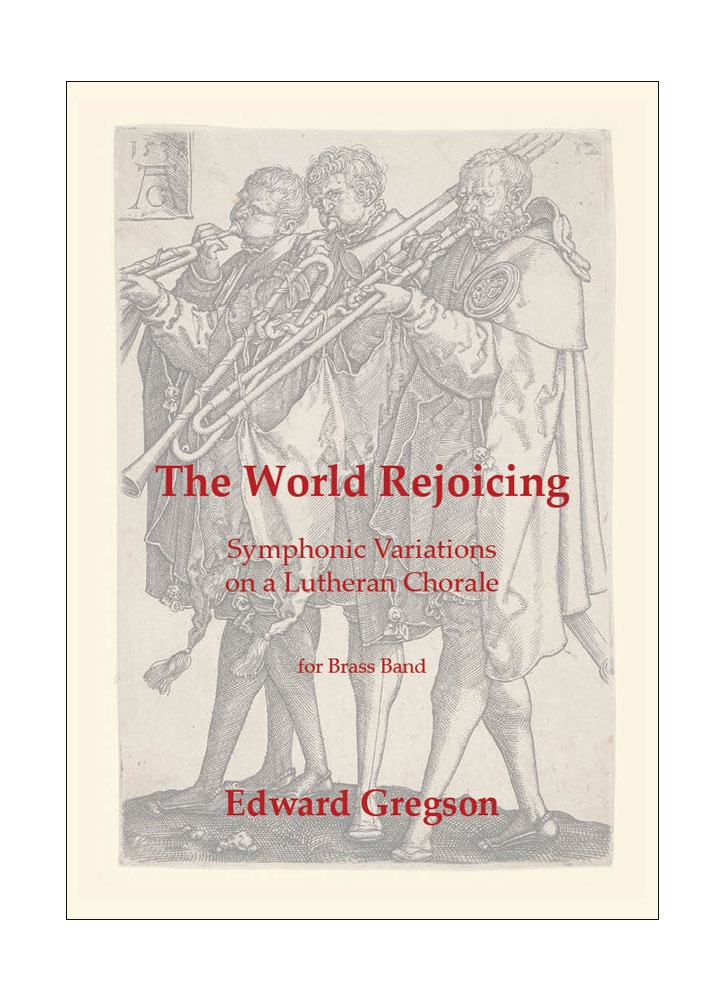
The World Rejoicing (Brass Band - Study Score)
In searching for a common link between the brass band traditions of the various European countries that commissioned this work, I considered the fact that hymns have always played an important role in the relationship that brass bands have with their particular communities; and thus I turned to a well-known Lutheran chorale, Nun danket alle Gott (Now thank we all our God), written around 1636 by Martin Rinkart, with the melody attributed to Johann Crger. A number of composers have incorporated this chorale into their music, most famously J.S.Bach in his Cantatas no. 79 and 192, and Mendelssohn in the Lobsegang movement of his 2nd Symphony (the harmonization of which is usually used when this hymn is sung).It seemed fitting therefore for me to return to a compositional form I have used many times before (Variations) and to write a work based on this hymn. I have used it in a similar way to that which I employed in my Variations on Laudate Dominum of 1976 - that is, rather than writing a set of variations using elaborations of the complete tune, I have taken various phrases from the chorale and used them within the context of other musical material, applying an overall symphonic process of continuous variation and development. The structure, or sub-divisions of the work, which is through composed and plays without a break, is as follows: Prelude, Capriccio, La Danza 1, Processional, La Danza 2, Arias and Duets, Fuga Burlesca, Chorale, and Postlude.The work is also partly autobiographical - in the manner say of Strauss's Ein Heldenleben - in that I have incorporated into the score brief quotations from many of my other major works for brass band. In that respect, The World Rejoicing sums up a particular facet of my life as a composer, and reflects the admiration I have always had for what is surely one of the great amateur music-making traditions in the world.The World Rejoicing is dedicated 'in loving memory of my brother', Bramwell Logan Gregson, who sadly passed away in the Autumn of 2018.Edward Gregson
Estimated dispatch 7-14 working days
-
 £44.99
The Dreaded Groove and Hook (Brass Band - Score and Parts)
The Dreaded Groove and Hook is an up-tempo acid-jazz number that draws inspiration from bands like Jamiroquai and The Youngblood Brass Band. The groove in question is the main tune that is shared round the band, whilst the hook, in 'pop' terms, is the catchy bit of the song. The whole band joins in to play a huge 'riff' that acts as a chorus to the jazz-like verses.The piece was commissioned by Jason Katsikaris and The Leyland Band, who gave the first performance as part of their programme for the Brass in Concert Championships, held at The Sage, Gateshead on the 16th November 2008. It has been recorded by the same band and conductor on the CD entitled Penlee.Suitable for 1st Section Bands and aboveDuration: 4.00
Estimated dispatch 7-14 working days
-
 £39.95
On the Castle Green (Brass Band - Score and Parts)
I was contacted by conductor and friend Desmond Graham who wanted to have a traditional concert march composed to celebrate the Golden Jubilee of his band; The Third Carrickfergus Band.Immediately my mind started wandering as I thought about all the great marches that I have enjoyed playing and listening to over the years. So when I put pen to paper I had already planned out the structure of the march and which instruments to feature.The march itself is split into two halves, the first in a minor key the second in a major key. The opening section starting loudly in F minor features stereotypical passages one would come to recognise in a traditional concert march: a cornet solo, a melodic bridging section and a robust bass solo led by the basses and trombones.The second half of the march changes pace and mood as it lifts into a major key giving it a more lighter feel. We hear a second cornet solo which plays the second theme of the march. After a second bridge section the theme is played by the front row cornets to allow the soprano to play an obligato melody similar to that heard in marches like "Army of the Nile" and "Stars and Stripes Forever". It all builds to a grandioso ending where the tempo drops and the final theme is played with a quick accel to the end.As for the title? In Carrickfergus lies an old castle that faces the town which is situated on a small plot of luscious green grass - "On The Castle Green".Paul Lovatt-Cooper
Estimated dispatch 7-14 working days
-
 £80.00
The Unfortunate Traveller (Brass Band - Score and Parts)
Imogen Holst (1907-1984) submitted The Unfortunate Traveller (1929) as her final work as a student portfolio at the Royal College of Music, where her composition teacher was Gordon Jacob. The title was taken from Thomas Nashe's famous 1594 picaresque novel of the same title. The Suite was first performed on 12 February 1933 at her Majesty's Theatre, Carlisle, by the St. Stephen's Band, with the composer conducting. Te concert was given in memory of Holst's uncle, Dr. H.A. Lediard. Holst had been impressed with the band's performance of his A Moorside Suite at the 1928 National Brass Band Championships (The Crystal Palace, South London) and was keen to work with them. Writing in Imogen Holst, a life in music, Christopher Grogan indicates that it was Gustav Holst's suggestion to include his daughter's work in the programme, quoting Imogen Holst's remarks made in interview to The Daily Mail as follows: "....it is the first time, so far as I know, that a woman has conducted a brass band at a public concert....It has been a delight to rehearse the St. Stephen's Band. It was their performance at the Crystal Palace Festival that inspired me to write this Suite, which I have dedicated to them."Imogen Holst accompanied her father to the Crystal Palace in 1928 to hear the performances of A Moorside Suite, and was so excited by the played and, audibly, by her father's music that she decided to write a brass band piece for her final examination. Te result was The Unfortunate Traveller (1929). However, it was not possible for her to present a brass band work for examination. She arranged it for string orchestra so that it could be played before she left the RCM in July 1930. Following the premiere of the original in 1933, the manuscripts did not resurface until 1969 Imogen found them among her late mother's effects. Although she requested score and parts be destroyed, they ended up in the possession of Manchester composer John Golland, who marked up the score presumably with the intention of creating a new performing edition. The original scoring reveals a lack of experience with what can be a tricky medium.With the agreement of the Holst Foundation, a revised edition, with additional percussion, was prepared in 2011 since when the work has been fortunate to travel round the world as a concert and contest piece. The original includes drums in the March only. The title was taken from Tomas Nashe's famous 1594 picaresque novel of the same title. Several Morris Dance tunes are introduced during the course of the four short movements, including Bonnie Green Garters, Shepherd's Hey, The Rose and The Wind Blaws Cauld. Quirky twists and turns of harmony and spirited rhythms that remind us how much Imogen Holst loved tradition English dance music.In September 2025, I made a performing edition of the composer's arrangement for string orchestra. The manuscript lacks the final movement, which I arranged in a similar style, ie. without extending the upper ranges. Making this edition raised some issues regarding the accuracy of my band version and some of the solutions I used to smooth out the voicing. I have used the composer's second thoughts to refine my performing edition and to correct a textual errors.- Paul HindmarshDuration: 10.00
Estimated dispatch 7-14 working days
-
£40.00
The Unfortunate Traveller (Brass Band - Score only)
Imogen Holst (1907-1984) submitted The Unfortunate Traveller (1929) as her final work as a student portfolio at the Royal College of Music, where her composition teacher was Gordon Jacob. The title was taken from Thomas Nashe's famous 1594 picaresque novel of the same title. The Suite was first performed on 12 February 1933 at her Majesty's Theatre, Carlisle, by the St. Stephen's Band, with the composer conducting. Te concert was given in memory of Holst's uncle, Dr. H.A. Lediard. Holst had been impressed with the band's performance of his A Moorside Suite at the 1928 National Brass Band Championships (The Crystal Palace, South London) and was keen to work with them. Writing in Imogen Holst, a life in music, Christopher Grogan indicates that it was Gustav Holst's suggestion to include his daughter's work in the programme, quoting Imogen Holst's remarks made in interview to The Daily Mail as follows: "....it is the first time, so far as I know, that a woman has conducted a brass band at a public concert....It has been a delight to rehearse the St. Stephen's Band. It was their performance at the Crystal Palace Festival that inspired me to write this Suite, which I have dedicated to them."Imogen Holst accompanied her father to the Crystal Palace in 1928 to hear the performances of A Moorside Suite, and was so excited by the played and, audibly, by her father's music that she decided to write a brass band piece for her final examination. Te result was The Unfortunate Traveller (1929). However, it was not possible for her to present a brass band work for examination. She arranged it for string orchestra so that it could be played before she left the RCM in July 1930. Following the premiere of the original in 1933, the manuscripts did not resurface until 1969 Imogen found them among her late mother's effects. Although she requested score and parts be destroyed, they ended up in the possession of Manchester composer John Golland, who marked up the score presumably with the intention of creating a new performing edition. The original scoring reveals a lack of experience with what can be a tricky medium.With the agreement of the Holst Foundation, a revised edition, with additional percussion, was prepared in 2011 since when the work has been fortunate to travel round the world as a concert and contest piece. The original includes drums in the March only. The title was taken from Tomas Nashe's famous 1594 picaresque novel of the same title. Several Morris Dance tunes are introduced during the course of the four short movements, including Bonnie Green Garters, Shepherd's Hey, The Rose and The Wind Blaws Cauld. Quirky twists and turns of harmony and spirited rhythms that remind us how much Imogen Holst loved tradition English dance music.In September 2025, I made a performing edition of the composer's arrangement for string orchestra. The manuscript lacks the final movement, which I arranged in a similar style, ie. without extending the upper ranges. Making this edition raised some issues regarding the accuracy of my band version and some of the solutions I used to smooth out the voicing. I have used the composer's second thoughts to refine my performing edition and to correct a textual errors.- Paul HindmarshDuration: 10.00
Estimated dispatch 7-14 working days