
Results
-
 £34.95
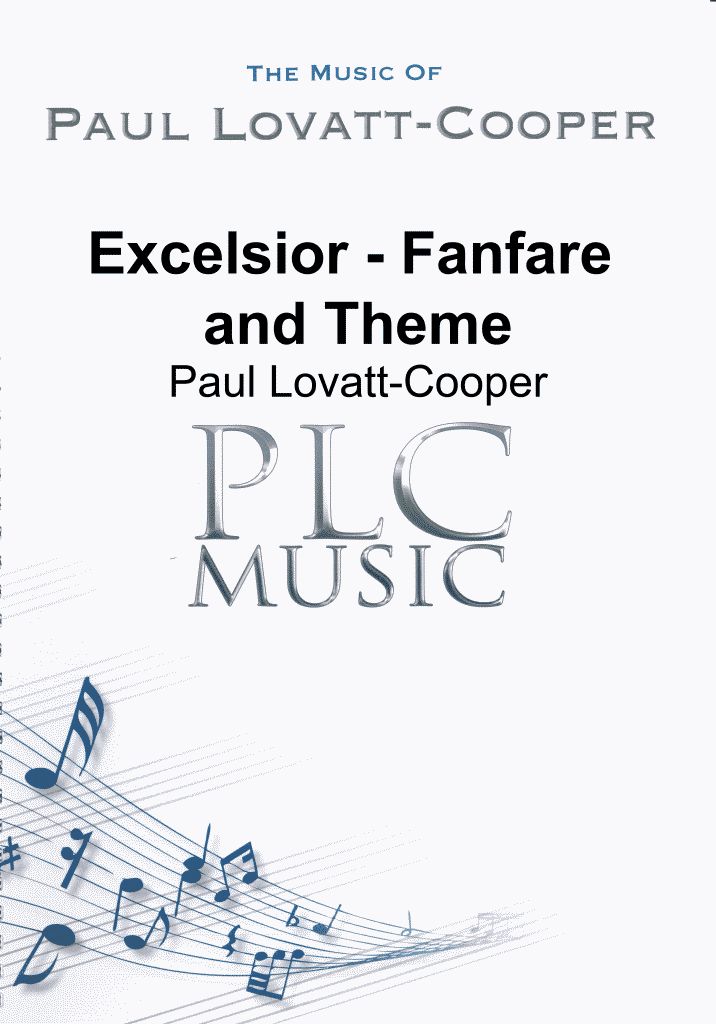
Excelsior - Fanfare and Theme (Brass Band - Score and Parts)
The New Mills Old Prize Band is the inheritor of a proud tradition going back 200 years. Its origin lies in a brass and reed band formed in 1812 by Timothy Beard and it is one of the oldest brass bands in continuous existence in the UK.The New Mills Old Prize Band is inextricably linked to the Beard family. Timothy Beard the founder of the band, was one of five children and two of his brothers, John and Stephen, were to join him in the band.Excelsior is based on the hymn tune 'Ransom' believed to have been composed in 1838 by Timothy's brother Stephen Beard. I have taken this hymn tune and composed a concert fanfare utilising the main melodic material from the original hymn tune.The title of the piece comes from the bands original motto "Excelsior!"Paul Lovatt-Cooper
Estimated dispatch 7-14 working days
-
 £29.95
Judd: A Joy Untold
This short, light-hearted solo has been described as The Salvation Army's answer to 'The flight of the bumble bee' and requires facility from the soloist and accurate accompaniment from the band. The solo opens and closes with whimsical references to Erik Leidzen's famous euphonium solo 'The Song of the Brother' and includes the tunes 'A robe of white' and 'I'll serve Thee'.
Estimated dispatch 7-14 working days
-
 £39.95
Judd: A Pastoral Symphony
This symphony for brass band seeks to explore the thought that 'the greatest need of any congregation is its pastor's personal holiness'. The first movement challenges the pastor 'to serve the present age', the tunes 'Majesty' and 'Lathbury' are used. The second movement expresses a priority to 'Seek...first the Kingdom of God'. The short third movement presents the question 'Except I am moved with compassion, how dwellest they Spirit in me?' before the triumphant finale reflects the desire of every Christian that his life and work will always be for the glory of God with the presentation of 'In my life Lord, be glorified'.
Estimated dispatch 7-14 working days
-
 £50.00
Judd: Beulah Land
Wilfred Heaton began to assemble material for 'Beulah Land' in the early 1990s following a request from the Amsterdam Staff Band for a new work. Despite reminding himself on the manuscript that he should either complete or destroy the work before his death, ultimately he did not manage either. This edition was subsequently realised in 2003 for the tour of the USA Western States by the Amsterdam Staff Band. 'Beulah Land' is Heaton's vision of the joy that awaits the Christian in Heaven and, according to his family, is reminiscent of the kind of music he often improvised at the piano. The three movements are as follows; 1. Better World; a waltz sequence on the tune 'Zealley' to which the words 'There is a better world, they say' are sung.2. Heavenly Home; an elegiac cortege using the tunes 'My home is in Heaven', 'I have a home that is fairer than day' and 'The home over there'.3. Happy Land; Beginning in waltz rhythm this soon gives way to a sequence of free variations on the song 'There is a happy land, Far, far away'.
Estimated dispatch 7-14 working days
-
 £44.95
Judd: Cristo Redentor
'Cristo Redentor' (Christ the Redeemer) is the Portuguese name of the unmistakable statue that overlooks every part of the vibrant Brazilian city of Rio de Janeiro. The composer was inspired to bring these images to music, creating various atmospheres to portray the diverse scenery. The melodies used, 'Lord I lift your name on high', 'Ochills' and 'There is a redeemer' are used to express the overall power of the love displayed for all in the outstretched arms of Christ the Redeemer.
Estimated dispatch 7-14 working days
-
 £59.95
Judd: My Strength My Tower - Contest Version
This music consists of a theme followed by five extensive variations. The theme is the composer's own tune set to the words, 'Thee will I love, my strength, my tower', a hymn by Johann Scheffler translated by John Wesley. A strong modal flavour is characteristic of the theme. Variation 1 This is a light and graceful variation with a good deal of imitative writing. It leads, without a break, into the next variation. Variation 2 Fire and ferocity are asked for in the course of this variation. Variation 3 This variation demonstrates the original approach of the composer. Solo lines for cornet and euphonium are included with their arabesques and arpeggii. Variation 4 Taking the form of a passacaglia, the 'ground' is given out at once by the basses. Fragments of the 'ground', plain or decorated, are combined and used in a number of ways, revealing the composer's mastery of counterpoint. Variation 5 The briskly moving and scintillating final variation abounds in sudden variations of dynamic. The tempo remains constant until an increase is called for in the coda. This 'contest' version has been prepared by Brian Bowen who was asked to re-work the percussion part and introduce a repiano cornet part (Salvation Army band publications do not, in general, have a part for repiano cornet).
Estimated dispatch 7-14 working days
-
 £39.95
Judd: None Other Name
None Other Name was written for the 1960 tour of England by the New York Staff Band of The Salvation Army and can justifiably be termed a classic of brass band repertoire. It is best described as a symphonic medley of six songs focused on the name of Christ; The Saviour's Name; Jesus is the Sweetest Name I know; There's a Wonderful Name, 'tis Jesus; He's the Lily of the Valley; Jesus, the Very Thought of Thee (St. Agnes); All Hal the Power of Jesus' Name (Diadem).
Estimated dispatch 7-14 working days
-
 £29.95
Judd: Paean
Commissioned by the Swiss Christian Brass Band Association in celebration of their 150th anniversary, the title 'Paean' means a shout of thanksgiving and praise. It is also the composer's personal expression of gratitude to God following major surgery. Although 'Paean' includes three fairly contemporary Christian songs, it is not intended to be played in any kind of rock or jazz style. The idiom is quite firmly rooted in brass band tradition. The opening fanfare-like section begins in celebratory mood before becoming more contemplative through the song 'Father God, I wonder'. A change of tempo heralds the statement of the thematically significant song 'Hosanna' before immediately moving to 'Faithful God'. Following a fugato the music retraces its steps to a triumphant restatement of the opening music.
Estimated dispatch 7-14 working days
-
 £44.95
Judd: Tunesmith Overture
A tunesmith is, by definition, one who composes melodies or songs. Howard Davies is such an individual, having written dozens of songs (melody and lyrics) foe The Salvation Army over the years. This overture takes a handful of his most popular melodies and turns them into a Broadway-style feature, providing fresh settings of these Howard Davies classics: Not if I owned the world, Tell all the people, God's still the one, The good Lord brought him through, The wonder of his grace and On the way to Heaven.
Estimated dispatch 7-14 working days
-
 £45.00
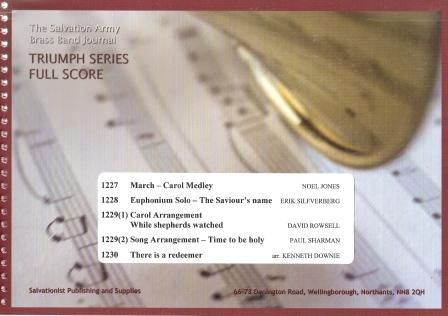
Triumph Series Band Journal July 2012 Numbers 1227 - 1230
No. 1227 March - Carol Medley (Noel Jones)This march features three carols, 'God rest ye merry, gentlemen', Hark! The herald angels sing' and 'Deck the Hall' together with brief references to others in a medley form. A couple of these references are somewhat camoflaged which provides further interest.No. 1228 Euphonium Solo - The Saviour's Name (Erik Silfverberg)A setting of Jane Clarke's lovely melody set to familiar words, 'There is a name I love to hear'.No. 1229 (1) Carol Arrangement - While shepherds watched (David Rowsell)A four-verse setting of the 16th Century tune, 'Winchester Old' commonly associated with the carol, 'While shepherds watched their flocks by night'.No. 1229 (2) Song Arrangement - Time to be holy (Paul Sharman)This arrangement of George Cole Stebbins' tune was originally made for the 2010 World Youth Convention in Sweden, the theme of which was 'Time to be holy'.No. 1230 There is a redeemer (Kenneth Downie)Melody Green-Sievright's popular song, 'There is a redeemer' was first published in 1982, 30 years before the appearance of this new setting.
Estimated dispatch 7-14 working days