
Results
-
 £105.20
Ungarsk marsj - Hector Berlioz - Bjorn Morten Kjaernes
The "Rakoczi March" (Hungarian March) was the unofficial state anthem of Hungary before Ferenc Kolcsey wrote the Himnusz which is today the official national anthem of Hungary. The first version of this march-song was probably created around 1730 by one or more anonymous composers, although tradition says that it was the favorite march of Francis Rakoczi II. That early version called back Francis Rakoczi II to save his people. It was very popular in the 18th century but in the 19th century the more refined Rakoczi March became prevalent. Hector Berlioz included the music in his composition "La Damnation de Faust" in 1846, and Franz Liszt wrote a number of arrangements, includinghis Hungarian Rhapsody No. 15, based on the theme. The march gave its name to a 1933 Austrian-Hungarian feature film - Rakoczy-Marsch This arrangement is based on Berlioz instrumentation and phrasing from his Hungarian March, but in the form of the 19th century Rakoczi March
Estimated dispatch 5-14 working days
-
 £105.20
Bla vals - Idar Torskangerpoll
A piece that explore the "blue" notes in music, and where we have the constant change of 3 or 2 in a bar. Solo in Horn (cued in 1st Cornet). Make sure that the bass line and percussion is steady and firm throughout the piece.
Estimated dispatch 5-14 working days
-
 £127.30
Var sang - Svein H. Giske
Our song was commissioned by Knarvik Skolekorps for their junior band in 2020. They wanted an original piece that could challenge their young players.This became a suite in three movements with themes that run through the whole piece.In the 2. movement there is a possibility for the band to sing in Song of friendship.. Young people finding friendship through music, as I myself have done, is one of the nicest things one can experience, in my opinion.Should you choose not to sing, you can just play the notes as printed.Svein H. Giske-September 2022-
Estimated dispatch 5-14 working days
-
 £60.99
Euphonium Ragtime - André Waignein
Pieces that showcase the euphonium are few and far between. Andr Waignein decided to change this and set out to compose a piece specifically for the euphonium.What makes this composition even more unusual is that he wrote the piece in the style of a ragtime. Euphonium Ragtime provides an exciting and entertaining solo opportunity your audiences will love!
Estimated dispatch 5-14 working days
-
 £60.99
Fanfare La Perie - Paul Dukas - Peter Wain
In 1911 the Russian impresario Diaghilev commisioned Paul Dukas to compose music for the famous ballet fairy-tale 'La Perie'by Jean Coralli.Fokine was to make a new choreography, so that the Russian ballet company 'Ballet Russes' would be able to perform the piece in Paris that same year. Due to a quarrel between Diaghilev and Dukas about who should dance the title-part, however, the ballet was not performed by the 'Ballet Russes'but by another company in 1912.The ballet 'La Perie' is Dukas' last symphonic work. In 1911 gaf de Russische impresario Diaghilev Paul Dukas opdracht om muziek te componeren voor het beroemde ballet sprookje 'La Perie' van Jean Coralli. Fokine was gevraagd om een nieuwe choreografie te maken, zodat het Russische balletgezelschap 'Ballet Russes' in staat zou zijn om het stuk in Parijs op te voeren in datzelfde jaar. Door een ruzie tussen Diaghilev en Dukas over de vraag wie de hoofdrol mocht dansen, werd het ballet in 1912 echter niet uitgevoerd door het 'Ballet Russes' maar door een ander gezelschap. Het ballet 'La Perie' is het laatste symfonische werk van Dukas.
Estimated dispatch 5-14 working days
-
 £134.99
Tuba Concerto - Philip Sparke
When writing his tuba concerto, Philip Sparke wanted to create a work which explored the many aspects of the instrument's technical and vocal qualities but without resorting to caricature. The result is a concerto in two joined movements, which can both be programmed individually, that contains both many lyrical lines together with stunning virtuosic passages. An outstanding concerto that tuba players and brass band audiences alike will enjoy and applaud.
Estimated dispatch 5-14 working days
-
 £134.99
West Wind - Oliver Waespi
West Wind is structured in three parts, each bearing a subtitle drawn from poems of Emily Bronte (1818-1848). Poetry of the Romantic period, Bronte's in particular, often presents a gentle, almost innocent surface, beneath which lies the most elemental and volatile emotional forces capable of erupting at any moment.Accordingly, the opening movement, West-wind, in the glory and pride!, begins with a mellow, warm soundscape, underpinned by lightly pulsating patterns, almost like an aquarelle. Gradually however, the music transitions into far rougher, forward-driven gestures - turbulent, restless, and at times unpredictable, much like the west wind itself.The ensuing Adagio reflects on the poem Stars, in which a fundamental tension between exaltation and regret, another recurring feature of Bronte's poetry, is palpable throughout. Introspective solo and chamber music statements give way to a broad ecstatic sound field involving the full ensemble, before finally receding into a solitary euphonium soliloquy.The final movement, Wild words of an ancient song, takes the form of an extended rondo-scherzo, driven by virtuosic, perpetual motion. The sense of relentless pursuit bears a nod to The Boy on the Moor by the German poet Annette von Droste-Hulshoff, a contemporary of Bronte who explored similar narratives, albeit from a different perspective.Although certain core musical elements recur - pulsating patterns, a chorale, a tone row - the work is guided less by systematic symphonic development than by an intuitive stream of variants. These generate a sequence of metamorphoses that illuminate the material from shifting vantage points, projecting the emotional landscapes of Romantic poetry into the present day.West Wind was commissioned by the Flowers Band and was first performed under Musical Director Paul Holland, at the 2026 European Brass Band Championships in Linz (AT), where they also became European Champions.
Estimated dispatch 5-14 working days
-
 £91.99
Fanfares, Songs & Dances - Philip Sparke
Fanfares, Songs & Dances was commissioned by Brass Bands England, the Lithuanian Brass Band Association and the Dutch National Brass Band Championships (NBK), and first performed at the 43rd 'NBK' in October 2024. The work is played in three linked movements: FANFARES opens in robust fashion with a sequence of fanfare-like statements, initially featuring the horns, whose modal theme includes a figure that will reappear throughout the work. Euphoniums and then cornets introduce a second theme, which is followed by a third, again initiated by the horns. Baritones then change the mood with a more-lyrical theme, which builds to a climax, eventually leading back to a recall of the initial fanfare theme. This gradually dissolves to introduce the second movement. SONGS continues to relax the fanfare feel with a long introduction to the movement's main theme, first appearing on solo cornet. A change of key introduces a bridge passage which leads to a sonorous chorale, which builds to a triumphal return of the cornet theme. A peaceful coda leads to the final movement of the work. DANCES is a scherzo-like movement based around a series of rhythmic melodies in triple time, which lead to a majestic return of the 2nd movement's chorale theme under cornet figuration. The opening dance theme returns and heralds a joyous coda.
Estimated dispatch 5-14 working days
-
 £64.40
The Master Plan! - Dean Jones
We all have a purpose...whether those are found in daily routines or much larger parts of our lives. Having a plan or a goal is a great way we can measure our success. Here's a small piece of music that explores 3 such elements:Covert Mission - a militaristic theme where the music conveys action and drama.Finding Someone - at some point, we share our lives with people who are special to us. The music has a more lyrical feel to help illustrate affection.Life Goals! - the strong rhythmic pattern to this section is the undertone for portraying a a sense of focus. We need to match desire with action when attempting something new - the sense of excitement and hope will need to be drawn from the music to convey this message.The music tells a compelling story of purpose, hope and passion....in the words of Col. Hannibal Smith from the A-Team, "I love it when a plan comes together!"
Estimated dispatch 5-14 working days
-
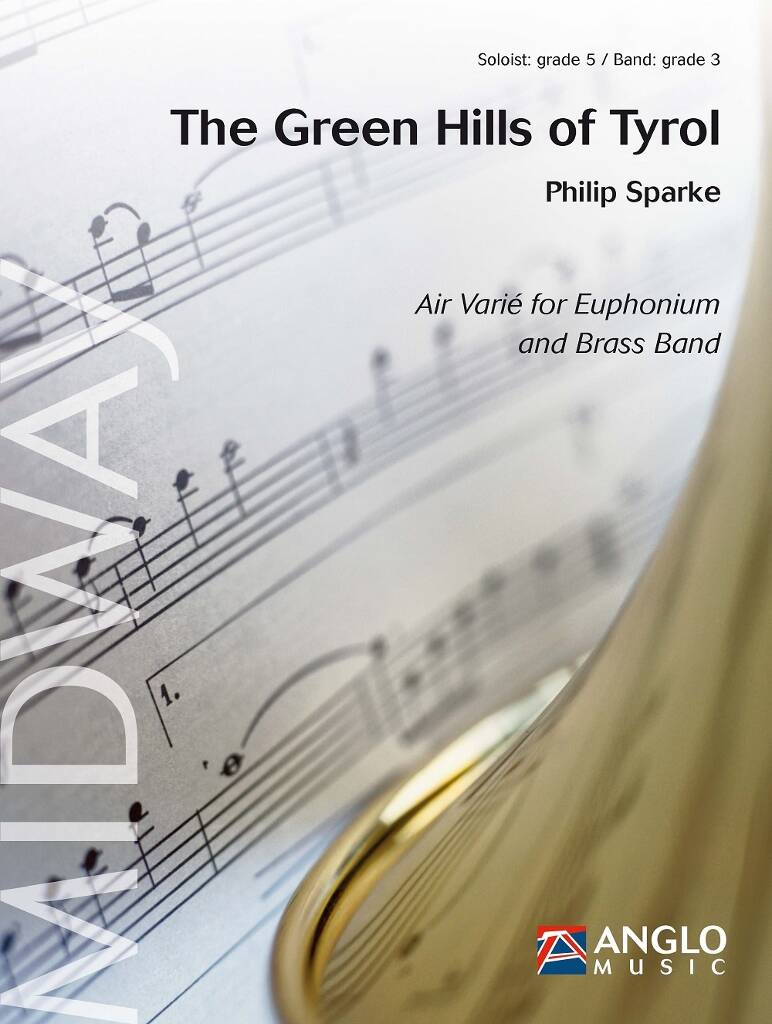 £69.99
The Green Hills of Tyrol - Philip Sparke
The Green Hills of Tyrol was commissioned by Jrena and Beat Knusel for their son, Swiss euphonium player Joel Knusel, to celebrate his 20th birthday in 2019. The request was for a piece suitable for use in a solo competition, possibly using a Scottish or Irish melody, and composer Philip Sparke suggested an 'old-fashioned' air varie might be a suitable idea. The piece follows the well-established formula of a theme followed by four variations. The history of the original melody is fascinating and, although it is now well-known as a bagpipe tune, its background is Austrian or Italian, rather than Scottish. The tune appears as a chorus of Swiss soldiers in Rossini's 1829 opera William Tell but was possibly an existing Tyrolean folk tune. In 1854, during the Crimean War, Pipe Major John MacLeod of the 93rd Highlanders heard a band of the Sardinian contingent playing selections from the opera in camp before the Siege of Sebastopol. He was struck by the melody and arranged it for his pipers, calling it The Green Hills of Tyrol, referring to Tell's visit to that corner of Austria in the opera. It has since become universally popular among pipe bands who usually refer to it as A Scottish Soldier, following the addition of new lyrics in a 1961 hit by Andy Stewart.
Estimated dispatch 5-14 working days
 View Music