
Results
-
£103.00
Fest - Polonaise - Johan Svendsen - Kjell Olav Martinsen
Johan Svendsen (1840 - 1911) was the first great Norwegian symphonic composer, as well as one of the leading conductors of his time. Next to Edv. Grieg, he was the most prominent figure in Norwegian music life at the end of the 1800's. Although he came from humble beginnings in Chistiania (now Oslo), he was to become a cosmopolitan who felt at home all over Europa. Svendsen spent most of his adult life abroad, living in Copenhagen for 25 years as maestro for the Royal Theatre Orchestra. Nonetheless he retained contact with Norway troughout these years and was a frequent and popular guest in his native country. He wrote his Festival Polonaise for a ball in 1873. This polonaise in a big ABA style
Estimated dispatch 7-14 working days
-
£70.00
Origins - Peter Meechan
Origins is in three movements, with each movement having a different subject matter, all linked by the idea of origins: the first movement refers to musical origins; the second to the origins of life; and the final movement to the space exploration - the research of all origins. The first movement is based on a short motif, heard in the first three notes the soloist plays. These three notes cover the interval of a minor third (an interval that often plays a crucial role in my music) on which the whole concerto is built. The soloist and accompaniment interplay freely throughout the opening section, before an ostinato accompaniment appears - over which the soloist sounds a long legato melody. A short cadenza follows and a return to the opening material leads the movement to an end. The second movement, titled Harryas Song, is - as tradition dictates - a slow movement. Happy and reflective in nature, the main melody was written on the evening that my closest friend, Mark Bousie (a fine euphoniumist himself), and his wife Jayne, had their first child - Harry Bousie. It seemed only fitting that this song should be written for Harry in celebration. The final movement brings me back to a lifelong fascination with space, and in this particular movement, the Space Shuttle Discovery. Having completed 39 missions (including flying the Hubble telescope in to orbit), and spent a total of 365 days in space, SS Discovery made its final voyage in 2011 and was taken to the Smithsonian in Washington D.C. in April 2012. This final movement, titled Discovery, pays tribute to the great shuttle whose missions inspired millions across the generations. Origins was commissioned by Marco Schneider, Adrian Schneider and the Dunshan Symphonic Wind Orchestra, Beijing, China.
Estimated dispatch 12-14 working days
-
 £64.95
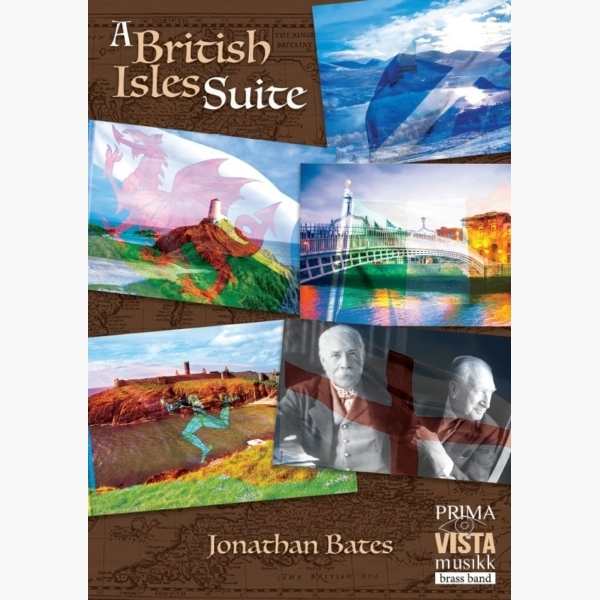
A British Isles Suite - Jonathan Bates
A British Isles Suiteis a musical exploration of poetry from around the British Isles. Each movement takes inspiration from a quote of literature specific to the country in question. The work is written in a symphonic style with a moderately...
Estimated dispatch 5-7 working days
-
 £54.95
Marche Slave - Pyotr Ilyich Tchaikovsky - Robert Childs
Marche Slave is not a march at all but an elaborate concert piece; a symphonic tone poem on the subject of the military alliance between Russia and Serbia. The work includes folk songs from both countries. Serbian folk tunes constitute...
Estimated dispatch 5-7 working days
-
£34.95
FAITH IS THE VICTORY (Brass Band Set) - James Curnow
James Curnow wrote this march while completing his Masters degree at Michigan State University and unsurprisingly reflects the great tradition of American symphonic wind band marches. Curnow embraces the sound world of the great Mid-Western universities (Michigan, Illinois, Iowa and Ohio State) and the march styles of Eric Osterling and Clifton Williams. Several changes of tempo indicate that this is anything but an ordinary street march. The wonderful changes of key are also notable and propel the music towards an exciting finish.
Estimated dispatch 7-14 working days
-
£34.95
CHALK FARM No.2 (Brass Band Set) - Edward Gregson
In 1909, The Salvation Army published a march called 'Chalk Farm'. 'Chalk Farm No. 2' was written to commemorate the centenary of the birth of Bandmaster Punchard, Bandmaster to Chalk Farm band for 50 years. The tune 'March on, we shall win the day' is common to both marches. The later march is symphonic rather than processional, including as it does irregular bars of 5 and 7 beats.
Estimated dispatch 7-14 working days
-
£44.95
NONE OTHER NAME (Brass Band Set) - Erik Leidzen
None Other Name was written for the 1960 tour of England by the New York Staff Band of The Salvation Army and can justifiably be termed a classic of brass band repertoire. It is best described as a symphonic medley of six songs focused on the name of Christ; The Saviour's Name; Jesus is the Sweetest Name I know; There's a Wonderful Name, 'tis Jesus; He's the Lily of the Valley; Jesus, the Very Thought of Thee (St. Agnes); All Hal the Power of Jesus' Name (Diadem).
Estimated dispatch 7-14 working days
-
£59.95
LORD IS KING, The (Brass Band Set) - Ray Steadman-Allen
Ray Steadman-Allen was for many years the driving force in Salvation Army music. His publication list of both brass and vocal works can be measured literally by the hundred. 'The Lord is King' is arguably his crowning achievement of over twenty major works for brass band. Although described as a suite, the work is more symphonic in conception and scale as well as being formidable to perform. The work is based on the Welsh hymn tune 'Llangollen' to which the hymn 'The Lord is King, I own His power' are associated. The three movements derive inspiration from the lines 'My joy, my toil, my craftman's skill, all have their place, and serve His will' found in verse five of the hymn.
Estimated dispatch 7-14 working days
-
 £30.00
Sortie in E Flat - Louis Lefebure-Wely
Louis James Alfred Lefebure-Wely is historically associated with the development of French organ music, as well as with organ technique. As a composer he was instrumental in the evolution of the French symphonic organ style and his works include many pieces for church use, and lighter fare like marches and sorties.It is probably in the latter genre that Lefebure-Wely scored his most enduring successes on the organ, with pieces like the sorties in B flat and E flat.Sue Hopkins has artfully captured the magic of Lefebure-Wely's writing and produced this great new piece which offers a perfect complement to your concert programme.
In Stock: Estimated dispatch 3-5 working days
-
 £60.00
Fantasie Concertante (Score only) - Philip Wilby
This exciting new concerto is a welcome addition to the repertoire of french and tenor horn players alike. Like the 18th-Century Serenade form there are five movements, arranged symmetrically around a slow movement - Soliloquy - which separates movements entitled Burlesque (two) and Valse Caprice (three) respectively. The first and last movements share common material of a more symphonic stature, and the concerto ends with a brisk fugato. The solo horn is (in the band version) accompanied by a quintet of solo players (two cornets, euphonium, trombone, and tuba) who provide the lion's share of the counterpoint and contrast with the main body of musicians who provide musical punctuation in the more sonorous tutti sections. The first movement, Don Quixote's Dream, contains references to Cervantes' famous hero, the Spanish nature of his stories, and the ambling gait of his horseback adventures.
Estimated dispatch 7-9 working days