
Results
-
 £30.00
Black Bottom Stomp - Jelly Roll Morton
Ferdinand Joseph LaMothe, professionally known as Jelly Roll Morton, was an American ragtime and early jazz pianist, bandleader and composer who started his career in New Orleans, Louisiana. Widely recognised as a pivotal figure in early jazz, Morton is perhaps most notable as jazz's first arranger, proving that a genre rooted in improvisation could retain its essential spirit and characteristics when notated. His composition "Jelly Roll Blues" was the first published jazz composition in 1915. Morton is also notable for writing such standards as "King Porter Stomp", "Wolverine Blues", "Black Bottom Stomp", and "I Thought I Heard Buddy Bolden Say". Notorious for his arrogance and self-promotion, Morton claimed to have invented jazz outright in 1902, much to the derision of fellow musicians and the critics. At the age of fourteen, Morton began working as a piano player in a brothel (or, as it was referred to back then, a sporting house). In that atmosphere, he often sang smutty lyrics and took the nickname "Jelly Roll". While working there, he was living with his religious, church-going great-grandmother; who he convinced that he worked as a night watchman in a barrel factory. After Morton's grandmother found out that he was playing jazz in a local brothel, she kicked him out of her house and told him that "devil music" would surely bring about his downfall. Born in downtown New Orleans, Louisiana, his exact birth date differs depending to whichever source you want to believe; his half-sisters claimed he was born in September 1885, but his World War 1 draft card showed September 1884 and his California death certificate listed his birth as September 1889. He died in 1941 in Los Angeles.
-
 £15.00
Anvil Chorus from Il Trovatore - Verdi
Programme Notes from Andrew Duncan:Like many of the arrangements in the Flexi-Collection - Popular Classics Series I have simplified the rhythms and time signature, etc. I have also omitted trills for ease of playing.Dynamics form a very important aspect of this arrangement and it is important to observe these, especially the p markings. Every dynamic from p through to ff is used as well as some crescendos.The 1st Cornet/Trumpet part is perhaps more difficult than in some of the other arrangements in the series, but the other parts are fairly simple in comparison.The Percussion part (which is optional) is unusual in that it calls for two 'Anvils' to be played. However if these are not available then a good effect can be obtained by hitting two pieces of metal with metal hammers.The Flexi-Collection ApproachFlexible scoring tailored to your needs - A perfect solution for expanding the repertoire of training and junior brass bands. The Flexi-Collection currently offers two series - Popular Classics and World Tour. Based on four-part harmony, these collections provide groups with the advantage of complete flexibility when they may not be balanced. If players or instruments are missing, the show can still go on!The Flexi-Collection - Popular Classics Series, encapsulates all that is great about the wonderful range of musical styles produced by Holst, Elgar, Handel, Verdi, Tchaikovsky, Grieg, Bizet and Parry.The thoughtful scoring and arranging by Andrew Duncan now means that groups of all abilities have access to a truly flexible set of music for their needs. With world parts, rudimentary theory, terminology translations and large format typesetting, The Flexi-Collection ticks all the boxes when it comes to bringing interesting music to the training and junior band/brass group environment.Available for Brass Band - The Flexi-Collection offers flexibility in every sense of the word.(Available individually or as part of the money-saving Flexi-Collection Popular Classics Album)
In Stock: Estimated dispatch 3-5 working days
-
 £25.95
Heed the Word - Lucy Pankhurst
Lucy Pankhurst created this impressive work in support of a charitable project, known in 2005 as Brass Band Aid. The organisation called for original compositions to be included in a follow-up CD release - Into Africa to help raise funds for projects in Adet, Africa, and to build awareness of the Make Poverty History campaign.Lucy's creativity and imagination are very prevalent in this work - a complete mix of powerful energy and poignant emotions flow from the score. A strong use of pulsating drums are balanced with sheer tranquility and rich chords. It exudes hope and positivity and perhaps, through its title, offers a gentle warning to listen carefully to the concerns that are aired around us - not least in recognition of the challenges facing the very communities the CD was aiming to help.The work was recorded by the Prairie Brass Band, US and featured on the Brass Band Aid CD - Into Africa.
In Stock: Estimated dispatch 3-5 working days
-
 £15.00
Toreador's March from Carmen - Bizet
Performance Notes from Andrew Duncan:The main feature of this arrangement is perhaps the wide range of dynamics used. Every dynamic from p through to ffis written and if played will, greatly enhance a performance of the piece.The distinctive style of the piece is also an important element for the players to embrace. Although the original rhythm has been simplified to facilitate ability, it has retained the intended 'feel' of the bravado style and offers a useful development of the players' musical awareness.The Flexi-Collection ApproachFlexible scoring tailored to your needs - A perfect solution for expanding the repertoire of training and junior brass bands. The Flexi-Collection currently offers two series - Popular Classics and World Tour. Based on four-part harmony, these collections provide groups with the advantage of complete flexibility when they may not be balanced. If players or instruments are missing, the show can still go on!The Flexi-Collection - Popular Classics Series, encapsulates all that is great about the wonderful range of musical styles produced by Holst, Elgar, Handel, Verdi, Tchaikovsky, Grieg, Bizet and Parry.The thoughtful scoring and arranging by Andrew Duncan now means that groups of all abilities have access to a truly flexible set of music for their needs. With world parts, rudimentary theory, terminology translations and large format typesetting, The Flexi-Collection ticks all the boxes when it comes to bringing interesting music to the training and junior band/brass group environment.Available individually or as part of the money-saving Flexi-Collection Popular ClassicsAlbum.Scored for Brass Band and supplied with additional Easy Bb, Easy Eb and world parts - The Flexi-Collection offers flexibility in every sense of the word.
In Stock: Estimated dispatch 3-5 working days
-
A Lazy Afternoon - Len Jenkins - Len Jenkins
'A Lazy Afternoon' brings to mind a lazy hot day in summer, possibly starting with a short drive out to somewhere pleasant for an afternoon's picnic. It is accepted that a drive out is now something many would choose to avoid, especially at busy weekends, but one can perhaps dream of open un-cluttered roads with no rush to get there. As such, this piece is ideal for the local summer fete. It has a gentle style that so befits an English village fete, recalling an era when things did not need to be so immediate and may thereby help to give a perfect respite from the everyday 'rush and tear'. As with many of Wobbleco's pieces, this is aimed at the average town and village band, and is within the reasonable playing capabilities of its members.
-
Duet For Two Cats - G. Rossini - Len Jenkins
"Duet For Two Cats" is often performed as an encore to vocal recitals and operatic galas. It may be sung by two sopranos, male-female pairs, or even as a tomcat duet and can be accompanied by a piano or a full orchestra. The lyrics are simple; the single word 'Miaow', repeated with various styles of inflexion and attitude throughout the piece. Our arrangement is for a cornet and trombone. The piece is generally ascribed to Rossini, though there is some doubt as to its actual origins and whether it is an authentic work by that composer. It is believed that an English composer, Robert Lucas Pearsall under the pseudonym G. Berthold may have assembled the various elements from Rossini and perhaps other composers into the piece as we now know it. In order to achieve the correct balance between band and soloists, there is a need to mute most of the band instruments. Recognising that not all bands will have the larger mutes which are expensive and sometimes unwieldy, we suggest a form of muting made famous by a jazz trumpeter and which works well on most instruments. It consists of a circle of heat resistant padded table covering or felt, slightly larger than the bell diameter, with an elasticated edge like a 'mop-hat'. With 3 holes in it to let the sound out, the mute is then simply stretched over the bell to achieve the desired effect and folded up when not required.
-
I Believe - Drake, Graham, Shirl & Stillman - Len Jenkins
"I Believe" is a popular song written by Ervin Drake, Irvin Graham, Jimmy Shirl and Al Stillman in 1953. It was commissioned with the intent of offering people hope and faith against the backdrop of the Korean War that followed so soon after World War 2. The number has been recorded by many artists and the edition by The Bachelors is perhaps the best well-known in Britain. This arrangement, which is very suitable for fetes and concerts, features the Flugel and Tenor Horns in a duet, with band accompaniment. It is dedicated to the twins Hazel and Heather who play these instruments in the Woburn Sands Band. Graham Cooper
-
Hickory Mice - Len Jenkins - Len Jenkins
Based on the well-known tune of 'Hickory Dickory Dock', which as kids we all knew, the mice get up to their usual adventures. Frenetic activity is followed by staggering exhaustion, or perhaps they got at the booze...Then the party really gets going, with references to various dance themes (and the behaviour of the visually impaired trio), even taking in the baroque and a stately minuet. Exhausted!
-
 £39.95
MacArthur Park (Score and Parts) - Jim Webb arr. Jack Peberdy
Perhaps Jim Webb's biggest hit is given the full brass band treatment by Jack Peberdy.
Estimated dispatch 7-9 working days
-
 £39.95
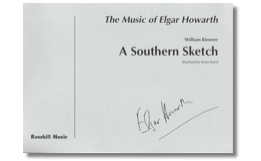
A Southern Sketch (Score and Parts) - William Rimmer Realised by Elgar Howarth
Taken from William Rimmer's The Artistic Soloist - a volume of character melodies for solo cornet - Elgar Howarth has furnished four of the tunes with full accompaniment for brass band. A Southern Sketch is a quaint melody suggestive, perhaps of the cotton fiels of the southern USA. Clean tonguing is required in the second strain, while the meno mosso requires a soft undertone.
Estimated dispatch 7-9 working days