
Results
-
 £60.99
Hymn of Faith - Louis Bourgeois - John Blanken
The French composer Louis Bourgeois lived from c.1510 to 1560. Bourgeois was cantor in Geneva and, commissioned by John Calvin, he composed melodies for metrical (rhyming) versions of the psalms. After completing about a hundred one-part psalms, he made some four-part arrangements, which were denounced and even resulted in his imprisonment for a day. Later, Bourgeois published a number of psalm collections, and judging from his book Le droict chemin de musique he was also an excellent educator. The melodies Bourgeois composed, are (contrary to Gregorian chants) particularly suitable for community singing. This applies to his hymn tune Saint Michael, which is why this melody hasbeen used for various texts, written for many occasions. John Blanken made this arrangement for a wedding ceremony: an occasion in which faith and trust play a large - if not the largest - role. Hence the title Hymn of Faith. The arrangement contains four verses of the hymn. After a majestic opening the hymn follows twice, the second verse being embellished in the tenor register. After a short interlude verse three follows, played by a quartet. The majestic opening is then repeated as a modulation into the fourth verse, which concludes the work in a brilliant tutti.
Estimated dispatch 5-14 working days
-
 £94.99
The Seven Divine Properties - Rob Goorhuis
Rob Goorhuis wrote this challenging work for solo euphonium with its marvellous title The Seven Divine Properties at the request of Danny Oosterman and after an idea of Anteun Hoesen. In fact, this piece came about because the Andels Fanfare Corps was going to record a CD in early 2012 exclusively with pieces by Rob Goorhuis. Anteun Hoesen plays the solo part in this piece on the CD.The concept of divine properties features heavily in various ancient religions: these are properties to which man can aspire--through striving towards divine properties one can evolve spiritually and become a better person. Different divine properties feature in various religions. Inthe Christian church, the terms Faith, Hope and Love play an important role.This composition is primarily written from an Old Testament point of view. The chosen qualities are as follows: Simplicity, Strength, Truth, Perseverance and Passion. After a short introduction of the thematic material, the various properties are depicted in musical miniatures.
Estimated dispatch 5-14 working days
-
 £115.60
Deck the Halls - John Philip Hannevik
The original Welsh song Nos galan dating back to the sixteenth century, has become an international Christmas carol with the English lyric Deck the hall with boughs of holly.The song does not offer much in terms of variation, but I have tried to construct a short piece where one can see that the song still offers itself to a wide array of stylistical treatments.The opening is almost like a Christmas Overture, before it wanders in to a renaissance-like style.The middle section offers a much more lush and lyrical rubato treatment, with lots of color and thick harmonization.The end then turns the tempo even more up than at the start of the piece, and brings us through a big band ending with long soaring lines.- John Philip Hannevik -
Estimated dispatch 5-14 working days
-
 £152.99
Between the Two Rivers - Philip Sparke
Between the Two Rivers was commissioned by Fanfare 'Prins Hendrik', from Aalst in the Netherlands. The title derives from the fact that the town of Aalst lies between two tributaries of the River Dommel. The community is a highly religious one, so the famous Luther chorale, Ein' Feste Burg, was an obvious choice for Philip Sparke to use as the theme for this new work. It takes the form of a theme with four contrasting variations. Variation 1 is a moto perpetuo, variation 2 has a slower march like feel, variation 3 is a sinister slow movement and the final variation is in the form of a lyrical fugue. Between The Two Rivers is sure to become a major work inmodern brass band repertoire.
Estimated dispatch 5-14 working days
-
 £59.99
Earl Of Oxford's March - William Byrd - Philip Sparke
The Battell was written during the late 14th Century when England was in a mood of national celebration after victory over the Spanish and French Armadas. The movement which Byrd called Marche Before The Battell became known as The Earl of Oxford's March and it appears with that title in an early manuscript copy of the Fitzwilliam Virginal Book. Written while Byrd was at the height of his powers, it still stirs the soul to this day. A perfect opener for your concert performances.
Estimated dispatch 5-14 working days
-
 £87.99
Hail the Dragon! - Philip Sparke
Its title, Hail the Dragon!, references a work Philip Sparke wrote in 1984, The Year of the Dragon. The piece opens with a lively and energetic fanfare. The mood becomes more subdued in the centre section as the cornet introduces a new theme that builds to an emotional climax. This leads into a recap of the opening fanfare which acts as a type of descant to short quotations from the last movement of The Year of the Dragon before reaching a thunderous finale.
Estimated dispatch 5-14 working days
-
 £169.99
The Spirit of Puccini - Hermann Pallhuber
The famous Puccini motifs in this work are taken from Tosca (E lucevan le stelle), Turandot (Nessun dorma), Gianni Schicci (O mio babbino caro) and a quite funny little persifl age of the aria Senti L'ora e vicina from Tosca. The Spirit of Puccini has testing moments for each of the principal players of the bands sections. Even although the music was inspired by this famous Italian composer, Hermann Pallhuber has succeeded in creating a piece of 'real band music' combining both the Italian influences and the modern British brass band sound.
Estimated dispatch 5-14 working days
-
 £43.99
The Last Spring - Edvard Grieg
Edvard Grieg is probably the best known of all Norwegian composers. He was one of the most important figures during the nationalistic romantic period and his music always contained the essence of this beautiful Scandinavian country. The Last Spring comes from Two Elegiac Melodies for String Orchestra and this version for brass band retains all the beauty and solemnity of the original. Evoke the peaceful atmosphere of Grieg's native land with this beautiful haunting work.
Estimated dispatch 5-14 working days
-
 £60.99
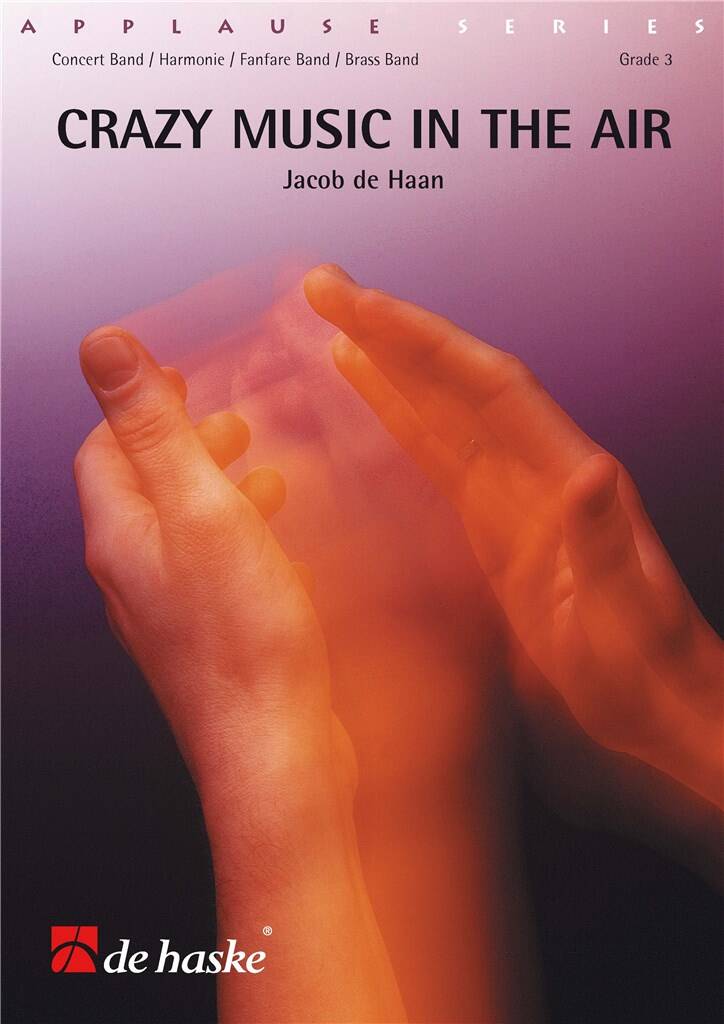
Crazy Music in the Air - Jacob de Haan
This composition in two parts is one of the first successful works Jacob de Haan published for Brass Band. Somewhat under the influence of Ted Huggen's Choral and Rock Out which was an overwhelming success at the time, the still very young Jacob de Haan wrote this composition. The first part (Air) exists of a choral melody with baroque grace notes, supported by a pop rhythm in the drums. The second part (Crazy Music) is a swinging bossa nova, in which various instrument groups present themselves in the continuously varying themes. The famous Black Dycke Mills Band contributed to the success of Crazy Music in the Air by regularly puttingthe piece on its tour programmes.
Estimated dispatch 5-14 working days
-
£60.99
The New Covenant - James Curnow
Throughout The New Covenant the composer seeks to portray through programmatic music the sensitivity, love and understanding of a compassionate Christ and the strength and wisdom of the Son of God who gave Himself to become the new covenant between God and man. This descriptive work creates a word painting by use of fragments from John Newton's beautiful hymn 'How Sweet The Name of Jesus'. An ideal work for any concert but especially for those taking place in Churches or Cathedrals.
Estimated dispatch 5-14 working days
 View Music