
Results
-
 £44.95
Metropolis 1927 (Brass Band - B4 Score only)
Fritz Lang's 1927 science fiction epic Metropolis is considered to be a masterpiece of cinematic vision and a high point of German Expressionist filmmaking. Set in a future dystopian world the film introduces the viewer to two contrasting communities living in the vast city of Metropolis. Those above ground live a life of privilege and pleasure serviced by the underground-dwelling drone workers whose role is to maintain and operate the banks of machines which provide the city's power.Lang's film, which can be considered a type of 20th century morality play, draws upon a range of themes and influences from Marxist ideals and social satire to overt religious symbolism.The music does not attempt to precis the plot, such as it is, but simply reflects my musical responses to Lang's noirish visual style and set designs - the brooding machine rooms, the decadent nightclubs, the gothic cathedral and so on - paradoxically a world of terrifying beauty.Metropolis 1927 was commissioned by Bramwell Tovey and The National Youth Brass Band of Great Britain with funds provided by The Arts Council of England. The first performances took place in the Winter Gardens, Weston-super-Mare on Saturday 19th April and in the Cheltenham Town Hall on Sunday 20th April 2014.This revised version was premiered by The Black Dyke Band, conductor Nicholas Childs, at the 38th European Brass Band Championships in the Konzerthaus Freiburg, Germany, on Saturday 2 May 2015.Peter Graham
Estimated dispatch 7-14 working days
-
 £124.95
Metropolis 1927 (Brass Band - Score and Parts)
Fritz Lang's 1927 science fiction epic Metropolis is considered to be a masterpiece of cinematic vision and a high point of German Expressionist filmmaking. Set in a future dystopian world the film introduces the viewer to two contrasting communities living in the vast city of Metropolis. Those above ground live a life of privilege and pleasure serviced by the underground-dwelling drone workers whose role is to maintain and operate the banks of machines which provide the city's power.Lang's film, which can be considered a type of 20th century morality play, draws upon a range of themes and influences from Marxist ideals and social satire to overt religious symbolism.The music does not attempt to precis the plot, such as it is, but simply reflects my musical responses to Lang's noirish visual style and set designs - the brooding machine rooms, the decadent nightclubs, the gothic cathedral and so on - paradoxically a world of terrifying beauty.Metropolis 1927 was commissioned by Bramwell Tovey and The National Youth Brass Band of Great Britain with funds provided by The Arts Council of England. The first performances took place in the Winter Gardens, Weston-super-Mare on Saturday 19th April and in the Cheltenham Town Hall on Sunday 20th April 2014.This revised version was premiered by The Black Dyke Band, conductor Nicholas Childs, at the 38th European Brass Band Championships in the Konzerthaus Freiburg, Germany, on Saturday 2 May 2015.Peter Graham
Estimated dispatch 7-14 working days
-
 £95.00
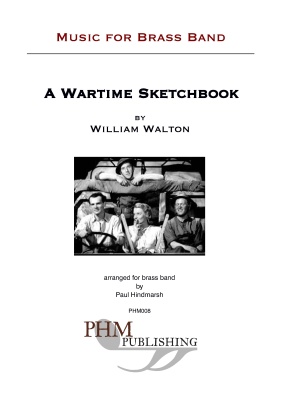
A Wartime Sketchbook (Brass Band - Score and Parts)
Early in 1941 William Walton, 39, received his call-up papers. He was by then one of the most eminent of British composers and was exempted from military service on condition that he provided music for films deemed to be of 'national importance'. Scoring Lawrence Olivier's Shakespeare epic Henry V in 1943 was the most substantial of these wartime projects. His role in patriotic films from 1941 and 42 like The Foreman went to France, Next of Kin, Went the day Well and The First of the Few was to provide appropriate title music and some underscoring at key moments. Walton extracted the most substantial portions of the latter as the popular Spitfire Prelude and Fugue for orchestra. The remaining music remained unpublished until 1990, when Christopher Palmer assembled the highlights into A Wartime Sketchbook. I was intrigued to hear these examples of Walton's wartime music and having discovered that they would fit naturally and idiomatically onto the brass band, I arranged six of the numbers into a suite for Besses o' th' Barn Band, which I was conducting at the time.In 1995 the brass band suite was recorded by the famous Black Dyke Mills Band as part of an all Walton album which I produced for the ASV label (ASV CD WHL 2093). This award- winning CD also included Walton's First Shoot, in the edition by Elgar Howarth, my transcription of movements from Music for Children and two substantial brass versions by Edward Watson of the suite from Henry V (with narrator) and the March and Siegfried Music from The Battle of Britain music.Prologue: This is the stirring title music from Went the day Well, a screen play by Graham Greene about a German airborne invasion of an English village. The main theme leads toBicycle Chase: Characteristic musical high-jinks for J.B.Priestley's The Foreman went to France.Refugees: From the same film, this is a poignant accompaniment to the long march of refugees. As Ernest Irving, the film's musical director, put it, "this really makes your feet sore and your knees sag."Young Siegfrieds: This lively movement comes from the music that Walton composed for The Battle of Britain in 1968, with the assistance of Malcolm Arnold, but which the film's producer rejected. It portrays first the Berliners, cheerfully ignoring the black-out and then, in the trio, the Young Siegfrieds of the Luftwaffe, courtesy of a parody of Siegfried's horn call from Wagner's opera.Romance: A soldier and a Dutch refugee snatch a few tender moments together in Next of Kin.Epilogue: At the end of The Foreman went to France, the French look forward with hope and optimism to eventual liberation.- Paul HindmarshDuration: 14.00
Estimated dispatch 7-14 working days
-
£40.00
A Wartime Sketchbook (Brass Band - Score only)
Early in 1941 William Walton, 39, received his call-up papers. He was by then one of the most eminent of British composers and was exempted from military service on condition that he provided music for films deemed to be of 'national importance'. Scoring Lawrence Olivier's Shakespeare epic Henry V in 1943 was the most substantial of these wartime projects. His role in patriotic films from 1941 and 42 like The Foreman went to France, Next of Kin, Went the day Well and The First of the Few was to provide appropriate title music and some underscoring at key moments. Walton extracted the most substantial portions of the latter as the popular Spitfire Prelude and Fugue for orchestra. The remaining music remained unpublished until 1990, when Christopher Palmer assembled the highlights into A Wartime Sketchbook. I was intrigued to hear these examples of Walton's wartime music and having discovered that they would fit naturally and idiomatically onto the brass band, I arranged six of the numbers into a suite for Besses o' th' Barn Band, which I was conducting at the time.In 1995 the brass band suite was recorded by the famous Black Dyke Mills Band as part of an all Walton album which I produced for the ASV label (ASV CD WHL 2093). This award- winning CD also included Walton's First Shoot, in the edition by Elgar Howarth, my transcription of movements from Music for Children and two substantial brass versions by Edward Watson of the suite from Henry V (with narrator) and the March and Siegfried Music from The Battle of Britain music.Prologue: This is the stirring title music from Went the day Well, a screen play by Graham Greene about a German airborne invasion of an English village. The main theme leads toBicycle Chase: Characteristic musical high-jinks for J.B.Priestley's The Foreman went to France.Refugees: From the same film, this is a poignant accompaniment to the long march of refugees. As Ernest Irving, the film's musical director, put it, "this really makes your feet sore and your knees sag."Young Siegfrieds: This lively movement comes from the music that Walton composed for The Battle of Britain in 1968, with the assistance of Malcolm Arnold, but which the film's producer rejected. It portrays first the Berliners, cheerfully ignoring the black-out and then, in the trio, the Young Siegfrieds of the Luftwaffe, courtesy of a parody of Siegfried's horn call from Wagner's opera.Romance: A soldier and a Dutch refugee snatch a few tender moments together in Next of Kin.Epilogue: At the end of The Foreman went to France, the French look forward with hope and optimism to eventual liberation.- Paul HindmarshDuration: 14.00
Estimated dispatch 7-14 working days
-
 £19.99
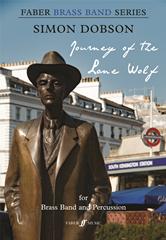
Journey of the Lone Wolf (Brass Band - Score Only)
Championship Section Test Piece for the 2016 National Finals of the British Brass Band Championship.The Lone Wolf of the title is the great Hungarian composer and folklorist Bla Bartok. Bartok's journey took him from the hills of the Balkans to the heart of the new world. His singular vision may have meant a life out in the cold, a life without warmth and love, a life without true happiness, a death mourned by a few in a strange land.The first of the three linked movements is capturing the Peasants' Song and follows the young Bartok and fellow composer Zoltan Kolday as they embark on Summertime adventures through the Hungarian countryside to collect and catalogue the astonishing variety of Gypsy and folk music heard in the Balkan hills. The arrival of WW1 plunges Bartok's beloved Hungary into chaos.Bartok was at times a cold man, aloof and lonely. The occasional moments of tenderness he showed are portrayed in Night Music. His brief but intense affairs speak of a love he could only long for. Jazz is my night music and here there are hints of what Bartok may have heard in the USA later in his life.Having been forced by the world's evils to leave his homeland of Hungary for America Bartok, the anti-fascist, felt isolated and angry. In the finale, Flight and Fight, we hear his longing for a simpler time of Gypsy folk dances as well as his maturity and depth as a composer finally exploring deeper colours and darker themes.Duration: 15.00
Estimated dispatch 7-14 working days
-
 £38.95
Unity Series Band Journal February 2014 Numbers 414-417
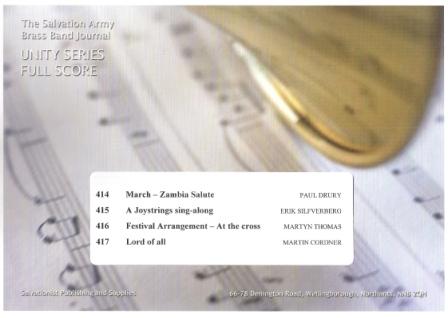
No.414 March - Zambia Salute (Paul Drury)In April 2009, a group from Chelmsford Citadel Corps visited Zambia. The purpose of the visit was to assist in the leadership of the Zambian Territorial Music School, held at Chikankata. This march was written to commemorate the event and received its premiere performance at the final festival. The melody featured is the chorus of the song, I know not why Dod's wondrous grace (S.A.S.B. 730).No.415 A Joystrings sing-along (Erik Silfverberg O.F.)This piece represents the first published work since the sudden Promotion to Glory of Bandmaster Erik Silfverberg O.F. The Joystrings made Salvation Army history about fifty years ago, introducing rock music on the Christian music scene. Many of their songs have become classics and have been used as thematic material in our brass music. Here is a selection of three of their songs, to be used either as a band piece or as accompaniment to a sing-along. The three songs are:- 'I want to sing it', 'It's an open secret' and 'Have faith in God'.No.416 Festival Arrangement - At the cross (Martyn Thomas)The well-known song, 'At the cross' (T.B. 580), is given a lively new setting by Martyn Thomas. The rock and swing treatment of this old melody should appeal to many!No.417 Lord of all (Martin Cordner)This piece was written for the 120th Anniversary of Balham corps (London Central Division) in 2011. In terms of a theme, the anniversary occasion prompted the primary thought that the piece should first be a praise-offering to God, acknowledging him for who he is. Therefore songs referenced in the piece are praide songs: 'Lord, reign in me', 'He is Lord', 'All hail the Lamb', along with a song of testimony, 'I'm a soldier bound for Glory' (T.B. 382),which speaks of the Christian hope in Heaven and challenges Salvationists to influence others by living out that hope. There is also a brief reference to the National Anthem of the Democratic Republic of Congo (4 bars before D)- man acknowledgement to the faithfulness of corps soldiers who in recent years have arrived from that country.
Estimated dispatch 7-14 working days
-
 £44.95
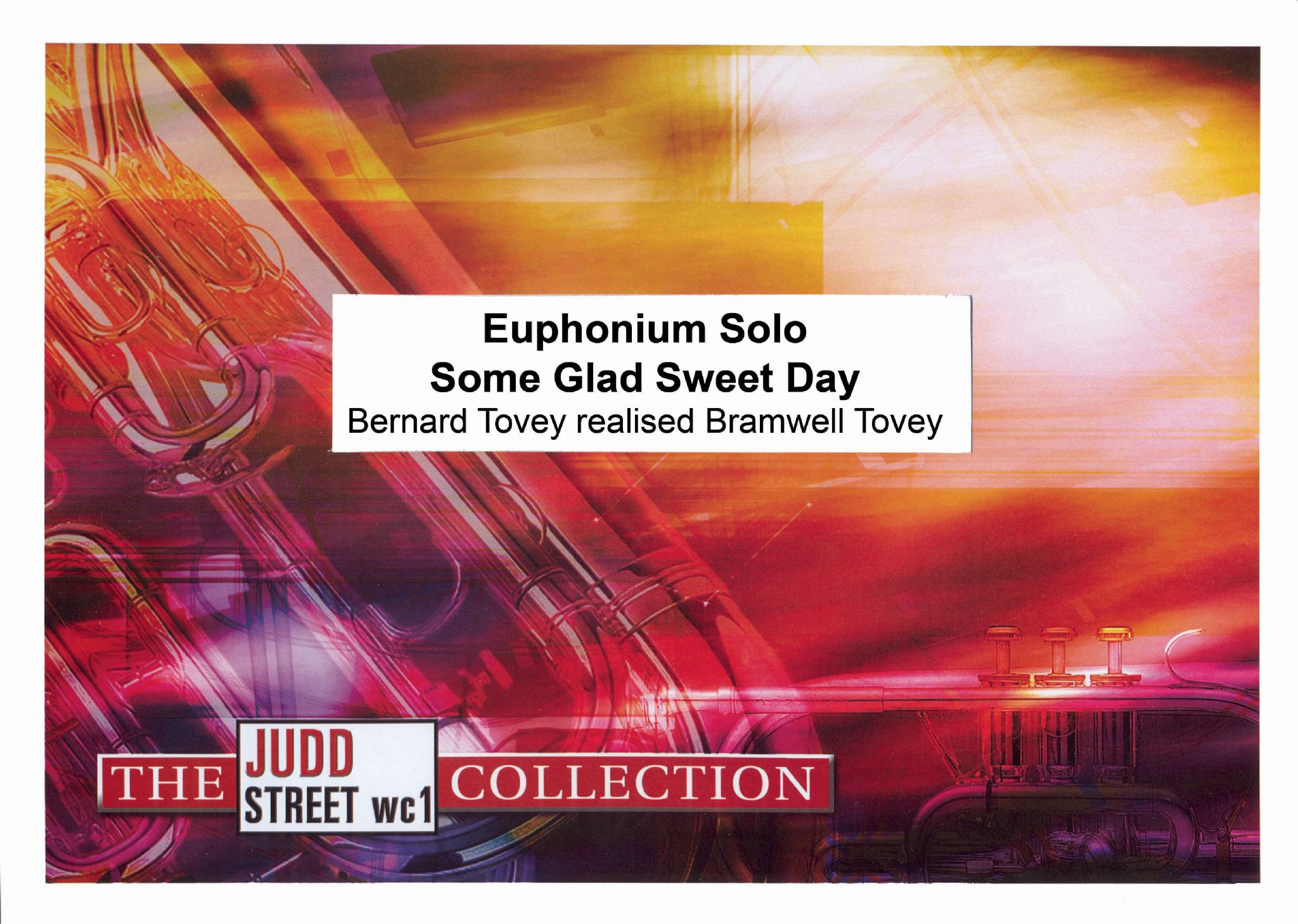
Judd: Euphonium Solo - Some Glad Sweet Day
September 2017 ReleaseEuphonium Solo - Some Glad Sweet Day (Bernard Tovey realised Bramwell Tovey)This solo was originally the work of Bramwell Toveys father Bernard Tovey, himself a fine Euphonium player. Bramwell Tovey has developed and gathered the original material and presented it for Euphonium Soloist, Derick Kane, to feature with the National Youth Brass Band of Great Britain in 2015. It employs the old song of the same title and provides a good challenge for the soloist.
Estimated dispatch 7-14 working days
-
 £69.95
Judd: Isaiah 40
Commissioned for the final of the 1996 National Brass Band Championships of Great Britain, Isaiah 40 represents Robert Redhead's only 'test piece' composition to date. The timeless truths contained in Isaiah 40 were written to encourage a people facing very intimidating circumstances. The Jewish people of the 5th Century BC were preparing to make an arduous journey though the desert to return to their ravaged homeland after a lengthy exile in the sophisticated society of Babylon. Both Scripture and music sound out a message of hope, as they view life from an eternal perspective, thus placing change in its proper context. Because 'the Lord is the everlasting God' his word 'stands forever' and 'those who hope in the Lord will renew their strength'. They will not merely get through somehow but 'they will soar on wings like eagles'.
Estimated dispatch 7-14 working days
-
 £50.00
Judd: Magnificat
Commissioned by 'Taakgroep NBK' for the 4th section of the Netherlands National Brass Band Championships 2005.
Estimated dispatch 7-14 working days
-
 £34.95
Judd: My Hope - Roger Trigg
'My Hope' was written for, and premiered by Enfield Citadel Band (Bandmaster Jonathan Corry) on 11th October, 2013. The work formed part of the band's annual pre-contest festival on the eve of the National Brass Band Championships which are held in the august surroundings of the Royal Albert Hall, London each year. The words 'my hope' appear in both hymns that are referenced in the music. The notes 'E', 'C', 'B' also feature throughout the work as homage to Enfield Citadel Band. The verse of 'My hope is built on nothing less' (S.A.S.B. 662), to the tune 'Solid Rock' (T.B. 446), is then introduced and forms the basis of the end of the first section - set in the minor, unlike the usual setting of the melody. The more sedate middle section that follows features an original theme, again using the notes 'E', 'C', 'B' as a melodic stimulus.The tune 'Michael' (Herbert Howells), to which the text 'All my hope on God is founded' (S.A.S.B. 530) is sung, provided the original impetus for this work. The song features as a new addition to The Salvation Army's 2015 iteration of its song book. It is a noble tune and there are big majestic, organ-like sounds utilised in its final treatment which brings the work to a climactic end.
Estimated dispatch 7-14 working days