
Results
-
£45.00
Braveheart - Horner, J - Barry, D
Positively medieval! - Braveheart is history the way it should be told, full of treachery, battle and passion and Mel Gibson in a kilt! Horner's score has a rare quality . . . it is cinematic and the themes have staying power and emotional substance (you can almost feel the cool fog rolling in from the sea and across the Scottish fields).Darrol Barry's sensitive score of the theme is stunning and anyone who has listened to this beautiful music will appreciate the depth of this arrangement.4th section +
In Stock: Estimated dispatch 1-3 working days
-
 £85.92
Chorale Tangents (Brass Band) Kenneth Downie
VIEW SCORE PDF This magnificent work by Kenneth Downie was commissioned by Festival Brass Band of Belgium, and its conductor Manu Mellaerts. It was first performed by the band on 10th October 2010, in Mechelen, a beautiful old city in the province of Antwerp. The composer writes: 'The chorale in the title is the famous one associated with the words 'Now thank we all our God', dating from 17th century Germany. The words were written by Martin Rinkart and the music by Johann Cruger. The use of the word 'tangents' in the title can best be understood as variations. This is another set of variations, in the line of St. Magnus, Princethorpe and Purcell Variations. I still cannot resist the urge to present familiar material in an unfamiliar way! Hopefully, the listener can relate to these tangents, and experience some of the joy that I receive when writing them.' To view a video of Festival Brass Band performing the work please visit: https://www.youtube.com/watch?v=Kc83_BYkZSc Sheet music available from: UK - www.brassband.co.uk USA - www.solidbrassmusic.com Instrumentation: Soprano Cornet Eb Solo Cornet Bb Repiano Cornet Bb 2nd Cornet Bb 3rd Cornet Bb Flugel Horn Bb Solo Horn Eb 1st Horn Eb 2nd Horn Eb 1st Baritone Bb 2nd Baritone Bb 1st Trombone Bb 2nd Trombone Bb Bass Trombone Euphonium Bb Bass Eb Bass Bb Timpani Percussion 1-3
In Stock: Estimated dispatch 1-3 working days
-
£35.00
These Mist Covered Mountains - Peter Meechan
These Mist Covered Mountains was commissioned by Keith Johnson (KMJ Recordings) for soprano cornetist, Mandy Crowther, to whom the piece is dedicated.In an age where we seem to be inundated with endless news cycles of various wars that we as a nation are involved in, and also those that we are not, it seems that war is now a constant, and we are in a never ending state.This short piece is intended to represent the cyclic nature of war, and the way that war never seems to have a true conclusion.
Estimated dispatch 12-14 working days
-
 £50.00
Triumph Series Band Journal November 2017 Numbers 1291-1294
March - The Galtonian (Nicholas Samuel)Dedicated to the Cambridge Citadel Band (Canada) in which the composer is the Corps Officer this march features 'We bring the sacrifice of praise', 'Ode to Newfoundland' and 'Happy Song'. The Galtonian is based on 'Galt' being the historical region of Cambridge.Entry - Thank you! (Erik Silfverberg)This work provides a different and inventive way to open festivals with the popular tune of 'Thank you!'Beside the sea (of Galilee) (Andrew Mackereth)This strong, powerful setting on the tune 'Lakeside' portrays many emotive responses and will be an excellent addition to the repertoire.March - Forever with the Lord! (Eiliv Herikstad)This rousing march features the tune 'Forever with the Lord' and evokes the style of the Salvationist composer Erik Leidzen.
Estimated dispatch 7-14 working days
-
 £33.62
One Voice (Brass Band) Barry Manilow arr. Mark Ford
Originally released in 1979 as the title track of Barry Manilow's sixth studio album, One Voice has become an enduring anthem for unity and social courage. It is a stirring ballad that reminds us how a single, brave voice can ignite a chorus of solidarity and lead the way toward positive change. Expertly crafted for brass band by Mark Ford, this setting captures the intimate, soaring spirit of the original while leveraging the unique textures of the brass band. The piece begins with a delicate, lyrical flugel horn solo, representing the 'single voice' of the title. As the arrangement progresses, the rest of the ensemble joins in, building from a gentle accompaniment into a magnificent, wall-of-sound finale that is sure to leave your audience inspired. To view a rolling score video of the work please visit https://youtu.be/RcQ5xbnyNjs Duration: Approx. 3.15 minutes Difficulty Level: 4th Section + This PDF download includes the full score and parts. Sheet music available at www.brassband.co.uk (UK) or https://satradecentral.org (USA) Instrumentation: Soprano Cornet Eb Solo Cornet Bb Repiano Cornet Bb 2nd Cornet Bb 3rd Cornet Bb Flugel Horn Bb Solo Horn Eb 1st Horn Eb 2nd Horn Eb 1st Baritone Bb 2nd Baritone Bb 1st Trombone Bb 2nd Trombone Bb Bass Trombone Euphonium Bb Bass Eb Bass Bb Timpani Glockenspiel Percussion
In Stock: Estimated dispatch 1-3 working days
-
 £49.99
No Time To Die - Christopher Bond
Delayed by the pandemic but scheduled for release in 2021, the much-anticipated James Bond film No Time to Die features a darkly beautiful and moody theme song recorded by Billie Eilish. With hints of the signature Bond harmonic flavour and stylish setting, this song is already on its way to becoming a classic. Note: whilst the demo video demonstrates the concert band arrangement, the version available to purchase on this website is the brass band transcription by Christopher Bond.
Estimated dispatch 10-14 working days
-
Kinderwalzer - Len Jenkins - Len Jenkins
The title originally began as 'kind of a waltz', but the music, in typical bier-keller fast-waltz style, progresses to be more representative of a children's nursery with fun and laughter all the way. That is, until the grotesque element appears and makes you wonder what it was that you glimpsed at the back of the wardrobe? Fortunately, all is resolved before bedtime and jollity returns. Sweet dreams!
-
 £55.00
Triumph Series Brass Band Journal, Numbers 1367 - 1370, November 2024
1367: March - Risen, conquering Son (Noel Jones)Two uplifting Easter songs are featured in this march; Low in the grave he lay (S.A.S.B. 228) with words and music written by Robert Lowry, and Thine is the glory (S.A.S.B. 276) with words by Edmond L. Budry and music by George F. Handel. Both serve as a powerful reminder of the resurrection of Jesus.1368: Horn Solo - O how much he cared for me (Keith Wilkinson)This solo was originally penned for Bandsman Frank Taylor, who plays Solo Horn at Stapleford Citadel Corps. As its basis, it uses the popular hymn No one ever cared for me like Jesus by Charles F. Weigle, a Baptist evangelist who wrote more than a thousand hymns.1369: My Redeemer lives (Olaf Ritman)This arrangement of Reuben Morgan's well-known worship song (S.A.S.B. 223) was first written as an accompaniment for congregational singing and can still be used in that way. It was inspired by the American R&B group Tower of Power and is meant to sound soulful and funky.1370: Selection - With life anew (Mervyn Clarke)This selection features music associated with two hymns; Blessd Saviour, now behold me (S.A.S.B. 575) by William Baugh and Breathe on me, breath of God (S.A.S.B. 294) by Edwin Hatch. Although Edwin Hatch's hymn-writing output was very small, this hymn has seen numerous settings and melodies associated with the words from which the piece takes its title; two of these melodies are featured here in Trentham and Carlisle.
Estimated dispatch 7-14 working days
-
 £14.95
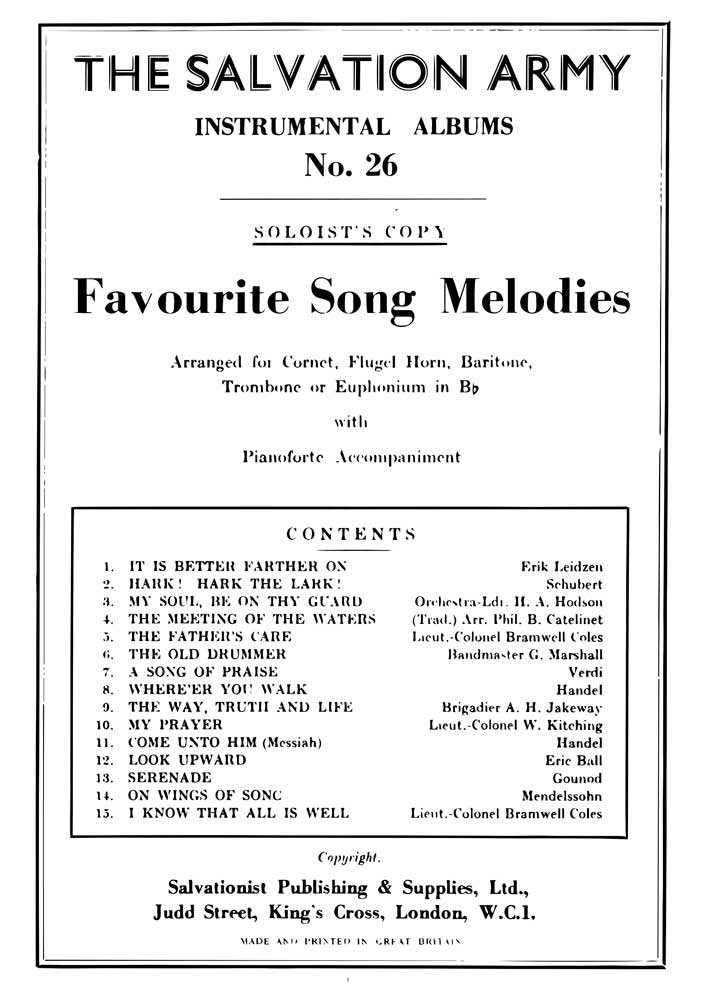
Instrumental Album No.26 - Favourite Song Melodies
Includes: It is better farther on; Hark! Hark the Lark!; My sou, be on thy guard; The meeting of the waters; The father's care; The old drummer; A song of praise; Where'er you walk; The way, truth and life; My Prayer; Come unto him (Messiah); Look Upward; Serenade; On wings of song; I know that all is wellInstrumentation: Arranged for Cornet, Flugel, Baritone, Trombone or Euphonium in Bb with Piano Accompaniment
Estimated dispatch 7-14 working days
-
 £44.95
Judd: Tunesmith Overture
A tunesmith is, by definition, one who composes melodies or songs. Howard Davies is such an individual, having written dozens of songs (melody and lyrics) foe The Salvation Army over the years. This overture takes a handful of his most popular melodies and turns them into a Broadway-style feature, providing fresh settings of these Howard Davies classics: Not if I owned the world, Tell all the people, God's still the one, The good Lord brought him through, The wonder of his grace and On the way to Heaven.
Estimated dispatch 7-14 working days
 View Music
 Watch video