
Results
-
 £39.00
El Capitan (Brass Band - Score and Parts) - Sousa, John Philip - Wilkinson, Keith M.
El Capitan was originally an operetta which was first produced in Boston in 1896. It was initially very popular and there are occasional revivals even to this day. The march of the same title uses themes from the opera and was also published in 1896. One notable feature - resulting from the use of themes from the operetta - is the abrupt transition from 6/8 to 2/4 half way through the march.This arrangement was prepared for the 2013 Summer concerts of Brass Band of the Western Reserve, musical director Dr Keith M Wilkinson.
Estimated dispatch 7-14 working days
-
 £119.99
Bellum et Pax (Brass Band - Score and Parts) - Roels, Stijn
Bellum et Pax is a composition describing the two ancient concepts of 'war' and 'peace.' While this piece appears to be one single movement, it consists of four sections that flow into one another. Mysterious and threatening tones lead the way into an epic battle between the chaos of war and enlightenment of peace. Peace triumphs, but menacing bass notes at the end symbolise the constant presence and threat of war and violence in the world.Duration: 11:45
Estimated dispatch 7-14 working days
-
 £55.00
A Thames Journey (Brass Band - Score and Parts) - Hess, Nigel - Littlemore, Phillip
Thames Journey is a 10-minute musical journey that follows the river Thames from its origins, as a few drops of water in Wiltshire, to the point where it meets the open sea at Greenwich. Along the way, Hess draws upon many musical links along the Thames, such as an old Wiltshire melody, morris dancing in Oxfordshire, boating songs from Berkshire and street songs in London. With such rich and diverse sources of music across several counties and centuries, this has quite understandably become one of Hess's most popular works to date. Suitable for Advanced Youth/3rd Section Bands and above. Duration: 10.00
Estimated dispatch 7-14 working days
-
 £74.99
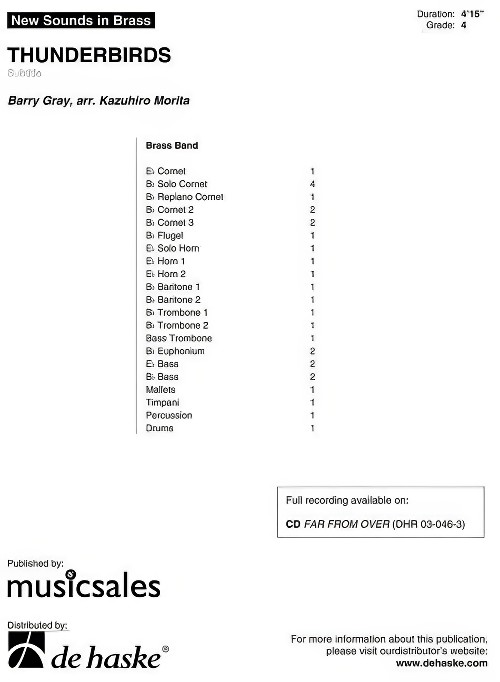
Thunderbirds (Brass Band - Score and Parts) - Gray, Barry - Morita, Kazuhiro
Who doesn't know the children's TV series Thunderbirds. The Gerry Anderson classic is still as popular today with both children and adults as when it was first shown in the sixties. This arrangement of the theme tune will be loved by all and will leave your audience humming it all the way home. Duration: 4.15
Estimated dispatch 7-14 working days
-
 £35.00
Ascension - Lucy Pankhurst
A major work written for the RNCM Brass Festival Competition 2005, and inspired by the nature of Ascension - creating a Musical depiction of the spiritual journey towards enlightenment, sanctuary and ultimate inner peace.As aninitial muse for this work, the 'Tibetan Singing Bowl' is utilised with the Brass Band in order to represent this path to Serenity, together withBaoding Balls(Chinese Health Balls) to mark the point of Final Ascension.Programme notes from the composer, Lucy Pankhurst:Ascension is a Musical depiction of the Spiritual Journey towards enlightenment, sanctuary and ultimate inner peace.As my initial muse for this work, the Singing Bowl is utilised with the Brass Band in order to represent this path to Serenity. "Tibetan" Singing Bowls date back to the 8th Century A.D., originating in the pre-Buddhist shamanic Bon Po culture in the Himalayas and are still used in modern Monasteries. The original purpose of them still remains a mystery, with accounts stating that it is forbidden to disclose the true function of the Bowls, as the "secrets of sound" yield so much Power, that they must be kept hidden.Listening to the tones created by the Singing Bowl effectively silences the internal dialogue of the listener, making it an excellent tool for Meditation, Centering and entering trance-like states. In Buddhism, as with many cultures, sound is an important part of Spiritual Practice. There are 9 methods to reach Enlightenment in the Buddhist Doctrine ; the seventh is SOUND.These Bowls are used by Healers in a similar way to help balance the body's residual energies. The Bowls are usually made from seven different sacred metals, intended to correlate directly to the seven sacred "Planets" : GOLD (Sun), SILVER (Moon), MERCURY (Mercury), COPPER (Venus), IRON (Mars), TIN (Jupiter), ANTIMONY (Saturn). Any one Bowl can create up to seven different frequencies (tones) simultaneously. In Healing, the Singing Bowl is played whilst balanced on the palm of the hand, struck three times to stabilise the surrounding energies, before rotating the wooden "beater" around the outer circumference of the Bowl to create the "singing" effect.I have included an optional Vibraphone part (to be played with a Double Bass Bow) with Tubular Bells, to be used only in performances where a Singing Bowl cannot be acquired. However, a traditional Bowl should be used whenever possible, to create this specific and unique sound.Baoding Balls or Chinese Health Balls are also utilised in this work. Their appearance in the Music here, however, is to mark the point of Final Ascension, where the music reaches its ultimate goal. These delicate cloisonne iron Balls are said to stimulate the acupressure points on the hand, thus improving the Chi and Energy Paths (Life Force) throughout the entire body. The delicate "tinkle" produced by these spheres is hypnotic and captivating. For this reason, where no Baoding Balls are obtainable for performance, only delicate metallic percussion should be used in replacement (i.e. Crotales, Antique Cymbals or (liberal) single strikes on a Triangle etc.). Bell Trees, Wind Chimes and Cow Bells should not be used.As in many cultures, the number three is important in Ascension, as it represents not only the purification from the Singing Bowl, but also it is a number of confirmation, reiterated throughout the music in the metallic percussion in addition to the Brass, re-affirming the correct path to Enlightenment.
In Stock: Estimated dispatch 3-5 working days
-
 £35.00
Swan Lake, Finale from - Tchaikovsky
As a finisher, this music is as exciting as it gets! The 'fully-charged' finale to Tchaikovsky's most dramatic ballet score begins at whirlwind speed. This gives way to the famous tender love theme, which is skilfully developed by before the music builds to a thrilling and exciting conclusion. This piece won the prize for the best new arrangement at 'Spennymore' in 1996, played by the Fodens Band conducted by Phillip McCann.Recorded by Whitburn Band (Victory).
In Stock: Estimated dispatch 3-5 working days
-
 £35.00
Divertimento (previously Spring's Awakening) - Andrew Duncan
This original solo for Eb Tenor Horn and brass band, composed by Andrew Duncan, has proved to be a welcome addition the solo repertoire.Written to demonstrate both the technical and lyrical sides of the Horn, the piece begins with a fast, bright (slightly Latin) section. This gives way to an expressive legato tune which, first played by the Soloist, is then taken up by the whole band. The central section, Andante, allows the soloist to really sing out and, following a short cadenza, the opening material returns to lead into an exciting Coda section.Also available for Eb Tenor Horn with piano accompaniment and F Horn with piano accompaniment.Difficulty Guide:Suitable for intermediate to advanced Tenor Horn players. Range: Low F# to high Db. (optional Bb).NB: The previous working title of Spring's Awakening has now been re-edited into this final title of Divertimento.
In Stock: Estimated dispatch 3-5 working days
-
 £25.00
Shining Stars - Lucy Pankhurst
This piece was originally commissioned by Denbighshire County Council for the Ruthin Area Brass Band. The composer, Lucy Pankhurst, has further dedicated it to Dennis Williams and Ann Pritchard-Jones "for their long-standing support".This work is made up of three movements - Fanfare, Theme and March, and offers lots of melodious energy. It's very accessible scoring for lower section bands and youth bands and provides an ideal way to work original compositions into your concert programme.
In Stock: Estimated dispatch 3-5 working days
-
 £228.70
Myte - Myth - Torstein Aagaard-Nilsen
Commissioned by Radoy Brass for their 20 years anniversary.This version was first performed by Manger Skulemusikklag in 2005.The Work is devided into Five Scenes:1. Sverdet (The Sword) 3:452. Advarsel - fra en vis mann (Warning - from a Wise Man) 2:303. Dragen (The Dragon) 3:004. Advarsel II - fra syngende fugler (Warning II - from singing birds) 1:355. Gull - forbannelsen (Gold - The Curse) 2:50Total durata 13:30This work is based on five scenes from the tale about "Sigurd Favnesbane" (Sigurd the dragonslayer). Moods and atmospheres in the piece represent my way of retelling the old myth.1. The SwordThe dwarf blacksmith Regin is hammering and sharpening the edges of the magical sword Gram. After three attempts the sword is finally sharp enough to kill a dragon. 2. Warning - from a Wise manRichard Wagners opera Sigfried is based on the same story. In the opera the hero get warned by a wise man. He tells the secret of how to survive an attack of the dragon by hiding in a hole in the pathway and then kill the dragon with the sword as thedragon passes on its way to the river to drink water.3. DragonThe Dragon (Favne) guards a fantastic treasure, but he is also the brother of the blacksmith Regin. Favne get killed and his blood flows slowly while he laments (trombone/bass trombone).4. Warning II - from singing birdsWhile frying the heart, Sigurd burns his thumb and put it into his mouth to cool it down. Then he swallow a drop of fresh magic dragon blood which transfers the ability to understand the birdlanguage. The birds sing warnings to Sigurd telling himthat Regin will betray him and later kill him. Sigurd then kills Regin instead.5. Gold - the CurseSigurd takes the gold treasure and escapes on the horseback of Grane. But his robbery of the gold lead him into trouble: The gold is banned and a curse will hit everyone whotakes it...Myth is a programmatic work where the story is quite clearly illustrated throughout the piece:In the first movement you can hear the blacksmith working with hammer on ambolt while the heat is intense from the glows. The dwarf has got his own theme i lower brass (bar 4-5). The hero Sigurd has his own identifying chord (2 bars before F). Thechord is also a symbol of the sword.In the second movement the warning from the wise man is expressed in the lyric bass line.The airblow in instruments illustrate the dragon Favne on his way out of his cave, and later the blood flows slowly. The dragon takes his last deep breath after a painful duet in trombones. The birds sing their motifs (lightly, but not cheerfulthough), until Sigurd cuts the head off Regin and it hits the ground.The last movement describes the atmosphere andstate of mind as the curse infects the obsessed thief.
Estimated dispatch 5-14 working days
-
 £102.99
Introduction & Punk - Torstein Aagaard-Nilsen
Torstein Aagaard-Nilsen's (1964) way of composing can be described as: uncompromising, wilful and contemporary. It is not surprising, therefore, that this occasionally causes a stir. In the middle of the Seventies a trend arose in youth culture, which was characterized by provocation, distrust of the great ideologies, and the autonomy of the individual. Punk is playful, aggressive, often humorous, and anti-everything, which inevitably leads to self-irony. The first part of Aagaard-Nielsen's composition (Introduction) is a texture based mainly on one short theme. This pompous theme breathes a spirit of cold empty plains, where icy winds sigh around yourhead. In the vehement Punk (Presto barbaro!) there is no longer any question of a theme. The basis for this part is formed by a repetitive motif (a descending minor third). This motif is alternated with very powerful percussion beats and later on shrill harmonies. De wijze van componeren van Torstein Aagaard-Nilsen (1964) laat zich omschrijven als: compromisloos, eigenzinnig en eigentijds. Niet verwonderlijk dat dit af en toe wat stof doet opwaaien. Midden zeventiger jaren ontstaat er een stroming binnen de jongerencultuur, die provocatie, wantrouwen tegen de grote ideologieen en de autonomie van het individu centraal stelt. Punk is speels, agressief, veelal humoristisch en anti-alles, wat onvermijdelijk leidt tot zelfspot. Het eerste deel (Introduction) is een weefsel, gebaseerd op voornamelijk een kort thema. Het pompeuze thema ademt de sfeer van kille lege vlakten, waar de ijzige wind je om de oren suist. Tijdens de 'heftige' Punk (Presto barbaro!) is van een thema geen sprake meer. De basis voor dit deel is een steeds herhalend motief (dalende kleine terts). Dit motief wordt afgewisseld met zeer krachtige percussie slagen en later schrille samenklanken. Dit alles zorgt voor een bombastisch geheel. Aan het slot van de Punk horen we het intoductie-thema tussen het punkgeweld door terugkomen.
Estimated dispatch 5-14 working days
 View Music