
Results
-
 £30.00
Janacek's 'Taras Bulba' - Janacek
Comments from Tim Paton, the arranger of Janacek's 'Taras Bulba': "I will never forget the day in 1967 when I was introduced to the music of Leos Janacek, a Czech composer born in 1854, who died in 1928. Janacek was little known in Britain until the 1960's, when the conductor Charles Macherras introduced his unique music. I heard a recording of Macherras conducting the Pro Arte Orchestra in a performance of Janacek's "Sinfonietta".It was in 1969 that I first heard Janacek's Symphonic Rhapsody, "Taras Bulba".Janacek's music is exciting, powerful, emotive, impassioned and unpredictable.I have taken the first and third movements of this piece, and adapted them for Brass Band, which was at times extremely difficult, but rewarding. It sometimes took up to an hour to be satisfied that a mere several bars had been reproduced to convey the composer's intentions.The Death of AndriThe Cossaks, under the leadership of Taras Bulba, are fighting against the Poles in the 17th century. Taras's son Andri seeks to rescue his love, a Polish princess, from a city which is being besieged by the Cossaks. Having found her, he throws in his lot with the Poles, but is finally captured by his father, who executes him as a traitor before riding off again to battle.Prophesy and Death of Taras BulbaTaras himself is finally captured and condemned to be nailed to a tree and burned alive. As the flames creep around him, Taras has the satisfaction of seeing histroops escape, and as he dies, sees a vision of his country freed at last.This is incredibly descriptive music. The mood is constantly changing, creating feelings of love and anger, celebration and melancholy, despair and triumph.This Brass Band EditionThe duration of the original symphonic rhapsody, three movements, is approximately 23 minutes. I chose the first and third movements, so the Brass Band edition is approximately 14 minutes. The main reason is twofold: Being realistic about the demands this music would place on the stamina of the brass player; Keeping the piece less than 15 minutes, so that, if desired, it could be used on the contest platform.Two unique qualities of Janacek's music had to be taken into account when preparing this brass band version. His compositional technique was individual, at times not sticking to traditional expectations, in both form and orchestration. I imagined what the genius himself would have said looking at my work, and how to tackle a particular section to emulate his original intentions. This was particularly the case when dealing with high woodwind and violin parts, the use of tremolo in string parts, and the orchestral harp.Percussion: Janacek included timpani, side drum, cymbals, triangle and tubular bells. For reasons stated previously, I have also included xylophone and glockenspiel. I have also added the gong in a couple of places to enhance the dramatic effect of the music.
In Stock: Estimated dispatch 3-5 working days
-
(I wonder why) You're just in Love - Irving Berlin - Len Jenkins
A great example of the compositional genius of Irving Berlin, with not one but two strong melodies, each independently capable of success, intertwined and used in counterpoint to each other. Good fun! See also 'Play a Simple Melody' also available from Wobbleco Music.
-
Codebreakers : Bletchley Park - Len Jenkins - Len Jenkins
Bletchley Park was the centre for Allied codebreaking in World War 2, responsible for decoding secret military codes used by enemy forces, in particular those related to the use of the 'Enigma' and other encoding machines. In the course of its endeavours it developed what was effectively the first electronic computer and brought to prominence the genius of Alan Turing when its wartime work was declassified and made public. The composer, Len Jenkins, still lives near Bletchley Park, went to school nearby, and attended training courses there when, after the war, it was used as a telecommunications training centre. This march is dedicated to the memory of all those who worked at Bletchley Park.
-
 £89.95
Revelation (Score and Parts)
Symphony for Double Brass on a theme of Purcell 1995 marked the tercentenary of Purcell's death, and my new score Revelation has been written as a tribute to his music and the ornate and confident spirit of his age. There are five major sections: 1 Prologue 2 Variations on a ground bass I 3 Fugue 4 Variations on a ground bass II 5 Epilogue and Resurrection The score uses many features of the Baroque Concerto Grosso, and arranges players in two equal groups from which soloists emerge to play in a variety ofvirtuoso ensembles. It quotes freely from Purcell's own piece Three Parts on a Ground in which he has composed a brilliant sequence of variations over a repeating six-note bass figure. This original motif can be heard most clearly beneath the duet for Cornet 5 and Soprano at the beginning of the 2nd section. There is, of course, a religious dimension to Revelation as the title suggests, and the score is prefaced by lines by the 17th century poet John Donne. His Holy Sonnet paraphrases the Book of Revelation in which the dead are raised at the sounds of the last trumpet. Donne's trumpets are themselves placed stereophonically ". . . At the round Earth's imagined corners" and it is this feature that today's players represent as they move around the performing area. Their final apocalyptic fanfares can be heard at the close of the score, as Purcell's music re-enters in a lasting tribute to England's first composer of genius. Philip Wilby September 1995 At the round Earth imagined corners, blow your trumpets, angels, and arise, arise from death, you numberless infinities Of souls, and to your scattered bodies go. All whom the flood did, and fire shall o 'erthrow All whom war, dearth, age, agues, tyrannies, Despair, law, chance hath slain, and you whose eyes Shall Behold God, and never taste death woe. John Donne after Revelation Ch. 11 v.15
Estimated dispatch 7-14 working days
-
 £44.95
Revelation (Score Only)
Symphony for Double Brass on a theme of Purcell 1995 marked the tercentenary of Purcell's death, and my new score Revelation has been written as a tribute to his music and the ornate and confident spirit of his age. There are five major sections: 1 Prologue 2 Variations on a ground bass I 3 Fugue 4 Variations on a ground bass II 5 Epilogue and Resurrection The score uses many features of the Baroque Concerto Grosso, and arranges players in two equal groups from which soloists emerge to play in a variety ofvirtuoso ensembles. It quotes freely from Purcell's own piece Three Parts on a Ground in which he has composed a brilliant sequence of variations over a repeating six-note bass figure. This original motif can be heard most clearly beneath the duet for Cornet 5 and Soprano at the beginning of the 2nd section. There is, of course, a religious dimension to Revelation as the title suggests, and the score is prefaced by lines by the 17th century poet John Donne. His Holy Sonnet paraphrases the Book of Revelation in which the dead are raised at the sounds of the last trumpet. Donne's trumpets are themselves placed stereophonically ". . . At the round Earth's imagined corners" and it is this feature that today's players represent as they move around the performing area. Their final apocalyptic fanfares can be heard at the close of the score, as Purcell's music re-enters in a lasting tribute to England's first composer of genius. Philip Wilby September 1995 At the round Earth imagined corners, blow your trumpets, angels, and arise, arise from death, you numberless infinities Of souls, and to your scattered bodies go. All whom the flood did, and fire shall o 'erthrow All whom war, dearth, age, agues, tyrannies, Despair, law, chance hath slain, and you whose eyes Shall Behold God, and never taste death woe. John Donne after Revelation Ch. 11 v.15
Estimated dispatch 7-14 working days
-
 £56.00
Pride (Brass Band - Score and Parts) - Fernie, Alan
A bluesy original work from the genius brass band writter, Alan Fernie
Estimated dispatch 7-14 working days
-
 £60.99
A Salzburg Impression (Brass Band - Score and Parts) - Mozart, Wolfgang Amadeus - Stratford, Dizzy
In this composition, Dizzy Stratford gives a musical impression of Wolfgang Amadeus Mozart's beautiful hometown. The theme of the work has been derived from the middle movement of one of Mozart's piano sonatas and provides the band with a glimpse into the creative genius of this great composer.Duration: 3:30
Estimated dispatch 7-14 working days
-
 £54.99
The Young Amadeus (Brass Band - Score and Parts) - Mozart, Wolfgang Amadeus - De Haan, Jan
Based on the famous melody from the Adagio movement of the Clarinet Concerto by Wolfgang Amadeus Mozart, this work has a beautiful lyrical quality to it. Compositions of this nature require the ability to play with great expression. The wonderful talent and genius of Mozart is clearly perceptible in this unforgettable melody.Duration: 3:30
Estimated dispatch 7-14 working days
-
 £67.50
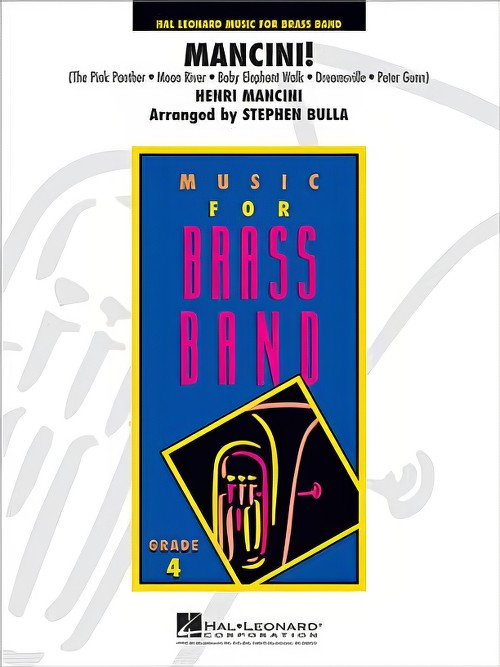
Mancini! (Brass Band - Score and Parts)
Some of the most recognisable themes from film and television over the years have come from the creative genius of Henry Mancini. Here is a symphonic showstopper featuring some of Mancini's biggest hits and most recognised melodies from the last four decades! Includes: The Pink Panther, Moon River, Baby Elephant Walk, Dreamsville, and Peter Gunn. 09:10
Estimated dispatch 7-14 working days
-
 £154.99
Spiriti (Brass Band - Score and Parts)
A Bach chorale stands at the centre of this work (F?r deinen Thron tret? ich hiermit).Anton Bruckner was one of Johann Sebastian Bach's great admirers. His work is full of the spirit of that musical genius. For Thomas Doss, it was Bruckner's spirit that always seemed to be with him while working on Spiriti. Bruckner's spirit is captured in this composition by a quote from the chorale of his Fifth Symphony at the end of the piece.The introduction, written in the style of a funeral march, already displays the first fragments of the chorale. Like splinters they are strewn throughout the first Allegro, combining and recombining in turbulent, powerful tutti passages. As the music becomes more rambunctious, the Bach-like fragments begin to swirl around each other, only to be scattered once more.The middle-section is of a more pensive nature. The Religioso character gives the audience time to reflect. The music is meditative and the quarter-note (or crotchet) elements mimic a soul that is yearning and crying out.The third part of the piece finally leads, by way of minimalist elements and the fragments mentioned earlier, to a magnificent presentation of the Bach chorale. As the church bells ring out, one can almost hear the great masters presiding at the organ. 17:00
Estimated dispatch 7-14 working days
 View Music