
Results
-
£29.95
WADE IN THE WATER (Brass Band Set) - Leonard Ballantine
Wade in the Water is a Negro Spiritual made popular in 1962 by the Ramsey Lewis Trio. Further versions followed in 1968 by Big Mama Thornton and in 1997 by Eva Cassidy. The song is thought to be a coded message for slaves escaping to freedom and tells the fugitive to walk in the water, instead of on the land, where tracking dogs cannot follow human scent. This version for brass band is in swing style.
Estimated dispatch 7-14 working days
-
 £55.00
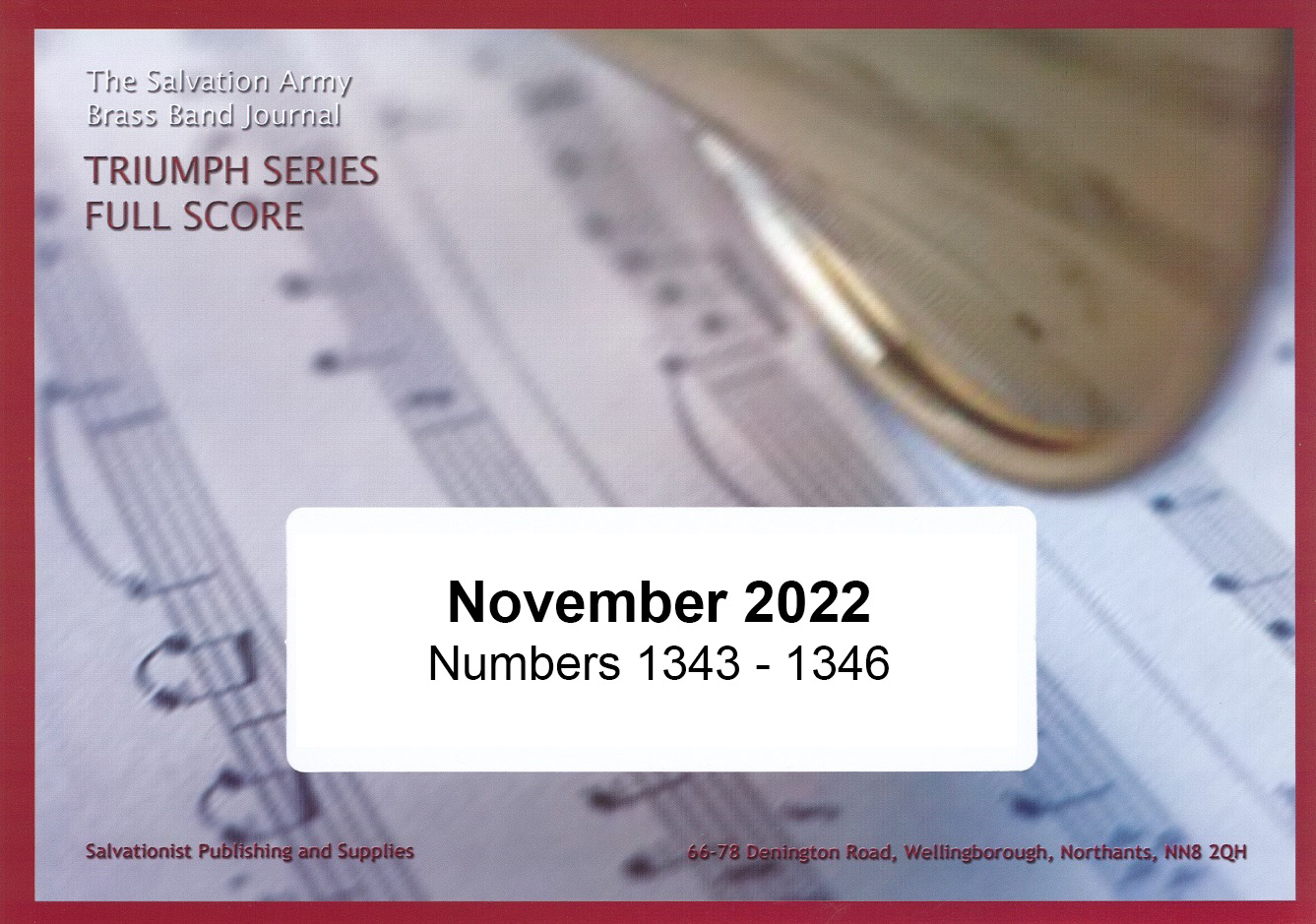
Triumph Series Brass Band Journal, Numbers 1343 - 1346, November 2022
1343: March - Spreading the Word (Ian Clarke)This lively march features the songs Look, ye saints! the sight is glorious (S.A.S.B. 227), When we walk with the Lord (S.A.S.B. 690), I want to tell what God has done (S.A.S.B. 852), and makes reference to the old chorus When I remember that he died for me I'll never go back any more.1344: Prelude on 'Anstasis' (Sam Creamer)The Greek word anstasis translates to resurrection and particularly refers to the resurrection of Jesus Christ. The popular worship song O praise the name (Anstasis) forms the basis of this prelude. While the theme of this work is most applicable for Easter use, it could well find its place in programme and worship repertoire all year round.1345: Flugel Solo - The old rugged cross (Eiliv Herikstad)This Flugel Horn Solo (also playable by Cornet) includes chords on the soloist part so that the soloist can have improvisational freedom, or can play the written out solo.1346: March - Showers of blessing (Zachary Docter)This energetic march uses Gary Rose's melody Showers of blessing (STTL Vol.24, Pt.1).
Estimated dispatch 7-14 working days
-
 £29.95
Judd: Wade in the Water
Wade in the Water is a Negro Spiritual made popular in 1962 by the Ramsey Lewis Trio. Further versions followed in 1968 by Big Mama Thornton and in 1997 by Eva Cassidy. The song is thought to be a coded message for slaves escaping to freedom and tells the fugitive to walk in the water, instead of on the land, where tracking dogs cannot follow human scent. This version for brass band is in swing style.
Estimated dispatch 7-14 working days
-
 £30.00
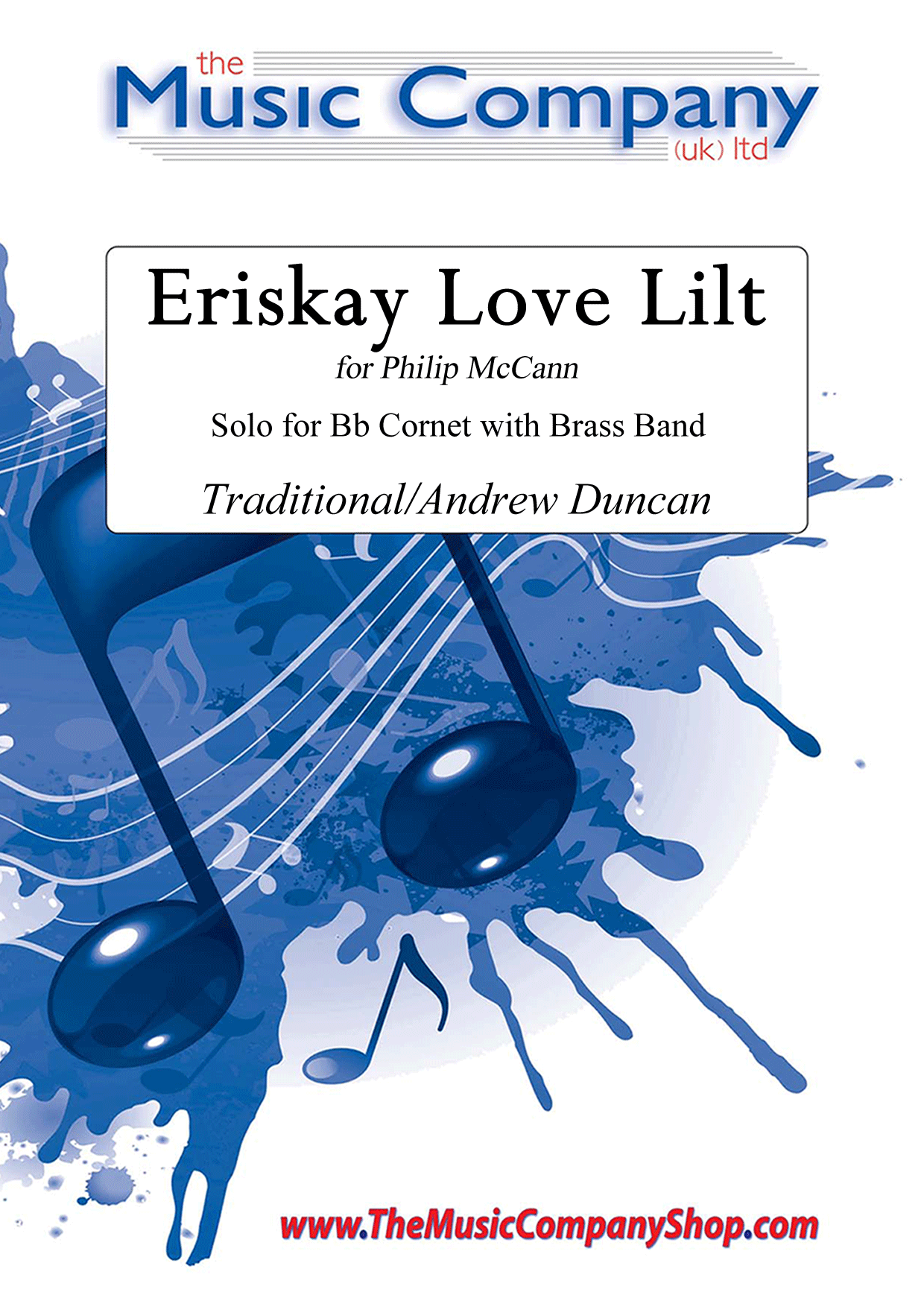
Eriskay Love Lilt (with brass band) - Trad
Eriskay Love Lilt is a traditional Gaelic melody from the Western Isles of Scotland, sensitively arranged here by Andrew Duncan as a cornet solo with brass band accompaniment.This arrangement was written in 2001 for Phillip McCann and was first played by him with the Hepworth Band at the 2002 Leek Music Festival in Derbyshire, England. It has also since been recorded by Eleanor Ferguson with the Whitburn Band on Reflections of Freedom.Andrew Duncan comments: The Isle of Eriskay (Eirisgeigh) lies forty miles off the North West coast of Scotland in the North Atlantic. It is a small island, only two kilometres square and lies between the larger islands of South Uist and Barra. Eriskay is one of the islands which form the archipelago known as the Western Isles or Na h-Eileanan an Air. The Eriskay Love Lilt is a hauntingly beautiful tune which is typical of the greater number of traditional Gaelic melodies in that it is largely based on the Aeolian mode, the black notes on the piano.Also available with piano accompanimentor as a solo with brass ensemble (10-piece).
In Stock: Estimated dispatch 3-5 working days
-
£33.00
Travellin' Light - Tepper, Bennett & Coleman - Broadbent, D
"Travellin' Light" written in 1959, became a signature hit for Cliff Richard and The Shadows, reaching No. 1 in the UK. Its breezy melody and optimistic lyrics evoke the freedom and romance of life on the road.
In Stock: Estimated dispatch 1-3 working days
-
 £29.50
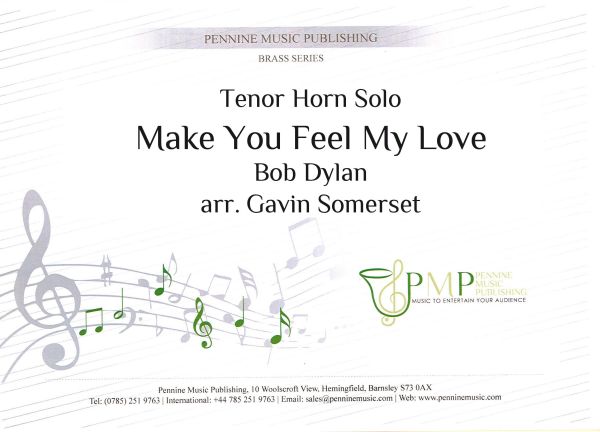
Make You Feel My Love (Tenor Horn Solo with Brass Band - Score and Parts)
With a melody that sits beautifully for the tenor horn, this song was written by Bob Dylan and first released by the singer, Billy Joel. In 2008, Adele released this version on her debut album which gained phenomenal success worldwide and featured appearances on the X-Factor and Britains Got Talent, as well as featuring countless times in films and across TV networks. This arrangement of the gorgeous melody allows the soloist the freedom to express themselves with careful scoring beneath in this delicate work. A stunning solo that belongs in every horn players repertoire.
Estimated dispatch 7-14 working days
-
 £50.00
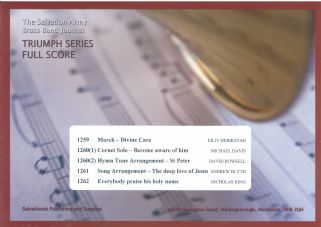
Triumph Series Band Journal March 2015 Numbers 1259 - 1262
No. 1259 March - Divine Care (Eiliv Herikstad)The message of this march is 'God will take care of you!' The introduction reflects the beginning of the song, God will take care of you (T.B.C.S. 124), which is presented in full at sections C and D.No. 1260 (1) Cornet Solo - Become aware of him (Michael Davis)A setting for Cornet and band of Colonel Robert Redhead's song, Become aware of him, which was originally published in The Musical Salvationist.No. 1260 (2) Hymn Tune Arrangement - St Peter (David Rowsell)An arrangement of the tune, St Peter, associated with the song, In Christ there is no east or west.No. 1261 Song Arrangement - The deep love of Jesus (Andrew Blyth)The strong hymn tune of Ebenezer (T.B. 433) was composed by Welshman, Thomas John Williams (1869-1944), who served as organist and choir director at various churches in and around Llanelli. This arrangement is more relaxed in style than the original and attempts to convey the freedom of the verses mostly associated witht he tune by Samuel T. Francis (1835-1925) O deep, deep love of Jesus, vast, unmeasured, boundless, free.No. 1262 Everybody praise his holy name (Nicholas King)A bright arrangement by Nicholas King of Remco Hakkert's song, Praise his holy name.
Estimated dispatch 7-14 working days
-
 £54.99
Free Mind (Brass Band - Score and Parts) - Jeanbourquin, Marc
For Free Mind, a light and dynamic piece, Marc Jeanbourquin drew inspiration from a gospel song, namely "Oh, Freedom", a post-Civil War African-American freedom song. In these times of crisis, the composer wanted to retain a positive and energetic spirit to symbolise the hope for better days. The four notes of the theme "Oh, Freedom" occur throughout the work and are brightened up by lively percussions, giving Free Mind a sparkling character that will lift the opening of a concert with enthusiasm. Duration: 3.00
Estimated dispatch 7-14 working days
-
 £104.99
The Baltic Way (Brass Band - Score and Parts) - De Haan, Jan
In 1989, the demonstration named the Baltic Way also known as the Baltic Chain-- was held in the Baltic states of Estonia, Latvia and Lithuania by its citizens in a call for independence from the Soviet Union. On 23rd August 1989, some two million participants formed a human chain, hand-in-hand all the way from the Estonian capital of Tallinn its Latvian counterpart, Riga, through to the Lithuanian capital of Vilnius - six hundred kilometres long. It became the longest human chain ever created and turned out to be the final push needed for much sought-after independence. This historic event became the source of inspiration for this composition. The introduction of thefirst movement, 'Struggle for Independence', is based on a nocturne for piano by the renowned Lithuanian composer and painter Mikalojus Konstantinas iurlionis (1875-1911), thematic material from which has been incorporated throughout the whole composition. The melancholic beginning is followed by a powerful theme which reflects the resolve of the Baltic people. The sudden aggressive, dissonant chords and a dominant and--in rhythmic terms--contrary bass drum announce that the resistance is not going smoothly. Just for a moment, we hear the anthem of the Soviet Union in the lower brass, but this is relentlessly pushed to the background by the rest of the band playing the Lithuanian national anthem, 'Tautika giesm ' (Lithuania, our homeland). The second movement, 'Decades of Suffering', echoes life under the Soviet Union's thumb. In the pursuit of independence, a peaceful protest is planned in which a human chain is formed across the Baltic states of Estonia, Latvia and Lithuania. This 'Chain of Freedom' is depicted in the final movement of the work. Duration: 10.30
Estimated dispatch 7-14 working days
-
 £29.95
Wade In The Water (Brass Band - Score and Parts) - Ballantine, Leonard
Wade in the Water is a Negro Spiritual made popular in 1962 by the Ramsey Lewis Trio. Further versions followed in 1968 by Big Mama Thornton and in 1997 by Eva Cassidy. The song is thought to be a coded message for slaves escaping to freedom and tells the fugitive to walk in the water, instead of on the land, where tracking dogs cannot follow human scent. This version for brass band is in swing style.
Estimated dispatch 7-14 working days
 View Music