
Results
-
 £14.95
Brass Band Manuscript Score Paper - A4 - 100 Sheets
A brass band manuscript paper scoring pad in A4 size.Write out your next masterpiece with our great quality paper.100 Sheets double sided 100gsm paper
In Stock: Estimated dispatch 3-5 working days
-
£44.95
EUPHONY (Euphonium Solo with Brass Band Set) - Robert Redhead
Previously only available in manuscript form, this euphonium solo with brass band accompaniment is now available in printed format. Euphony (meaning a pleasant, sweet sound) is based on the tunes of Sidney Cox with material taken from the songs; 'He found me', 'This one thing I know', 'You can tell out the sweet story' and 'Deep and wide'. At the time of writing, the composer remarked; 'The euphonium is often associated with melodies and harmonies that lend themselves to pleasing sounds'. That is true of this solo but it also presents considerable technical challenges for the soloist in terms of range and technique.
Estimated dispatch 7-14 working days
-
£59.95
BEULAH LAND (Brass Band Set) - Wilfred Heaton - Paul Hindmarsh
Wilfred Heaton began to assemble material for 'Beulah Land' in the early 1990s following a request from the Amsterdam Staff Band for a new work. Despite reminding himself on the manuscript that he should either complete or destroy the work before his death, ultimately he did not manage either. This edition was subsequently realised in 2003 for the tour of the USA Western States by the Amsterdam Staff Band.'Beulah Land' is Heaton's vision of the joy that awaits the Christian in Heaven and, according to his family, is reminiscent of the kind of music he often improvised at the piano. The three movements are as follows;1. Better World; a waltz sequence on the tune 'Zealley' to which the words 'There is a better world, they say' are sung.2. Heavenly Home; an elegiac cortege using the tunes 'My home is in Heaven', 'I have a home that is fairer than day' and 'The home over there'.3. Happy Land; Beginning in waltz rhythm this soon gives way to a sequence of free variations on the song 'There is a happy land, Far, far away'.
Estimated dispatch 7-14 working days
-
£59.95
CELESTIAL PROSPECT (Brass Band Set) - Wilfred Heaton
Selected as 2nd Section test piece for 2003 'Regionals'Wilfred Heaton originally composed Celestial Prospect in the 1940's but, so the story goes, it was rejected by the SA Editorial 'chiefs' as being too modern. The original manuscript was lost for many years, turning up in the 1980's in New York. Heaton re-worked it for the New York Staff Band, and it is now accepted as a classic of the SA 'Festival' genre.
Estimated dispatch 7-14 working days
-
 £59.95
Bonnie Northumbria - Brass Band - LM786
COMPOSER: Laurie JohnstonProgramme NotesNorthumberland, or Northumbria as it is also known, is the most northern county in England and has magnificent and stunning landscapes just waiting to be explored. Filled with mystical castles, atmospheric ruins and historical sites and edged by spectacular coastal scenery, there is something wonderful to see at every turn. The Devils Causeway passes through Northumbria and reaches Berwick upon Tweed at the coast. Walkers and cyclists can also take the Coast and Castles Cycle Route or the North Sea Trail which journey through some of the most beautiful scenery along the way.The Blaydon Races is aGeordiefolk songwritten in the 19th century byGeordie Ridley, in a style deriving frommusic hall. It is regarded by many as the unofficialanthemofTynesideand is frequentlysungby supporters ofNewcastle United Football ClubandNewcastle Falconsrugby club.Blaydonis a small town inGateshead, situated about 4 miles (6.4km) fromNewcastle upon Tyne, inNorth East England. The race used to take place on the Stella Haugh 1 mile (1.6km) west of Blaydon.Stella South Power Station(demolished in 1995) was built on the site of the track in the early 1950s, after the races had stopped taking place in 1916.Water of Tyne (sometimes rendered as The Waters of Tyne) is a folk song (Roud number1364) from the north-east of England. The song is sung by a girl or woman lamenting the fact that her paramour is on the opposite bank of theRiver Tyne. Sleeve notes to Michael Hunt's recording of Tyneside songs states that "the ferry is believed to be that atHaughton Castleon theNorth Tyne". Alternatively the "rough river" in the last line may indicate a point further downstream, possiblyTynemouth.The song was collected byJohn Bellin 1810 and published two years later inRhymes of Northern Bards.The Keel Row is a traditional Tyneside folk song evoking the life and work of thekeelmenofNewcastle upon Tyne. A closely related song was first published in aScottishcollection of the 1770s, but may be considerably older, and it is unclear whether the tune is Scottish or English in origin.The opening lines of the song set it inSandgate, that part of the quayside overlooking the River Tyne to the east of the city centre where the keelmen lived and which is still overlooked by theKeelmen's Hospital.Versions of the song appear in both England and Scotland, with Scottish versions referring tothe Canongaterather than Sandgate. The earliest printing was in the 1770s inEdinburghin A Collection of Favourite Scots Tunes, edited by Charles Maclean, though the tune was also found in several late eighteenth-century English manuscript collections. As the term "keel" was used both sides of the border, it has not been determined which version was the original, althoughFrank Kidsonsurmised that like many other songs collected by Maclean it may originally have been aJacobiteair from the time of the1745 rebellion. Some versions of the song make reference to a "blue bonnet[...] with a snowy rose upon it", a clear attempt to evoke Jacobite symbolism, whether dating from 1745 or not.Kidson, however, also noted that he had found the tune of The Keel Row associated with an early dance called "The Yorkshire Lad" as early as 1748.By the 19th century the tune was well associated with the River Tyne; a few years before the 1850s the keelmen had met yearly to celebrate the founding of the Keelmen's Hospital, perambulating the town to the accompaniment of bands playing The Keel Row.Dance To Thy Daddyis a traditional Englishfolksong, originating inNorth East England. An early source for the lyrics, Joseph Robson's "Songs of the bards of the Tyne", published 1849, can be found on the Farne archive. In Farne's notes to the song, it is stated that these lyrics were written by William Watson around 1826.
In Stock: Estimated dispatch 3-5 working days
-
£29.95
DEEP RIVER (Brass Band Set) - William Broughton
An arrangement, in 'Count Basie' style, of the spiritual of the same name. The tempo indication on the original manuscript states "the slower the better" and therein lies probably the most difficult aspect of the piece.
Estimated dispatch 7-14 working days
-
 £55.00
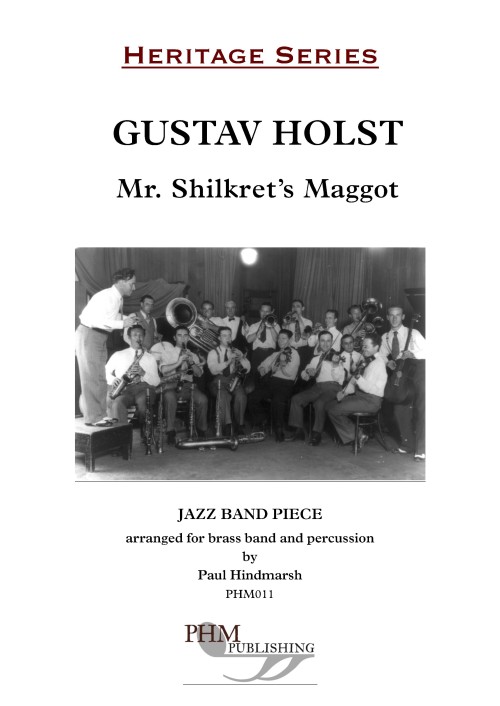
Mr Shilkret's Maggot (Brass Band - Score and Parts) - Holst, Gustav - Hindmarsh, Paul
This short piece was composed in 1932 during a visit Gustav Holst was making to the USA. He was invited by the band leader Nathaniel Shilkret to contribute to a series of piece for concert jazz band based on a folk song. Rather than using a traditional tune, Holst invented one of his own in folk song style and therefore the piece was not performed. Holst considered various titles for the piece including Mr. Shilkret's Dump, Folly and Maggot. On the manuscript he described it as a Jazz Band Piece. When the composer's daughter Imogen re-scored the piece for the English Chamber Orchestra to record under her direction in 1967, she changed decided to use the title Capriccio.Her re-orchestration involved removing the saxophone quartet, adding cor anglais and a second bassoon and changing cornet parts to trumpets. She retained the harp, extensive percussion, piano and celesta. My brass band version is based on the composer's manuscript, held at the British Library. It retains the composer's cornet parts, re-voices the woodwinds and strings, and places keyboards and harp onto glockenspiel, marimba, vibraphone and xylophone.I have selected the title Mr. Shilkret's Maggot for my scoring of Jazz Band Piece, which was first performed by The Cory Band, conducted by Philip Harper, at the Royal Northern College of Music Brass Band Festival, 29 January 2017.- Paul HindmarshDuration: 5.30
Estimated dispatch 7-14 working days
-
 £95.00
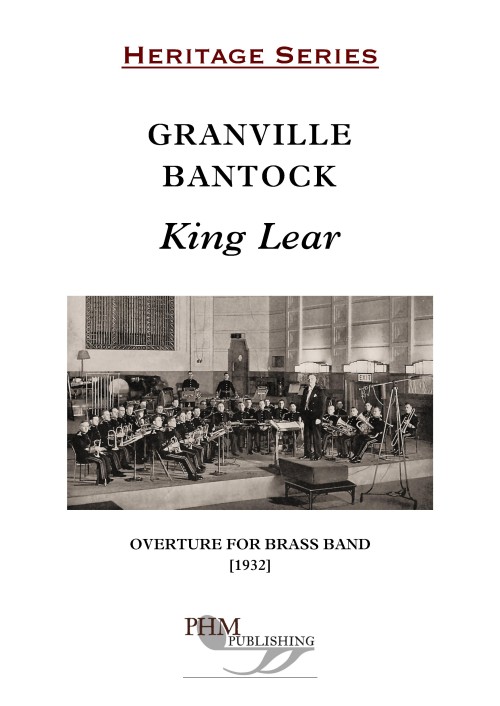
King Lear (Brass Band - Score and Parts) - Bantock, Granville - Hindmarsh, Paul
Sir Granville Bantock (1868 - 1946) composed the second of his five major brass band work for Callender's Cableworks Band, completing the commission on 30 November 1932. Based in the Thames-side district of Belvedere near Erith, the band was active between 1898 and 1961. The works band of the Callender Cable & Construction Co. Ltd, it was at the peak of its popularity during the 1930s and was a frequent broadcaster on the radio. The band employed an in-house arranger and played saxophones in its lighter material. King Lear was one of the band's major commissions and was not published in Bantock's lifetime. The manuscript score and parts were thought to be lost for decades, but were found in the library of the Haydock Band (Lancashire), which had inherited part of Callender's library of manuscripts material and bespoke arrangements after it has been transferred to nearby Prescott Cables Band after Callender's Cable Works closed.King Lear is a substantial work, in essence a dramatic tone poem in the romantic Tchaikovskian manner, presenting a series of character portraits of the foolish old king and his three daughters, Goneril, Regan and Cordelia. The music is dramatic and lyrical by turns, with the most generous lyrical episode revealing perhaps the warm-hearted Cordelia. An expansive melody that flows from this is brought back towards the end as the main climax of the work.In 2001, Bantock's score was recorded by the University of Salford Brass Band, conducted by Dr. Roy Newsome. The original is serviceable, but in comparison with the orchestral version he made in 1936 (part of which was recorded on a Paxton 78 rpm) and later brass band scores, performing editions of which were prepared by others, it lacks colour and range typical of Bantock's orchestral work. Above all it lacks percussion, which can be heard on the recorded extract. With the kind permission of the Bantock Estate, I have prepared a performing edition for publication that incorporates percussion, derived from the orchestral recording and added editorially in similar manner elsewhere. I have revoiced some of the low- lying instrumental parts to present the material in more comfortable ranges. Editorial interventions more elaborate than revoicing the original text have been identified as cue notes.- Paul HindmarshDuration: 15.00
Estimated dispatch 7-14 working days
-
£40.00
King Lear (Brass Band - Score only) - Bantock, Granville - Hindmarsh, Paul
Sir Granville Bantock (1868 - 1946) composed the second of his five major brass band work for Callender's Cableworks Band, completing the commission on 30 November 1932. Based in the Thames-side district of Belvedere near Erith, the band was active between 1898 and 1961. The works band of the Callender Cable & Construction Co. Ltd, it was at the peak of its popularity during the 1930s and was a frequent broadcaster on the radio. The band employed an in-house arranger and played saxophones in its lighter material. King Lear was one of the band's major commissions and was not published in Bantock's lifetime. The manuscript score and parts were thought to be lost for decades, but were found in the library of the Haydock Band (Lancashire), which had inherited part of Callender's library of manuscripts material and bespoke arrangements after it has been transferred to nearby Prescott Cables Band after Callender's Cable Works closed.King Lear is a substantial work, in essence a dramatic tone poem in the romantic Tchaikovskian manner, presenting a series of character portraits of the foolish old king and his three daughters, Goneril, Regan and Cordelia. The music is dramatic and lyrical by turns, with the most generous lyrical episode revealing perhaps the warm-hearted Cordelia. An expansive melody that flows from this is brought back towards the end as the main climax of the work.In 2001, Bantock's score was recorded by the University of Salford Brass Band, conducted by Dr. Roy Newsome. The original is serviceable, but in comparison with the orchestral version he made in 1936 (part of which was recorded on a Paxton 78 rpm) and later brass band scores, performing editions of which were prepared by others, it lacks colour and range typical of Bantock's orchestral work. Above all it lacks percussion, which can be heard on the recorded extract. With the kind permission of the Bantock Estate, I have prepared a performing edition for publication that incorporates percussion, derived from the orchestral recording and added editorially in similar manner elsewhere. I have revoiced some of the low- lying instrumental parts to present the material in more comfortable ranges. Editorial interventions more elaborate than revoicing the original text have been identified as cue notes.- Paul HindmarshDuration: 15.00
Estimated dispatch 7-14 working days
-
 £80.00
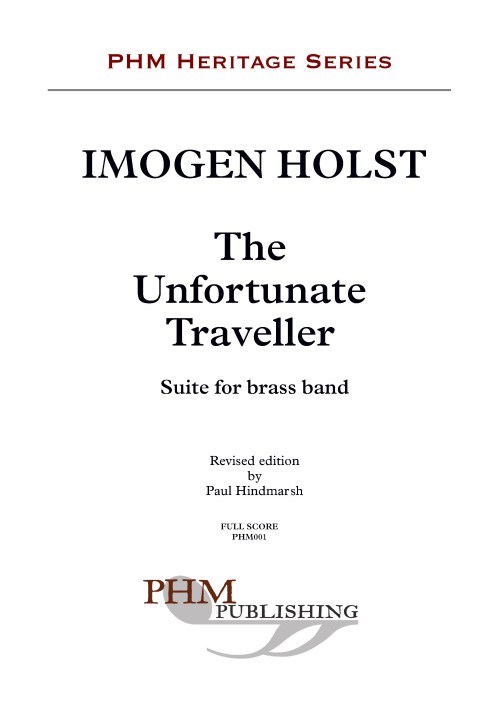
The Unfortunate Traveller (Brass Band - Score and Parts) - Holst, Imogen - Hindmarsh, Paul
Imogen Holst (1907-1984) submitted The Unfortunate Traveller (1929) as her final work as a student portfolio at the Royal College of Music, where her composition teacher was Gordon Jacob. The title was taken from Thomas Nashe's famous 1594 picaresque novel of the same title. The Suite was first performed on 12 February 1933 at her Majesty's Theatre, Carlisle, by the St. Stephen's Band, with the composer conducting. Te concert was given in memory of Holst's uncle, Dr. H.A. Lediard. Holst had been impressed with the band's performance of his A Moorside Suite at the 1928 National Brass Band Championships (The Crystal Palace, South London) and was keen to work with them. Writing in Imogen Holst, a life in music, Christopher Grogan indicates that it was Gustav Holst's suggestion to include his daughter's work in the programme, quoting Imogen Holst's remarks made in interview to The Daily Mail as follows: "....it is the first time, so far as I know, that a woman has conducted a brass band at a public concert....It has been a delight to rehearse the St. Stephen's Band. It was their performance at the Crystal Palace Festival that inspired me to write this Suite, which I have dedicated to them."Imogen Holst accompanied her father to the Crystal Palace in 1928 to hear the performances of A Moorside Suite, and was so excited by the played and, audibly, by her father's music that she decided to write a brass band piece for her final examination. Te result was The Unfortunate Traveller (1929). However, it was not possible for her to present a brass band work for examination. She arranged it for string orchestra so that it could be played before she left the RCM in July 1930. Following the premiere of the original in 1933, the manuscripts did not resurface until 1969 Imogen found them among her late mother's effects. Although she requested score and parts be destroyed, they ended up in the possession of Manchester composer John Golland, who marked up the score presumably with the intention of creating a new performing edition. The original scoring reveals a lack of experience with what can be a tricky medium.With the agreement of the Holst Foundation, a revised edition, with additional percussion, was prepared in 2011 since when the work has been fortunate to travel round the world as a concert and contest piece. The original includes drums in the March only. The title was taken from Tomas Nashe's famous 1594 picaresque novel of the same title. Several Morris Dance tunes are introduced during the course of the four short movements, including Bonnie Green Garters, Shepherd's Hey, The Rose and The Wind Blaws Cauld. Quirky twists and turns of harmony and spirited rhythms that remind us how much Imogen Holst loved tradition English dance music.In September 2025, I made a performing edition of the composer's arrangement for string orchestra. The manuscript lacks the final movement, which I arranged in a similar style, ie. without extending the upper ranges. Making this edition raised some issues regarding the accuracy of my band version and some of the solutions I used to smooth out the voicing. I have used the composer's second thoughts to refine my performing edition and to correct a textual errors.- Paul HindmarshDuration: 10.00
Estimated dispatch 7-14 working days
 View Music