
Results
-
 £79.99
Strathcarron - Philip Sparke
Strathcarron is a movement from Philip Sparke's Hymn of the Highlands, in which each movement reflects a different location in the beautiful Scottish highlands. Stratcarron, named after a village at the head of Loch Carron, near the Isle of Skye, takes the form of a sword dance which alternates between fast and slow tempi.
Estimated dispatch 5-14 working days
-
£72.99
Cinemania - Robert Finn
This music sounds as if it came straight off the cinema screen. However, there's no movie for this fantastic score! Just like EVERY good film score, this work also includes moving melodies, fast virtuoso passages and, last but not least, a romantic love theme. The instrumentation takes into account that a group may not be complete and this means that the piece can be played by practically every orchestra. Highly recommended for concerts and competitions.
Estimated dispatch 5-14 working days
-
 £104.99
Slavia - Jan Van der Roost
Jan Van der Roost originally composed each and every note of 'Slavia' (as in case in 'Puszta', 'Rikudim' and 'A Highland Rhapsody'). Consequently, 'Slavia' does not contain any arrangement of existing tunes, but is an original composition 'in the style of...'. The introduction has an ABA structure and exposes a broad melodic line. Following a short cadenza, there is a second movement in a fast and fiery tempo. The tempi increase, gradually culminating in an exciting final climax, making this 'Slavonic Rhapsody' a spell-binding experience to the very last note.
Estimated dispatch 5-14 working days
-
 £60.99
Orion - Jan Van der Roost
There are all sorts of marches: fast and slow, solemn and energetic, military and civil, procession and funeral. Orion is a so-called 'slow march'. However the moderate tempo does not make a passive or heavy impression. On the contrary, this march contains natural optimism and spontaneity. The persistant 'pulse' gives this majestic march a noble character
Estimated dispatch 5-14 working days
-
 £69.99
Czardas (Xylophone solo) - Monti - Gert Bomhof
Vittorio Monti was born on January 6, 1868 in Naples (Italy). His musical education (Violin and composition), he enjoyed at the conservatory there. Around his 30's Monti went to Paris. He earned a living as a conductor and wrote several ballets and operettas. In his last years, before his death in 1922, Monti devoted himself to teaching and composing. His famous 'Czardas' has made his name known even today.Initially the Czardas was a Hungarian folk dance, but after the mid-nineteenth century it was even a dance for the upper-class. Czardas begins with a slow introduction, the Lassan (slow and sad), and then the fast part,Friska, follows. Czardas is not, as so many people think, typical gypsy music.
Estimated dispatch 5-14 working days
-
 £74.99
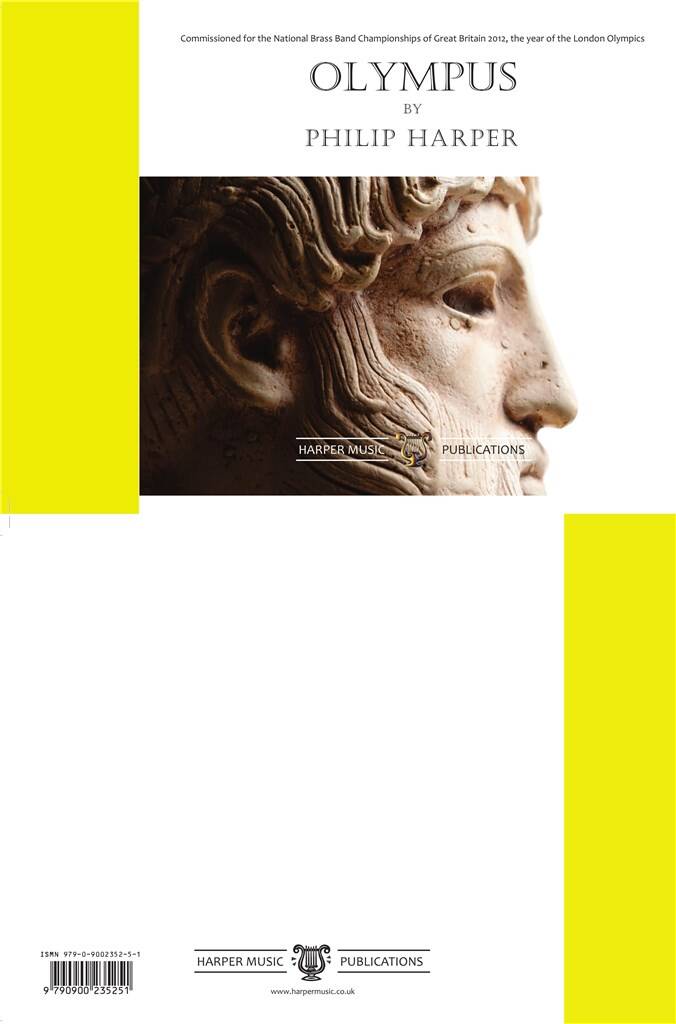
Olympus - Philip Harper
Selected as the test-piece for the 3rd Section Regional contests of the National Brass Band Championships 2012The music begins with a depiction of the exciting Opening Ceremony where noisy fanfares and sudden swells add to the cosmopolitan flag-waving clamour. Without a break the music leads to The Chariot Race, a fast compound-time gallop withthundering hooves in the basses and percussion, and a heroic melody introduced by the tenor horns. Chariot racing was the main equestrian event in the Ancient Greek Games, which were founded in memory of King Oenomaus. In the Greek legend he suffereddefeat in a chariot race to his son-in-law and Zeus' grandson, Pelops, but much of the music is bitter-sweet to symbolise the fact that Pelops had to cheat to win drawing parallels with some of the issues still facing modern-day athletics. A slow, mystical passage follows, describing The Temple of Zeus at Olympia. The statue of Zeus, who was honoured throughout the Ancient Games' history, was housed inside the temple and was one of the Seven Wonders of the Ancient World. Themusic depicts this period of the dawn of one of mankind's most ancient civilisations and there is a series of solo passages above a drone. The next section is called The Olympic Flame and a broad and lyrical anthem-like melody develops slowly in the euphoniums, which gradually ascends until the horns can take it over before passing upwards again to the cornets (Higher). The musicbursts into bright life at the lighting of the flame and the regular rhythmic pattern which has been established goes through an accelerando (Faster). The final section is called The Olympic Truce and aims to capture the cooperative spirit of the ancient practice of ending wars for the duration of the games. The anthem-like melody makes an affirmatory return (Stronger) and the work ends asit began with a blaze of colour and a real sense of optimism and global celebration. "Citius, Altius, Fortius" (Faster, Higher, Stonger)NOTES ON PERFORMANCEPercussion requirements: 1 to 3 players (3 Timpani, Snare Drum, Tenor Drum, Cymbals, Glockenspiel, Triangle)
Estimated dispatch 5-14 working days
-
 £85.90
Imaginations - Andrew Pearce
iMaginations is a bright and colourful overture with a strong memorable theme in a fast meter that is shared across the sections of the band. It drives forward relentlessly with great vigour and vitality, culminating in a soaring legato rendition of the main theme, first heard in trombones and trumpets. I have aimed this piece at more advanced bands who will find it an exciting ride. '
Estimated dispatch 5-14 working days
-
 £115.00
Epic Journey to Torshavn - Andrew Pearce
Epic Journey to Torshavne is an impressive concert work, commissioned by Gouden Spiker Festival 2016. The journey begins At Sea as trombones announce first sighting of the island. A stirring theme in basses creates mystery and anticipation as the island gradually appears. A lively theme in 3/2 introduces Folk Dance & Celebration conjuring dramatic images of early settlers, followed by a calmer rendition entitled People of Torshavn. A brass chorale segues into Finale with a fast reprise and brass chords underscore the splendour of the island.
Estimated dispatch 5-14 working days
-
 £115.60
Music for Halloween - Roar Minde Fagerli
"Music for Halloween" is three simple pieces who describes spooky and scary moods we ALL know from halloween.The first movement describes The Grim Reaper, a scary character who represents death.The second movement describes the black magic of voodoo and its supernatural forces.The third movement describes a spooky ghost train who drives fast through the dark night.
Estimated dispatch 5-14 working days
-
 £30.00
Edward Gregson: Music of the Angels, for Symphonic Brass and Percussion
DescriptionProgramme NoteMusic of the Angels is a dramatic work of some 16 minute's duration, scored for a large symphonic brass ensemble, including seven trumpets, and percussion. The percussion section deploys 'dark' instruments such as three tam-tams, a bass drum and two sets of timpani.The title of the work is based on a quotation from the Book of Revelations:And I saw the seven angels which stood before God; and to them were given seven trumpetsThus, the idea behind the work is a dramatic one and the composer has emphasised this by the partial spatial arrangement of the ensemble, with six solo trumpets standing centre stage, but behind the main ensemble, and the seventh trumpet off-stage throughout.The work opens with a four-note motif, dominant throughout the work, announced initially by four off-stage horns and answered by fanfare figures on four solo trumpets. Then in turn each of the first four solo trumpets announce their own cadenzas before joining together, independently playing their own music. This reaches an intense climax before subsiding into slow music which might be described as a Kyrie eleison - a lament for humanity - a cantilena for flugel horn and euphonium, accompanied by trombones. The drama soon returns with the entry of trumpets 5 and 6, playing music that is fast, more urgent and foreboding, and describing in musical terms the horsemen of the Apocalypse.At the climax of this section trumpet 7 enters dramatically, representing the words of the seventh angel ... and time shall be no more. The opening four-note motif is here transformed into a cadenza of epic proportions, to the partial accompaniment of three tam-tams (representing the Holy Trinity). The ensuing scherzo, scored for the ensemble, is fast and furious, but despite the somewhat desolate mood of this music (briefly interrupted by the re-appearance of trumpet 7), it slowly moves towards a more optimistic conclusion, transforming the 'lament for humanity' music into an affirmative and triumphant climax.This work has been commercially recorded on a critically acclaimed CD from London Brass on the Chandos label, available HERE.For more information on Edward Gregson's music please visit the composer's website: www.edwardgregson.com
Estimated dispatch 7-14 working days
 View Music