
Results
-
£60.99
Marching Blues - Hayato Hirose
Marching Blues was written in the blues and swing-jazz style of the great big bands. It is an ideal show march that can be used for encores, popular performances, family concerts and much more. As an added entertaining feature why not get your Eb bass player to stand for his/her 28-bar solo! From small ensembles to large bands, Marching Blues will bring great joy to all generations of performers and audiences on many occasions.
Estimated dispatch 5-14 working days
-
 £60.99
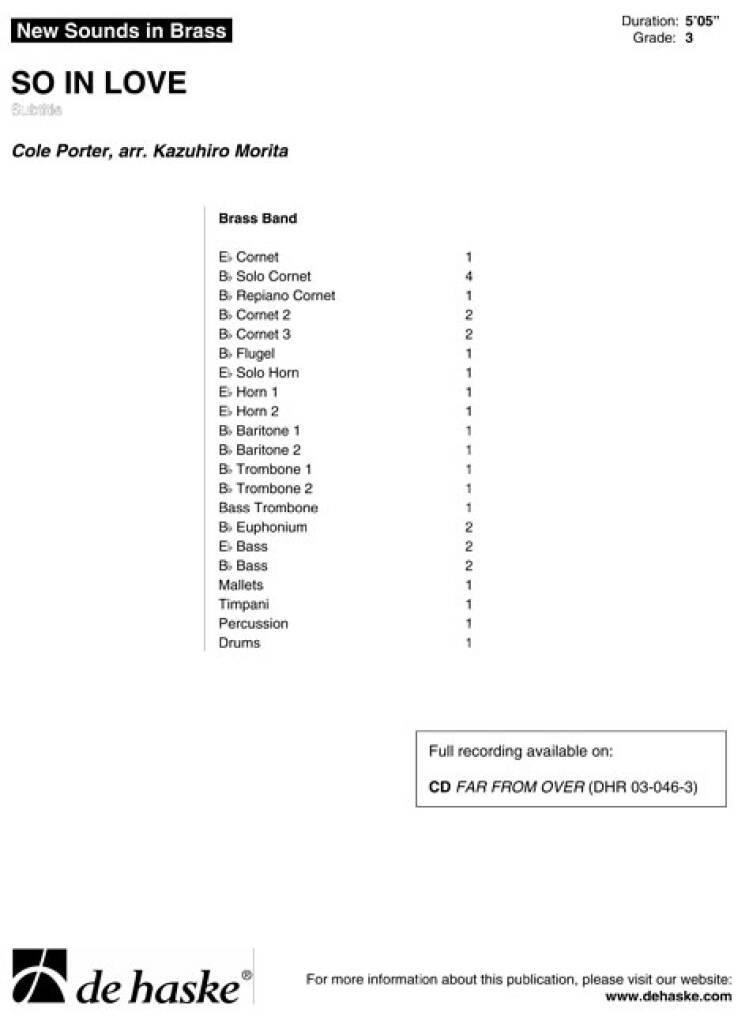
So in Love - Cole Porter - Kazuhiro Morita
Cole Porter was one of the great masters of Broadway musicals during the thirties, forties and fifties, with So in Love, from the musical Kiss Me Kate, being one of his best loved works. It has been recorded by many artists including Bing Crosby, Lulu, Shirley Bassey and Julie Andrews, however it is the Ella Fitzgerald version that is best known. This jazzy musical classic can now be enjoyed by your brass band with this excellent new arrangement.
Estimated dispatch 5-14 working days
-
 £60.99
Angels from the Realms of Glory - Roland Kernen
The title of this clever arrangement reveals the Christmas song it is based on. The melody can be traced back to a French folksong from the 18th century which is now known around the world. In France it is called Les anges dans nos campagnes, in Germany it is most widely known as Engel auf den Feldern singen and in England it was originally called Angels From the Realms of Glory but it often known as Angels We Have Heard on High. Everyone will rejoice upon hearing the 'Gloria in excelsis Deo' refrain!
Estimated dispatch 5-14 working days
-
£54.99
The Muppet Show Theme - Jim Henson - Lorenzo Bocci
"It's time to play the music. It's time to light the lights. It's time to meet the Muppets on the Muppet Show tonight." These lyrics opened the Muppet Show, which has been broadcast in over 100 countries around the world. The multi-talented Jim Henson was the creative inspiration for the show, developing the characters, providing some of the voices for the puppets and composed the theme song. Now you can bring the lights and music to your stage with this flexible arrangement in five parts with drum kit!
Estimated dispatch 5-14 working days
-
 £60.99
Emerald Jubilee - Jan de Haan
An Emerald Jubilee celebrates a 40th anniversary. Jan de Haan composed this colourfully orchestrated concert march to celebrate Will van der Beek's 40th anniversary as conductor of the Deutsche Musikverein Haaren. As publisher of van der Beek's transcriptions of classical works Jan de Haan can look back on many years of successful collaboration with the knowledge that there will be many more to come. Unusually cast in a minor key, the main theme provides an interesting contrast to the more melodic major key of the second movement. The relatively slow theme gives this march a dignified stately and subdued quality.
Estimated dispatch 5-14 working days
-
 £60.99
Allein Gott in der Hoh' sei Ehr - Jacob de Haan
Jacob de Haan begins his arrangement of the well-known hymn Allein Gott in der Hoh' sei Ehr (All Glory Be to God on High) with a quotation from his own Missa Katharina, a mass for choir, soprano, and band. To this melody he sets the Latin text from the last part of the Gloria. The chorale is then heard after an interlude and can, at the director's discretion, be accompanied by the choir singing in either German or English. A perfect work for church concerts.
Estimated dispatch 5-14 working days
-
 £69.99
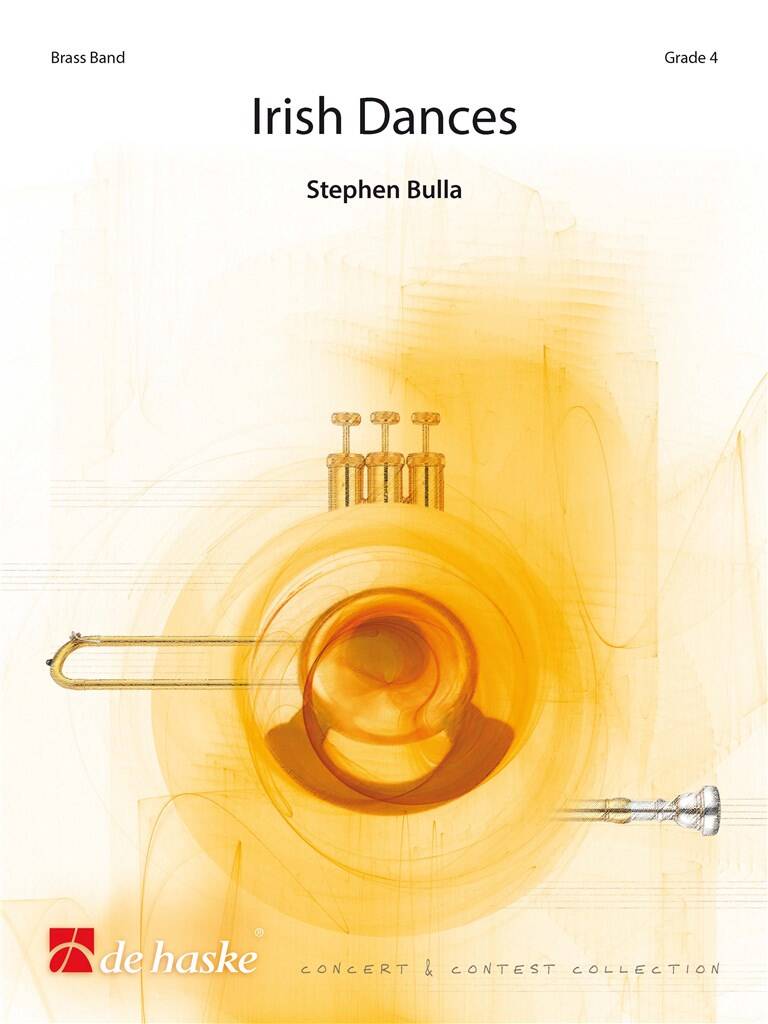
Irish Dances - Stephen Bulla
The rich musical heritage of Ireland represents some of the greatest traditional melodies. These melodies somehow retain the flavour of the culture and its traditions, which at times can be as lively as they are enchanting. This setting for Brass Band features a familiar selection of contrasting dance-like tunes that are drawn from the modern era of traditional Irish songs.
Estimated dispatch 5-14 working days
-
 £69.99
Deilig er Jorden - Tom Brevik
The pilgrim's song "Deilig er Jorden " can be called an international carol. The Norwegian text was written by Danish poet Inge Bernhardmann on a melody of Polish origin. A majestic carol! Therefore particularly suitable as an opening work for your Christmas concert. Optional with organ.
Estimated dispatch 5-14 working days
-
 £102.99
Introduction & Punk - Torstein Aagaard-Nilsen
Torstein Aagaard-Nilsen's (1964) way of composing can be described as: uncompromising, wilful and contemporary. It is not surprising, therefore, that this occasionally causes a stir. In the middle of the Seventies a trend arose in youth culture, which was characterized by provocation, distrust of the great ideologies, and the autonomy of the individual. Punk is playful, aggressive, often humorous, and anti-everything, which inevitably leads to self-irony. The first part of Aagaard-Nielsen's composition (Introduction) is a texture based mainly on one short theme. This pompous theme breathes a spirit of cold empty plains, where icy winds sigh around yourhead. In the vehement Punk (Presto barbaro!) there is no longer any question of a theme. The basis for this part is formed by a repetitive motif (a descending minor third). This motif is alternated with very powerful percussion beats and later on shrill harmonies. De wijze van componeren van Torstein Aagaard-Nilsen (1964) laat zich omschrijven als: compromisloos, eigenzinnig en eigentijds. Niet verwonderlijk dat dit af en toe wat stof doet opwaaien. Midden zeventiger jaren ontstaat er een stroming binnen de jongerencultuur, die provocatie, wantrouwen tegen de grote ideologieen en de autonomie van het individu centraal stelt. Punk is speels, agressief, veelal humoristisch en anti-alles, wat onvermijdelijk leidt tot zelfspot. Het eerste deel (Introduction) is een weefsel, gebaseerd op voornamelijk een kort thema. Het pompeuze thema ademt de sfeer van kille lege vlakten, waar de ijzige wind je om de oren suist. Tijdens de 'heftige' Punk (Presto barbaro!) is van een thema geen sprake meer. De basis voor dit deel is een steeds herhalend motief (dalende kleine terts). Dit motief wordt afgewisseld met zeer krachtige percussie slagen en later schrille samenklanken. Dit alles zorgt voor een bombastisch geheel. Aan het slot van de Punk horen we het intoductie-thema tussen het punkgeweld door terugkomen.
Estimated dispatch 5-14 working days
-
 £109.99
The Power of the Megatsunami - Carl Wittrock
The word 'tsunami' is of Japanese origin. When you look it up in a dictionary, you will find that it means 'a great sea wave produced by submarine earth movement or volcanic eruption'. A megatsunami is the superlative of this awesome expressionof power that nature can create, and has catastrophic consequences. When Carl Wittrock completed this composition not many such big earth movements had occurred, but since then we have become all too familiar with the disastrousconsequences which a tsunami may have. On the 26th of December 2004 a heavy seaquake took place near the Indonesian island of Sumatra. Tidal waves 10 meters in height ravaged the coastal regions of many countries for miles around. The tsunamitook the lives of thousands of people and destroyed many villages and towns. There are more areas which run the risk of being struck by a tsunami, such as the island of La Palma, one of the Canary Islands. This island is based on oceaniccrust at a fracture zone and as such is one of nature's time bombs. The consequences of a natural calamity like a megatsunami are immense. In the case of La Palma, the tidal wave will move in the direction of South America, where it may reach 50km inland, destroying everything on its way. In his composition Wittrock describes an ordinary day which will have an unexpected ending. Right from the beginning there seems to be something in the air, the music creating an oppressiveatmosphere of impending disaster. Themes are interrupted, broken off suddenly, followed by silence, suggesting the calm before the storm. Suddenly a short climax (glissandi in the trombone part) indicates the seaquake, and the megatsunami isa fact. Hereafter follows a turbulent passage symbolising the huge rolling waves. After nature's force has spent itself, resignation sets in and the composition ends with a majestic ode to nature.
Estimated dispatch 5-14 working days
 View Music