
Results
-
.png) £29.95
£29.95Attack of the Fighting Machines - Jonathan Bates
DURATION: 3 minutes. DIFFICULTY: Championship. 'Attack of the Fighting Machines' was composed for the City of Bradford Brass Band in 2022 as part of a set of music inspired by H.G Wells' world-renowned 'War of the Worlds' book. . As the first part of the story nears an end, the mass evacuation of mankind begins as a crowd races toward an already packed steamer. Bedlam ensues as the steamer pulls away from port and heads toward the horizon. Just moments later, the silhoutte of a fighting machine appears, followed by another, and another, as the next battle of Man v Martin rages on to afiery conclusion.
In Stock: Estimated dispatch 1-3 working days
-
 £29.95
Prelude on St. Clements - Jonathan Bates
DIFFICULTY: 3rd+. DURATION: 5'00". 'Prelude on St Clement's' was composed for the 2023 Royal Northern College of Music Brass Band Festival in memory of internationally renowned conductor and composer Bramwell Tovey. . Bramwell was the Artistic Director of the National Youth Brass Band of Great Britain throughout the composer's 7 years as a tenor horn player in the NYBBGB and the hymn tune 'St Clement's (no. 82 in the 120 Hymns for Brass Band book) was used by Bramwell to conclude every course. This setting of 3 verses of the hymn tune 'The Day Thou Gavest. was premiered by the RNCM Brass Band in January 2023.
In Stock: Estimated dispatch 1-3 working days
-
£130.00
The Final Frontier (Bra) - Geert Jan Kroon
In The Final Frontier, the composer explores different associations with the universe. Inspired by Stephen Hawking's (1942-2018) book Brief Answers to the Big Questions, the piece describes the wonders and dangers of the universe, the big questions about the smallest elements, and the possibility of space travel.
Estimated dispatch 7-14 working days
-
£74.00
A New Life (Bra) - Leslie Bricusse & Frank Wildhorn - Paul Saggers
Jekyll & Hyde is a 1990 musical loosely based on the 1886 novella Strange Case of Dr Jekyll and Mr Hyde by Robert Louis Stevenson. Originally conceived for the stage by Frank Wildhorn and Steve Cuden, it features music by Frank Wildhorn, a book by Leslie Bricusse and lyrics by all of them. After a world premiere run in Houston, Texas, the musical embarked on a national tour of the United States prior to its Broadway debut in 1997. Many international productions in various languages have since been staged including two subsequent North American tours, two tours in the United Kingdom, a concert version, a re-vamped US tour in 2012, a 2013 Broadway revival featuring Constantine Maroulis, and an Australian concert version in 2019. A New Life depicts Jekyll's love interest Lucy, dreaming for a new life without the fear of Hyde, however Hyde enters and finds a love note from Dr Jekyll to Lucy. In a fit of jealousy Hyde stabs her to death not knowing that he himself is Dr Jekyll.
Estimated dispatch 7-14 working days
-
£113.00
My Bass and I (Bra) - Roger Deronge
"My bass and I". It could be the title of a children's book about the close friendship between a boy and his bass tuba. And such a friendship it actually is, the friendship between Bernd van Echelpoel and his tuba.
Estimated dispatch 7-14 working days
-
 £99.00
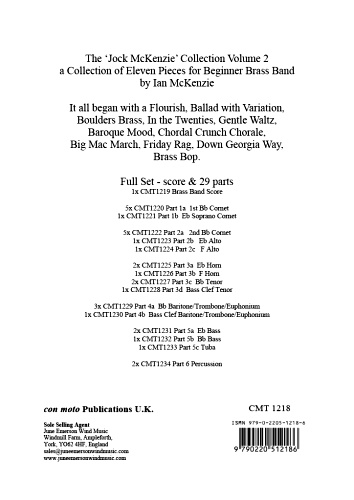
THE JOCK MCKENZIE COLLECTION Volume 2 for Brass Band (score & parts) - McKenzie, Jock
The score (CMT1219, which is ring bound on A4) shows parts 1 & 2 in Bb, part 3 in Eb and part 4 in bass clef concert pitch plus the percussion parts (drum kit & auxiliary). Each individual part book is printed on double sided B4 and presented with a colour cover. Indian Queens Junior Band plays 'Boulders Brass' on you tubeContents / Comments:
In Stock: Estimated dispatch 1-3 working days
-
 £30.00
Edward Gregson: Music of the Angels, for Symphonic Brass and Percussion
DescriptionProgramme NoteMusic of the Angels is a dramatic work of some 16 minute's duration, scored for a large symphonic brass ensemble, including seven trumpets, and percussion. The percussion section deploys 'dark' instruments such as three tam-tams, a bass drum and two sets of timpani.The title of the work is based on a quotation from the Book of Revelations:And I saw the seven angels which stood before God; and to them were given seven trumpetsThus, the idea behind the work is a dramatic one and the composer has emphasised this by the partial spatial arrangement of the ensemble, with six solo trumpets standing centre stage, but behind the main ensemble, and the seventh trumpet off-stage throughout.The work opens with a four-note motif, dominant throughout the work, announced initially by four off-stage horns and answered by fanfare figures on four solo trumpets. Then in turn each of the first four solo trumpets announce their own cadenzas before joining together, independently playing their own music. This reaches an intense climax before subsiding into slow music which might be described as a Kyrie eleison - a lament for humanity - a cantilena for flugel horn and euphonium, accompanied by trombones. The drama soon returns with the entry of trumpets 5 and 6, playing music that is fast, more urgent and foreboding, and describing in musical terms the horsemen of the Apocalypse.At the climax of this section trumpet 7 enters dramatically, representing the words of the seventh angel ... and time shall be no more. The opening four-note motif is here transformed into a cadenza of epic proportions, to the partial accompaniment of three tam-tams (representing the Holy Trinity). The ensuing scherzo, scored for the ensemble, is fast and furious, but despite the somewhat desolate mood of this music (briefly interrupted by the re-appearance of trumpet 7), it slowly moves towards a more optimistic conclusion, transforming the 'lament for humanity' music into an affirmative and triumphant climax.This work has been commercially recorded on a critically acclaimed CD from London Brass on the Chandos label, available HERE.For more information on Edward Gregson's music please visit the composer's website: www.edwardgregson.com
Estimated dispatch 7-14 working days
-
 £28.50
Island of the Setting Sun - Richard Rock
Premiered by the Salford University Brass Band and performed at the Europeans in 2010. Inspired by a book of the same name from Mythical Ireland (www.mythicalireland.com)
Titles No Longer Available
-
 £64.95
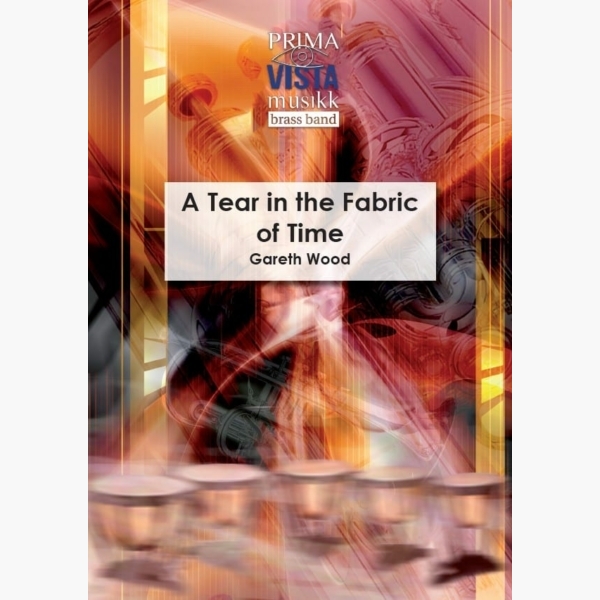
A Tear in the Fabric of Time - Gareth Wood
A Tear in the Fabric of Time is essentially a symphony for brass band and was inspired by the book The Elegant Universe by Brian Greene, which attempts to simplify complex ideas in modern physics for the layperson. This piece...
Estimated dispatch 5-7 working days
-
£34.95
COVENANTERS, The (Brass Band Set) - Kenneth Downie
In 1638, many members of the Presbyterian Church of Scotland signed a document called the National Covenant. By doing so, they were declaring that they acknowledged only Jesus Christ as the spiritual head of their church, and not any king or queen. This had become necessary because the Stuart kings believed in the Divine Right of Monarchs and saw themselves as head of the church. In the previous year, Charles I had forcibly introduced the Book of Common Prayer, invoking the wrath of the common people who faced the threat of torture, transportation or execution if they did not use the new liturgy and worship at their local church. The net result of this was that many met illegally in the countryside or in barns and large houses. These meetings became known as 'conventides' and many took place in the south-west of the country. Anyone caught attending was at risk of execution by the muskets of the dragoons who were employed in the area for that specific purpose. This music was written to honour the bravery and loyalty of these Christians to their faith, in the face of extreme danger, in the hope that it will inspire us also to be faithful. There are overtones of military threat, secrecy and solidarity. An old pentatonic tune is used, which the composer heard as a boy being sung to the words The Lord's My Shepherd.
Estimated dispatch 7-14 working days


 View Music