
Results
-
 £34.95
Elixir of Youth (Brass Band - Score and Parts)
Elixir of Youth (2013) was written for the 2013 Brass for Heroes charity event where it was premiered on 19th October 2013 at St Paul's Hall in Huddersfield under the baton of Philip Harper. The title of the work reflects the nature of the band that was put together for that premiere performance; an all-star youth band comprising a selection of the country's young brass banding talent, with the term Elixir referring here to the everlasting talent seen in young brass players throughout the United Kingdom's brass bands and bands' and teachers abilities to keep producing such high quality musicians for the banding movement.The work, structured in three sections, is a showcase for band with a heroic opening where fanfare-like gestures in the cornets and trombones juxtapose rapid euphonium and baritone runs, alongside sweeping horns and percussion effects. As the piece progresses, a grove is introduced - just in the tubas at first, accompanied by a hi-hat - before spreading through the band, definitely stuff to tap your toes to! The middle, slower section of the work sees both flugel and cornet solos, with additional inputs from the euphonium and solo horn before a climax and return to the tempo and music of the opening section. A rousing close concludes the work where all of the work's themes are interweaved to create a sense of power, unity and grandeur; an Elixir of Youth.
Estimated dispatch 7-14 working days
-
 £59.95
Voices of Youth (Brass Band - Score and Parts) - Gregson, Edward
The suite Voices of Youth is one of Gregson's earliest brass band compositions, written while he was still a student at the Royal Academy of Music in London. Voices of Youth was commissioned by the National Youth Brass Band of Great Britain and was premiered by them under the baton of Geoffrey Brand.The work has three movements:Nobility of Youth (Duration: 4.00)Sadness and Tenderness (Duration: 2.30)Gaiety (Duration: 2.45)In Nobility of Youth there are the rich sonorities beloved of Salvationist composers such as Eric Ball and, particularly, Ray Steadman Allen, whose music he admired. The modal contour of the melodies here and at the climax of the slow movement Sadness and Tenderness reveal lessons well learned from Holst and Vaughan Williams. Gaiety is probably the most interesting amalgam of all. Beginning in the harmonic world of Gilbert Vinter - whose influence Gregson readily acknowledges at this time - the music is transformed into a bravura waltz of which Percy Grainger might have been proud. It then veers off via a contrapuntal episode of academic correctness, into a coda that takes us into more adventurous harmonic realms.Duration: 10.00
Estimated dispatch 7-14 working days
-
 £29.50
The Essence of Brass (Youth Band) - Gavin Somerset
Two years after the inaugural BrassFestUK event comes the anthem for 2019, 'The Essence of Brass'. Composer Gavin Somerset has revisited many of the ideas contained within the very popular work written for the inaugural BrassFestUK, The Spirit of Brass two years ago, to deliver once again, an uplifting original work for Brass Bands that will keep both players and audiences entertained. The piece opens with the work's heroic theme which has a genuine feel-good factor throughout, making this year's anthem a sure hit with all bands once again. NB. This Youth Band edition also works alongside the original senior band version.
In Stock: Estimated dispatch 1-3 working days
-
 £29.50
The Essence of Brass - Gavin Somerset
Two years after the inaugural BrassFestUK event comes the anthem for 2019, 'The Essence of Brass'. Composer Gavin Somerset has revisited many of the ideas contained within the very popular work written for the inaugural BrassFestUK, The Spirit of Brass two years ago, to deliver once again, an uplifting original work for Brass Bands that will keep both players and audiences entertained. The piece opens with the work's heroic theme which has a genuine feel-good factor throughout, making this year's anthem a sure hit with all bands once again. NB. A Youth Band version is also available which works as a standalone item or alongside the senior band edition.
In Stock: Estimated dispatch 1-3 working days
-
 £29.50
Shining Brass - Franner Otter
A perfect opener for lower section bands, 'Shining Brass' was the winning entry from the 2024 British Bandsman composition contest. The contest was run by the popular brass band media outlet to encourage new composers to create a new piece for lower section and youth bands. Following an array of wonderful entries, 'Shining Brass' was selected as the winner, featuring pleasing melodies and an energetic momentum that both players and audiences will love.
In Stock: Estimated dispatch 1-3 working days
-
 £29.50
The Spirit of Brass - Gavin Somerset
Commissioned for BrassFestUK 2017 & recorded by the Cory Band, the Spirit of Brass is an exciting, new energetic work that will fit perfectly into any concert, particularly as an opening item. With memorable themes, the composition takes its roots from that of John Williams' various Olympic themes that he has composed over the years. As well as this 'main version', there is also a youth/training band version of the work available which is more accessible to younger bands. The two versions work as standalone items, or can be performed side-by-side. A great new original piece for Brass Band.
In Stock: Estimated dispatch 1-3 working days
-
£29.50
The Spirit of Brass - Youth Band - Gavin Somerset
Commissioned for BrassFestUK 2017 & recorded by the Cory Band, the Spirit of Brass is an exciting, new energetic work that will fit perfectly into any concert, particularly as an opening item. With memorable themes, the composition takes its roots from that of John Williams' various Olympic themes that he has composed over the years. As well as this training band version, there is also a full band version of the work available for mainstream bands. The two versions work as standalone items, or can be performed side-by-side. A great new original piece for Brass Band.
In Stock: Estimated dispatch 1-3 working days
-
 £29.50
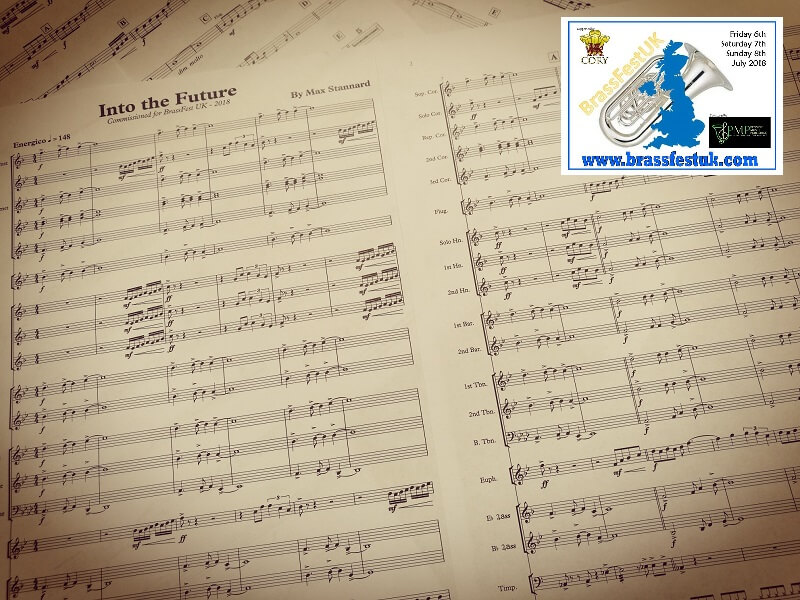
Into The Future - Youth Band - Max Stannard
With the success of the inaugural BrassFest UK events last year and along with it, the commssioned work to celebrate the Brass Band movement, the event this year threw the doors open with a competition to compose the 2018 anthem for bands across the country to enjoy. Judged by Philip Harper, Gavin Somerset and Christopher Bond, this winning work by Max Stannard was written with a view to celebrating the youngsters and future of the Brass Band movement.Click Here for the Senior Band edition
In Stock: Estimated dispatch 1-3 working days
-
£89.99
Penlee (Brass Band - Score and Parts)
2013 Finals of the National Brass Band Championships of Great Britain - 3rd SectioTo some, the tragic story of the Penlee lifeboat, Solomon Browne, would need no introduction, and to some the pain felt is still very much a reality. The composer, born just a few weeks before that fateful night on the 19th December 1981, has created this work as a musical homage to the bravery of the souls who lost their lives and has dedicated it to their memory.Penlee was commissioned by the Cornwall Youth Brass Band using funds bequeathed by Michael Pickett. The first performance was given by the Cornish Youth Brass Band, conducted by Ian Porthouse, at St. Michael's Church, Newquay, on 30th December 2008.Penlee has been voted into the Classic FM Hall of Fame 2011 at No.106. Not only is it the first time a brass work has been featured in the Hall of Fame, but it was also the highest new entry.The work has subsequently been recorded by the Leyland Band, conducted by Jason Katsikaris, on the CD entitled Penlee.Suitable for Advanced Youth/3rd Section Bands and aboveDuration: 13:30
Estimated dispatch 7-14 working days
-
 £50.00
A Celebration of Youth (Score and Parts)
A Celebration of Youth was written in 2001 for the Worcester County Youth Brass Band conducted by Nicky Daw. It's a lively four minute concert piece suitable for opening or closing a programme, in turn heraldic, then romantic, and always rhythmic. Playable by most levels of bands.
Estimated dispatch 7-14 working days
 View Music