
Results
-
 £11.20
I was glad (Brass Band with Organ - Additional Parts) Parry trs. Wainwright
I was glad was originally a choral introit which is a popular piece in the musical repertoire of the Anglican church. It is traditionally sung in the Church of England as an anthem at the coronation of the British monarch, most recently that of King Charles III in May 2023. This transcription for brass band combines the choral and accompaniment parts meaning it is playable as a standalone arrangement. An optional organ part is included to augment the brass. The cornet section is divided into two choirs to create an antiphonal effect. The 'Vivats' are included in this transcription but an optional cut is provided for that section. To view a follow-the-score video please visit www.youtube.com/watch?v=Vx95uSp1yU8 PDF download includes additional parts. Purchase the full score and brass band parts here. Sheet music available from: UK - www.brassband.co.uk USA - www.solidbrassmusic.com Difficulty Level: 2nd Section + Parts included in this download: Solo Horn F 1st Horn F 2nd Horn F 1st Baritone Bass Clef 2nd Baritone Bass Clef 1st Trombone Bass Clef 2nd Trombone Bass Clef Euphonium Bass Clef Tuba 1 Bass Clef (Bass Eb equivalent) Tuba 2 Bass Clef (Bass Bb equivalent)
In Stock: Estimated dispatch 1-3 working days
-
 £33.62
In the Bleak Midwinter (Brass Band) Holst arr. Mack Wilberg trs. Barrie Gott
A transcription for brass band of Mack Wilberg's popular setting of the much loved carol In the Bleak Midwinter, as sung by The King's Singers and The Choir of King's College, Cambridge at Carols from Kings in 2020. This is a reflective and beautiful arrangement of the classic Gustav Holst Christmas carol and remains faithful to the Wilberg choral setting. The arrangement underpins the well-loved melody with luscious, romantic harmonies, including moments of exquisite chromaticism. To view a rolling score video please visit www.youtube.com/watch?v=t2DbgNgezAQ PDF download includes score and parts. Sheet music available from: UK - www.brassband.co.uk USA - https://satradecentral.org Difficulty Level: 4th Section + Length: 5.10 minutes Instrumentation: Soprano Cornet Eb Solo Cornet Bb Repiano Cornet Bb 2nd Cornet Bb 3rd Cornet Bb Flugel Horn Bb Solo Horn Eb 1st Horn Eb 2nd Horn Eb 1st Baritone Bb 2nd Baritone Bb 1st Trombone Bb 2nd Trombone Bb Bass Trombone Euphonium Bb Bass Eb Bass Bb
In Stock: Estimated dispatch 1-3 working days
-
 £4.48
£4.48Love Eternal (Trombone Solo with Brass Band - Solo Copy) Cooper arr. Lamplough
Love Eternal was arranged by Gavin Lamplough for trombone virtuoso Isobel Daws to perform in a special concert with the Melbourne Staff Band to honour its Bandmaster Ken Waterworth, on the occasion of his retirement after 30 years of leading the band. The arranger uses Jarod Cooper's popular contemporary worship song King of Kings, Majesty as the basis for the work and the piece seeks to provide a vehicle for the rich timbres of the trombone to be enjoyed by the listener. To view a rolling score video featuring Isobel Daws and the Melbourne Staff Band please visit www.youtube.com/watch?v=AEpbHNFPMxs This title is also available as a tenor horn solo with brass band here. This PDF download is for the Trombone solo part in Bb.
In Stock: Estimated dispatch 1-3 working days
-
 £33.62
March - The Green Island (Brass Band) Espen Haukas
This march was written to mark the centennial jubilee of the renowed Manger Musikklag. The title for the piece comes from the many descriptions of the county Manger Musikklag originates from, on the island of Radoy. As the composer writes, 'It is a uniquely lush and beautiful landscape, which is echoed on the famously green trimmed jackets worn by the band at concerts and competitions. Radoy is not without reason called "the green island". With regards to the composition, I have not tried to reinvent the idea of a march. But rather to present my own take on its familiar style. The piece is meant to have a reassuring familiarity about it, whilst the ending will surely make the audience smile.' To view a video of Manger Musikklag performing the march please visit www.youtube.com/watch?v=KqFt7AMCwLk PDF download includes score and parts. Sheet music available from: UK - www.brassband.co.uk USA - www.solidbrassmusic.com Difficulty Level: 2nd Section + Instrumentation: Soprano Cornet Eb Solo Cornet Bb Repiano Cornet Bb 2nd Cornet Bb 3rd Cornet Bb Flugel Horn Bb Solo Horn Eb 1st Horn Eb 2nd Horn Eb 1st Baritone Bb 2nd Baritone Bb 1st Trombone Bb 2nd Trombone Bb Bass Trombone Euphonium Bb Bass Eb Bass Bb Percussion 1-2 Glockenspiel
In Stock: Estimated dispatch 1-3 working days
-
 £33.62
Margaret - Brass Band (Timothy Matthews arr.Kenneth Downie)
VIEW SCORE PDF The arranger, Kenneth Downie writes: 'This music was commissioned by Mike Griffiths, Music Director of Riviera Concert Brass, based in Torquay in Devon, England. It is developed around the hymn tune Margaret, and written in memory of the lady of that name who was a renowned supporter of, and generous donor to the band. The graceful melody was written by Timothy Matthews (1826-1910), and it is usually associated with the words of the hymn, the first verse of which says: Thou didst leave thy throne and thy kingly crown When thou camest to earth for me; But in Bethlehem's home was there found no room For thy holy nativity, O come to my heart, Lord Jesus; There is room in my heart for thee. I feel that there is a strong emotional core to this lovely tune and any performance should seek to bring out this quality, in a musical manner.' PDF download includes score and full set of parts. Sheet music available from: UK - www.brassband.co.uk USA - www.solidbrassmusic.com Difficulty Level: 4th Section + Instrumentation: Soprano Cornet Eb Solo Cornet Bb 1st Cornet Bb 2nd Cornet Bb Flugel Horn Bb Solo Horn Eb 1st Horn Eb 2nd Horn Eb 1st Baritone Bb 2nd Baritone Bb 1st Trombone Bb 2nd Trombone Bb Bass Trombone Euphonium Bb Bass Eb Bass Bb Timpani Glockenspiel Percussion
In Stock: Estimated dispatch 1-3 working days
-
 £33.62
Pachelbel for Brass (Canon in D) - Brass Band (Pachelbel arr. William Himes)
VIEW SCORE PDF Canon in D is certainly the most popular and enduring work of Johann Pachelbel (1653-1674). With its repetitive and foundational bass line and the lyrical imitative themes that follow, this music has proven to be especially well suited as a wedding processional, with the flexibility to reduce or lengthen the music as needed for the occasion. Here it has been arranged by William Himes for brass band with flexible scoring, meaning it is playable by as few as 12 players but works equally well with a traditional size band. There is an optional cut reducing the total length of the piece by around 1.30 minutes if required. PDF download includes score and full set of parts. Sheet music available from: UK - www.brassband.co.uk USA - www.solidbrassmusic.com Difficulty Level: 4th Section + Instrumentation: Soprano Cornet Eb (optional) 1st Cornet Bb (2 players) 2nd Cornet Bb Flugel Horn Bb (optional) 1st Horn Eb 2nd Horn Eb Baritone Bb 1st Trombone Bb 2nd Trombone Bb Bass Trombone Euphonium Bb (2nd player optional) Bass Eb Bass Bb Timpani (optional) Percussion (optional)
In Stock: Estimated dispatch 1-3 working days
-
 £33.62
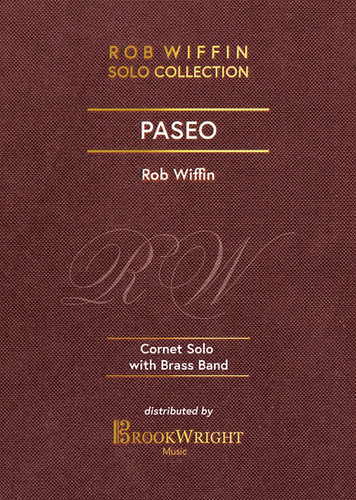
Paseo (Cornet Solo with Brass Band) Rob Wiffin
A gentle solo for cornet with band accompaniment. Paseo is a Spanish word for a leisurely walk or stroll: the soloist takes the musical line for a walk with no great sense of hurry, and although there is one moment where the pleasantness of the stroll is threatened, it quickly passes and the good mood is resumed. Technically it needs a good sense of cantabile and control over the range from low D to D two octaves higher. To allow the soloist to sing through without fighting the accompaniment, the section cornets and percussion are omitted. Audio demo: https://soundcloud.com/user-565396545/paseo-cornet-solo-with-brass Duration: Approx. 4.10 minutes Difficulty Level: Medium This PDF download includes the full score and parts. Sheet music available at www.brassband.co.uk (UK) or https://satradecentral.org (USA)
In Stock: Estimated dispatch 1-3 working days
-
 £44.83
Summit (Brass Band) Andrew Batterham
Summit is a powerful descriptive work, lifting from broad beginnings to an exciting climax. It was written for the Hyde Street Youth Band in Melbourne's west, for the 2023 Australian National Band Championships. The piece was designed to give the band a chance to display their credentials. It will be an ideal choice for youth bands and above for both concert and contest programmes. To view a video of Hyde Street Junior Band performing the piece please visit www.youtube.com/live/G9klW3mhyI8?feature=share&t=7397 (the performance commences at 2:03:17) PDF download includes score and parts. Sheet music available from: UK - www.brassband.co.uk USA - https://satradecentral.org Difficulty Level: 4th Section + Instrumentation: Soprano Cornet Eb Solo Cornet Bb Repiano Cornet Bb 2nd Cornet Bb 3rd Cornet Bb Flugel Horn Bb Solo Horn Eb 1st Horn Eb 2nd Horn Eb 1st Baritone Bb 2nd Baritone Bb 1st Trombone Bb 2nd Trombone Bb Bass Trombone Euphonium Bb Bass Eb Bass Bb Percussion 1-3
In Stock: Estimated dispatch 1-3 working days
-
 £37.35
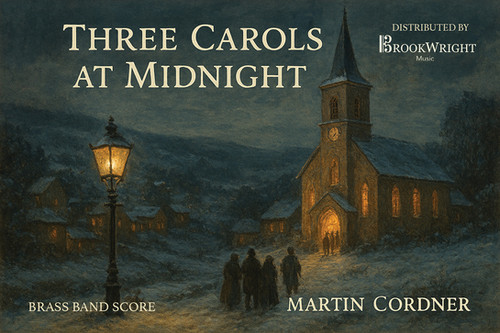
Three Carols at Midnight (Brass Band) Martin Cordner
Rooted in the sacred stillness of a French village on Christmas Eve, this suite by Martin Cordner draws upon traditional carols that have echoed through centuries of candlelit chapels and midnight vigils. Each movement offers a window into the Nativity story: I. Mystery: Noel Nouvelet (Christmas Comes Anew) opens with modal wonder, evoking the anticipation of Christ's coming and the quiet awe of Advent. II. Cradle: Entre le boeuf et l'ane gris (Between the Ox and the Grey Donkey) rests in pastoral tenderness, where the newborn Savior lies between humble beasts, watched over by angels and the Virgin. III. Joy: Il est ne, le divin enfant (He is born, the Divine Infant) bursts forth in celebration, proclaiming the divine birth with rustic dance and jubilant praise. Together, these carols form a musical triptych - moving from mystery to intimacy to exultation. Three Carols at Midnight invites listeners to step into the hush of a French Noel, where the sacred story is told not only in word, but in melody, memory, and light. All proceeds support the mission and ministry of The Salvation Army Delaware Command, USA. To view a rolling score video of the work please visit www.youtube.com/watch?v=fUcCluBS18Q Difficulty level: 4th Section + Duration: approx. 5.00 minutes This PDF download includes parts and score. Sheet music available at www.brassband.co.uk or www.durhammusicshop.co.uk (UK) or https://satradecentral.org (USA) Instrumentation: Soprano Cornet Eb 1st Cornet Bb 2nd Cornet Bb 1st Horn Eb 2nd Horn Eb 1st Baritone Bb 2nd Baritone Bb 1st Trombone Bb 2nd Trombone Bb Bass Trombone Euphonium Bb Bass Eb Bass Bb Percussion 1-2 Glockenspiel
In Stock: Estimated dispatch 1-3 working days
-
 £33.62
Viva la Banda! (Brass Band) Dave Collins
Viva la Banda is fun, high energy and has some wonderfully catchy melodies for all members of the band to enjoy. In places it is harmonically surprising, taking us through the twists and turns of a Latin adventure. Imagine the sights and sounds of a hot plaza, and transport your audiences across the sea from your local bandstand! To view a rolling score video of the work please visit www.youtube.com/watch?v=uawvYv2-INU Duration: Approx. 4.15 minutes Difficulty Level: 3rd Section + PDF download includes parts and score. Sheet music available from www.brassband.co.uk (UK) or https://satradecentral.org (USA) Instrumentation: Soprano Cornet Eb Solo Cornet Bb Repiano Cornet Bb 2nd Cornet Bb 3rd Cornet Bb Flugel Horn Bb Solo Horn Eb 1st Horn Eb 2nd Horn Eb 1st Baritone Bb 2nd Baritone Bb 1st Trombone Bb 2nd Trombone Bb Bass Trombone Euphonium Bb Bass Eb Bass Bb Drum Set Congas Agogo
In Stock: Estimated dispatch 1-3 working days
 Watch video