
Results
-
 £34.95
Rhapsody For Cornet And Band (Cornet Solo with Brass Band - Score and Parts) - Bowes, Ray
This is a lyrical solo based on the carol 'A Christmas Lullaby'.
Estimated dispatch 7-14 working days
-
£17.50
Rhapsody For Cornet And Band (Cornet Solo with Brass Band - Score only) - Bowes, Ray
This is a lyrical solo based on the carol 'A Christmas Lullaby'.
Estimated dispatch 7-14 working days
-
£34.95
Kings Of Swing (Brass Band - Score and Parts) - Larsson, Kevin
The opening features a cornet, trombone and tuba trio, intended to be the three kings, as they swing their way to Bethlehem using the classic Christmas carol, 'We three kings of Orient are'.
Estimated dispatch 7-14 working days
-
£17.50
Kings Of Swing (Brass Band - Score only) - Larsson, Kevin
The opening features a cornet, trombone and tuba trio, intended to be the three kings, as they swing their way to Bethlehem using the classic Christmas carol, 'We three kings of Orient are'.
Estimated dispatch 7-14 working days
-
 £60.99
Chorale and Canzone (Brass Band - Score and Parts) - De Haan, Jan
The words and lyrics of the Christmas Carol From Highest Heaven I Come To Tell were written by the great Martin Luther (1483-1546) and can be found in The Hymns of Martin Luther. Martin Luther expressed radical views which began the reformation movement. His followers protested at the treatment given to Martin Luther, the event from which the term 'Protestant' was derived. It was first published in Joseph Klug's Gesangsbuch in around 1535. Add a majestic Baroque feel to any concert with this simple yet effective arrangement.Duration: 2:45
Estimated dispatch 7-14 working days
-
£47.50
With Sweet Jubilation - James Curnow
Explore different settings of the Medieval Latin carol "In Dulci Jubilo" via this solid arrangement by James Curnow. Opening with an exquisite "Brass Choir" section a la Michael Praetorius (1571-1621) and progressing through a "Woodwind Choir" section in the later J.S.Bach style, WITH SWEET JUBILATION is wonderful "style study" material. The grace of the early masters and the clearly focused unifying concept of the arrangement by James Curnow combine to make this addition to the Curnow Music Press "Splendor of Christmas Series" a wonderful holiday experience for the young band.
Estimated dispatch 5-14 working days
-
 £45.00
Two Herefordshire Carols (Brass Band - Score and Parts)
The two traditional tunes that comprise this straightforward setting were sung to Ralph Vaughan Williams (1872-1958) by Mrs. Esther Smith of Dilwyn, near Hereford, during one of the great composer's folk song collecting tours of England in the early years of the twentieth century. They were included in Twelve Traditional Carols from Herefordshire, edited by E.M. Leather and Vaughan Williams. The words to which Mrs. Smith sung the first tune were probably drawn from eighteenth century evangelical sources. The editors replaced these with six of the 16 verses of a traditional seventeenth century carol text, Joseph and Mary.The second melody, which appears as the centre piece of this arrangement, was sung to a carol that tells of a farmer who ploughed on Christmas Day. It is in fact a translation of a German traditional carol Gelobet seist du Jesu Christ that was published in Goodly Psalmes and Spiritualle Songes (1546) translated by Miles Coverdale. Vaughan Williams used the title Coverdale's Carol.The brass band settings follow the settings made by Vaughan Williams in 1920 for the Oxford Book of Carols. Since his simple harmonic approach is similar in both settings, three verses of his haunting version of Coverdale's Carol have been folded inside four verses of the slightly more animated treatment of Joseph and Mary. The harmonisations of Vaughan Williams have been given some brass band colour, with some verses taken by soloists from the ensemble. The accompaniment figuration that embellishes the second verse of Joseph and Mary has been used to open and close this arrangement and to bind the verses together.- Paul HindmarshDuration: 5.00
Estimated dispatch 7-14 working days
-
 £70.00
General Series Band Journal August 2017 Numbers 2170-2173
Praise to the Lord! (Andreas Holmund)A joyful and exuberant setting of the tune 'Lobe den Herren' which will be popular amongst many groups looking for an exciting programme item.Carol of the bells (Warren Brookes)The 'Carol of the bells' is an extremely popular and much used carol. This setting will bring a useful addition to the Christmas repertoire and is arranged by a Salvationist from Australia.Breathe on me (Paul Drury)This work is based on the 'Sing to the Lord' setting by Mark Porter which has proved popular amongst many vocal groups. It is hoped that this developed setting will enhance its popularity.March Cedarlights (Norman Bearcroft)Lt. Colonel Norman Bearcroft provides a march with all his hallmarks of energy and rhythmic and melodic interest. The march was written as a tribute to the International College for Officers and features the tunes 'Joy, joy, joy there is joy in The Salvation Army', 'They shall come from the East' and 'The World for God' reflecting the internationalism of the College.
Estimated dispatch 7-14 working days
-
 £60.00
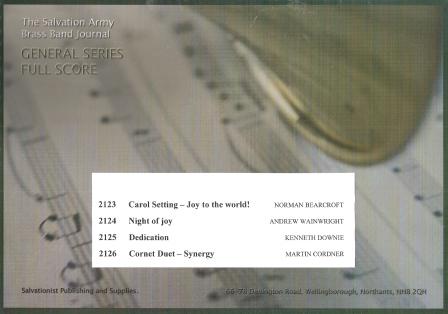
General Series Band Journal August 2013 Numbers 2123-2126
No. 2123 Carol Setting - Joy to the world! (Lieut. Colonel Norman Bearcroft)'Joy to the world' is a melody often attributed to Handel, but it is a bringing together of a couple of brief snippets of themes from his oratorio, 'Messiah'. These were put together by Lowell Mason to form the tune, 'Antioch', which we use for this carol. The carol has been arranged in majestic style by Lieut-Colonel Norman Bearcroft.No. 2124 Night of Joy (Andrew Wainwright)'Night of Joy' is based on a traditional Spanish Christmas song entitled 'Cantemos a Maria' ('Let's sing to Mary').No. 2125 Dedication (Dr Kenneth Downie)A setting of Colonel Brindley Boon's beautiful song of dedication, 'I dedicate myself to thee' (Musical Salvationist, November 1950).No. 2126 Cornet Duet - Synergy (Captain Martin Cordner)This piece celebrates the Biblical principle of believers working together in the Body of Christ and incorporates the song with words by Catherine Baird 'We're in Gods Army and we fight together with the composers own melody to Philip Paul Bliss's words 'Whosoever heareth! shout, shout the sound.
Estimated dispatch 7-14 working days
-
 £30.00
I Saw Three Ships - Traditional
This is a traditional English carol rumoured to have originated in Derbyshire. The earliest printed version is from the 17th century and the familiar version was later published in William Sandys' collection of 'Christmas Carols Ancient and Modern' in 1833. There are numerous theories as to the meaning of the carol's words; after all, Bethlehem, the place of Jesus' birth is not a coastal location. It has been suggested that the ships are actually camels (ships of the desert) used by the Magi for their visit to the baby Jesus. My arrangement takes advantage of the traditional 'jig' style of this carol to add a little 'Celtic' flavour.
 View Music